Finding whip-poor-wills is an ear-first job, not a sight job. To learn how to find whip-poor-wills at dusk, get to a clearing edge 30 to 60 minutes before sunset on a night with at least half a moon up, stand still, and listen for a three-syllable chant that repeats about once a second. Bring binoculars, a red-light flashlight, a wind check, and someone who knows where you are walking.
The Eastern whip-poor-will (Antrostomus vociferus) is a nightjar, not an owl, and it is one of the hardest breeding birds in eastern and central North America to actually lay eyes on. The call is famously easy to recognize and famously easy to never see the bird behind. Most people who hear one go years without a sighting.
A few things to know before you head out:
- They call at night, and mostly on moonlit nights. The window runs from the waning gibbous through the waxing gibbous, roughly the time when at least half the moon is illuminated.
- Season is late May through June, with a thinner late-summer window for birds heading south.
- Habitat is specific: sandy or sandy-loam soils, a large opening, and nearby pine-dominated or early successional forest.
- They are found by sound first. Sitting quietly at the clearing edge beats walking a transect every time.
- Populations are down steeply since the middle of the last century, so a known local site is worth far more than a hopeful one.
Table of Contents
- What You Need
- Step-by-Step: How to Find Whip-poor-wills at Dusk
- Choose a productive dusk habitat
- Arrive 30 to 60 minutes before sunset
- Listen for the three-syllable chant
- Scan open ground and low perches
- Use light without spoiling the sighting
- Confirm the identification before you record it
- Common Mistakes
- Frequently Asked Questions
- What sound does a whip-poor-will make?
- Is it possible to hear a whippoorwill call at night?
- What time of year do Whip-poor-wills sing?
- Why are whip-poor-wills tied to the moon?
- What is mistaken for a whip-poor-will?
- How rare is it to see a whippoorwill?
- Conclusion
What You Need
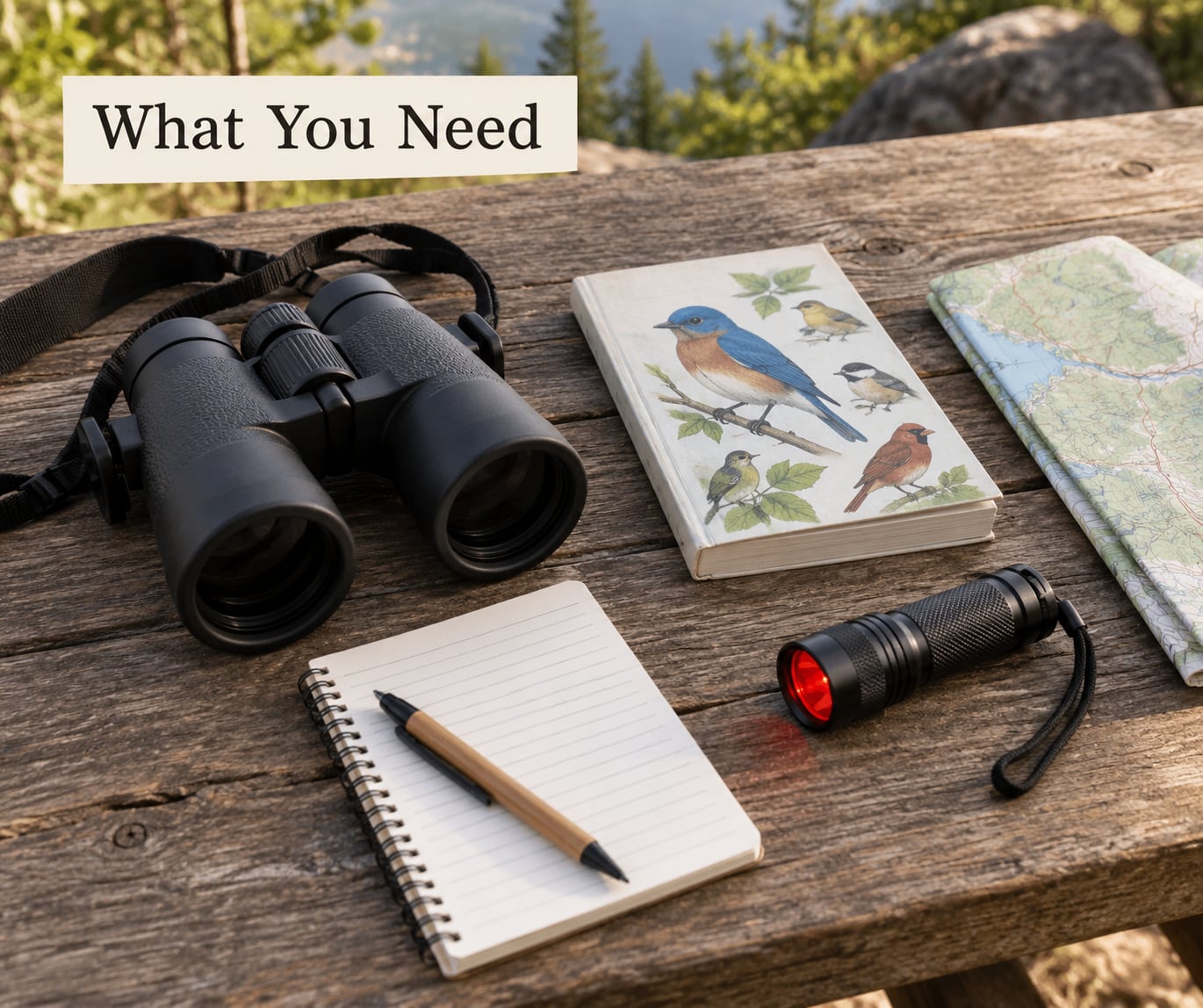
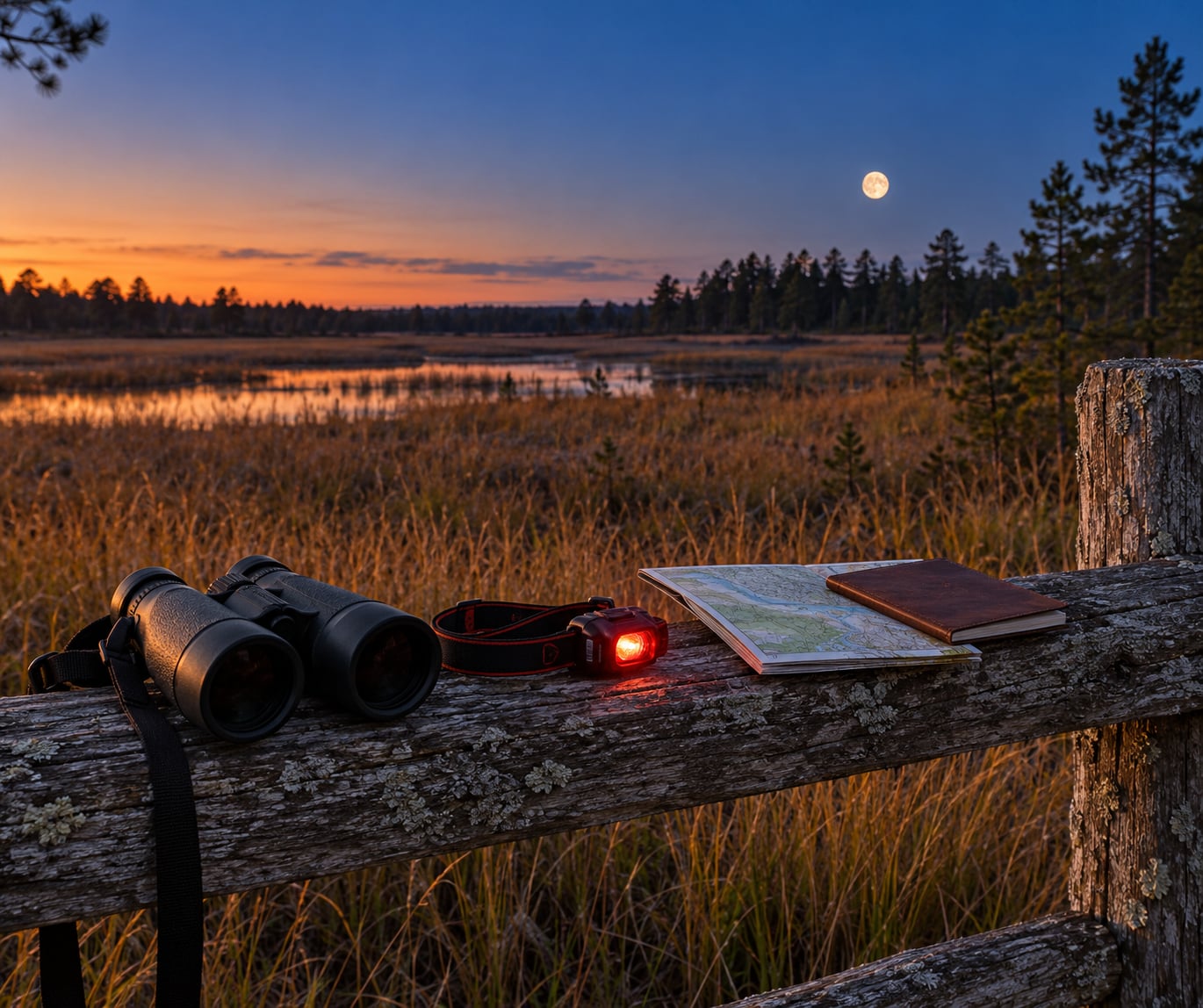
Binoculars are worth carrying but they are not what finds the bird. A 8×42 or 10×42 pair handles the dark fine, and you will use them to check a silhouette against the sky or to look for eye-shine on a track. A headlamp with a red filter matters more than most people expect, because you will want to check a map or a phone screen without blowing out your night vision and losing the bird you just heard.
Two apps do real work here. Merlin Sound ID will flag a recording for you, though be warned it frequently misassigns whip-poor-will audio, so treat a Merlin result as a prompt to check it yourself rather than a verdict. Any moon phase app will do; the useful number is percentage illumination, not the phase name. A voice recorder on your phone, set to record in the background, captures the bout so you can count how long a single male sang and file it properly later.
Clothing matters more in a marsh at 11 p.m. than at any other birding event you will attend. Long sleeves, long pants, closed shoes, and a layer for after midnight. The bug spray is not optional in peak season, and neither is the water.
Field information to check the day before: moon illumination percentage for the night, wind speed, cloud cover, sunrise and sunset time for your exact coordinates, and whether the site is private land with a gate you need to open in the dark. If you are joining a nocturnal survey or an Audubon chapter outing, take the route they give you rather than improvising.
Safety planning takes five minutes. Tell a person your site, your route, your expected return time, and when to start worrying if you have not checked in. If a gate needs opening after dark, bring a second person or skip the site. Closed-toe shoes handle the uneven ground at marsh edges better than anything else you own.
Finally, the conditions themselves. Weather is a go or no-go decision, and the thresholds below come from repeatable nocturnal survey work, not guesswork.
| Condition | What it does | Decision |
|---|---|---|
| Moon at 50% illumination or more | Birds sing hardest through the gibbous phases | Go |
| Moon under about 25% illuminated | Little or no advertisement calling | Skip or plan another night |
| Wind under 8 mph | Calls carry and birds are audible | Go |
| Wind over 8 mph | Calling drops and detection collapses | No go |
| Light, scattered cloud | Reflects moonlight and extends activity | Fine |
| Heavy overcast | Suppresses moonlight and shortens activity | Marginal |
| Steady rain | Stops sallying and masks the call | No go |
| Highway noise or barking dogs nearby | Masks the chant at source | No go |
| Sandy soil, large opening, pine or young forest | Preferred foraging and roosting structure | Go |
| Urban or heavily lit ground | Light pollution and cats both work against you | No go |
Step-by-Step: How to Find Whip-poor-wills at Dusk
Choose a productive dusk habitat
Look for a large opening bordered by young or early successional woodland, ideally with pine nearby and the ground sandy or sandy-loam. Old fields reverting to shrubs, the edge of a powerline cut, a gravel pit, a recently logged unit, and the margins of a beaver pond all work. Birders posting on purplemartinforum described whip-poor-wills in northeast Kentucky as most abundant in forest with a thick understory of young trees sitting right beside an opening, which matches what most survey data shows.
Water is optional, so do not write off a dry pine edge. What matters is the combination of bare or open ground, insect life, a roosting structure within a short hop, and darkness on the horizon. A site with a house and a streetlight at the far end of the opening is a compromised site.
Arrive 30 to 60 minutes before sunset
The dusk chorus is your window. Whip-poor-wills start calling as light fades and are often still vocal for a while after dark, but the birds are moving and feeding hard in that first hour and you have far more light to work with than you will at midnight. Being on site before the calling starts means you learn exactly where each male is anchored instead of stumbling around a dark clearing trying to triangulate a sound.
Pick your spot before full dark, stand with your back to any light source, and settle in. This is the single change that converts an unsuccessful evening into a successful one more often than any other.
Checking the moon before you drive saves a wasted trip. The active window runs from the waning gibbous through the waxing gibbous, which is the stretch of the month when at least half the moon is illuminated.
| Moon phase | Illumination | Expected calling |
|---|---|---|
| Full moon | 100% | Peak activity, extended well into the night |
| Waning gibbous | 50 to 100% | Strong, best window right after full |
| Last quarter | About 50% | Still singing, mostly in the first half of the night |
| Waning crescent | Under 50% | Quiet; occasional short bursts near dawn |
| New moon | 0% | Little or no advertisement calling |
| Waxing crescent | Under 50% | Occasional single birds as males arrive on territory |
| First quarter | About 50% | Calling strengthens toward the following gibbous nights |
| Waxing gibbous | 50 to 100% | Strong, building toward full moon |
Listen for the three-syllable chant
The advertisement call is a sharp, rolling three-syllable phrase, written in field guides as something like whip puwiw WEEW or whip-po-wa-will, delivered at roughly one repetition per second. It carries further than you expect, often well past half a mile on a still night. The first part is soft and the last syllable is the loudest, which is why many people hear only the tail end of it.
There is also a quieter introductory cluck that precedes a bout, and it is audible only when you are within roughly 30 metres of the bird. If you hear that cluck, you are close enough to have a real chance of seeing the bird come out. Close birds sometimes switch to a low growling or churring call instead of the chant.
Individual males differ. Some sing fast, some slow, some sit in a high or a low key, and a few favour a minor interval that sounds flat to people used to other night birds. Once you have heard two or three, you can pick out the same male on a later night, which turns a wasted evening into a tracking project.
Under a bright moon and near a full moon, several males will speed up and overlap into a cacophony. That is normal and it is a good sign about density, but it makes counting individual birds harder. Record it anyway; the cacophony is itself the evidence of a productive site.
Know what else you will hear. Screech-owls and other nocturnal sounds are the usual source of false positives.
| Sound | What it sounds like | How to tell it apart |
|---|---|---|
| Eastern whip-poor-will | Rolling three-syllable chant, about one per second | Repeats relentlessly from one fixed perch, same spot for many minutes |
| Chuck-will’s-widow | Two to four syllables, slower, much heavier and more slurred | Larger, deeper voice; slower delivery; only in the deep Southeast |
| Common poorwill | Two syllables, poor-will, repeated in pairs | Western and southwestern range, dry habitat, two notes not three |
| Eastern screech-owl | Long, rising, wavering whistle | Single sustained note that drifts upward, not a rolling chant |
| Common nighthawk | Short churring or a repeated buzz, often in flight | Fast and buzzy rather than liquid; usually heard while moving through the air |
| Frogs and insects | Chirps, clicking, sustained chorus | Irregular rhythm, no fixed perch, changes position constantly |
Do not rely on recordings played through a speaker to draw one in. Imitation attempts rarely work on this species and they disturb every other listener at the site. A recording is a tool for learning the call before you go, not a lure.
Scan open ground and low perches
This is where most people give up, and it is the step that pays off. Once you have locked onto a caller, sweep your eyes slowly across the ground beneath the perch line: bare limbs, fallen branches, the base of a mature tree, a fence line running along the edge of the opening. Birds often sit on the ground or on a low horizontal branch, perfectly still, relying on mottled grey-brown plumage that matches leaf litter exactly.
Watch the airspace as well. A bird sallies out to catch moths and beetles, and the flight itself is easier to catch than the perched bird. The white corner patches on the wings and the white tips to the tail show in a bird flying across a moonlit sky even when the body itself is invisible.
Against a full moon or a moonlit cloud layer, a flying silhouette is often the only view you get. That counts as a sighting, and it is worth recording.
On quiet back roads, drive slowly and scan for eye-shine. Birds in a headlight beam throw back a bright orange reflection, and r/birding regulars report this as the sighting method that actually works. Keep your speed low, watch the verge rather than the centre line, and be ready to stop.
Use light without spoiling the sighting
Keep the red filter on and keep the beam short. A white beam at 30 metres will either flush a perched bird into the trees or stop it calling for several minutes, and a bird that stops calling does not restart where it was. Bright light also attracts every mosquito in the marsh, which is its own problem.
Binoculars under a moonlit sky are more productive than any light. Sit down, stay down, and scan. Patience is the technique here, not gear.
If the bird flushes from almost underfoot, do not chase it. Most birds return to a perch in the same area within a few minutes if you freeze and wait where you are. Many first encounters happen exactly this way, which is why arriving before dark and staying put beats pacing a clearing with a headlamp.
Confirm the identification before you record it
Put together habitat, behavior, call, and appearance. Suitable habitat at dusk on a gibbous-moon night, a three-syllable chant repeating once per second from a fixed perch, and either a fluttering bird showing white wing patches or a perched bird on the ground with a rounded head and long tail: that is a whip-poor-will.
Visual confusion is not with other nightjars so much as with the Common Nighthawk, and r/birding and r/birdwatching threads fill with this question every summer. The nighthawk has long, pointed wings that extend past the tail, a notched tail, and a white wing patch set well out along the wing. Perched, a whip-poor-will’s wings stop short of the tail tips, it looks flat and broad rather than long and sleek, and its plumage is mottled all over instead of barred.
Be honest about how much you have. A recording from 200 metres is a detection, not a sighting. Both count, but they go in different boxes on a report card.
For the recording, follow the nightjar protocol: time, place, distance, and behavior, plus the recording itself. Because Merlin Sound ID so often rejects or misassigns whip-poor-will audio, expect to add a written explanation of the species before the checklist accepts the record. Log the time to the minute, the distance estimate, whether the bird was seen or only heard, and the moon phase. If the site is unusual for the species or the bird is a local first, submit it to a state rare-bird records committee as well as eBird. Nightjar records are valued precisely because the species is hard to detect and the population is small.
Common Mistakes
Arriving after dark. You lose the thirty to sixty minute dusk window when the birds are vocal and visible, and you spend the first half hour stumbling around learning a clearing that would have taken you five minutes in fading light. Fix: be on site and in position before the first call.
Going on a dark-moon night. Under about 25% illumination most males simply do not advertise, and an empty evening at a good site tells you nothing about the site. Fix: check illumination before you leave home, not from the car.
Wandering the clearing instead of standing in it. Movement breaks the sound, and a bird that stops singing usually does not restart from the same spot. Fix: pick one spot, sit, and stay there for at least an hour.
Blasting white light through the trees. It flushes a perched bird and silences the neighborhood. Fix: red filter, short beam, use it only for maps and gear.
Searching canopy height. People look up because the call seems to come from everywhere. Whip-poor-wills work the lowest few metres, including the ground. Fix: scan horizontally along the litter line and at fence rails, not into the trees.
Calling an identification off one unclear sound. A single stray note heard through a roadside or a phone clip is not a detection. Fix: get a clean sequence of at least three repetitions from a fixed perch before you write it down, or record it as heard-only with a low confidence note.
Assuming silence means the species has gone from your area. Moon, wind, cloud, insects, and noise all knock birds out of audibility. Fix: keep a log of date, moon percentage, wind, and result across several nights before you conclude anything about the site.
One more piece of honest framing: hearing one is routine where they still breed, and seeing one is not. Vermont survey crews heard ten birds across 161 points in a season, with a first detection only after roughly five failed nights. Persistence at a good site beats a long drive to a marginal one.
Frequently Asked Questions
What sound does a whip-poor-will make?
A whip-poor-will gives a sharp, rolling three-syllable advertisement call, often written as whip puwiw WEEW, repeated at roughly one call per second from a fixed perch. A quieter introductory cluck comes just before a bout and is only audible within about 30 metres. Individual males vary: some sing fast, some slow, some sit in a high or low key, and a few favour a minor interval.
Is it possible to hear a whippoorwill call at night?
Yes, and on the right night it is one of the easiest birds to hear in North America. The catch is that they call mostly on moonlit nights, with activity concentrated between the waning gibbous and waxing gibbous phases, when at least half the moon is illuminated. On a new-moon night a site can be full of birds and completely silent. Wind under 8 mph, low cloud or none, and the absence of highway noise all widen the window.
What time of year do Whip-poor-wills sing?
The main singing season runs from late May through June, as males arrive on breeding territory. A thinner window opens in late summer as birds move through on their southbound migration, and in many areas that second chance is underused. Arrival dates shift with latitude, so southern birds are on territory earlier than northern ones. Moon phase matters more than calendar date once you are inside the season.
Why are whip-poor-wills tied to the moon?
Whip-poor-wills are lunarphilic, meaning their activity is synchronised to the moon cycle. They hunt flying moths and beetles by sight, so moonlight extends both feeding time and the hours in which a male can advertise to rivals and mates. The heaviest calling happens from the waning gibbous through the waxing gibbous, and egg-laying is timed so that the peak food demand of chicks falls during the bright half of the lunar cycle.
What is mistaken for a whip-poor-will?
The most common confusion is with the Common Nighthawk, heard as a short buzzy churr rather than a liquid chant. A whip-poor-will perched shows wings that stop short of the tail tips and heavily mottled plumage, while a nighthawk has long pointed wings extending past the tail. Chuck-will’s-widow gives a slower, heavier two to four syllable call, and the Common Poorwill of the west says a two-syllable poor-will.
How rare is it to see a whippoorwill?
Rarer than you would expect from how well known the call is. Most birders who hear one go years, sometimes decades, without a clear view. Even the Vermont Center for Ecostudies heard only ten birds across 161 survey points in a season, and one of their crews got a first detection only after about five failed nights. Your best chances come at the clearing edge at dusk, watching for sallies rather than approaching a caller.
Conclusion
Start with four things this week. Pick a known site with sandy soil, a big opening, and young or pine forest along the edge. Check the moon for at least half illumination and keep the wind under 8 mph. Be in position 30 to 60 minutes before sunset and then stand still, because how to find whip-poor-wills at dusk comes down to patience more than technique. When a male starts up, log the time and the bearing, switch to dim or red light, and wait for the sally rather than walking toward the sound.
Record what you get, sight or sound, with the moon phase noted. That log is the only reliable answer to whether a site is empty, and the next time you hear the chant this year, you will already know where the bird sits. This guide stays current for 2026, and the moon table above is the one worth checking before every trip.