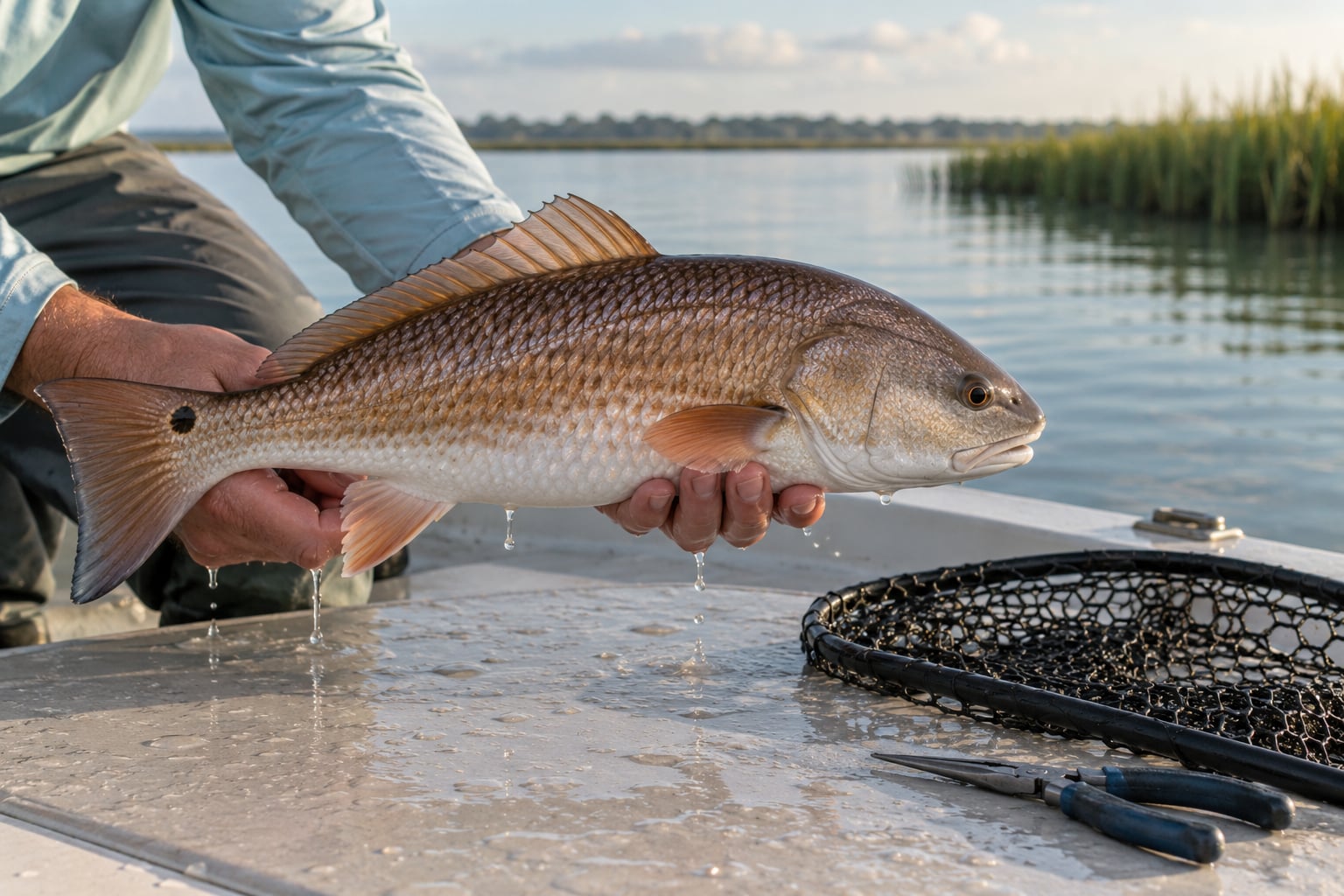
How to handle a redfish without hurting it is a short, repeatable order of operations: wet your hands, grip only the firm lower lip, cradle the belly so the fish stays horizontal, pull the hook out fast, and put the fish back in the water mouth-first into the current. Nearly all the harm anglers do to red drum happens in the thirty seconds on either side of the hook coming free.
Redfish are red drum, Sciaenops ocellatus, an inshore saltwater gamefish of the Gulf and South Atlantic. They fight hard and they look tough, but the skin that keeps them alive is a thin mucous layer, and the mouth that looks so solid is built on a bony throat plate. Handle them badly for a minute and you undo a lot of that toughness.
The sequence below works from a boat, a kayak, a wade or a pier, and it takes about three minutes from fish-alongside to fish-swimming-away once you know the order.
Table of Contents
- What You Need
- Step-by-Step: How to Handle a Redfish Without Hurting It
- 1. Prepare Before You Touch the Fish
- 2. Grip the Redfish Firmly but Gently: How to Hold a Redfish Safely
- 3. Lift and Support the Fish Correctly
- 4. Remove Hooks Without Extra Injury
- 5. Measure, Photograph, and Release Responsibly
- Common Mistakes
- Frequently Asked Questions
- Should I use dry hands when handling a redfish?
- What is the best way to hold a redfish while unhooking it?
- Can I lift a redfish by the mouth when checking its size?
- How long can a redfish stay out of the water during release?
- What should I do if a redfish is deeply hooked or exhausted?
- Conclusion
What You Need
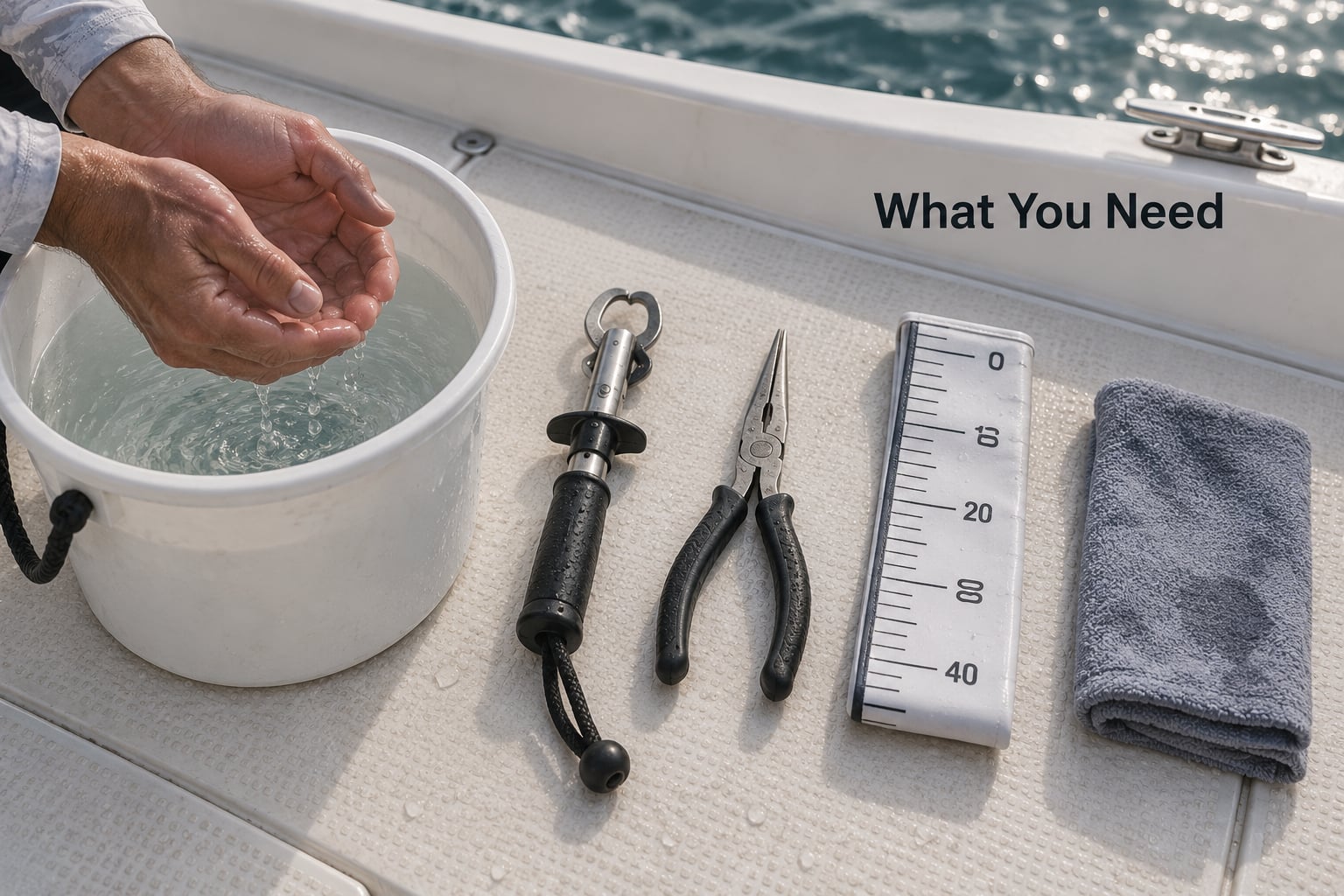
None of this is specialized. Every item is something that fits in a tackle bag or a deck box, and most of them cost less than a box of shrimp.
- Water for your hands. A bucket of seawater, a rinse bottle, or simply the water you are standing in. This is the single most important item on the list.
- A knotless rubber net. Knotted nets abrade the slime coat and shed rubber particles onto the fish. A drop net is the pier version, lowered rather than lifted.
- Long-nose pliers or a dehooker. A dehooker gets into the corner of a redfish mouth and twists the hook out instead of pulling backward through tissue.
- A lip gripper for bull reds. A clamp-style Boga gripper lets you re-grip a thrashing fish after a miss. Anything over about 12 pounds is where your thumb and forefinger stop being enough.
- Measuring board and camera within arm’s reach. If you have to set the fish down to find them, you lift twice. That is how handling time triples.
- A damp rag, never a dry one. Useful over the eyes to settle a fish, and useful to lay on a hot deck.
- The current slot and size rules for your water. Check SCDNR, NOAA or your own state agency before the trip so you are not guessing in front of a fish.
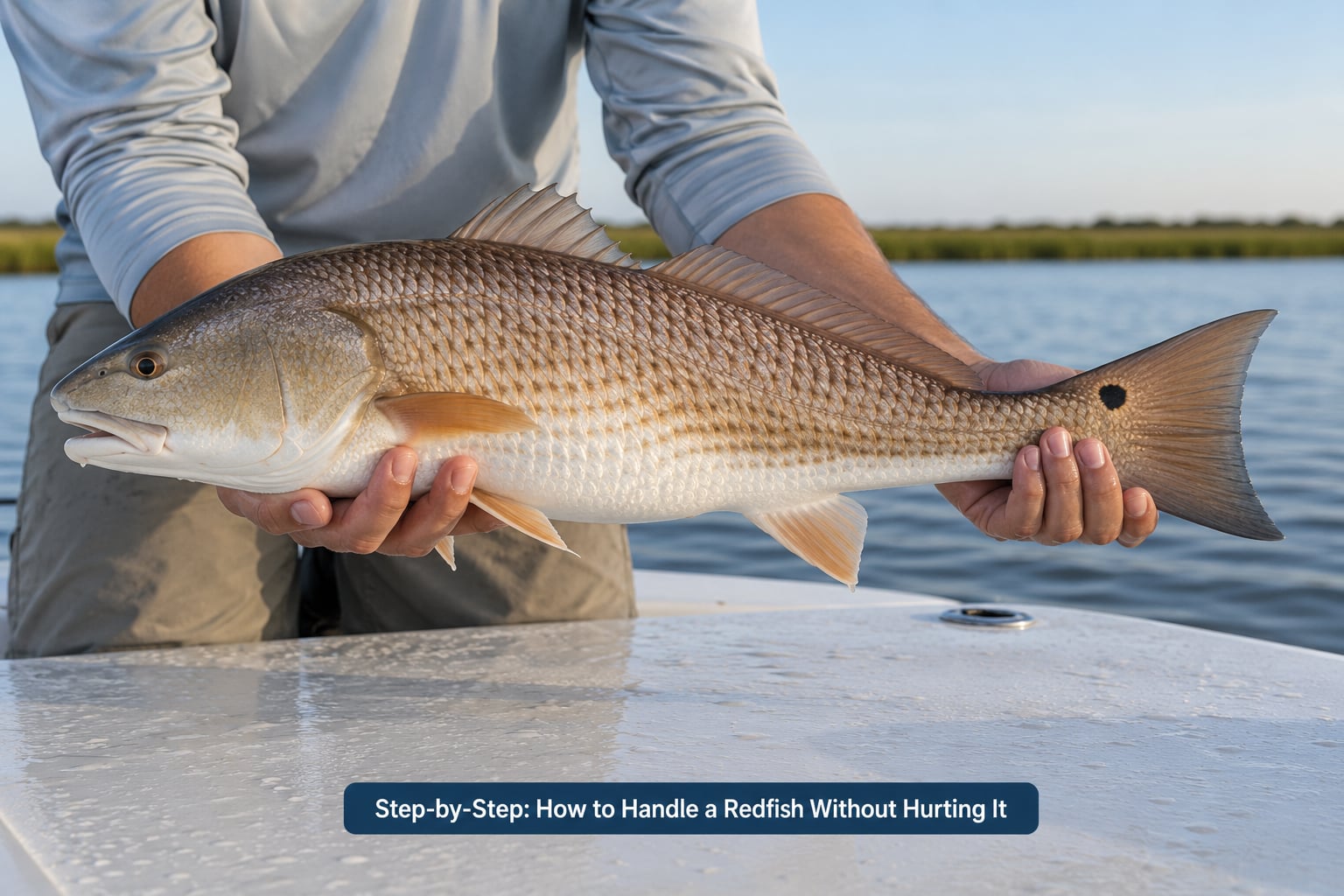
Step-by-Step: How to Handle a Redfish Without Hurting It
1. Prepare Before You Touch the Fish
Get the fish in the net or alongside before your hands go near it. Lead the fish with a wet hand cupped under the belly, and keep the net in the water with the fish in it while you sort out your pliers.
What you are looking for in those first seconds is condition. Bright color, a firm body, and a fish that is still orienting itself toward the current are all good signs. A fish that hangs at the surface, is bellied up, or is bleeding heavily from a gill is already in trouble, and that changes your plan.
You will see it worked when the fish stays in the water or in the net the entire time you are getting organized. No lifting to find something.
2. Grip the Redfish Firmly but Gently: How to Hold a Redfish Safely
The lower lip is the one grip point on a red drum that will not tear. Everything else fails: the gill plates bleed, the eyes bruise, and anything inside the mouth is a mistake.
Redfish also have pharyngeal teeth, those bony plates in the throat that crush crabs and shrimp. That bony throat is why a big redfish cannot be held like a trout, with a fist in the mouth. The jaw hangs off the skull on a short, heavy frame, and gravity plus a fish that weighs 30 pounds will pull it out of alignment.
Here is the nuance that trips people up. The blanket rule you will hear is never hold a fish by the mouth. That rule exists because of the way most people do it, which is pinching the lower lip between thumb and forefinger. Do that on a bull red and you can gash the lip. Do it with a clamp gripper closed fully on the lip and you are fine, because the load is spread instead of concentrated on two points. Anglers on SurfTalk and the kayak forums report no visible jaw or lip damage from repeated lip gripping with a gripper.
You will see it worked when the fish can pull against your grip without tearing free, and when you can still open its mouth for the hook without letting go.
3. Lift and Support the Fish Correctly
Lift horizontally or not at all. One hand under the belly near the pectoral fins, the other supporting the tail stock, with the spine in a straight line from nose to tail. The fish should look like it is still swimming.
Think about what a vertical jaw hold feels like from the fish’s side. Every ounce of that fish is hanging off a small piece of cartilage at the front of its skull, and its organs are sliding toward its head. Hold it that way for a trophy photo and you can do real internal damage to a fish that swims away and dies later.
Two hands is not optional on a bull red. Past about 15 pounds, the tail stock alone is not strong enough to hold the fish, and the belly support is what stops the spine from sagging.
You will see it worked when the fish hangs level, its head is slightly down, and it is not swinging or beating its tail to get free.
4. Remove Hooks Without Extra Injury
Speed matters more than technique here. The fish is losing oxygen with every second, and the best hook removal is the one that happens first.
- Shallow hook, barbless or crushed barb: grip the eye of the hook with long-nose pliers and back it straight out along the same angle it went in. Redfish hooks come out of the mouth corner and the gill plate more often than anywhere else.
- Deeply hooked, swallowed bait: do not dig. Cut the leader with a small pair of line cutters as close to the hook as you can reach, leave it, and let the hook work through or rust out. Non-stainless circle hooks corrode in a few days.
- Do not tear it out with a long pull. A redfish mouth will bleed a lot from a ripped hook and it will tell you the difference between a released fish and a dead one.
Better still, work on a shallow-hooked fish with its head in a wet net or in the water. Several regular pier anglers dehook on the surface in the net and never lift the fish at all until it is time to go.
You will see it worked when the hook comes out in one or two movements and the fish is not gushing blood around the mouth or a gill cover.
5. Measure, Photograph, and Release Responsibly
Have your board and your camera in your hands before the fish is out of the water. If it needs to be measured against a legal limit, measure it against the board while it is supported, not against your own arm or a memory.
For photos, keep it horizontal, keep it wet, and keep it quick. The rule most anglers use is their own breath: if you cannot hold your breath comfortably for the shot, the fish has been out too long. That lands you somewhere in the 30 to 45 second range, which is the same number most agencies and tournament rules use as a limit.
Then release it properly. Put the fish back in the water, hold it by the tail or under the belly with the head pointing into the current, and let it work. Twenty to sixty seconds of revival with water moving over the gills is the range that shows up in release guidelines. When the fish holds itself steady, starts to move with the current, and then swims off under its own power, you are done.
Headfirst, into the current. Never swing the fish around and toss it tail-first over your shoulder, and never drop it on the deck to admire it.
You will see it worked when the fish leaves on its own with no shove.
Common Mistakes
Almost every dead or dying released redfish traces back to one of these. None of them are dramatic, which is exactly why they are so common.
| Mistake | What to do instead | Why it matters |
|---|---|---|
| Dry hands, a dry towel, or a bare deck | Rinse your hands and the surface with seawater first | Dry surfaces strip the mucous layer and open skin to infection |
| Pinching the lower lip between thumb and forefinger | Use a clamp lip gripper, or support the fish in the water | A pinch grip can gash the lip badly on a big fish |
| Fingers inside the mouth or across the gills | Keep hands outside the mouth entirely | Gill plates are thin and bleed easily, and blood in the water is hard on the fish |
| Hanging a bull red vertically by the jaw | Two hands, horizontal, belly supported | Jaw dislocation and internal organ shift under the fish’s full weight |
| Gaffing or heavy-lifting a fish at the pier | Use a knotless net or a drop net | A gaff tears skin at the shoulder and removes the coat with it |
| Laying the fish on the deck between steps | Keep it in the net, in a water-filled net, or in the water | Deck carpet, hot concrete and salt water all cost the fish more than the lift would have |
| Sticking a fish you plan to release in the livewell | Release it on the spot | Confined fish lose condition, and you will be tempted to keep it |
Two more things are worth a mention. The first is the fight. A redfish that runs for fifteen minutes builds up lactic acid in the muscle tissue, and the angler who “wins” the fight by landing a fish that was played to exhaustion has handled it badly before it ever came out of the water. Heavy enough tackle and a fast, short fight is a handling decision, not a toughness decision. Circle hooks and barbless hooks are worth the swap for the same reason.
The second is heat. Summer shallow redfish and any bull red coming through on a spawn run are already stressed before you touch them. Keep air exposure under a minute, revive longer, and release immediately without a trophy delay. If a fish is deeply hooked, bleeding from a gill, or showing signs of barotrauma from a deep drop, releasing it is not the conservation-friendly choice. Keeping it is. That is not a failure, it is the correct call.
Frequently Asked Questions
Should I use dry hands when handling a redfish?
No. Wet your hands and everything the fish touches before you lift it. The mucous layer on a redfish skin is the main barrier to infection, and dry hands, dry towels, carpet and hot concrete all strip it. A fish can swim away strongly with a stripped coat and die a few days later from what it picked up. Pour seawater on your hands and on the deck, or keep a wet rag in your other hand.
What is the best way to hold a redfish while unhooking it?
Cradle the fish horizontally with one hand under the belly and one supporting the tail, and work the hook with pliers or a dehooker from that position. For a shallow hook, grip the eye of the hook and back it out along the angle it entered. For a deep hook or swallowed bait, cut the leader close to the hook instead of digging or tearing it out.
Can I lift a redfish by the mouth when checking its size?
The lower lip is the only part of a red drum built to take a grip, but pinching it with two fingers can gash it. Use a clamp-style lip gripper for anything over about 12 pounds, and never put fingers inside the mouth or across the gills. To measure, support the fish horizontally with two hands and use a board. A bull red hung vertically by the jaw can have its jaw dislocated and its organs shift under its own weight.
How long can a redfish stay out of the water during release?
Keep it to 30 to 45 seconds if you can, which is roughly how long most people can hold their breath comfortably. Measure, photograph and unhook in one lift with the tools already in your hands, then put the fish straight back. After release, hold it headfirst into the current for 20 to 60 seconds and let it swim away on its own before you let go.
What should I do if a redfish is deeply hooked or exhausted?
Deeply hooked means cut the leader close to the hook and move on. Non-stainless circle hooks will rust out in days, and digging for a swallowed hook does more damage than the hook will. If the fish is exhausted, gasping at the surface or bleeding heavily from a gill, put it back in the water headfirst and hold it into the current until it holds itself steady. If it will not recover, keeping the fish is the kinder choice.
Conclusion
Start with water. Wet your hands, wet the deck, and keep the fish in the net or in the sea instead of carrying it around. Support the belly with both hands, keep it level, use a clamp gripper on the lower lip if it is big enough to need one, and never put fingers in the mouth or on the gills.
Then move fast. One lift, hook out fast, cut the leader instead of digging, and back in the water headfirst into the current for 20 to 60 seconds. If the fish is too damaged to survive, keep it. Angling works because the fish come back, and handling is the part you control completely. Learn that order once and you have answered the only question that matters here: how to handle a redfish without hurting it.