Most people get stuck in marsh mud because they treat it like a dirt road. It is not one. The way to avoid getting stuck in marsh mud is simple: learn what is under the water before you commit, move slowly enough that you can stop at any moment, and turn back the moment the ground stops answering. Give yourself 30 minutes of planning and the trip usually ends the way you planned it.
That is worth doing carefully, because marsh mud is one of the few surfaces where a bad call gets worse the longer you wait. Every minute of spinning tires widens the hole, and every minute of standing in cold water takes something out of you. Most of the stuck stories I have read come from people who arrived ten minutes later than they needed to.
My own reminder comes from a hunting forum thread where a guy got stuck three times in one deer season, twice alone, once after two hours of digging in water with no cell signal. The fix was never a better winch. It was a tide table and a pole he pushed into the bottom before every corner.
This guide covers the whole chain: what to carry, how to read the ground, how to move on it, and what to do when your boot, your kayak, or your truck is already in it.
Table of Contents
- What You Need
- Planning and navigation
- Footwear and clothing
- Poles, traction, and improvised devices
- Comms and emergency kit
- Step-by-Step: How to Avoid Getting Stuck in Marsh Mud
- 1. Check the Tide, Weather, and Route Before Leaving
- 2. Use the Right Footwear and Traction
- 3. Test the Ground Before Committing Your Weight
- 4. Move Slowly and Keep a Stable Route
- 5. Protect Your Gear and Keep an Escape Plan
- 6. Get Out Safely If You Begin to Sink
- Common Mistakes That Get People Stuck
- Crossing flooded sections on a guess
- Following animal trails
- Walking alone
- Wearing the wrong boots
- Ignoring rain and tide
- Digging a wider hole
- Anchoring to bumpers and pulling at an angle
- Churning the wetland for entertainment
- Frequently Asked Questions
- How deep can marsh mud get before it is dangerous?
- What is the best footwear for walking through a marsh?
- Does low tide always make marsh mud safer to cross?
- Should I walk on marsh boardwalks even if the route is longer?
- What should I do if my boot is stuck in deep mud?
- Can a kayak or canoe get stuck in marsh mud?
- Conclusion
What You Need
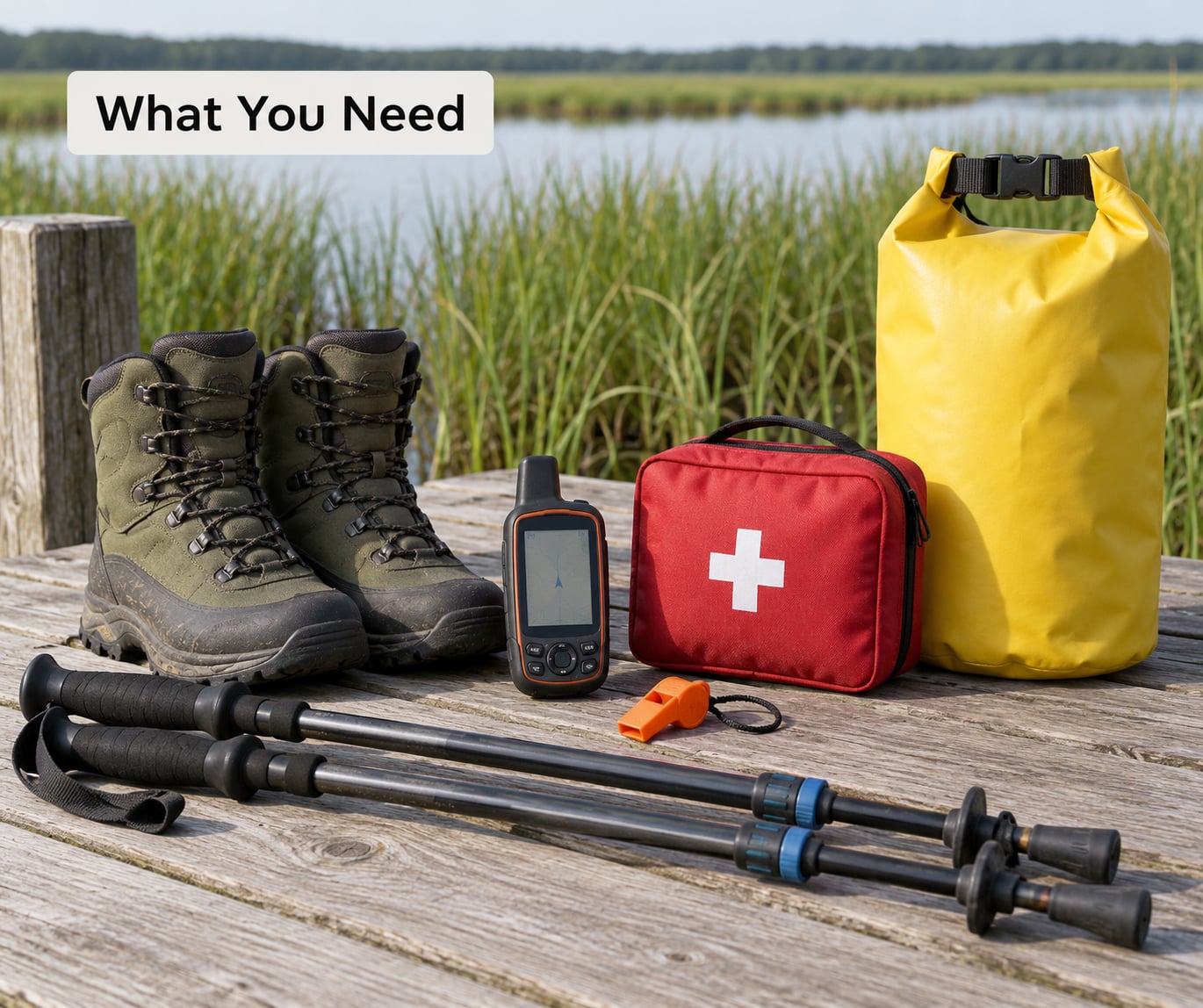
The gear list for marsh travel is short, and every item on it earns its place by keeping you moving or getting you out. Most people arrive with plenty of clothing and no way to signal for help.
Planning and navigation
A printed or downloaded tide table for the exact spot, a map of the marsh with the designated routes marked, and a phone or handheld GPS with your route loaded before the network drops. Wetlands have very few landmarks that look different from one another once the grass is all the same height.
Know where the boardwalks and elevated walkways start and end, and identify at least one high, dry turnaround point along the route. That point is what makes an early exit a real option instead of a wish.
Footwear and clothing
Stocking-foot chest waders with well-laced boots are the standard choice for deep mud, because the boot slides off and the water drains instead of sealing around the leg. Knee-high rubber boots work for shallow soft ground but fill with water and mud quickly.
Gaiters keep slurry out of the boot cuff, and a spare dry pair of socks in a sealed bag matters more than people expect. Long pants beat shorts once the vegetation is shoulder high.
Poles, traction, and improvised devices
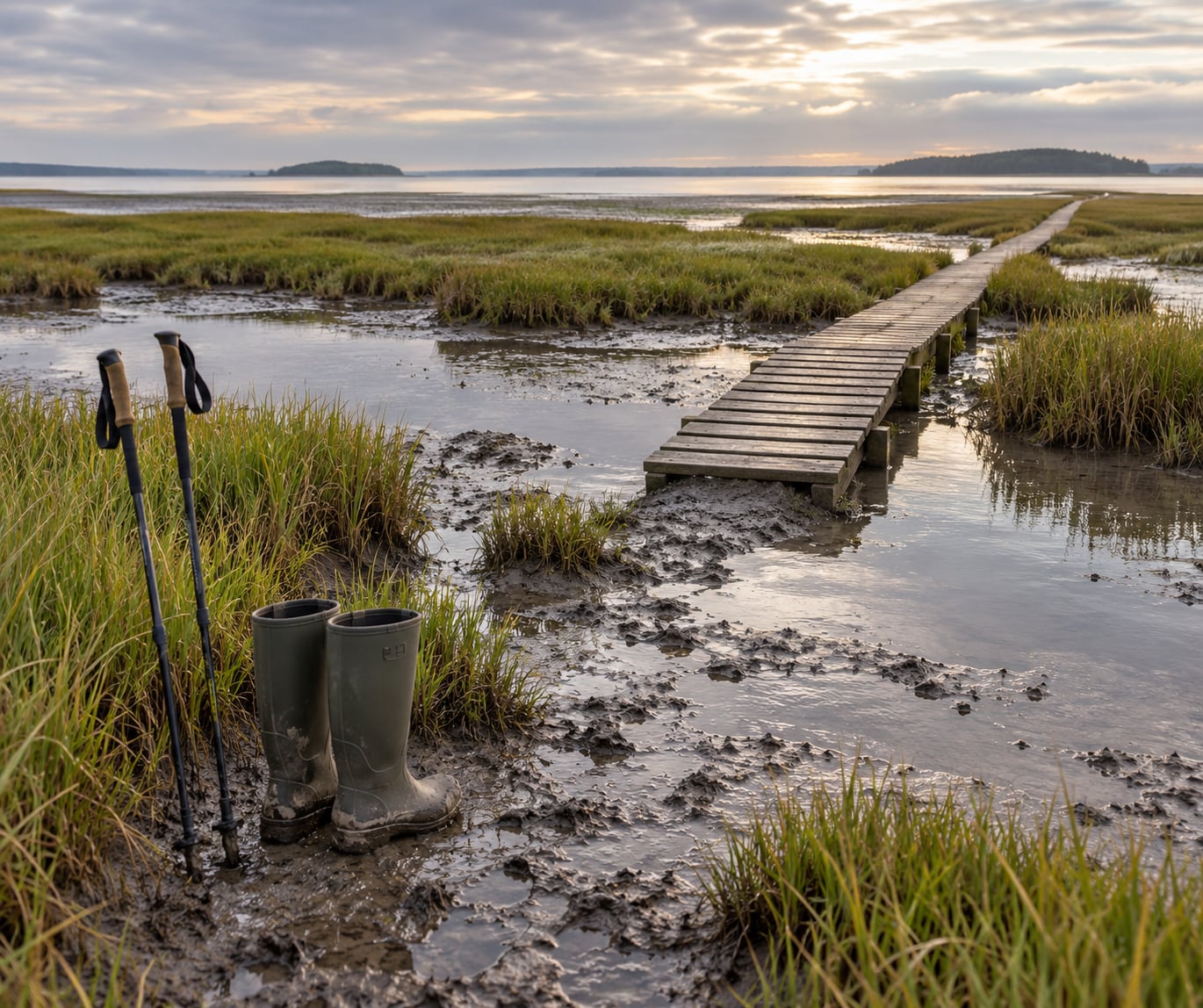
A pair of trekking poles is the single most useful walking tool in a marsh. They probe the bottom ahead of your feet, take weight off your knees, and give you three points of contact when you stop to stand still.
Two boards roughly the size of your boot, with straps, let you stand on the surface instead of in it. Homemade versions made from scrap lumber get called splatchers, a name popularized on a Hobie forum thread, and they work well enough that regulars build them by hand.
Comms and emergency kit
A phone in a waterproof case or on a floating strap, a whistle louder than your voice, a satellite messenger if the cell map shows a gap, a headlamp, a first-aid kit, and a one-gallon water container. Check coverage at the launch point before you leave, not at the moment you need it.
Nobody goes alone. A buddy who knows the route, has a phone, and is willing to turn around early is worth more than any piece of recovery gear.
Step-by-Step: How to Avoid Getting Stuck in Marsh Mud
1. Check the Tide, Weather, and Route Before Leaving
Marsh bottom firmness changes with the water above it. A firm sand flat you crossed at low tide on foot can be a soft muck pocket two hours later, and a route that was a raised causeway at low water becomes a channel at high water.
Pull the tide table for your specific station, not a nearby city. Then layer three other signals on top: rainfall in the last two days, which adds water without draining it; strong wind, which pushes water into low ground and can raise the level well above the predicted tide; and the previous tide cycle, since a marsh that never fully drained is still soft from the day before.
Next, read the route itself. Official access information usually names boardwalks, marked routes, and closed areas. Marsh managers close routes for a reason, usually because a boardwalk section has washed out underneath or a vehicle has torn the mat down to subsoil.
Walk the first hundred yards of the route before committing the rest of it. Note the places where the ground is high enough to stand on and mark your exit point. If you cannot get back to the launch within the time you have, you have already chosen the wrong loop.
2. Use the Right Footwear and Traction
Boot-foot waders are the most common reason waders end up stuck. The rubber boot is a suction cup: every step pulls a vacuum against the leg, and in soft gumbo the hiker becomes part of the problem. Anglers on the Refuge Forums wader forum made the same point independently, recommending stocking-foot waders with laced boots for hunting deep gumbo.
Stocking-foot waders solve this because the boot can be pulled free of the leg while your foot stays in it. Lace the boots tight from the toe up so nothing shifts inside, and tape or cinch the neoprene at the calf if you will be standing in water for a while.
Add spikes or rubber mud grippers to the boot sole for anything but firm sand. On snowshoes, a raised outer edge matters more than the tread pattern, because a flat deck lets mud ooze over the top and stop you dead. That was the fix one metal detecting forum regular landed on after fighting the same problem every season.
Use two poles rather than one. Plant them ahead, let the tips take your weight, and move your feet between them so you always have a stable three-point base before the next step.
3. Test the Ground Before Committing Your Weight
Push a pole straight down before you step anywhere you have not already walked. Firm sand meets the pole and stops it in a few inches. Soft muck lets it sink to your forearm and keeps going. A sink hole swallows it entirely with no resistance at all, and that is the one that will take your leg to the knee.
Learn to read the surface before you learn to read the map. Bright green upright grass usually means water moves through here regularly and the bottom stays loose. Dense low mat of brown stems over firm sand is a safe corridor. Open water with no bottom visible is a channel, and channels drop away sharply at the edges.
Never step into water you cannot see the bottom of without probing first. Those edges are where people go in, because the water looks shallow in the middle and then falls off where you were planning to put your foot.
Turn around the moment probing turns up nothing stable in your path. Reversing is free. Going back fifty yards to a causeway costs you twenty minutes and keeps your boots dry.
4. Move Slowly and Keep a Stable Route
Short steps, placed flat, are the whole technique. Heel-to-toe placement spreads the load; a flat sole punched straight down concentrates it and drives you deeper. Keep your weight low, your knees bent, and your hips back so you are sitting rather than standing over your feet.
The mistake that sinks people is yanking a foot straight up. That breaks the suction seal violently, throws your balance forward, and drops your center of gravity into the hole. Slide the foot forward along the bottom, unweight it onto the poles, then lift.
Where tracks, boardwalks, and oyster-shell ramps already exist, use them. A boardwalk takes your weight off the bottom entirely and exists precisely because that ground does not hold. Walking the long way around a wet patch on a raised walkway is not a detour, it is the route.
Paddlers use the same logic. Sit forward and keep your weight over the open water rather than over the hull while you cross soft water, because a hull that touches down in soft mud stops suddenly and loses steerage. Keep the bow pointed at clear water, and pole instead of paddle through shallow tonnage so you can feel the bottom before you commit.
5. Protect Your Gear and Keep an Escape Plan
Load is your slowest leak. Every pound in the boat or pack is a pound you have to lift through suction later, and it drags your center of gravity toward the mud. Consolidate into fewer bags, split shared gear between two people, and cache nothing heavy that you cannot carry back.
Keep electronics in dry bags above the waterline. Salt water and marsh silt ruin a radio, and a radio that fails during the recovery is a radio you cannot use to call for help.
Verify cell coverage at the trailhead, set a check-in time with someone on shore who knows what to do if you miss it, and keep a straight-line escape direction in mind the whole time. On a flat marsh you can usually walk out in one direction, but only if you know which one before your legs are buried.
Agree on the hard rule with your group out loud: if anyone says the ground is unsure, everyone turns back with no debate. Nobody gets left behind to prove a point to a plant.
6. Get Out Safely If You Begin to Sink
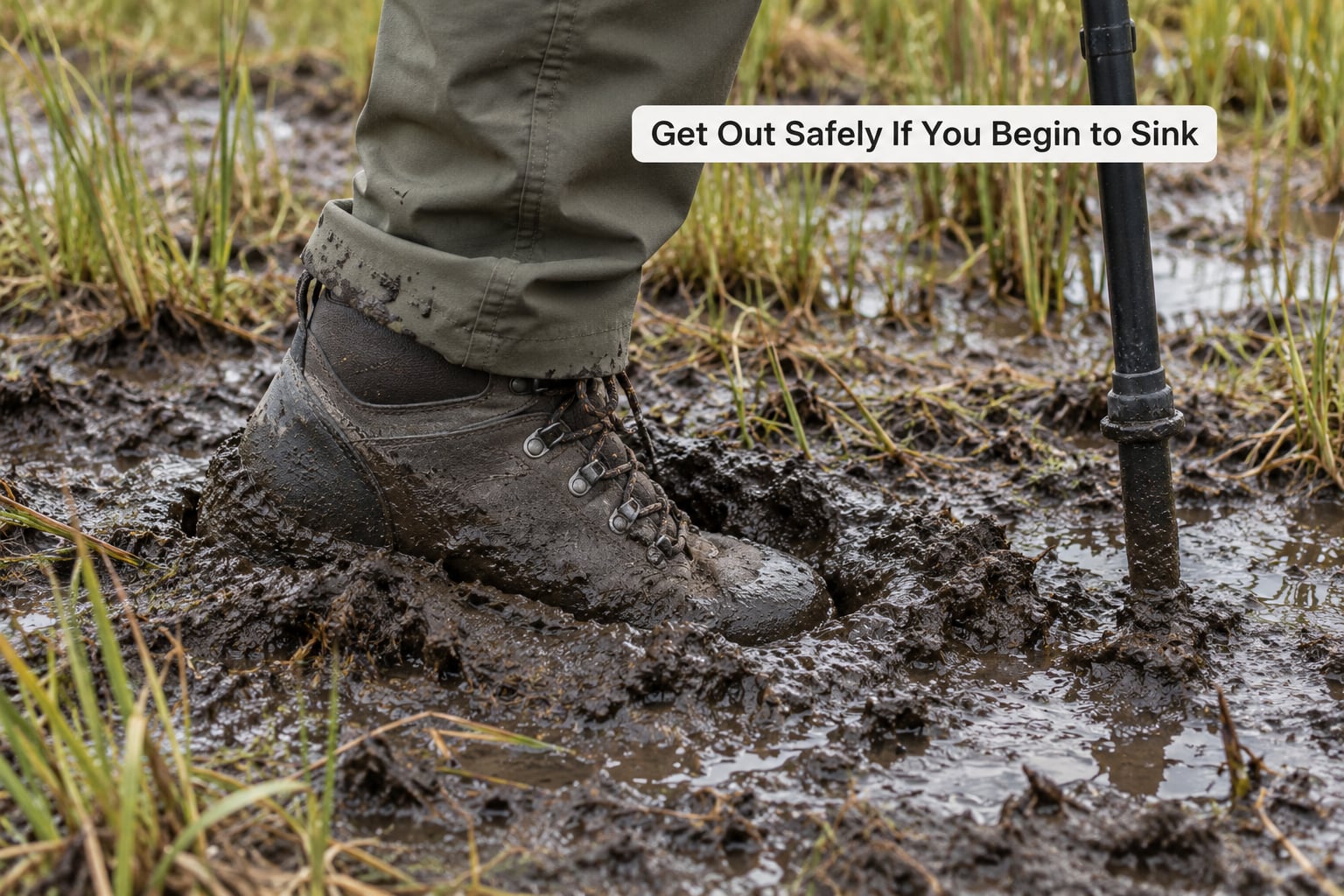
The first ten seconds decide how this ends. Stop moving. Spinning or thrashing widens the hole and turns a recoverable situation into a rescue, which is the advice that comes up again and again in recovery threads.
Plant both poles and lower your hips onto them so your weight is off your legs. Take a pack off your back before anything else. From a supported position, move the free foot forward into firmer material, transfer weight onto it, and drag the stuck foot forward along the bottom rather than lifting it.
If a boot is buried to the ankle, do not pull upward. Find the heel, slide a pole shaft down in front of the toe to lever the boot forward, and roll your foot out while your weight sits on the pole. If the suction will not break, unlace and step out of the boot rather than tearing your leg out of the shaft.
For a boat or kayak sitting in soft bottom, do not paddle hard to break it free. Get out on the side where the water is deeper, push the hull back with your feet on firmer bottom if you can reach, and paddle backward along the channel you came from. Dragging forward with paddles just drives the bow further into it.
Call for help when self-recovery would take more than a few minutes of effort, when you are up to your chest in cold water, when current is running, or when your anchor points are the only thing that could take a pull. Factory tow hooks and bumpers are not rated recovery points, and a failed pull in soft mud swings whatever you were attached to.
Before you leave, check for trapped water in your boots, cracks in the sidewalls, and a wheel or track that is running deeper on one side than the other. Damage that does not announce itself keeps happening after you get home.
Common Mistakes That Get People Stuck
Most stuck incidents trace back to one of a short list of choices, and each one has a straightforward fix.
Crossing flooded sections on a guess
Water that looks like a low crossing on a map is frequently a channel with a soft lip on both sides. Probe the bottom at the entry, the midpoint, and the exit before you step or drive, and turn back if any of the three does not answer.
Following animal trails
Deer and turkey trails run along the edges of wet ground, which is exactly where the soft lip is. They are useful as long-distance sight lines, not as a walking surface.
Walking alone
A solo mistake in a marsh takes one bad ankle instead of a few minutes. Bring someone, and tell them the route and your check-in time before you start.
Wearing the wrong boots
Boot-foot waders on soft gumbo turn your legs into plungers. Stocking-foot waders with laced boots break free; that is the entire reason the distinction exists.
Ignoring rain and tide
Two days of rain leaves a marsh soft at the height of the tide, not just low in it. Combine the forecast, the wind direction, and the tide table before you trust a route you walked last month.
Digging a wider hole
Digging out from under a tire in unstable soil is what pushes a vehicle deeper and traps the person with the shovel. Forum accounts of two-hour digging sessions usually end with the vehicle lower than it started. Place boards and mats ahead of the tires instead and drive out along the path you came in on.
Anchoring to bumpers and pulling at an angle
Bumpers are not rated recovery points and fail in real extractions, and an angled pull toward a low spot can lift a vehicle onto two wheels or unload a suspension. Straight lines, rated points, and everyone standing clear of the line are the rules that keep recovery from becoming an injury.
Churning the wetland for entertainment
Spinning tires in a marsh tears the rooted mat apart and exposes subsoil that can take decades to recover. Boards and boards-and-mats cost you nothing, keep you out, and leave the habitat intact for the next season. If you do dig, fill the hole back in.
Frequently Asked Questions
How deep can marsh mud get before it is dangerous?
Marsh mud has no reliable depth, because depth depends on what is under it rather than how much water is on top. Firm sand stops a pole within a few inches, soft muck runs past your forearm, and sink holes swallow it with no resistance at all. Probe at three points along any crossing before you commit, and assume anything you cannot probe is deeper than your boot.
What is the best footwear for walking through a marsh?
Stocking-foot chest waders with tightly laced boots are the best choice for soft marsh mud, because the boot can be freed from your leg instead of sealing around it. Add mud grippers or spikes on the sole, and wear gaiters to keep slurry out of the cuff. Boot-foot waders act like suction cups in gumbo and are the most common reason waders end up stuck.
Does low tide always make marsh mud safer to cross?
No. Low tide exposes more ground but does not make the exposed ground firm. A marsh that never fully drained stays soft for days after the water drops, and wind-blown water raises levels above the predicted tide. Check the tide table for your exact station, then add recent rainfall and wind direction. Firm sand that you walked last month can be soft muck this week.
Should I walk on marsh boardwalks even if the route is longer?
Yes, whenever the boardwalk reaches your destination. Walkways put your weight on a structure instead of on the bottom, which is exactly what soft mud does not tolerate, and marsh managers build them along the routes that survive. Detouring around a wet patch on a raised walkway is not wasted time. If a section is closed or washed out, treat that as a warning about the ground around it.
What should I do if my boot is stuck in deep mud?
Stop moving and plant both poles, lowering your hips onto them so your weight comes off your legs. Take your pack off, slide the free foot forward into firmer material, then drag the stuck foot along the bottom rather than lifting it. If suction will not break, lever the heel forward with a pole shaft, or unlace and step out of the boot instead of pulling your leg free.
Can a kayak or canoe get stuck in marsh mud?
Yes, in shallow channels with soft bottom, and the hull usually stops rather than slides. Keep your weight forward over open water, pole instead of paddling so you can feel the bottom, and never drive the bow down into it. To get free, step out on the deeper side, push the hull back off the bottom with your feet, and paddle backward along the channel you came in on.
Conclusion
Start with conditions: tide table, recent rain, wind, and the official route information for the place you are actually going. Then choose firm ground instead of the shortest line, probe anything you have not already walked, and move in short flat steps with your weight low and your poles planted.
Carry the poles, the boards, the whistle, and the dry bag, and never go alone. Most of all, turn back early. Reversing a bad decision at the halfway point costs twenty minutes; reversing it after your leg is buried costs hours, money, and a story you did not want to tell. A minor mud problem becomes dangerous almost entirely because somebody pushed it a little further than the ground allowed.