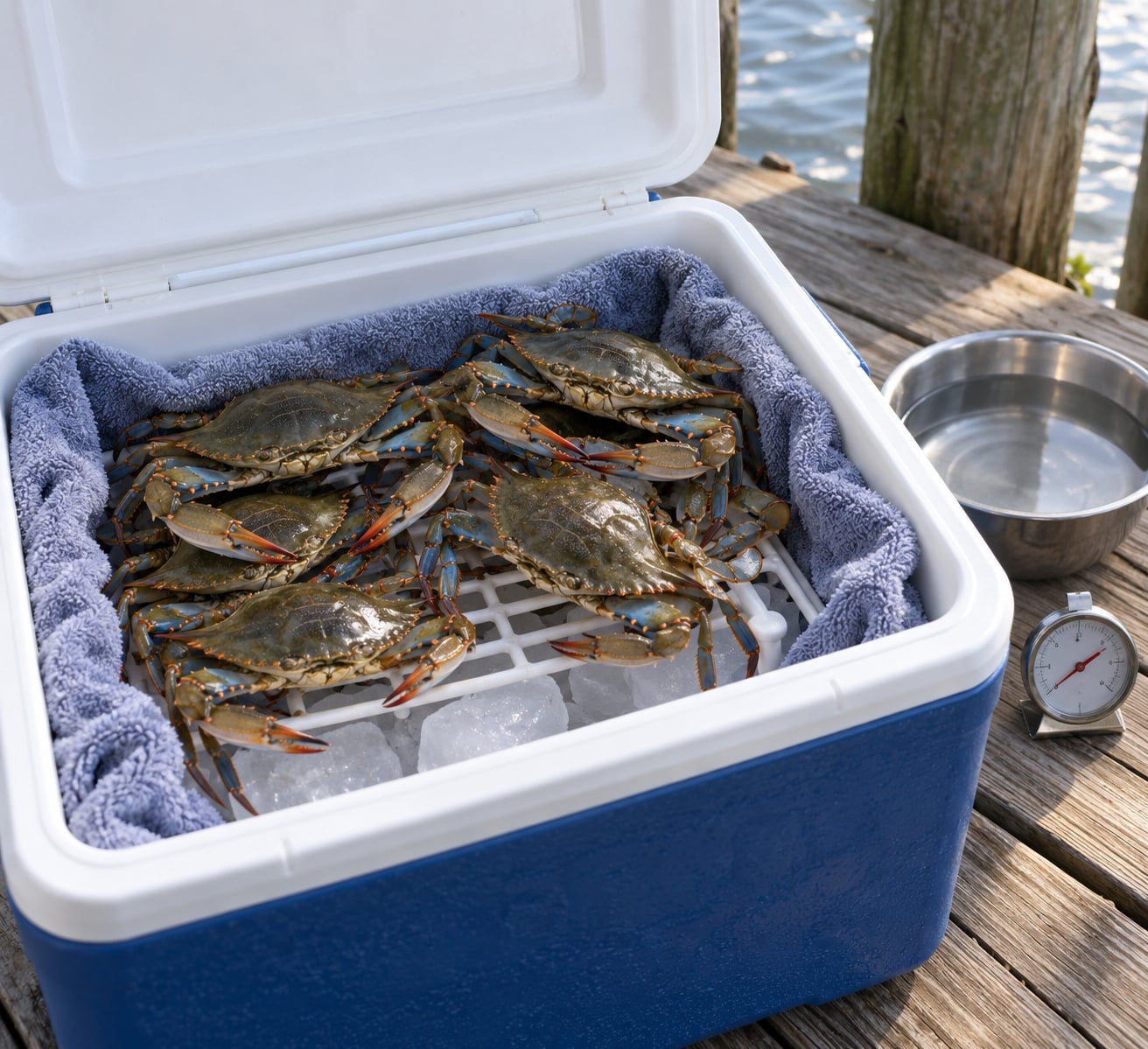
To keep crabs alive until you cook them, hold them cool, damp and ventilated. Put them in an open container or a cooler with the drain plug pulled, cover them with a damp towel or damp newspaper, and keep the temperature between 40 and 55F. Never submerge them in fresh water, never lay them directly on ice, and never seal the container airtight.
That is the whole rule, and it takes about five minutes to set up. The hard part is resisting the two things most people try first: putting the crabs in water, or burying them in ice. Both kill them, usually overnight, and usually in a way that only becomes obvious in the morning.
I have held crabs for the better part of two days after a bay trip, and the same three variables decide whether they are lively at dinner or limp in the bucket. Cool slows their metabolism so they stop burning through energy. Damp keeps the gills wet, because a crab breathes through gills that must stay moist even though they work perfectly well in air. Ventilated means oxygen keeps arriving. Take away any one of the three and you have a problem within hours.
Table of Contents
- What You Need to Keep Crabs Alive
- Step-by-Step: How to Keep Crabs Alive Until Dinner
- 1. Prepare the container
- 2. Keep the crabs cool and damp
- 3. Check the crabs regularly: what healthy, stressed and dead look like
- 4. Plan to cook them promptly
- 5. Prepare the crabs for cooking
- Common Mistakes That Kill Held Crabs
- Storing crabs in standing water
- Placing crabs directly on ice
- Sealing the container
- Leaving them in sun or a hot vehicle
- Giving them the refrigerator fan blast
- Storing raw whole crabs for a week
- Frequently Asked Questions
- How long can I keep crabs alive before cooking them?
- Should crabs be stored in water?
- Does ice kill crabs?
- How do I tell if a crab is alive?
- Can I cook a crab that was kept in the refrigerator?
What You Need to Keep Crabs Alive
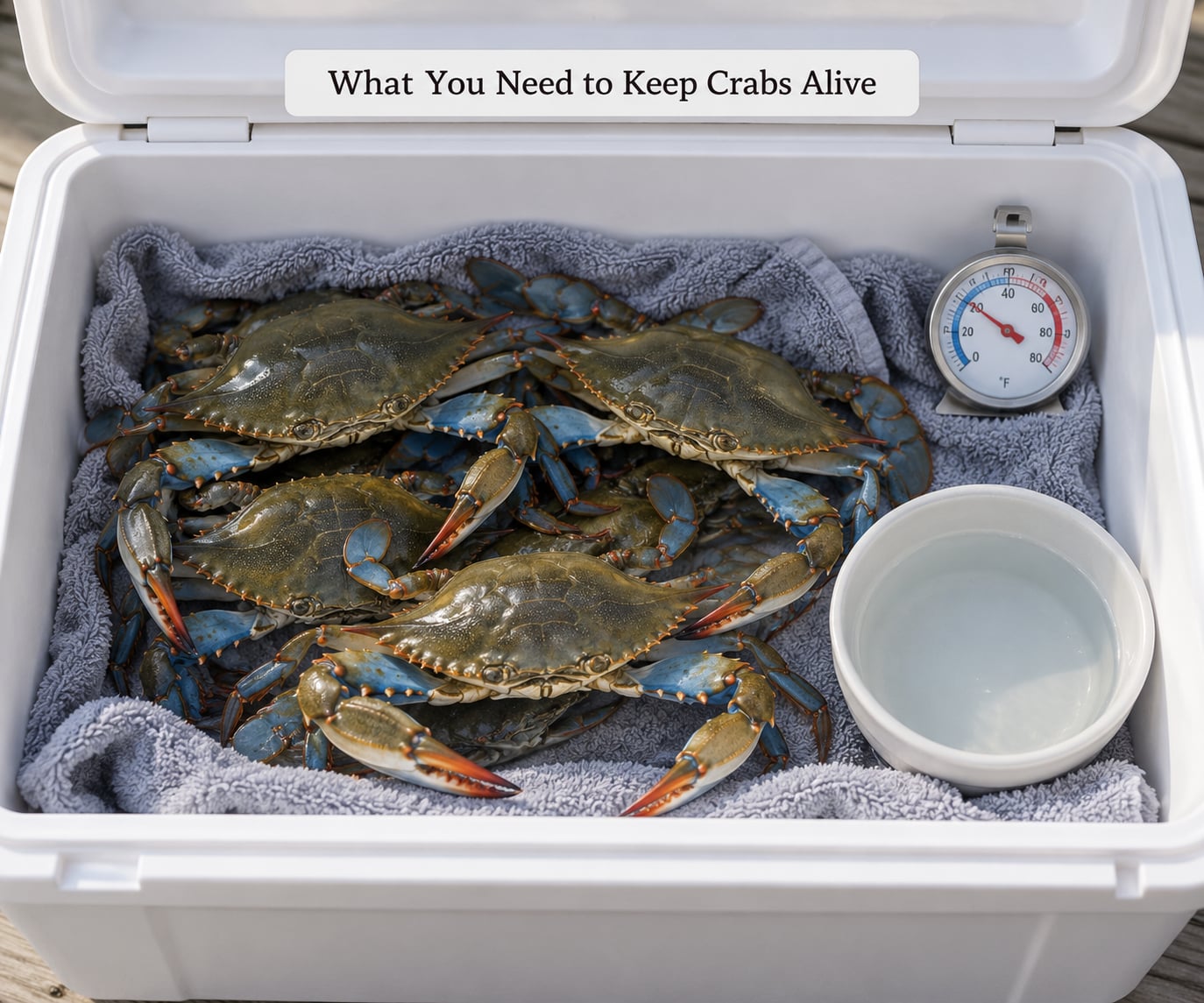
You need very little, and all of it is cheap or free. The container matters more than anything else you buy.
- A breathable container. A cooler, a bushel or wicking basket, an open crate, or a refrigerator-safe container that does not latch shut. Anything that traps air with no way out is a problem.
- A damp towel or damp newspaper. Shredded paper, a damp hessian sack, a damp burlap square or a moist tea towel all do the same job. This is the layer that keeps the gills wet.
- Ice or frozen packs. Used to control temperature, not to bury the crabs. Bagged blocks drip slowly and last longer than cubes.
- A refrigerator thermometer. A cheap dial one is enough. Household fridges run colder and colder in different places, and most failures come from guessing.
- A pair of gloves. Blue crabs in particular have claws worth respecting.
- A shallow bowl or tray. For inspecting the hold and for rinsing the crabs right before cooking.
Rubber bands for the claws are worth adding too. Banding the claws of a soft-shelled crab costs you nothing and stops it working its way out of the container or damaging its neighbours.
Step-by-Step: How to Keep Crabs Alive Until Dinner
1. Prepare the container
Rinse out the cooler or container with plain water and leave the drain plug pulled. If you are using the refrigerator instead, put the container on the bottom shelf or in the crisper drawer, away from anything that drips.
Line the base with your damp material, and put the crabs on top of that layer rather than into it. Then drape a second damp layer over the crabs so the moisture sits on both sides of them. It should be damp, not dripping. If you squeeze the towel and water runs out, you have gone too far.
For a fridge, keep the container uncovered or loosely covered. Opening the door briefly every few hours, as Crabbing Hub suggests, lets a fresh slug of air move through.
2. Keep the crabs cool and damp
Aim for 40 to 55F in the container. Colder than about 40F is a real problem for most species, and above roughly 60F they burn through energy fast and lose condition. Around 50F is the practical target, which is roughly where commercial walk-in units hold live crab, and about where a seafood-market worker’s holding setting sat in the research I read on this.
You will find different numbers quoted online, and it is worth knowing why. Some sources say 32 to 45F, others 45 to 55F, and one widely shared answer says 55 to 60F. The low figure comes from treating cold as the goal; the high figure comes from wanting a slow cool-down rather than a chill. The usable answer sits in the middle: cool, above freezing, stable.
To hold that temperature, put ice underneath or beside the container, never on the crabs. A riser rack, a couple of folded boxes or a spare piece of cardboard between the ice and the basket solves the direct-contact problem in about ten seconds. In the fridge, move the container if the back wall is frosting over.
Keep the whole thing out of direct sun. A cooler in a hot car trunk is worse than one in the cabin, because trunk space heats up faster and gets no airflow. Shade is the single cheapest improvement you can make.
3. Check the crabs regularly: what healthy, stressed and dead look like
Pick one up gently by the sides of the shell, not by a leg. A healthy crab grips your finger and pulls, its legs move, and the body feels firm under the shell.
A stressed crab is slow to respond but still clamps when touched. That is normal at cool temperatures and it is not the same as dead. The crabs that come out of a good overnight hold are often calm and unbothered, which is what a low metabolism looks like.
Dead means limp. A dead crab has legs that drag without any resistance, a body that feels slack and heavy, eyes that look sunken or grey, and often a faint ammonia smell in the container. Anything that smells sharp and chemical has been dead for a while.
What your checks tell you:
- Clustered on the walls, gills flaring wide means low air or low moisture. Open the container up and add air.
- Wet but warm, and moving sluggishly means too much meltwater and too little cold. Add ice underneath and drain.
- Firm, responsive, cool to the touch means the setup is working. Leave it alone.
Remove any dead crab straight away. One dead crab in a closed container changes the smell and the chemistry for everything else in there within hours.
4. Plan to cook them promptly
Cooking the same day is always the safest answer, both for quality and for peace of mind. If you cannot, treat 24 to 48 hours as a realistic ceiling and plan backwards from it.
A one-night hold in a cooler or a fridge is well within normal practice. A two-night hold gets marginal, and you should expect fewer crabs moving in the morning than you put in. Past three days, stop planning to cook them and change the plan instead.
Two useful yardsticks from people who do this often: a TidalFish regular of many years put the workable band at not much below 50F, with three to five days if kept moist, while a crabber on r/crabbing described a cooler setup that holds up for roughly 12 hours. The gap between those two numbers is usually species and setup, not technique.
If you know you cannot cook inside two days, the better option is to clean the crabs live and freeze the meat. Boil for about eight minutes, remove the meat, let it cool, and bag it. That keeps for months and skips the whole holding question. Crab-O-Licious makes the same argument: clean them while they are alive, then refrigerate or freeze.
If a crab dies in your hold, discard it. There is no safe window worth relying on for a crab that died in storage.
5. Prepare the crabs for cooking
Give live crabs a quick rinse in cold seawater, or in plain water if that is all you have, and scrub the shell. Do not soak them. A soak in fresh water is the fastest way to kill a crab that survived the trip home.
Pull off any crab that is already dead or unresponsive before cooking, and clean the pot and the surface you are working on so nothing from a dead crab touches the live ones.
Then cook as the recipe calls, and follow the USDA safe minimum internal temperature of 145F for seafood. On a whole crab that means the thickest part of the meat, not the shell, has to reach 145F.
Common Mistakes That Kill Held Crabs
These six account for nearly every overnight crab loss. Each one is avoidable, and several of them look like the right thing to do.
Storing crabs in standing water
Fresh water is fatal. Osmosis pulls fluid out of the crab’s tissues faster than it can replace it, and still water has no oxygen worth the name by the second hour. On r/crabbing, people repeat the same warning: fresh water will kill them. Bagged grocery-store ice is fresh water, so a bagged ice on the bottom of a cooler is the same mistake wearing a disguise.
The fix is to keep them out of water entirely and wet them with a damp cover instead.
Placing crabs directly on ice
Direct contact chills a crab below what it can tolerate, and the meltwater pooling under it is fresh. This is different from the fresh water mistake and deserves its own name, because ice feels like the safe choice.
The fix is a barrier: ice underneath a riser, crabs on a damp layer, damp material over the top, and the drain plug out so meltwater leaves rather than pools.
Sealing the container
An airtight bag or a latched container is the third killer. Crabs respire and the oxygen in a sealed space runs out quickly, particularly in a container at a warm temperature. You want a container that is damp on the inside and open to fresh air.
Leaving them in sun or a hot vehicle
Direct sun heats a container fast, and a hot car is the same problem with a metal roof over it. Worse, people assume a trunk stays cool, and it does not. Put the cooler in the shade and out of a parked car entirely.
Giving them the refrigerator fan blast
That blast dries the damp cover out and chills the crabs faster than the set temperature suggests. Put the container on a shelf, not directly in front of a vent, and keep the cover damp.
Storing raw whole crabs for a week
This one is a plan failure rather than a storage failure. Whole raw crabs do not belong in a fridge for a week. Clean them live, then refrigerate the meat for a day or two or freeze it.
Three habits that prevent most of the above: buy blocks or bags of ice rather than loose cubes so meltwater stays low, check the container every few hours instead of trusting it blindly, and keep one dead crab from becoming six dead crabs by removing it immediately.
Frequently Asked Questions
How long can I keep crabs alive before cooking them?
Plan on cooking them the same day when you can. A one-night hold in a cooler or refrigerator is normal and easy to do, and a two-night hold is still workable if the container stays damp and near 50F. Past about three days, quality drops and more crabs die than survive, so switch to cleaning them live and freezing the meat instead.
Should crabs be stored in water?
No, and this is the mistake that kills the most home-held crabs. A saltwater crab in fresh water takes on osmotic shock and dies, and a bucket of still water runs out of dissolved oxygen within hours even if it is seawater. If you must use water, it has to be seawater with aeration running, and you need to move that water. Most people should just use a damp cover.
Does ice kill crabs?
Ice does not kill crabs on its own, but direct contact does two things at once. It chills the crab below what most species tolerate, and the meltwater underneath is fresh, which causes the same damage as a freshwater bath. Put your ice underneath a riser or cardboard so crabs sit above the melt, cover them with a damp layer, and pull the drain plug so nothing pools.
How do I tell if a crab is alive?
Pick it up by the sides of the shell and watch what happens. A live crab clamps your finger and pulls, its legs move, and the body feels firm. A stressed crab is slow but still grips, which is normal when it is cold. A dead crab has legs that drag with no resistance, a slack heavy body, sunken or grey eyes, and often a sharp ammonia smell in the container.
Can I cook a crab that was kept in the refrigerator?
Yes, as long as it is still alive. A crab that came out of a good hold alive is fine to cook, and cooking it is exactly what makes it safe. The rule concerns crabs that died in storage rather than crabs that were stored well. Discard anything that died in the container, and cook the rest promptly to an internal 145F.
Start with the container, not the crabs. Damp material on the bottom, crabs on top, damp material over them, ice underneath a riser with the drain plug open, and the whole thing in the shade near 50F. That setup covers you overnight and comfortably through the next day, and if a crab is still gripping your finger the morning of the cook, you did it right.