Most released fish die from two things: exhaustion and air exposure. Kill the clock on the fight, keep the fish wet the entire time, and support its body without touching the gills or the slime coat, and the overwhelming majority of what you catch swims away healthy. The whole procedure takes about ten seconds of handling once the fish is in the net.
The research backs up how sharply the details matter. A trout study reported by Field & Stream found about 88 percent survival with no air exposure at all, roughly 62 percent at 30 seconds, and about 28 percent at a full minute. A fish does not have to be mistreated to die. Ten seconds too long in the sun can be the whole difference.
Table of Contents
- What You Need
- Wet hands, and a reason to keep them wet
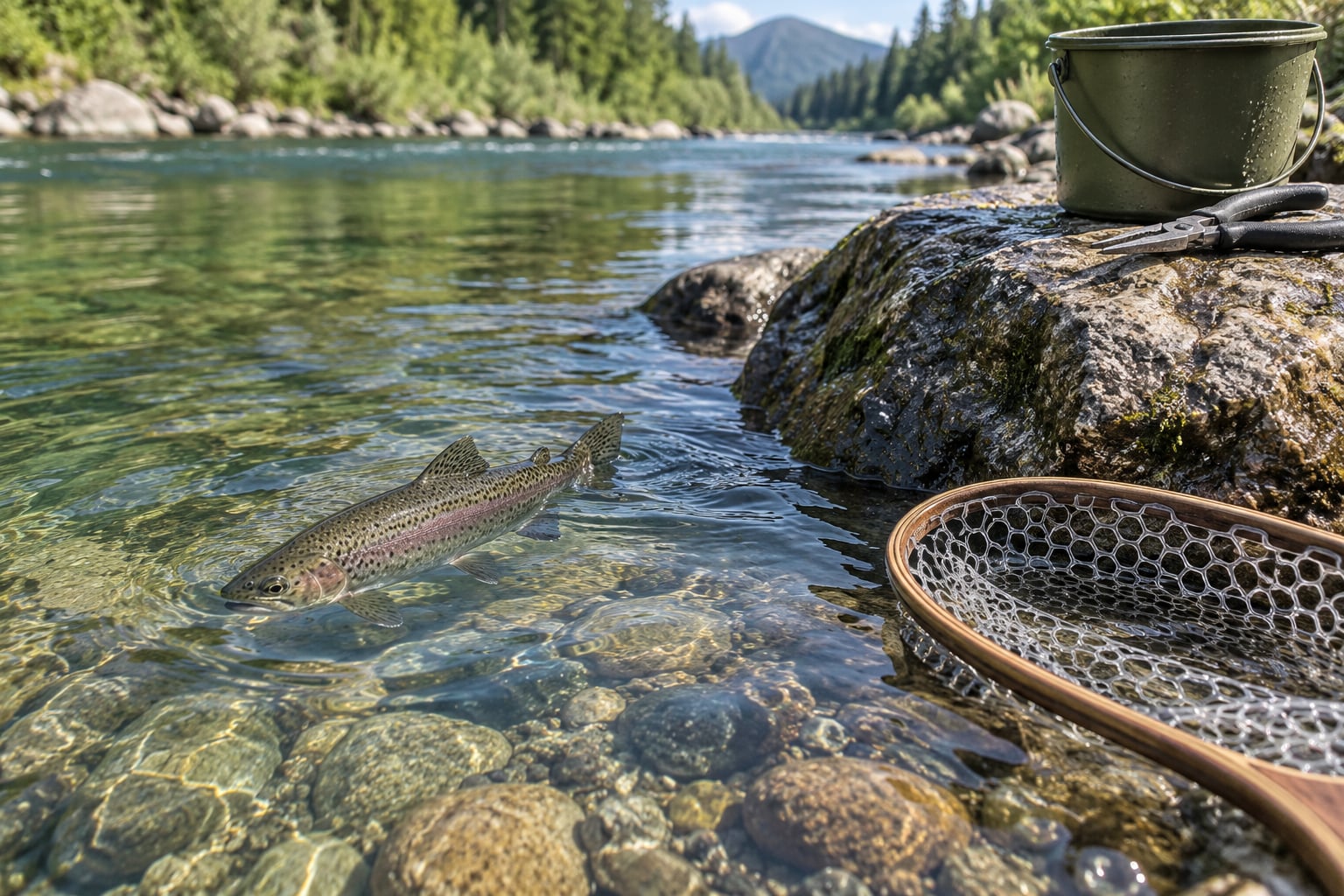
- A landing net with rubberized mesh
- A pliers, hemostats or a dehooking tool
- A bucket or livewell with oxygenated water
- Barbless hooks where the fishing allows it
- A way to identify the fish and check the rules
- Something to cut the leader with
- Step-by-Step: How to release a fish so it survives
- How to release a fish so it survives in shallow water
- How to release a fish so it survives in deeper water
- Handle the fish with minimal stress
- Check the fish’s recovery before letting go
- Common Mistakes
- Using a towel to hold the fish
- Dry hands and nylon mesh nets
- Putting a released fish on a stringer
- Touching the gills or squeezing the body
- Letting the fish sit in the boat or livewell
- Digging out a deeply hooked hook
- Fishing hard in warm water and then releasing
- Frequently Asked Questions
- How long should a fish be out of the water during release?
- Can I release a fish that has been out of the water for several minutes?
- Should a fish be revived before I release it?
- Is releasing a fish into deeper water safer than releasing it in shallow water?
- Does water temperature change how I should release a fish?
- Are there rules for releasing fish that I must follow?
- Conclusion
What You Need
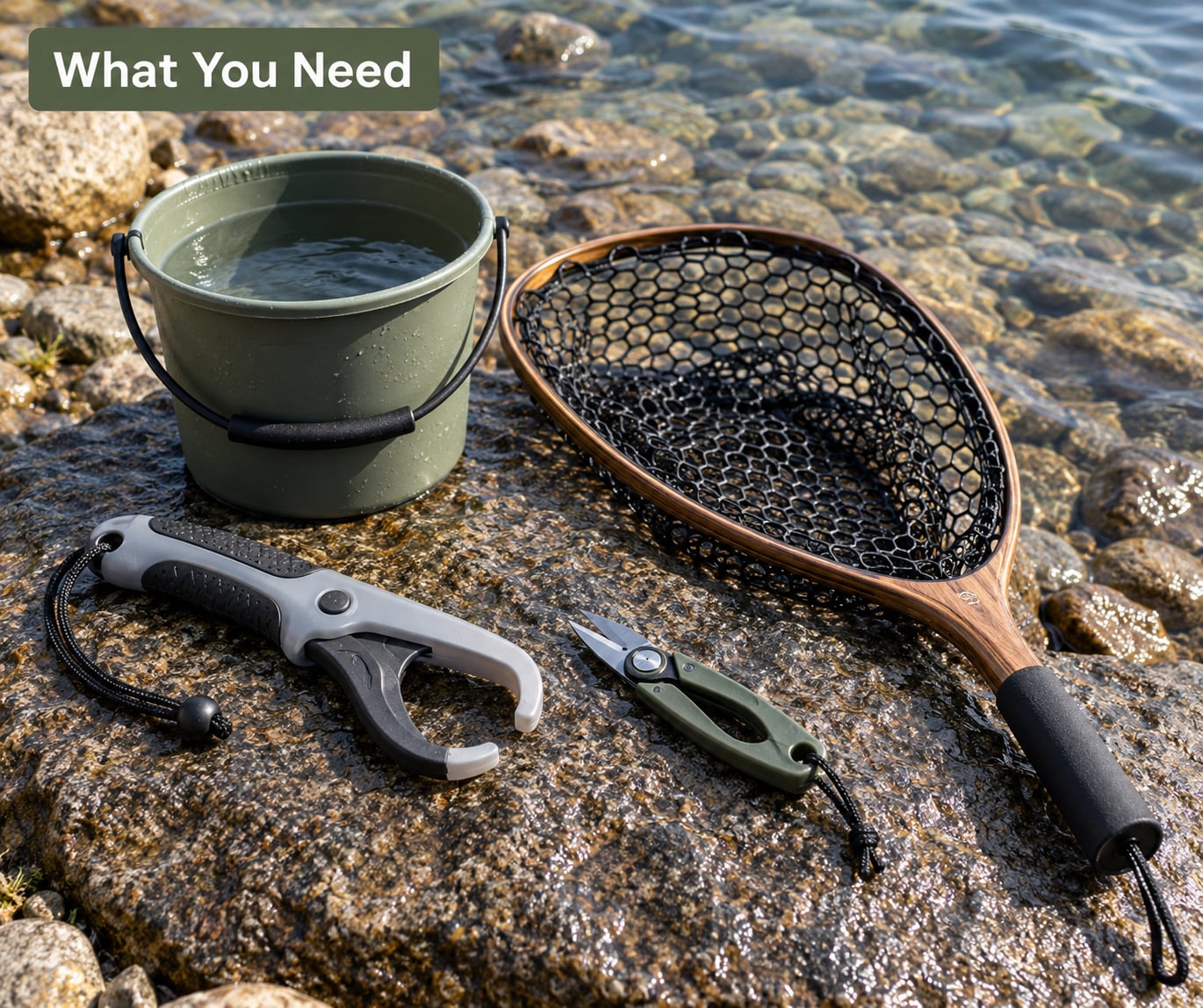
None of this is gear you need to buy on a whim. Every item solves one specific way a released fish gets hurt, and most anglers already own four of the five.
Wet hands, and a reason to keep them wet
Wet your hands before the fish ever comes out of the water and rinse them again between fish. Dry skin strips the protective slime coat the way a stick strips paint off a boat hull, and once that coat is gone the fish is exposed to parasites and bacteria for weeks. This is the single easiest habit to change and the one that costs nothing.
A landing net with rubberized mesh
Cotton or soft nylon mesh rubs scales and slime off as the fish thrashes. Rubberized mesh is the standard for a reason: it grips a wet body without stripping it. Skip the net entirely for small panfish and for trout you can hand-land cleanly in shallow water, since every net contact is still contact.
A pliers, hemostats or a dehooking tool
Long-nose pliers handle most hooks. Hemostats give you the leverage on a deeply hooked fish without yanking. A pliers-style dehooker grips the bend of the hook and backs it straight out the way it went in, which is far gentler on the jaw than twisting. Keep the tool in your hand, not in a pocket, before the fish is netted.
A bucket or livewell with oxygenated water
If you need to hold a fish for more than a moment, it belongs in water. A shaded bucket with water taken from the same body is fine. If your boat has a livewell, run the aerator or the bubbling intake. What you are avoiding is a fish lying on ice, a wet deck, or a net full of fish sitting still in the sun.
Barbless hooks where the fishing allows it
For trout, walleye, bass and most fly-fishing applications, barbless hooks come straight out with a twist of the wrist instead of dragging a barb through tissue on the way out. That is not a preference, it is a speed tool.
A way to identify the fish and check the rules
Know what you are holding before you hold it. Species identification determines the grip and whether you are in a mandatory-release section, a slot limit, or a legal harvest. Your state or provincial wildlife agency publishes the rules, and they change between seasons.
Something to cut the leader with
A small pair of line cutters or a hook-removal tool. If a bait hook is swallowed deep, you cut the leader close to the mouth and stop. More on that below, because it is the decision many beginners get wrong.
Step-by-Step: How to release a fish so it survives
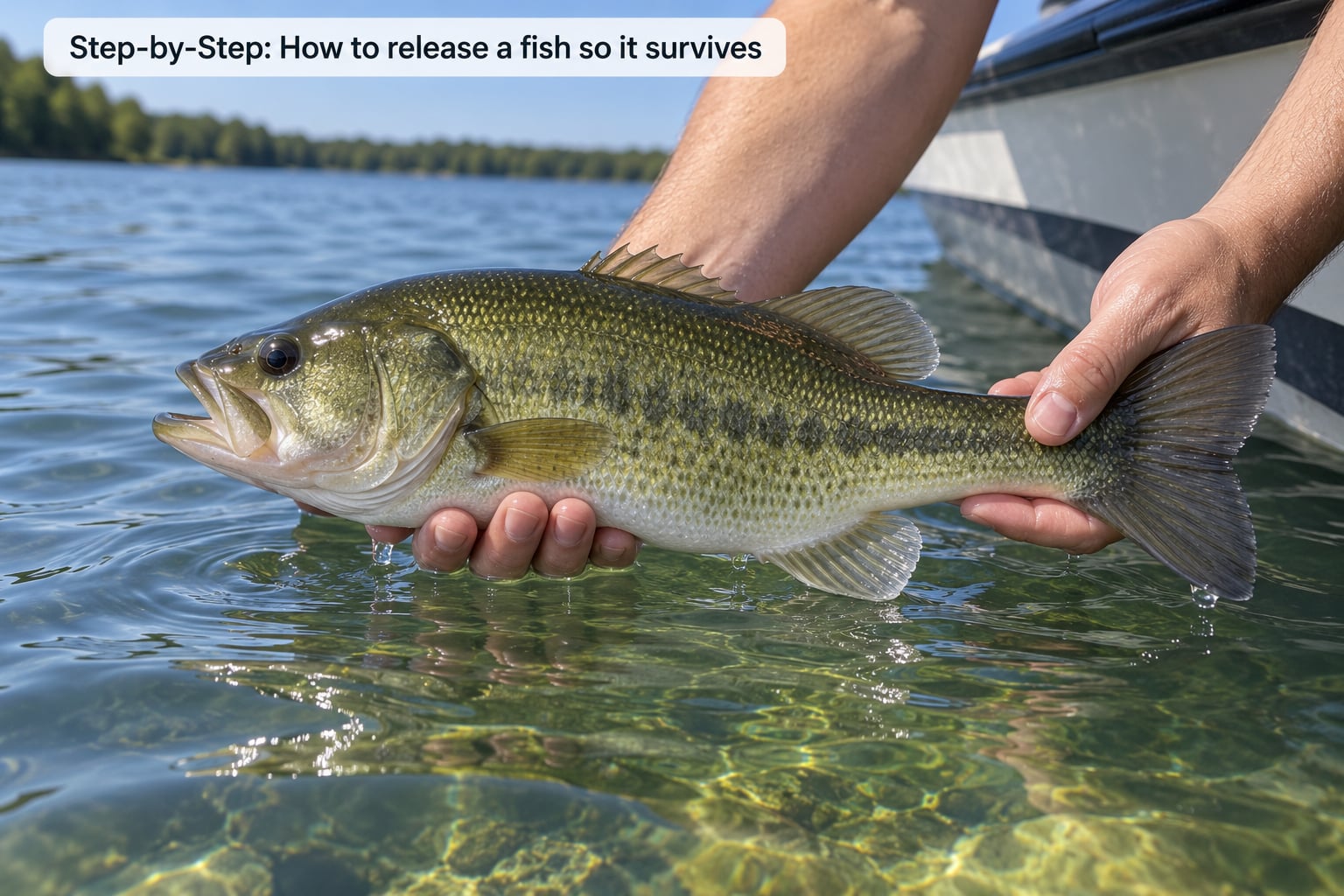
Run the sequence in this order and do not improvise steps out of it. The order matters because each step exists to limit the time between the fish fighting and the fish breathing.
- Shorten the fight. Once the fish is on, tip the spool up and give yourself slack. Steer the fish away from rocks and structure and into open water. A longer fight means more lactic acid built up in the muscle and a weaker fish at the net.
- Net the fish, do not chase it. Lead it with a wet net already in the water. Scoop under the fish rather than pushing the net at it from the front, and keep the mesh submerged until the fish is inside.
- Wet your hands and get a two-hand grip. One hand under the belly just behind the pectoral fins, the other at the base of the tail. Squeeze gently. Never squeeze hard, never hug the fish against your chest, and never reach for the jaw of a trout.
- Remove the hook fast. Barbless hooks come out with a twist. Barbed hooks that are shallow come out with pliers. A deeply hooked or swallowed bait hook gets cut, not dug out.
- Keep the fish in the water. Aim for no more than ten seconds of air exposure. If you must lift the fish for a photo, lift it above the water, never out of sight of it, and count the seconds out loud.
- Revive in current. Put the fish in the water facing upstream and hold it there by the tail, tail-boating it, in well-oxygenated moving water. Do not move it upstream against the current.
- Confirm recovery, then go. The fish should hold itself upright and swim off on its own. Do not toss it away from you.
How to release a fish so it survives in shallow water
Work at knee depth or less where you can see the bottom, and stay kneeling rather than standing. Lower the fish into the water rather than dropping it from any height. Let the fish settle on the bottom with the net still under it, and only lift the net once the fish has lifted itself and is holding its own weight.
In shallow water the fish is usually close to where it was caught, which makes recovery quicker. Watch for it tilting back toward horizontal and the tail beating in a steady rhythm. A fish that flips and immediately falls is not ready.
How to release a fish so it survives in deeper water
Deep water changes the risk profile. A fish released into deep water has to swim off before anything eats it, and a fish released near a drop-off may not be able to hold its depth yet. Where you have the option, release in water of similar depth and temperature to where the fish was hooked.
Lower the fish rather than dropping it, and support it with one hand under the belly until its fins spread and it kicks. If you are wading, release at the depth you are standing in. From a boat, lower it over the side or across the gunwale while the boat is stopped. Long, heavy fish such as salmon are commonly tail-boated for several minutes in current before anyone lets go.
Handle the fish with minimal stress
Every contact costs the fish something. Cup a fish with wet hands rather than pinning it. If you must lift a larger fish, one hand under the belly near the pectoral fins and one at the tail base, held horizontally, takes the weight off the gill plates. Never put fingers inside the gills or press on them from the outside; that is where the blood vessels sit.
Lipping a trout is the most repeated bad habit in angling forums. Trout have delicate, cartilaginous jaws, and the damage from a lip grip can leave a fish unable to feed. Lipping a bass, by contrast, is common and generally tolerable on a fish you intend to release, but for one you do not intend to eat, the two-hand grip is better anyway.
Pike, musky and pickerel have teeth. Stay out of the mouth entirely and use the belly-and-tail grip. Catfish are different again: support the belly and keep a hand over the mouth so the spines do not lodge, but never squeeze the head or lift by the jaw.
Check the fish’s recovery before letting go
A fish that swims away has not necessarily recovered. Many exhausted fish swim off, circle, drift downstream and die in an hour. Give it time in the water and watch for three things.
- Posture. Upright, level, fins spread. A fish lying on its side or on the bottom is still in trouble.
- Tail beat. A strong, regular tail beat means the muscle is back. Slow or irregular means more time.
- Response. It should hold itself in the current rather than being pushed by it.
If the water is cold and well oxygenated, a minute or two in the current is usually enough. If the fish is exhausted or the water is warm and low in oxygen, several minutes of tail-boating can make the difference. When in doubt, hold longer. You lose nothing but time.
Common Mistakes
None of the mistakes below are intentional, and most come from habits built up over decades of fishing. Fixing them is cheap.
Using a towel to hold the fish
Towels remove slime, rub scales loose and can dry a fish out in seconds. Forum arguments about whether a damp towel is okay go on forever because the answer is that you did not need the towel. Wet hands are better and they take no space in the boat.
Dry hands and nylon mesh nets
Both strip the mucus layer. Cotton is only marginally better. Use rubberized mesh or land the fish by hand and net it only when the fish is big enough to be a handful of line.
Putting a released fish on a stringer
A stringer goes through the mouth or gills. If you are releasing the fish, do not stringer it. There is no version of this that is safe.
Touching the gills or squeezing the body
Grabbing gill plates causes crushing and bleeding. Squeezing the belly pushes water out of the fish and pops scales. A firm cradle around a wet body with two hands is the whole technique.
Letting the fish sit in the boat or livewell
Unnecessary time in a livewell adds handling stress and, in a livewell without a good aerator, oxygen trouble. Bring the fish to the net only when you are ready to release it. For pictures and measuring, that means doing it in the water or with the fish barely out of it.
Digging out a deeply hooked hook
Trolling a bait through a trout or a bass puts the hook deep where it is not coming out cleanly. Cut the leader at the mouth. The hook is often shed within days or weeks and the fish keeps eating, whereas surgery in the mouth with pliers means blood, damaged tissue and infection.
Fishing hard in warm water and then releasing
A trout stressed in water above roughly 65 degrees F, in a tailwater or at high elevation, has almost no thermal reserve left. Either fish early in the morning, move to cold water, or do not fish at all. Piling extra handling stress onto a fish that is already in heat stress is how catch-and-release mortality happens.
Frequently Asked Questions
How long should a fish be out of the water during release?
Ten seconds is the target for air exposure, and that is a ceiling rather than a goal. A trout study reported by Field and Stream found about 88 percent survival with no air exposure, roughly 62 percent at 30 seconds, and about 28 percent at 60 seconds. Most fish only need a few seconds above water for a quick photo, or none at all. Handle the fish at the water’s surface whenever you can and let go as soon as it is moving strongly.
Can I release a fish that has been out of the water for several minutes?
Often yes, and this surprises most anglers. The hook injury is usually less serious than people assume, so if the fish is alive, wet, correctly gripped and returned to cool, well-oxygenated water, it stands a good chance. Revive it in the current until it holds itself upright and beats its tail steadily, which can take several minutes. Cut away a deep hook rather than digging it out. Warm water and hot air cut the odds considerably.
Should a fish be revived before I release it?
Yes, whenever the fish is not swimming strongly on its own. Hold it in the water facing upstream and grip only the tail, letting the current pass over the gills so it can breathe. Do not move it against the current. Keep it there until it holds its depth without help and its tail beat is strong and regular. Releasing a fish that merely flopped away is the most common way anglers lose fish they thought they saved.
Is releasing a fish into deeper water safer than releasing it in shallow water?
Neither is inherently safer. Shallow water makes recovery easier because you can watch the fish and steady it, and the fish does not have to swim far to reach cover. Deep water puts more distance between a weak fish and whatever is hunting it, but an exhausted fish may not be able to hold depth at all. If you have a choice, release into water of similar depth and temperature to where the fish was hooked and where it can quickly reach structure.
Does water temperature change how I should release a fish?
It changes everything about the release. Cold, oxygenated water lets a fish recover quickly, and a brief revival in current is usually enough. Warm water holds less oxygen and pushes a stressed fish much closer to its limit, so recovery takes longer and the survival odds drop. FishWest suggests treating roughly 65 degrees F as a personal cutoff for targeting trout in the heat, and moving to tailwaters, high elevation or a cooler hour instead. Handle less in summer, not more.
Are there rules for releasing fish that I must follow?
Yes, and they vary by state, province and water. Some sections are catch-and-release only, meaning a hooked fish must go back regardless of size. Others set slot limits, allowing harvest only within a size range, or set creel and possession limits. Rules change between seasons, so check your wildlife agency before the trip rather than at the ramp. A fish that is illegal to keep is still handled with the same care, and the same technique applies either way.
Conclusion
Start before the fish is in the net: wet your hands, get a rubberized mesh net under the fish, and have pliers in your palm rather than in a pocket. From there the whole job is speed and support, land it fast, keep it wet, grip it belly and tail, pull a barbless hook, and hold it in the current until it swims away on its own. That is how to release a fish so it survives, and it costs almost nothing beyond changing how you already hold a fish.
Keep Fish Wet and the NOAA Coastal Conservation Association’s Releasense program are the two places to read more of the science, and state wildlife agencies publish release guidance and video that is worth watching once before the season starts.