To target flounder on a sand bottom, work the edges where clean sand meets structure and keep your bait inside the bottom 12 inches of the water. Flounder bury into sand and ambush what passes over them, so presentation height and speed decide whether you get a bite.
That is the whole game. Sand gives you nowhere to hide, and it gives a hungry flounder a perfect place to hide in. The fish are usually there; the problem is almost always that the bait passes too high, too fast, or in the wrong water.
A full session takes a couple of hours once you find fish, and the skill is in reading the bottom rather than in the gear. Anglers on iBoats and r/Fishing keep coming back to the same three answers: live bait near the bottom, slow retrieve, and patience before the hookset. Everything below is built around those.
Table of Contents
- What You Need
- Step-by-Step
- Read the Sand Bottom and Locate Flounder Habitat
- Choose a Rig That Keeps the Hook Near the Bottom
- How to Target Flounder on a Sand Bottom With the Right Presentation
- Set the Hook on a Flounder Bite
- Use Tide, Current, and Weather to Improve Your Catch
- Common Mistakes
- Frequently Asked Questions
- What is flounder’s favorite bait?
- Do flounder eat off the bottom?
- What time of day do flounder bite best?
- How deep do flounder bury in the sand?
- How to catch flounder on the beach?
- What to Do First on Your Next Sand-Bottom Trip
What You Need
The gear list for a sand bottom is short, and most of it is stuff you already own.
- Rod and reel: A 7 to 8 foot medium-fast spinning rod with a size 2000 to 3000 reel is the workhorse. It covers wading, a kayak and a shallow boat without changing setups.
- Line: 15 to 20 pound braided line gives you the sensitivity to feel a soft bite over a featureless bottom. Fluoropolymer leaders hide well in clear water.
- Leader: 12 to 24 pounds of leader material between the line and the hook. Longer leaders soften the bite for live bait; short ones feel the tap sooner.
- Weights: Egg sinkers, split shot and sinkerless bead-chain rigs cover different depths and currents.
- Hooks: Size 2/0 to 3/0 circle or needle hooks, plus a small assortment of bait-holder hooks for rigged shrimp.
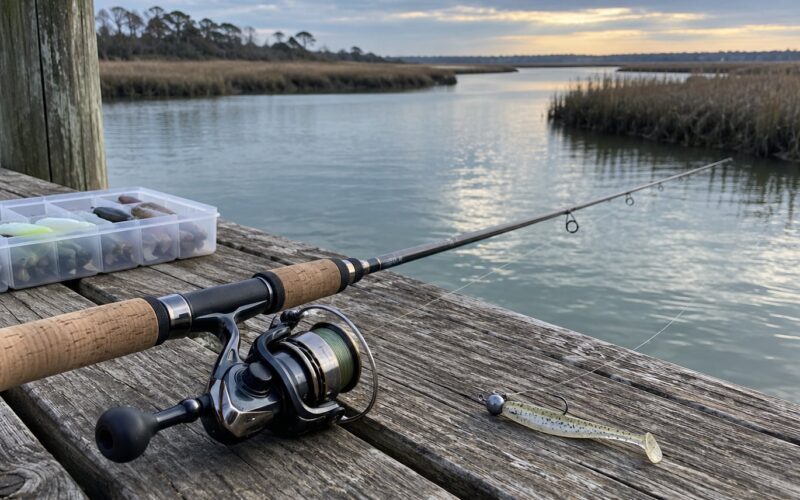
- Bait and lures: Live finger mullet, live shrimp, mud minnows or pinfish, plus scented soft plastics and paddle-tail shads.
- Bottom-marking tools: Polarized sunglasses are the single most useful item on this list. A shallow water depth sounder or a phone app with a depth map gets you to the drop-off faster.
Optional gear depends on where you fish. From shore you add a surf rod, a sand spike and a good pair of polarized glasses. From a kayak, a paddle and a rod holder matter more than anything else. At night, a headlamp and a gig or a bottom probe change the game.
Safety gear is not optional anywhere. A personal flotation device comes first, then waders with cleats if you are walking on a flat, and a light if you will be out past dusk.
For a quick spec reference, match your setup to the water depth like this.
| Component | Shallow flat to 4 feet | Drop-off and channel to 15 feet |
|---|---|---|
| Rod | 7 foot medium-fast spinning | 7 to 8 foot medium-heavy spinning or conventional |
| Reel | Size 2000 | Size 2500 to 3000 with a smooth drag |
| Line | 15 pound braid | 20 pound braid |
| Leader | 12 pound fluoro, 12 to 18 inches | 16 to 24 pound fluoro, 18 to 24 inches |
| Bottom weight | Bead chain or split shot | Egg sinker matched to current |
| Jighead weight | 1/8 to 1/4 ounce | 1/4 to 3/8 ounce |
| Hook | Size 2/0 circle | Size 2/0 to 3/0 circle or needle |
Step-by-Step
Read the Sand Bottom and Locate Flounder Habitat
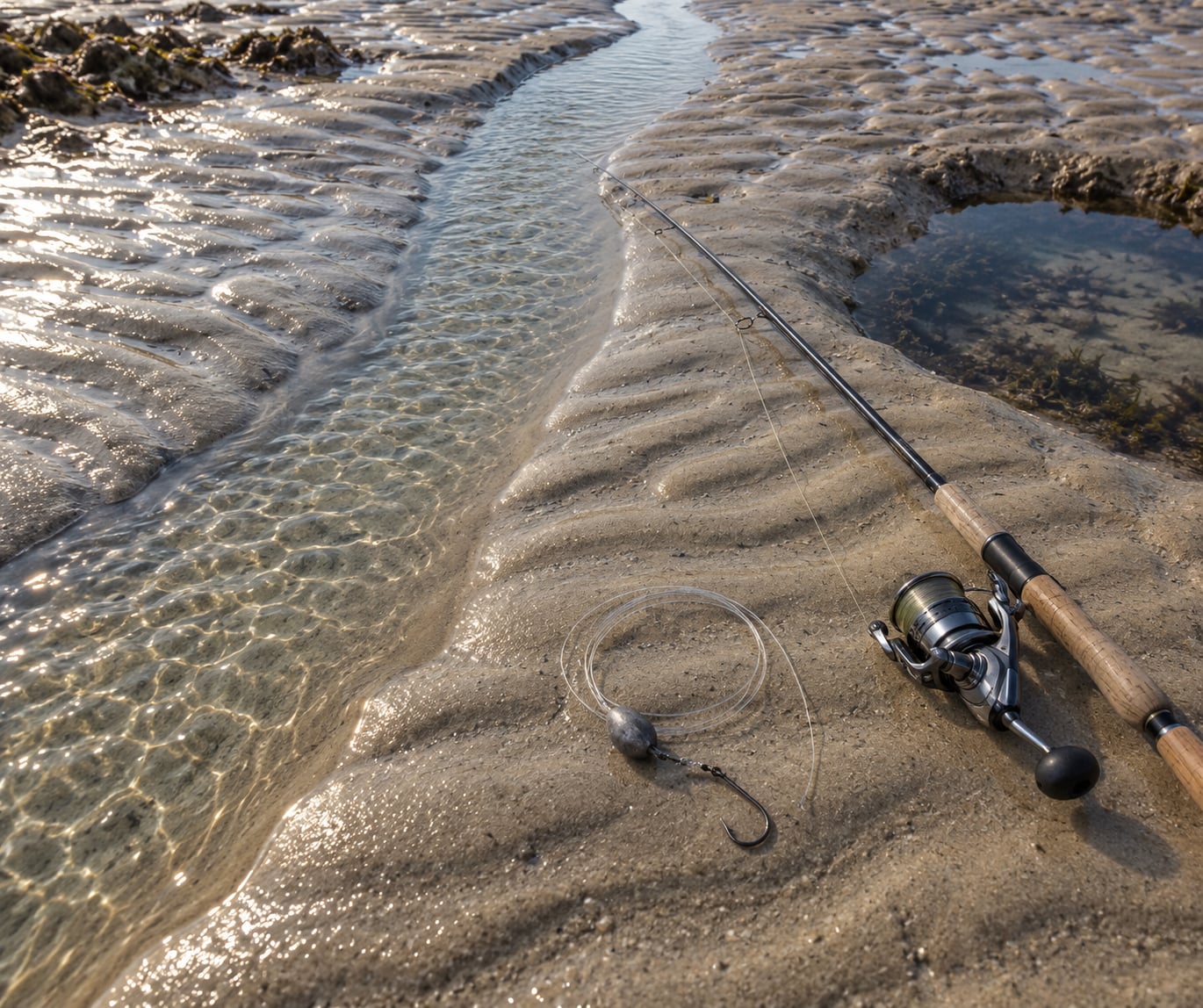
Start by reading the sand, because on a flat bottom the water itself gives little away. Flounder concentrate where the bottom changes: the lip of a drop-off, the edge of a sand bar, a trough running off a channel, a mud-to-sand seam, or the foot of a structure such as a jetty, oyster bed or wreck.
Clean open sand is the worst place on the map. Featureless sand gives you no current seam, no food and no reason for a fish to hold. Sand next to something is where the action is.
Look for these signs in order of reliability:
- Depth change you can see or feel: A sudden shoaling on the sounder, a darker colour change on the water, or a wave that breaks sooner than it should out front of you.
- Ripples and troughs: Sand ripples show where water is moving across the flat. Flounder sit in the troughs and on the upstream edge of the ripple line, not on the crest.
- Depressions and holes: Sandy pot holes on grass flats, blowouts in the middle of a flat and scour bowls around structure are all fish-holding features. The mscfishing guide to Gulf Shores makes the same point: look for slight depressions in the sand.
- Bait signs: Disturbed sand, a dark patch of bottom, or a trail where something has been working.
- Current seams and rips: Where the tide pushes past a sand bar you get a defined edge of moving water. Flounder feed in that seam because food concentrates there.
From shore, read the water rather than the bottom. Watch the way small waves break, look for a colour or clarity change along a line, and note where birds and working boats sit. From a kayak or boat, a sounder turns reading the bottom into a two-minute job.
Best time to be on the sand is moving water. A rising tide pushing over a bar and a falling tide pulling off it both work, and an incoming tide that starts to push hard usually covers more ground than slack water.
Choose a Rig That Keeps the Hook Near the Bottom
The rig has one job: put the hook in the strike zone and hold it there. Every version below does that in a different way, so match the rig to the water rather than fishing one setup all day.
| Rig | Best sand-bottom situation | Working depth | How it holds the bait low |
|---|---|---|---|
| Carolina | Drop-off edges and sand channels where you want to feel a subtle bite | 2 to 10 feet | Egg sinker above a swivel keeps a live bait swimming just off the sand |
| Texas | Shallow flats in current, and any place the sinker snags | 1 to 8 feet | Bulb or peg sinker slides freely so the bait creeps along the bottom |
| Tandem | Deep sand, channel edges and any bottom with shell or debris | 8 to 20 feet | Single bottom weight with a fixed leader skips snags cleanly |
| Popping cork with split shot | Deep water, night fishing and slow deliberate work | 8 to 25 feet | Bait pinches under the cork and rides a foot or two off the bottom |
| Jighead and soft bait | Active casting at structure edges and clear flats | 1 to 12 feet | Weighted head puts the hook in the sand on every bounce |
On flat sand, the tandem or a jighead will not snag you, but they also do not let a live bait hover. Over a hard seam with shells and oyster edges, use the egg sinker and a bead-chain so you can lift over the rough stuff. In heavy current over shallow sand, the Texas rig keeps you connected to the bait instead of dragging a heavy weight across your toes.
Match jighead weight to depth rather than to the size of the bait. A 1/8 ounce head works to about four feet, a 1/4 ounce to about eight feet, and 3/8 ounce or heavier below that. Too light and the bait never gets down; too heavy and you are dragging through the strike zone on every lift.
How to Target Flounder on a Sand Bottom With the Right Presentation
Once you are over the fish, the retrieve decides everything. Most missed bites on a sand bottom are not hookset problems. They are presentation problems that feel like hookset problems.
Bounce the drop-off. Cast up-current of the lip and work the bait down the face in short hops. Let it drop for a count, then lift just enough to feel the weight come off the bottom. Two or three hops, then move.
Hold the seam. A hard-bottom seam rewards a slower game. Drop the bait and let it sit for five or ten seconds, then twitch it twice and stop again. This is the twitch-twitch-pause that works so well on fish sitting still.
Dead-stick the natural bait. If there are live shrimp or finger mullet in the area and the fish are feeding hard, put it in the sand and leave it. Many anglers report the biggest fish of the trip coming on stationary live bait, right under the boat.
Watch your drag. On a sand bottom the fish rarely runs. A light drag and a firm rod tip tell you the difference between bottom contact and a real bite, and they keep the hook buried when the flounder turns.
Keep the rod tip low enough that the line stays slack on the bottom. You want to feel the bait leave the sand, not pull a tight line against a fish that has not decided anything yet.
Set the Hook on a Flounder Bite
A flounder strike is heavy but quiet. The most common signals are a sudden weight that does not match the bottom, a small hop as the bait leaves the sand, line that moves steadily sideways in current, or a bait that simply stops bouncing.
The hardest signal is the one anglers miss most: nothing at all. Flounder swallow the bait and often hold it before turning away, so a stationary bait on a sand bottom is a strike as often as it is a dead rig.
Use a count instead of a guess. When you feel the difference, count to five before doing anything. If you are on live bait or a slow presentation, count to four or five. If it is a fast artificial, set sooner. The Louisiana Sportsman advice of holding the rod tip high so the bait barely skims the bottom pairs well with this: the light touch is what tells you the fish took it.
When you set, sweep the rod to the side rather than straight back. A flounder has a hooked jaw and a pointed head, and a sideways sweep seats the hook and keeps the leader away from the teeth of the plate it can slap. Then keep light pressure while you lift. Never pull a flounder straight up out of the bottom.
Rig a release tool before you ever get to a boat. Flounder hide in the sand and often come up covered, and reaching into a bucket to feel around for one is how fingers get hurt. Use a lip gripper, a dehooker, or a needle-nose pliers, and keep the fish in water until you are ready to measure it.
A flounder buried in sand usually shows the eyes and a bit of the snout, and it will puff sand as it settles. If you can spot that, walk or paddle over and drop a bait right on its head. Polarized glasses cut glare off the surface and make the depression behind the fish easier to see.
Use Tide, Current, and Weather to Improve Your Catch
Tide stage shapes the whole session. On the flood, fish push onto the flat to feed as the water uncovers the bottom ahead of them. On the ebb, they work the edge of the falling tide and then slide back into the channel. A tide that has just started to run hard over a sand bar is usually the best fishing of the cycle, and the last two hours before high water often produce the most.
Wind matters more on sand than most anglers expect. A strong onshore wind chops the surface and hides fish that a light breeze leaves visible. A light offshore or crosswind clears the surface and lets you sight fish on the sand, which is the single biggest upgrade you can make to a sand-bottom trip.
Swell flattens the sand and pushes bait onto the flats, which is good, but a big swell also makes the bottom bounce irregularly and hides the strike. Water clarity decides how you fish it. In clear water, sight fish and go straight to them, and keep your terminal tackle quiet. In stained water, you will not see a thing, so switch to scent: a scented soft plastic, a live bait with a natural scent, or a slightly longer leader so the swim looks natural.
Season follows the water temperature more than the calendar. Fish move shallow as it warms and drop to deeper channels and drop-offs as it cools, and the sand structure that holds them in spring can go empty in a hard summer heat. Check local regulations for size limits, bag limits and closed areas before you go, and follow them exactly.
Here is the simple decision process. Moving tide beats slack water. A drop-off edge or a sand-to-mud seam beats open sand. Clear water means sight fish; stained water means scent and slower retrieves. And if nothing is happening after a few slow passes, change the rig weight before you change the spot.
Common Mistakes
Fishing too fast. A steady retrieve is the most common reason anglers come home with nothing. Slow it to a count of two per bounce, and add a pause long enough to count to five. Tip for next trip: mark the rhythm on your reel handle so you can keep it even.
Letting the bait ride too high. On sand the bait often sits a foot or two above the fish and you never know it. Watch your line as you retrieve and drop the rod tip whenever it goes slack, because slack line means the bait is hovering, not working. Tip: raise the sinker one size and drop back down.
Using tackle that will not reach the bottom. Too-light weight or too-light jighead means the bait drifts in the strike zone without ever touching the sand. Test it before the tide starts by counting the seconds between the weight hitting bottom and the line coming tight.
Ignoring the drop-off and casting at open sand. If you are catching nothing and the bottom is featureless, you are in the wrong place. Move to the edge of the channel or the seam and cast up-current so the bait drifts down onto the fish.
Setting the hook too early. Many bites feel like a bump and get pulled away before the fish turns. Count to five before reacting. Tip for the next trip: use a softer drag so the fish does not throw the hook when you finally do set.
Setting the hook straight back. A backward sweep on a flounder is a coin flip. Sweep to the side, and keep steady side pressure while you lift instead of yanking upward.
Too much drag. A flounder is a short, strong fish that fights close to the bottom. Set the drag just heavy enough to feel the bite and light enough that the fish cannot spool you when it turns. Check the drag knob before the first cast, not after the first fish.
Wading straight through the fish. On a clear flat, your shadow spooks everything within 20 feet and the flat stays empty for the rest of the trip. Approach from the up-current side, step slowly, and stop before you reach the fish instead of walking to it.
Snagging out on the edge. Sand next to structure usually means shells and debris. Use a bead chain or a single bottom weight rather than a heavy egg sinker, and lift the bait a foot early when you are working the seam.
Frequently Asked Questions
What is flounder’s favorite bait?
Live finger mullet is the most dependable bait in most coastal waters, and live shrimp is an easy buy near a ramp or pier. On artificials, bounce a scented paddle-tail shad along the sand or work a white jighead. Keep the size matched to the forage that is in the water that week.
Do flounder eat off the bottom?
Mostly. Flounder feed on whatever passes through the bottom foot of the water column, and most of that feeding happens within inches of the sand. That is why a slow bottom bounce beats a cast and a stop. Keep your rod tip low and your line a little slack so the bait stays in the band where the fish are actually hunting.
What time of day do flounder bite best?
Moving water beats the clock. The best bite usually runs from about an hour after the turn to the last two hours before high or low water, and the stretch just before high water is often the most consistent. Overcast mornings and late evening moves produce plenty, and in summer first light beats midday heat. Calm, clear water also makes fish easier to spot.
How deep do flounder bury in the sand?
They settle into soft sand with the eyes and top of the head showing and the body hidden below the surface. Polarized glasses on a shallow flat make a depression or a raised rim easy to spot, along with a puff of sand when the fish resettles. On a falling tide more fish get exposed and the depressions read clearly from a boat or kayak.
How to catch flounder on the beach?
Work a drop-off or a sand channel from the surf and cast along the edge rather than straight out onto the beach. A surf rod and a heavier sinker keep the bait from swinging back in the swash. Fish the last two hours before high water and the first two after, and stay where moving water meets still.
What to Do First on Your Next Sand-Bottom Trip
Find a sand channel, a trough or a hard-bottom seam next to structure, rig a slow bottom bounce, and work the transition rather than the middle. A small jighead in clear water or a live bait on a Carolina rig in a current seam, both held inside the bottom 12 inches.
Then adjust to what you see: the tide, the wind, the clarity of the water and the fish under you. Local rules on size and bag limits come first, and the fish will always tell you more than a chart will.