How to report invasive species sightings is simpler than most people expect: take a clear photo, note the exact location and date, and send it to the program that covers that organism and that place. You do not need to be certain about the species, and you should never handle the organism to get a better picture of it.
Reports go somewhere real. A state coordinator, a tribal natural resources office, or a federal database receives your record, compares it against existing sightings, and decides whether it needs an on-site visit. That chain only works if the record is specific enough to be usable, which is where most well-meaning reports fall apart.
The whole process takes about ten minutes once you know what to capture, and the hardest part is usually the identification. Even an uncertain report helps, because a suspected organism at a documented location can be checked by someone who has the training you lack.
Table of Contents
- What You Need
- Identification evidence
- Location details
- Recording tools
- Where to send it
- Step-by-Step
- Identify the Species Responsibly
- Document the Location and Date
- Capture Clear Supporting Evidence
- Check Whether a Report Is Already Active
- How to Report Invasive Species Sightings
- Follow Up or Escalate Urgent Findings
- Common Mistakes
- Guessing the species
- Omitting or rounding the location
- Sending edited or screenshot photos
- Handling the organism to get a better photo
- Reporting the same sighting to several systems
- Sending sensitive details to the wrong agency
- Frequently Asked Questions
- What should I do if I cannot identify an invasive species?
- Should I remove an invasive species I find outdoors?
- Which agency should receive my invasive species report?
- Can I submit invasive species sightings with photos only?
- What information makes an invasive species report most useful?
- What should I do if I find a potentially dangerous invasive species?
- Conclusion
What You Need
Three kinds of material make a report useful: evidence of what the organism is, evidence of where it is, and a route to submit both. Gather these before you open a form, because forms time out and photographs get buried in a camera roll.
Identification evidence
Start with what you can see without touching anything: overall shape, leaf arrangement, flower or fruit, stem cross-section, bark, tracks, scat, or feeding damage. For animals, note size relative to something of known dimensions and whether it moved in a distinctive way.
Decide honestly which of two categories you are in. If you recognize the organism as one already on a watch list or noxious weed list for your region, you are reporting a known invasive. If you only know that it looks out of place, you are reporting a suspected species, and the report needs a description field filled in carefully instead of a name.
Location details
Exact coordinates are the single most valuable field in any form. A report of “near the north trail” has to be found again by someone driving a truck; decimal degrees or a dropped pin means a field tech can stand in the same spot.
Also record the habitat, because it tells the reviewer how the organism arrived. Note whether the site is a trail edge, a pond margin, a riverbank, a roadside, a garden bed, or a timber yard, and add a nearby landmark when the pin might be imprecise.
Recording tools
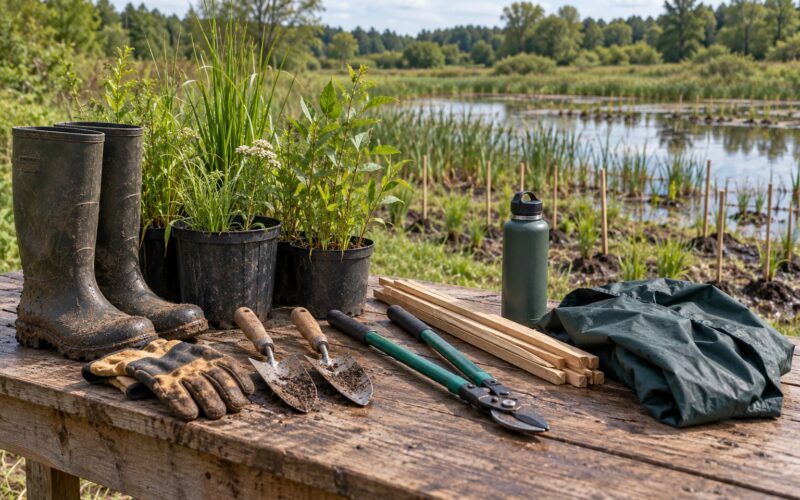
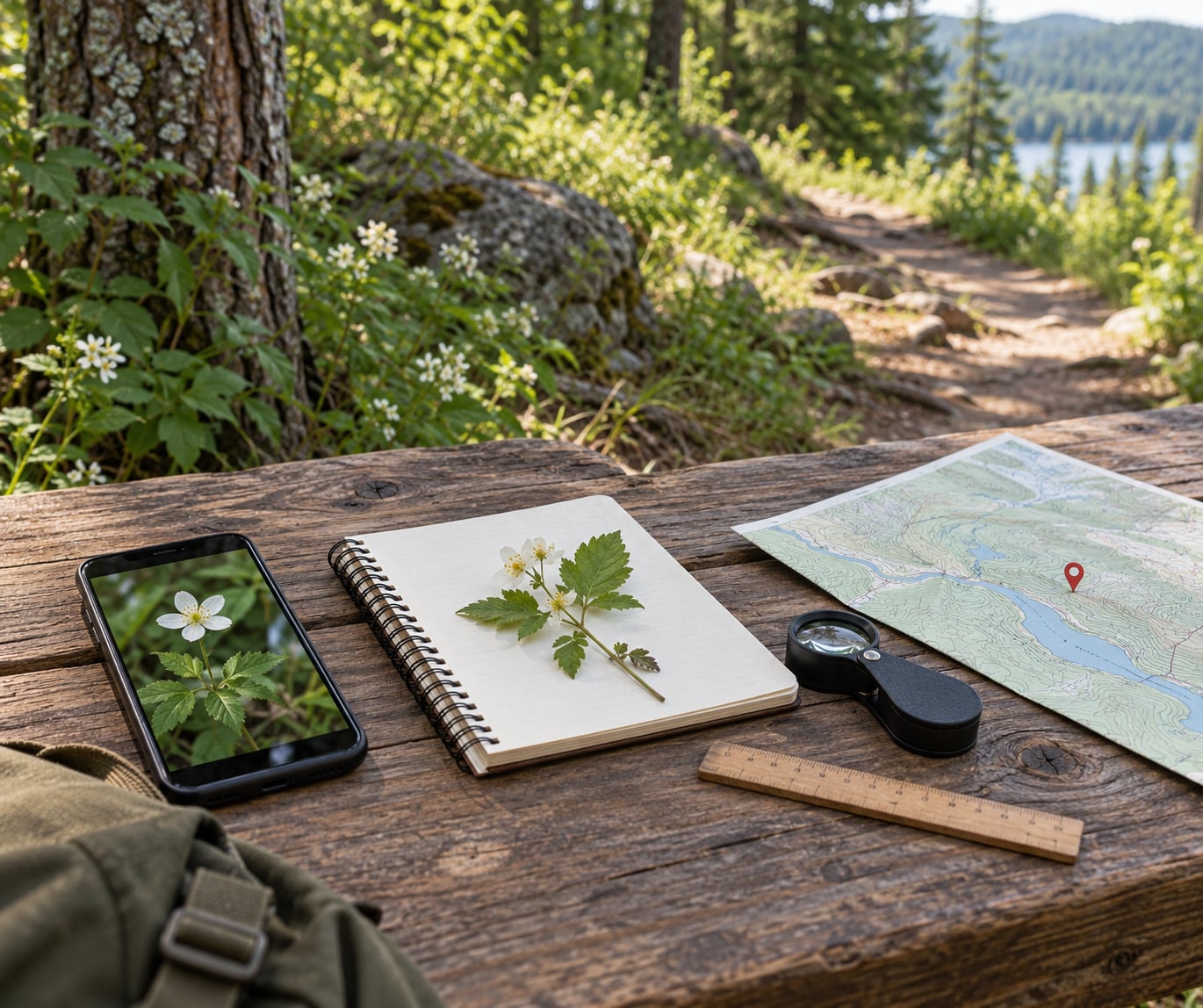
A phone covers most of it, and nearly every program accepts photos taken on one. Beyond that, a 10x loupe or hand lens, a small ruler or coin for scale, a field notebook, and a GPS-enabled map app are enough. If you expect to mail a specimen, a rigid container and a way to keep it cold matter, but only after a program tells you it wants one.
Where to send it
National portals such as EDDMapS, iNaturalist, and the USGS Nonindigenous Aquatic Species database all accept reports from anywhere in the country. State invasive species programs, county weed districts, tribal natural resources departments, and university extension offices handle local response, and they are the ones who will act on a ground-level infestation.
Step-by-Step
Work through the steps in order. Skipping the documentation steps and submitting a bare location is the most common reason a report gets closed without action.
Identify the Species Responsibly
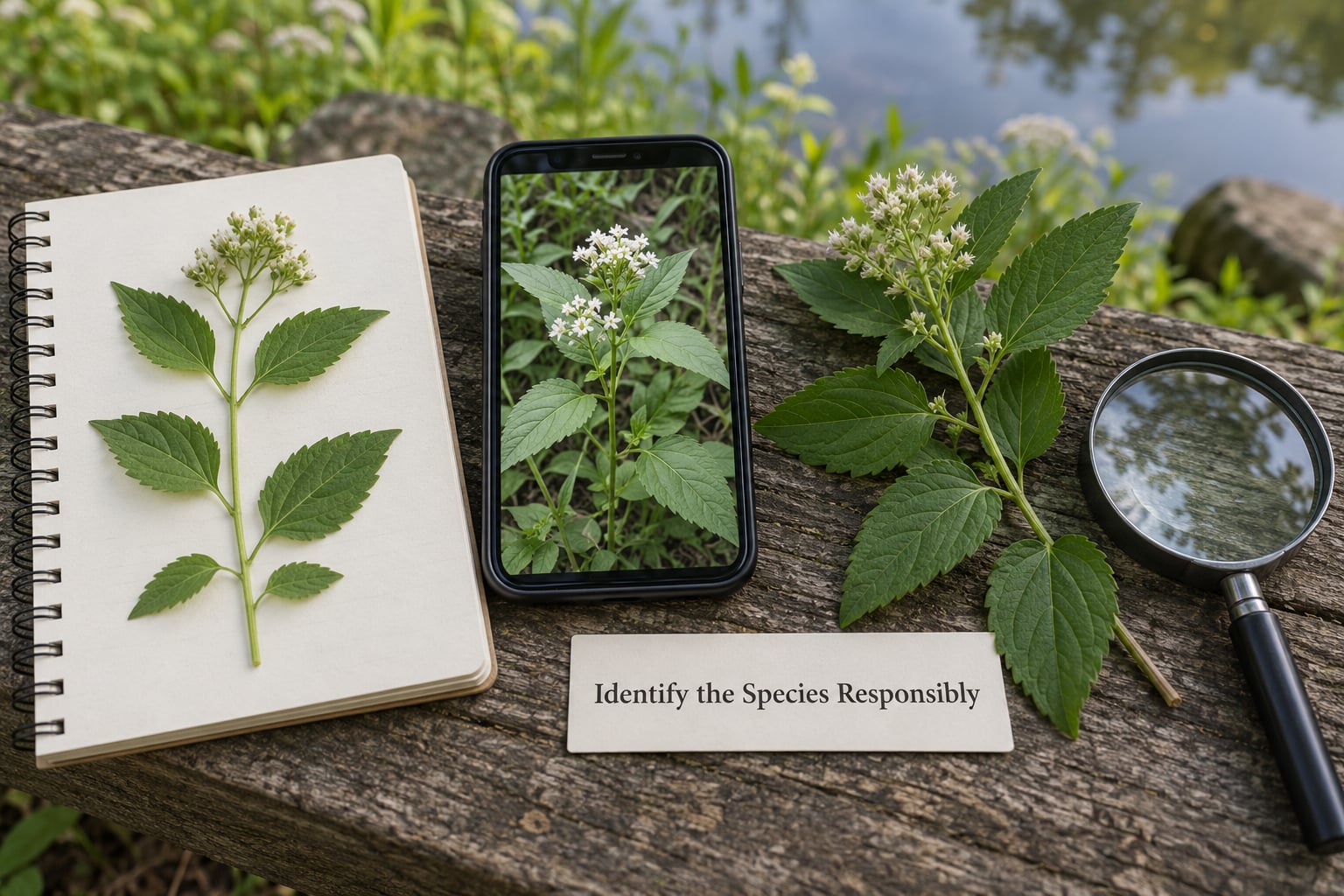
Compare the organism against a trusted source rather than a social media post. State extension sites, university weed guides, and the USDA PLANTS database give you diagnostic traits, and iNaturalist’s identification suggestions give you second and third opinions from people who work on the taxonomy.
Look for the traits that separate a real invasive from a harmless native lookalike, such as leaf shape, stem arrangement, seed head type, or wing pattern. When two species are close, write both names in the report and describe which feature ruled out the other. A hedged report with reasoning is more useful to a coordinator than a confident wrong name.
Do not handle the organism to identify it. Sap, spines, stinging hairs, and fungal spores all transfer when you touch, pull, or bag something, and boots and tools carry seeds between sites afterward. Photograph through the lens, zoom, or binoculars and stay where you are.
Document the Location and Date
Drop a pin in your map app while standing in front of the plant or animal and note it before you walk on. Most phones also write coordinates into the photo metadata, which lets a reviewer recover an approximate position, though a reported pin is still better.
Record the date and the time of day, then describe conditions that a reviewer could not infer: soil moisture, sun or shade, whether the ground was wet, recent mowing or disturbance, and whether the organism was flowering, fruiting, or dormant. Reproduction stage tells a coordinator how fast a population can grow this season.
Count what you can. A rough number of individuals, or the approximate area covered, changes the priority a report receives, and “a single patch about the size of a parking space” tells more than “several.”
Capture Clear Supporting Evidence
Take four kinds of pictures if you can manage it: a wide shot showing where the organism sits in the surroundings, a mid-range shot of the whole plant or animal, a close-up of the diagnostic feature, and one with a coin or ruler for scale.
Keep the original files. Screenshots, cropped-and-resaved images, and photos run through editing apps lose the metadata that confirms date and position, and heavily compressed versions can hide the diagnostic detail a reviewer needs.
Photograph the surroundings too: the host plant an insect is feeding on, the substrate an aquatic species is sitting in, or the trail surface where tracks were found. Habitat context frequently identifies the organism when the close-up does not.
Check Whether a Report Is Already Active
Before submitting, look at the map layers the program publishes. EDDMapS and most state portals show known populations, active survey grids, and recent verified records, so you can tell whether you are confirming an existing site or adding a new one. If a survey is already scheduled nearby, your record speeds the trip up rather than creating duplicate work.
Search iNaturalist for observations of the same species nearby in the same season. A cluster of unverified observations often means several people saw the same thing, and adding yours to the record saves a biologist a trip.
How to Report Invasive Species Sightings
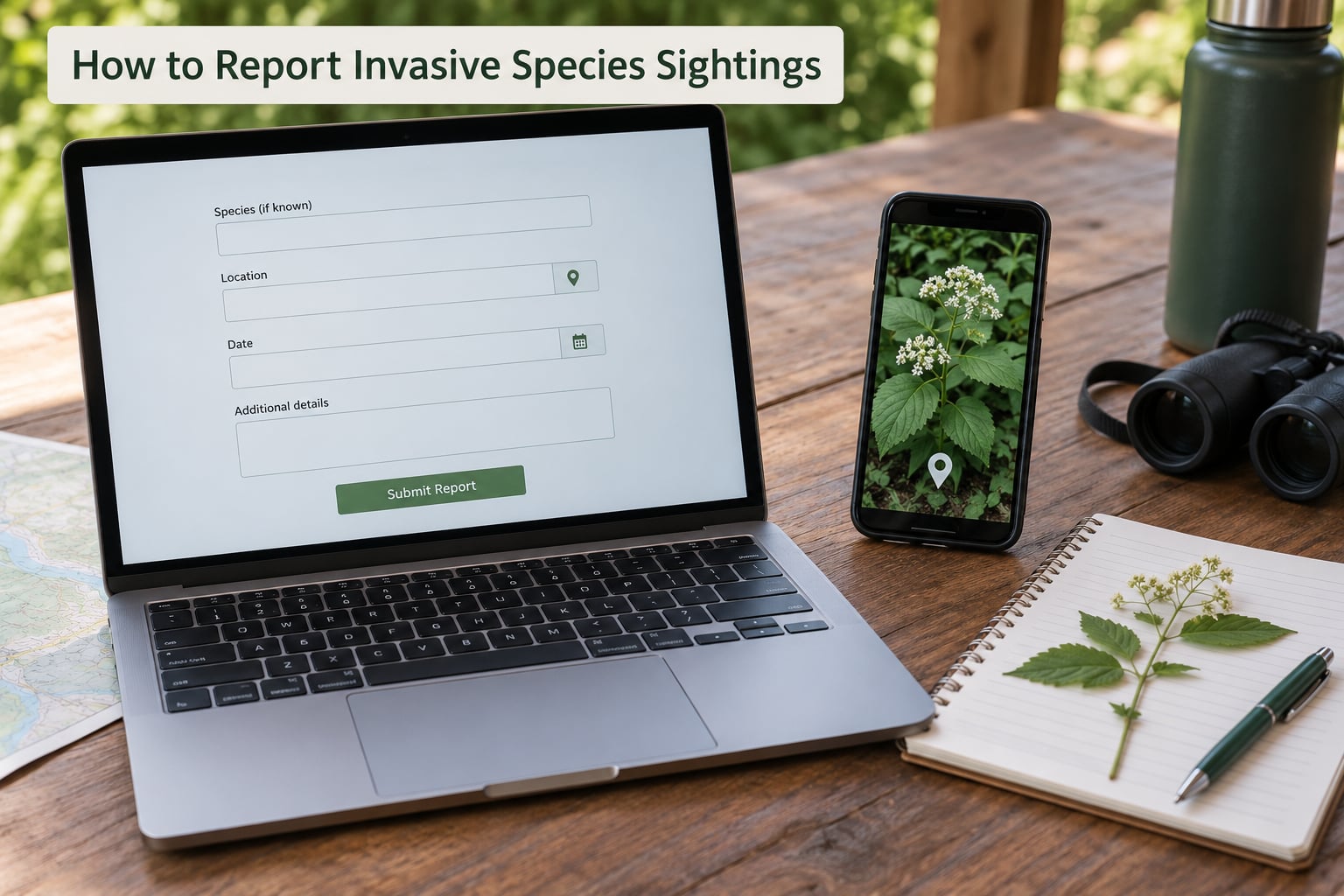
Pick the route that matches the organism. A plant, insect, or land vertebrate generally goes to a state or county program, and many of those programs accept EDDMapS or iNaturalist submissions directly, which saves you from finding the right agency yourself.
Aquatic and marine organisms follow a different path. Boaters and anglers report them to their state aquatic nuisance species program or fish and wildlife agency, with the USGS Nonindigenous Aquatic Species database as the national record. Both land and aquatic reports can go to the national invasive species information center for routing when you cannot tell who covers your location.
On the form, fill every required field even when the answer is an estimate. In EDDMapS, the observation record asks for species, date, and location, and a photo or host observation ties the record to verifiable evidence. In iNaturalist, use the observation photo rather than a downloaded image so the geotag stays attached, and add a note describing the site.
Attach the photos, submit, and write down the report number or the URL of the observation. If you used a phone app, register an account first so the record is tied to a name a coordinator can reply to.
Follow Up or Escalate Urgent Findings
Save your submission and watch for a response. Records routed through a portal are typically reviewed by a coordinator or an identification committee, and an observation that gets community confirmation is far more likely to be verified. If nothing comes back after a couple of weeks, it is entirely reasonable to email the program and mention your report number.
Escalate quickly in specific situations: the organism is spreading across a visible boundary inside a single visit, it is causing injury or illness, it is a known high-concern species in your state, or it is a large vertebrate that poses a safety risk. Call the state hotline rather than filling out a form when a snakehead, Burmese python, nutria, or similar animal is confirmed. Rapid response programs can act the same day; a queued report cannot.
For identification help, your state’s invasive species coordinator, a county extension office, or a local weed district can visit a site. Many programs would rather come look at an unknown plant than sort through a photograph.
Common Mistakes
Each of these has a fix, and together they account for most reports that a coordinator cannot act on.
Guessing the species
Writing a confident name for an organism you half-recognize produces records that carry bad data into official databases. Fix it by describing the organism and naming your two candidates, or by marking the observation as needing an identification.
Omitting or rounding the location
A vague location turns a useful record into a wasted field day. Fix it by dropping a pin at the spot and adding the nearest trail or road name so the reviewer can find it even if the pin drifts.
Sending edited or screenshot photos
Cropped, brightened, or re-saved images lose the date and position data that make a record trustworthy, and a blurry close-up loses the diagnostic feature. Fix it by uploading originals straight from the camera roll and taking one additional wider shot.
Handling the organism to get a better photo
Pulling a branch, picking a seed head, or lifting a rock to see underneath is how people spread the species they just found. Fix it by working at a distance with a lens or binoculars, and by cleaning boots and tools before you reach another patch.
Reporting the same sighting to several systems
Submitting an identical report to a state portal, a county district, and a national database fragments the record and can make a single plant look like three populations. Fix it by sending one primary submission, then adding the observation to a community-science platform if you want the public record, and letting the programs sync.
Sending sensitive details to the wrong agency
Exact coordinates for a private property, a nesting site, or a location on restricted land can create problems for the landowner. Fix it by reporting through the agency covering that land type, noting that you are on private ground, and describing the location generally in the public text fields of community platforms.
A few habits make everything easier. Shoot one photo before you think about the form, and write the coordinates down in the moment rather than reconstructing them later. Clean your gear between sites, and never carry an organism home from a place you suspect is infested. Keep a small record of dates, coordinates, and species for your own property, because the second infestation on the same land is the one people miss.
Frequently Asked Questions
What should I do if I cannot identify an invasive species?
Submit it anyway, and describe the organism instead of naming it. Describe size, shape, color, leaf or body structure, where it was growing, and what it was growing on, then upload the four photos you would normally take. Programs routinely route unidentified reports to an identification specialist, and a documented unknown at a precise location is more valuable than no record at all. Do not collect the organism to bring in unless a coordinator asks you to.
Should I remove an invasive species I find outdoors?
Usually no. Removal decisions belong to the land manager, the state program, or a property owner with the right permit, because timing, method, and follow-up treatment all affect whether an eradication attempt succeeds. Pulling a single plant can leave roots behind or spread seed, and treating an area without a plan can worsen it. On your own property, ask your county extension office or weed district for guidance before you act.
Which agency should receive my invasive species report?
Start with the state or county program that covers the land where you made the observation, and use EDDMapS or iNaturalist if that program accepts their submissions. Aquatic and marine organisms go to the state aquatic nuisance species program or fish and wildlife agency. If you cannot identify the right agency, the national invasive species information center routes reports for you, and a tribal natural resources department handles finds on tribal land.
Can I submit invasive species sightings with photos only?
Yes, a photo report is accepted by most programs and is the minimum useful submission. It works best with three additions: the date, the exact coordinates, and one image showing the whole organism in its habitat rather than only a close-up. Photos alone are enough for many plants and insects. Vertebrates, some aquatic organisms, and anything a program intends to formally confirm usually need a specimen or an expert site visit.
What information makes an invasive species report most useful?
Six fields do most of the work: species or a description of what you saw, exact coordinates, date and time, a clear photo with a size reference, the habitat or host plant, and an estimate of how many individuals you saw and over what area. Add the conditions, such as whether it was flowering or fruiting and whether the site was wet or disturbed. That combination is usually enough for a coordinator to confirm the record or schedule a visit.
What should I do if I find a potentially dangerous invasive species?
Keep your distance, do not handle it, and do not attempt removal, then call the state invasive species hotline or the local wildlife agency the same day. Give them your location, the species if you know it, and a photo. If the sighting is in a place where other people are likely to encounter it, note the nearest access point or trail so staff can warn visitors. Confirmed reports of high-concern vertebrates such as large constrictors or venomous-looking exotics move to the front of the queue.
Conclusion
Four actions, in order, and the report is done. Photograph the organism without handling it, taking a wide shot, a close-up of the diagnostic feature, and one with a coin for scale.
Record the exact coordinates and the date while you are still standing there. Then identify the reporting system that covers the organism and the land, which for most finds is a state or county program reached through EDDMapS or iNaturalist.
Submit the report with the original photos and keep the report number. If the organism is spreading fast or poses a safety risk, call instead of filing, and you will be 2026‘s better for having reported it before anyone else did.