Cordgrass die off happens in marshes for a handful of well-understood reasons, and the most common one is an overpopulation of herbivorous marsh crabs. When the predators that keep those crabs in check are removed, the crabs eat new cordgrass shoots faster than the plants can replace them and burrow through the mud that holds the roots in place. On top of that, marshes also brown every autumn on schedule, and that normal seasonal die-back is easily mistaken for a dead marsh.
Getting those two things apart matters. A marsh that looks tired in late October is usually doing exactly what cordgrass does every year. A marsh that has been scraped to bare mud in July is not.
Below I walk through what cordgrass actually is, the real causes of die-off, how the process unfolds in stages, how to diagnose a marsh in the field, what recovery looks like, and what people can do about it.
Table of Contents
- What Makes Cordgrass Die Off in a Marsh?
- Why Cordgrass Die Off Happens in Marshes
- What Causes Cordgrass to Die Off?
- 1. Marsh crab overgrazing
- 2. Predator loss, which sets off the trophic cascade
- 3. Avian herbivory
- 4. Salinity shifts
- 5. Sediment shortage
- 6. Burial, scour, and erosion
- 7. Disease, pollutants, and invasive competition
- How Does the Cordgrass Die-Off Process Unfold?
- How Can You Tell Die-Off From Normal Seasonal Change?
- Can a Marsh Recover After Cordgrass Dies?
- What Can People Do to Help Cordgrass Marshes Recover?
- Frequently Asked Questions
- Is brown cordgrass dead?
- Why did the cordgrass in my marsh turn brown?
- Can dead cordgrass grow back?
- Does salt water kill cordgrass?
- Are storms causing the marsh to die?
- Should I remove dead cordgrass from a marsh?
- What to Do First
What Makes Cordgrass Die Off in a Marsh?
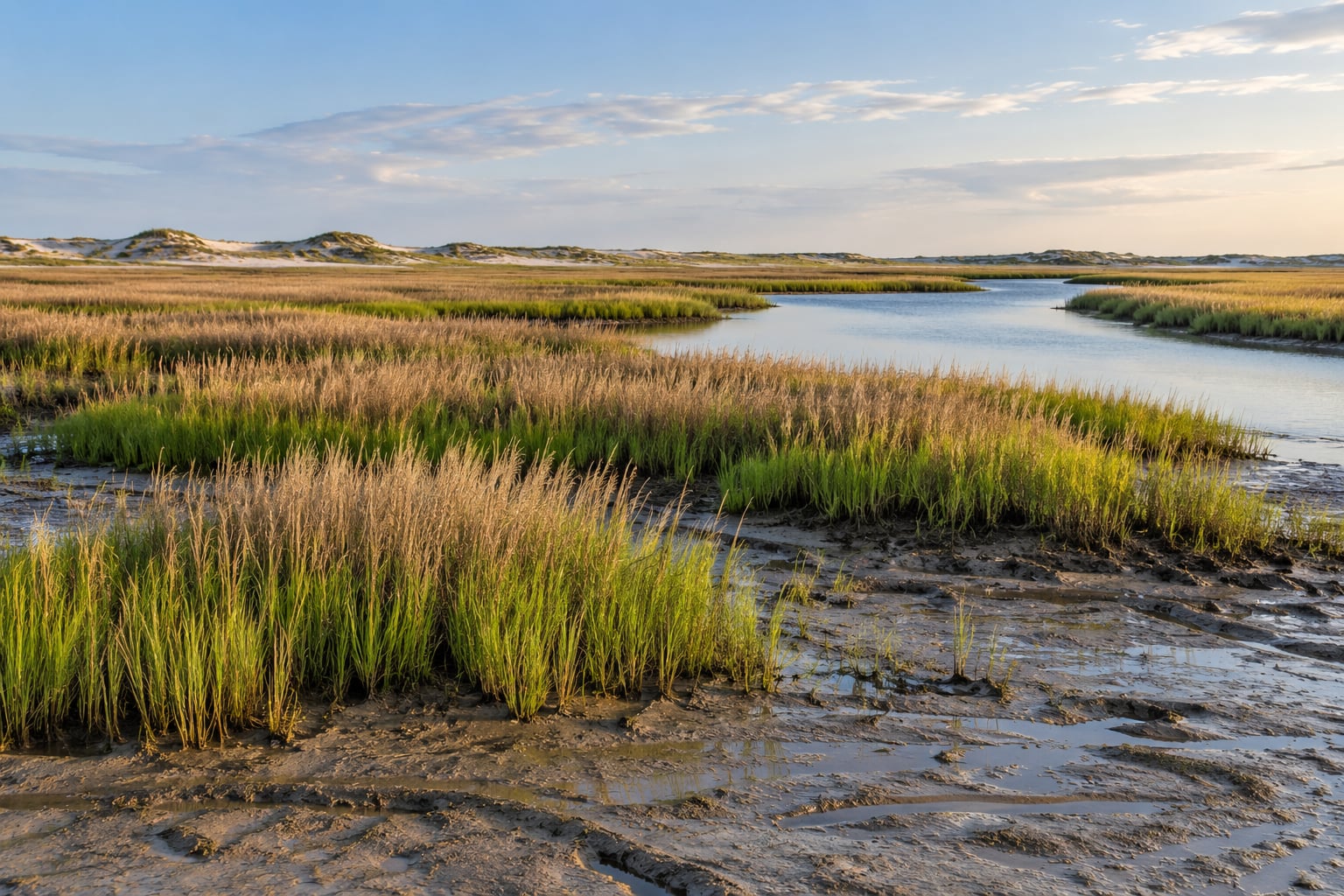
Cordgrass die-off is the widespread loss of smooth cordgrass, Spartina alterniflora (also written as Sporobolus alterniflorus), the grass that builds most of the Atlantic, Gulf, and Pacific tidal marshes in North America. The meadow thins, then balds, then converts to open mudflat.
Smooth cordgrass is a salt-tolerant perennial that spreads by underground rhizomes. It pushes air down through leaf tissue into an oxygen-starved root zone, and it dumps excess salt out through glands on the leaf surface. Those two tricks let a plant live in ground that would kill most grasses, and they are also why the plant is slow to recover once something knocks it over.
That combination explains a lot of the confusion around why cordgrass die off happens. The same physiology that tolerates salt and anoxic mud also means the plant invests heavily in standing biomass and slow rhizome spread. When the tops are cut or smothered, recovery is measured in seasons, not weeks.
Why Cordgrass Die Off Happens in Marshes
Cordgrass dies when it cannot hold water, cannot breathe at its roots, cannot get enough light, cannot stay anchored, or gets eaten faster than it grows. Those five failures come from seven families of pressure: tidal hydrology, sediment supply, salinity, weather, herbivores, pathogens, and people.
The important word in the question is happens. Most brown cordgrass in a marsh is not dead. It has moved its nutrients down into the rhizome, dropped the standing stalks, and gone dormant until the water table drops and the growing season restarts. The dead stalks standing over the mud are part of the machine, not evidence of failure.
Die-off proper happens when a stressor removes the marsh’s natural checks. Bertness and his colleagues described the mechanism cleanly in their work on substrate-mediated consumer control of salt marsh die-off: take away the predators, the grazers explode, and the substrate goes with them.
That is also the part most write-ups get wrong. They list causes without ranking them. In any given marsh one driver usually dominates and the rest are background noise, which is why the field diagnosis matters more than the list.
What Causes Cordgrass to Die Off?
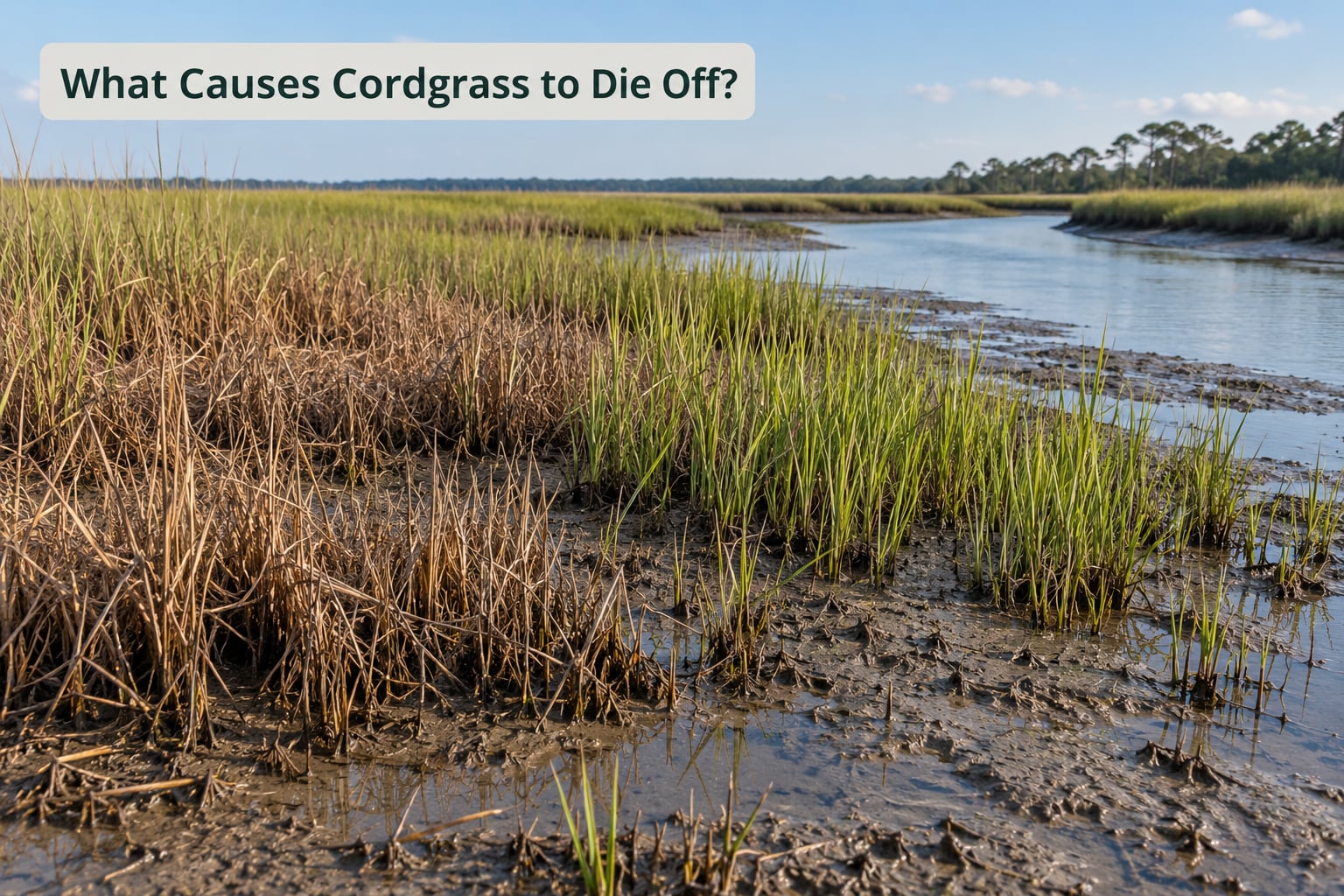
These are the drivers that account for most cordgrass die-off, roughly in the order they show up along the Atlantic coast.
1. Marsh crab overgrazing
The purple marsh crab, Sesarma reticulatum, is the single most cited cause of abnormal die-off in New England marshes. It eats new cordgrass shoots, especially the tall early shoots that later become the seed-producing stalks. Where crab density is high, grazed shoots are cut back so often that the plant never reaches the stage where it can spread.
The burrowing is half the problem. Crabs excavate sediment to build burrows, and burrow walls break down faster than normal marsh soil. The organic matter that holds a healthy marsh together gets exported, the surface gets lower and looser, and surviving plants lose their footing.
2. Predator loss, which sets off the trophic cascade
Purple marsh crab populations are held down by predators that eat them: striped bass, blue crab, bluegill, and, on many coasts, the invasive European green crab. Heavy recreational and commercial fishing removes the predators, and predator release lets the herbivorous crab boom.
That chain runs overfishing, predator loss, crab numbers climbing, cordgrass overgrazed, substrate destabilized, then erosion. It is a trophic cascade, meaning a change at the top of the food web reshapes everything below it. Fixing the marsh means working at the top, not reseeding the bottom.
3. Avian herbivory
Canada geese and wintering waterfowl pull shoots and till rhizomes near the surface. Light grazing is normal and often good. Concentrated grazing on a small high-marsh patch, repeated year after year, can hold that patch bald through the growing season.
Goose damage has a distinctive shape: bare ground close to an upland edge or a lawn that borders the marsh, with a smooth boundary rather than a ragged one.
4. Salinity shifts
Cordgrass handles salt well, but not every level equally. Sustained salinities above roughly 30 parts per thousand start to cost the plant growth. Freshening has its own problem: a drop in salinity favors less salt-tolerant competitors, and common reed or other invasive grasses move in from the upland edge.
Salinity is easy to overestimate by eye and easy to underestimate from a single sample. Salinity in a marsh changes by several parts per thousand between a spring tide and a week later, so single readings mislead.
5. Sediment shortage
Healthy marshes build elevation by trapping suspended sediment. When a marsh sits behind a berm, a seawall, a causeway, or a closed tidal gate, sediment supply drops and elevation falls behind relative sea level.
The plants drown at the root. This one is easy to diagnose because it hits the low-elevation parts of the marsh first, usually the creek edges, while the high marsh stays green.
6. Burial, scour, and erosion
Too much sediment is as bad as too little. Dredge spoil, storm-driven sediment pulses, or construction fill can bury shoots before they clear the surface. On the other side, boat wakes, prop scour, ice scour, and channel migration remove roots.
Wrack, dense mats of eelgrass or algae that land on the marsh, also smothers growth. A single bad wrack year can set a low marsh back several years.
7. Disease, pollutants, and invasive competition
A salt-excreting grass has plenty of salt-requiring pathogens that show up when salinity and temperature climb together. On top of that come oil and chemical releases, septic and agricultural runoff, and nutrient enrichment, which drives algae growth, shades the mud surface, and drives oxygen down.
Invasives take the gaps die-off opens. Common reed, tall fescue in the upland transition, and the exotic grass Phragmites on the Pacific coast all move into marsh edges that are already thin.
| Cause | What you see in the field | Where on the marsh | Recover on its own? |
|---|---|---|---|
| Marsh crab overgrazing | Stubby grazed shoots, packed burrows, loose peat | Mid and high marsh, often near creek edges | No, needs predator recovery |
| Goose grazing | Tilled soil, clipped shoots, smooth bare edge | Marsh edge next to upland or lawn | Only if pressure drops |
| Salinity stress | Overall yellowing and thin canopy | Whole marsh, worst at the creek | Sometimes, over several years |
| Sediment shortage | Dark, waterlogged soil, plants pulling free easily | Low marsh and creek edges | No, needs hydrologic fix |
| Sediment burial or wrack | Mat of debris, shoots poking through | Along a shoreline or channel | Partly, if the pulse was one-off |
| Boat or storm scour | Sharp-edged cut in the canopy along a channel | Along channels and the marsh edge | Partly, slowly |
| Nutrients or pollutants | Algal film, odor, sudden die-back near a source | Near a runoff or discharge point | No |
| Invasive competition | Tall reeds advancing from the upland side | High marsh and marsh edge | No, needs active control |
How Does the Cordgrass Die-Off Process Unfold?
Die-off rarely happens all at once. It moves through stages that are visible from a marsh edge, and catching it early is the difference between a growing season and a decade.
Stage one, chronic stress. Conditions are slightly off every year: a little too saline in August, a little too wet in spring, a few more crabs than last year. The canopy looks a little thinner and a little shorter. Nothing obviously dies.
Stage two, shooting failure. New shoots get grazed, cut, or buried before they raise themselves above the surrounding vegetation. A marsh with no seed stalks and no tall shoots is losing its reproductive and dispersal stage at the same time.
Stage three, yellowing and thinning. Plants that survive draw on rhizome reserves, then run out. Leaf color fades from deep green to olive to yellow. Pull on a stem and it comes free with almost no resistance, because the rhizome has stopped anchoring.
Stage four, bare ground and burrow collapse. Where crabs are the driver, burrows open up, walls slump, and peat begins to wash out with each tide. Bare patches no longer trap sediment the way vegetated marsh does, so they deepen.
Stage five, expansion or conversion. A bare patch behaves as a seed bank sink with no incoming sediment and no stems. Left alone, it grows into a panne, then mudflat, then open creek. That last step is the one that does not come back on a management timescale.
Recovery can begin at any stage below conversion. Rhizomes survive far longer than most people assume, and they recolonize bare ground if hydrology and herbivore pressure have been addressed.
How Can You Tell Die-Off From Normal Seasonal Change?
Seasonal die-back is brown stalks standing over green base growth, arriving in the same weeks every year, going away with spring tides and cold weather. Pathological die-off is bare mud, exposed sediment, and failing plants during the growing season.
Five field checks separate the two without any equipment.
Check the timing. Cordgrass senesces on schedule, usually from late summer through winter. Cordgrass dying in June, July, or August, while neighboring marshes are green, is a problem.
Check the base. Look at ground level in healthy dormant cordgrass and you will usually find fresh green growth under the brown stalks. If you can see mud at the base in midsummer with no new shoots anywhere, the plants are not coming back on their own.
Pull a stem. Healthy cordgrass resists. If it slides out of the mud with no resistance at all, the roots have gone.
Count burrows. A square foot of marsh surface covered in crab burrows and droppings tells you the grazer pressure is high. This is the single most diagnostic sign in a New England die-off.
Compare across seasons and neighbors. Photograph the same spot from the same angle on the same date each year. Marsh managers do exactly this, and a two-year record turns guesswork into evidence. If the marsh is browning a month earlier each year, that is a trend, not weather.
| Feature | Normal seasonal die-back | Abnormal die-off |
|---|---|---|
| Timing | Late summer through winter | Any time, often worst mid-season |
| Color | Tan to brown stalks, green base | Yellowing live plants, no green base |
| Ground cover | Continuous litter layer over mud | Exposed mud, scoured peat |
| Repeatability | Same weeks every year, same extent | Patch grows or new patches appear |
| Cause signature | Season and dormancy | Burrows, goose tilling, salinity, scour |
| Spring response | Green shoots within weeks of warm water | Delayed, thin, or absent |
| Action needed | None | Diagnosis and management |
Position on the marsh narrows it down further. Creek edges go first under salinity and elevation stress. The upland edge goes first under goose grazing and invasive encroachment. Mid-marsh patches with heavy burrowing point straight at crabs. Whole-marsh yellowing with intact sediment points at salinity, nutrients, or a disease.
Can a Marsh Recover After Cordgrass Dies?
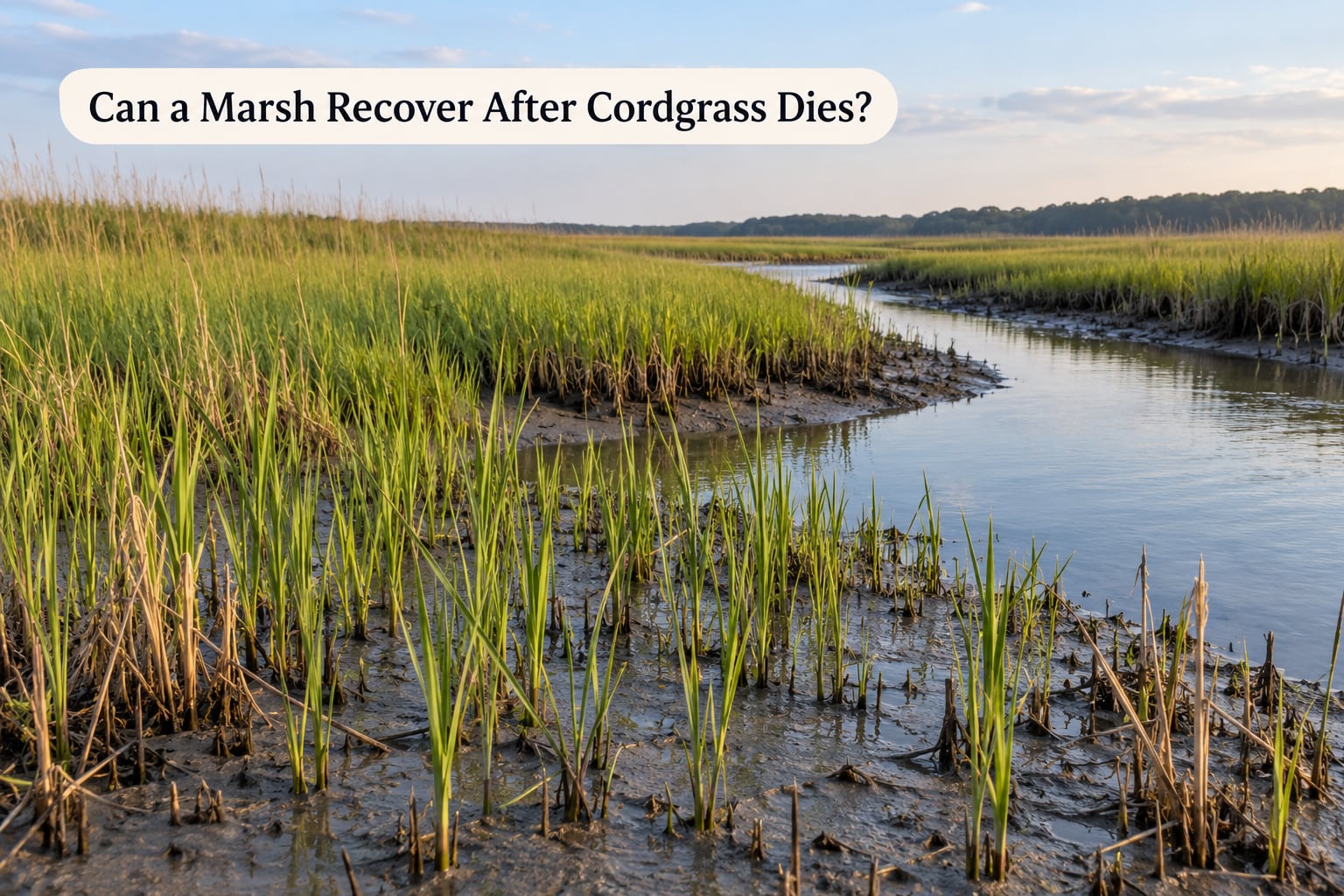
Most marshes do recover, provided hydrology is intact and the stressor is removed. Cordgrass spreads by rhizome, so established plants recolonize adjacent bare ground without any planting at all. The question is how long that takes.
Expect three different timelines. Temporary stress, like one dry summer or one wrack year, shows green shoots the following spring. Herbivore-driven thinning takes one to three growing seasons once crab numbers drop. Bare mudflat where the peat itself has washed out takes years, sometimes decades, and may never fully revert.
Signs that a marsh is on its way back are simple: continuous green base growth, new shoots appearing at the edge of a bare patch, burrows filling with sediment, marsh silt frogs and clams returning to creek bottoms, and wrack lines washing up instead of washing through.
Where hydrology is broken, restoration has to start with the water. Reopening a blocked tidal creek or gate, or re-establishing sediment supply with a living shoreline, often does more for a marsh than planting. Planted cordgrass plugs in a marsh with no sediment supply wash out in the first winter that tests them.
The common techniques managers use:
- Fix the hydrology first. Reconnect tidal flow, breach or remove the obstruction that cut off the marsh, and confirm the marsh drains and floods on a normal tidal cycle.
- Restore sediment supply. Restore the natural floodplain connection, or build a living shoreline of coir logs, oyster shell, and sand that spreads sediment across the intertidal zone.
- Re-establish predators. Where crab-driven die-off is the problem, protecting or restoring forage fish and larger predators is what brings crab populations back to a normal range.
- Control invasives early. Remove Phragmites, common reed, and upland turf seedlings from the marsh edge while the ground is still intact. Once Phragmites has a foothold it is very hard to dislodge.
- Plant only where needed. Direct-seed or plug into bare, hydrologically correct gaps. Managers report mixed long-term results from planting, with transplanted stands sometimes underperforming natural recolonization.
- Manage access and sediment. Fence or board sensitive banks, restrict boat routes, and stage work outside the growing season.
Be realistic about long-term evidence. Marsh restoration projects monitored for twenty years show mixed outcomes, which is normal for a system driven by sediment, sea level, and weather. Restoration that fails usually fails because the hydrology was never fixed, not because the plants were the wrong ones.
What Can People Do to Help Cordgrass Marshes Recover?
If you use marshes for birding, fishing, paddling, hunting, or land, most of the useful action is restraint and observation.
Stay on marked routes and boardwalks. Walking on marsh soil crushes rhizomes and sediment that would otherwise hold the marsh together, and the damage stays long after the boot prints fade. Stay off the marsh when the ground is softest, which is usually in spring and just after rain.
Keep wakes away from the marsh edge. Prop scour and wake erosion cut the bank where cordgrass is holding sediment in place, and it does not regrow there once the edge is gone.
Do not pull, rake, mow, or burn dead cordgrass. That litter layer is the food supply for detritivores, it holds the sediment surface, and it feeds the invertebrates and forage fish the next generation depends on. Dead cordgrass in a marsh is a resource.
Do not bring bait or discharge water into a marsh, and clean mud and gear off the boat before launching somewhere else. Bait introduces marine invertebrates including green crab, and mud moves disease between wetlands.
If you own marsh or shoreline land, the biggest wins are runoff and erosion control on your side. Keep fertilizer, pet waste, and sediment out of the marsh ditch system, and stabilize any bank that is failing.
Watch and record. A photo series from a fixed point, a short note in a field journal about crab burrow density, or a report to your state wetlands program or land manager when you see new bare ground is genuinely useful data. Managers cannot manage what nobody documented.
Frequently Asked Questions
Is brown cordgrass dead?
Usually not. Cordgrass pulls its nutrients out of the standing stalks and into the rhizome before it goes dormant, so brown stalks over a green base are a healthy winter and late-summer condition. Look at ground level in the growing season: fresh green growth under brown stalks means normal dormancy, while exposed mud with no new shoots means the plants have actually died.
Why did the cordgrass in my marsh turn brown?
Timing tells you most of it. Cordgrass browns on its own schedule in late summer and fall as it goes dormant for the winter. Browning in June or July, or browning in patches while nearby marsh stays green, points to a stressor: marsh crab grazing, goose grazing, salinity, sediment shortage, or scour from boats and storms.
Can dead cordgrass grow back?
It depends on how far it got. Cordgrass spreads by rhizome, so surviving plants recolonize adjacent bare ground and often need no planting, given a season or two. Where the peat has washed out and the ground is now open mudflat, recovery takes years and may not finish in your lifetime. Hydrology has to be working before regrowth can hold.
Does salt water kill cordgrass?
Not in normal tidal amounts. Cordgrass has salt-excreting glands on its leaves and transports air down to roots sitting in oxygen-poor mud, which is why it thrives where other grasses fail. Sustained salinity above roughly 30 parts per thousand does cut growth back, and unusually fresh water can be a problem too by letting less salt-tolerant competitors take over.
Are storms causing the marsh to die?
Storms contribute more than they usually get credit for. They scour roots at creek edges, drop dense wrack that smothers shoots, and push sediment around. A single storm usually leaves patchy damage that recovers. Repeated storms without recovery in between, or storms acting on a marsh that is already thin from sediment shortage or grazing, push it toward real die-off.
Should I remove dead cordgrass from a marsh?
No. The dead litter layer holds sediment in place and feeds the insects, worms, and small crustaceans that juvenile fish and crabs depend on. Removing it exposes the soil surface to erosion and starves the food web that feeds the marsh. The one exception is a wrack mat thick enough to smother new shoots, and even then managers usually wait and let it break down rather than pulling it off.
What to Do First
Stand at the same spot, look at the base of the stems, and pull one. Green growth at the base in the right season means dormancy and you have nothing to act on. Exposed mud with no shoots, or a patch covered in crab burrows, means something is wrong.
Then compare the marsh to itself a year ago, and to the nearest marsh that still looks healthy. Check whether the damage follows a pattern, and check for burrows, goose tilling, or a cut edge along a channel.
If it looks abnormal, reduce your own disturbance first: stay on the boards, keep wakes off the marsh edge, and leave the dead stalks in place. Then report it to whoever manages the wetland, which is usually a state wetlands program, a local land trust, or the refuge or park agency that owns the site. New bare ground reported early is the cheapest problem a marsh manager ever gets to deal with.