Landowners flood rice fields for waterfowl because a harvested, shallowly flooded field hands migrating ducks and geese two foods at once: leftover grain and the insects that swarm around decomposing rice straw. Add winter lease income, cost-share payments, and weed and erosion control, and closing a drainage gate for a few months starts to look like a good trade. Flooding is voluntary in almost every case, and it is habitat management rather than a way to grow rice.
Most of the shallow, flooded winter habitat that ducks rely on in the Central and Gulf coasts used to come from bottomland hardwood forests, prairie potholes, and coastal marsh. A large share of that is gone. Rice fields are flat, leveed, and piped for irrigation already, so a grower can turn working farmland into seasonal wetland with very little new construction.
Ducks Unlimited has put winter-flooded rice at more than 700,000 acres nationally, with roughly 110,000 of those acres helped along by Ducks Unlimited and the Natural Resources Conservation Service. That figure has held up for years, which tells you how durable the practice is as a habitat tool.
Table of Contents
- Why Landowners Flood Rice Fields for Waterfowl
- Are Landowners Required to Flood?
- What the Four Drivers Come Down To
- How Does Flooded Rice Field Habitat Attract Waterfowl?
- Why flooded rice feeds better than flooded corn
- What Water Depth and Timing Work Best?
- Why Does This Benefit Landowners as Well as Birds?
- Lease income and program payments
- Benefits with no birds involved
- How Is Managed Flooding Different From Natural Marsh Flooding?
- What Challenges and Tradeoffs Do Landowners Manage?
- Cost and water supply
- Spring conflicts
- Vegetation and encroachment
- Declining rice acreage
- Legal and ethical arguments
- Adjacent property and rules
- How Can a Landowner Start a Waterfowl Habitat Project?
- Frequently Asked Questions
- Why do landowners flood rice fields for waterfowl instead of leaving them dry?
- How deep should a rice field be flooded for waterfowl habitat?
- Does rice-field flooding help ducks and geese find food?
- Does flooding a rice field replace a natural wetland?
- Can landowners receive conservation or incentive payments for waterfowl flooding?
- How do weather and drainage affect a managed rice-field flooding project?
- Conclusion
Why Landowners Flood Rice Fields for Waterfowl
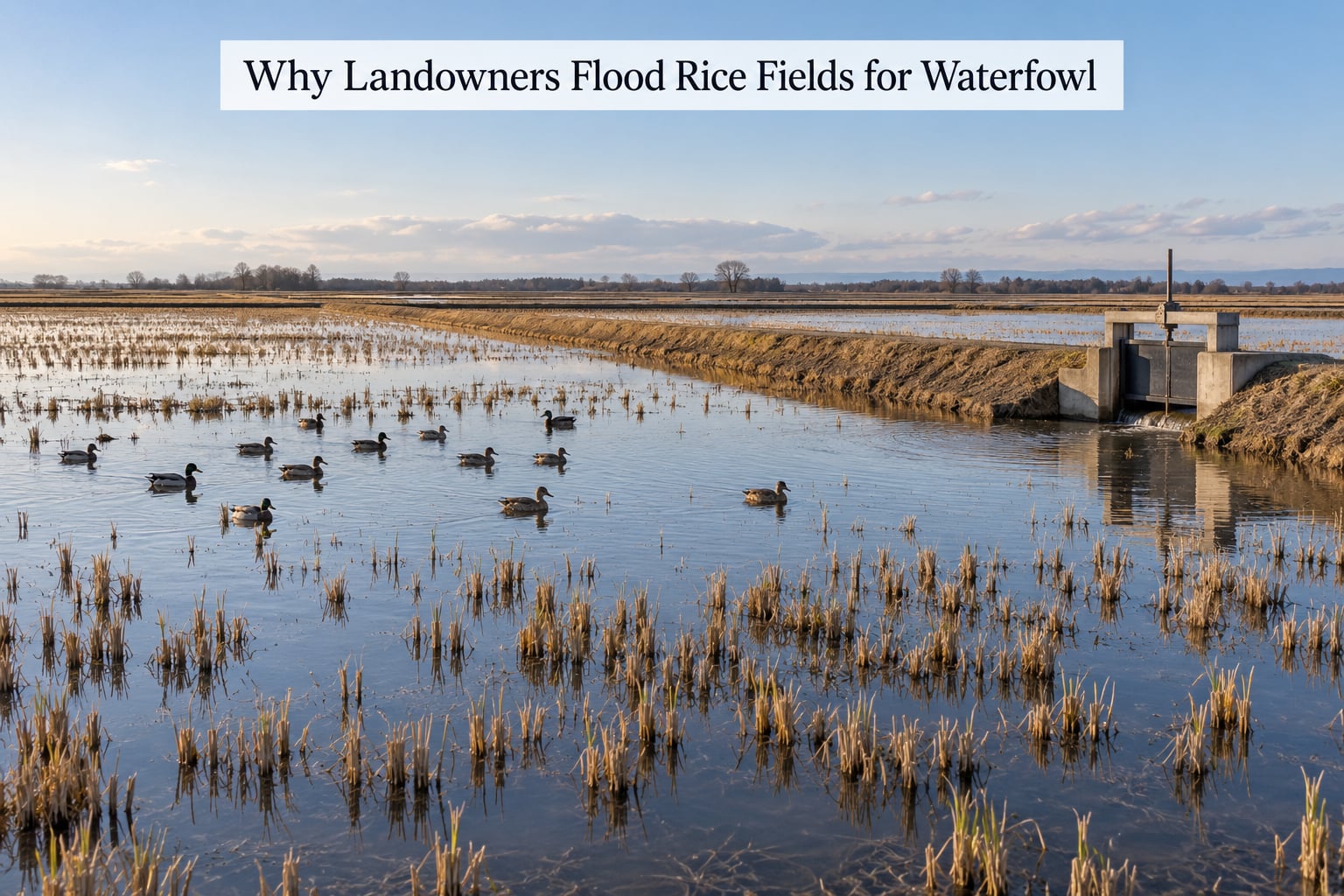
The short answer is that winter flooding reproduces something natural wetlands used to provide every year: standing water over open ground, right where birds need it during a season when everything else is frozen or dry. The rice field becomes a stopover and wintering site, and the landowner gets a season of use out of ground that would otherwise sit idle.
Are Landowners Required to Flood?
No. Flooding a rice field for waterfowl is a voluntary conservation practice in every major rice region, and rice itself does not need winter water. The growing-season flood that paddy rice requires is a completely separate thing from the post-harvest flood that bird habitat depends on.
Growers flood because partners pay for it, hunters lease the flooded acres, or both. Some do it for the agronomic reasons alone. If a landowner decides the schedule is not worth it, nobody fines them, though a lease or cost-share agreement they signed may carry its own obligations.
What the Four Drivers Come Down To
Talk to growers and conservation staff in the Mississippi Alluvial Valley, the Gulf Coastal Plain, and the California Central Valley, and the same four reasons keep surfacing.
- Food for birds. The field supplies carbohydrates and protein at the exact point in the migration when natural forage is scarce.
- Hunting lease revenue. Flooded ground draws hunters who would otherwise hunt public land, and lease payments on flooded acres often exceed what the same ground earns as open dryland habitat.
- Farm operations. Holding water costs less than pumping it, suppresses weeds, cuts erosion, and gives leftover straw somewhere to go.
- Conservation programs. Cost-share, rental, and easement programs from Ducks Unlimited, the Natural Resources Conservation Service, the U.S. Fish and Wildlife Service, and state wildlife agencies pay part of the cost.
Only the first driver is about birds. That matters, because a landowner who stops making money on it usually stops flooding, whatever the ducks think about it.
How Does Flooded Rice Field Habitat Attract Waterfowl?
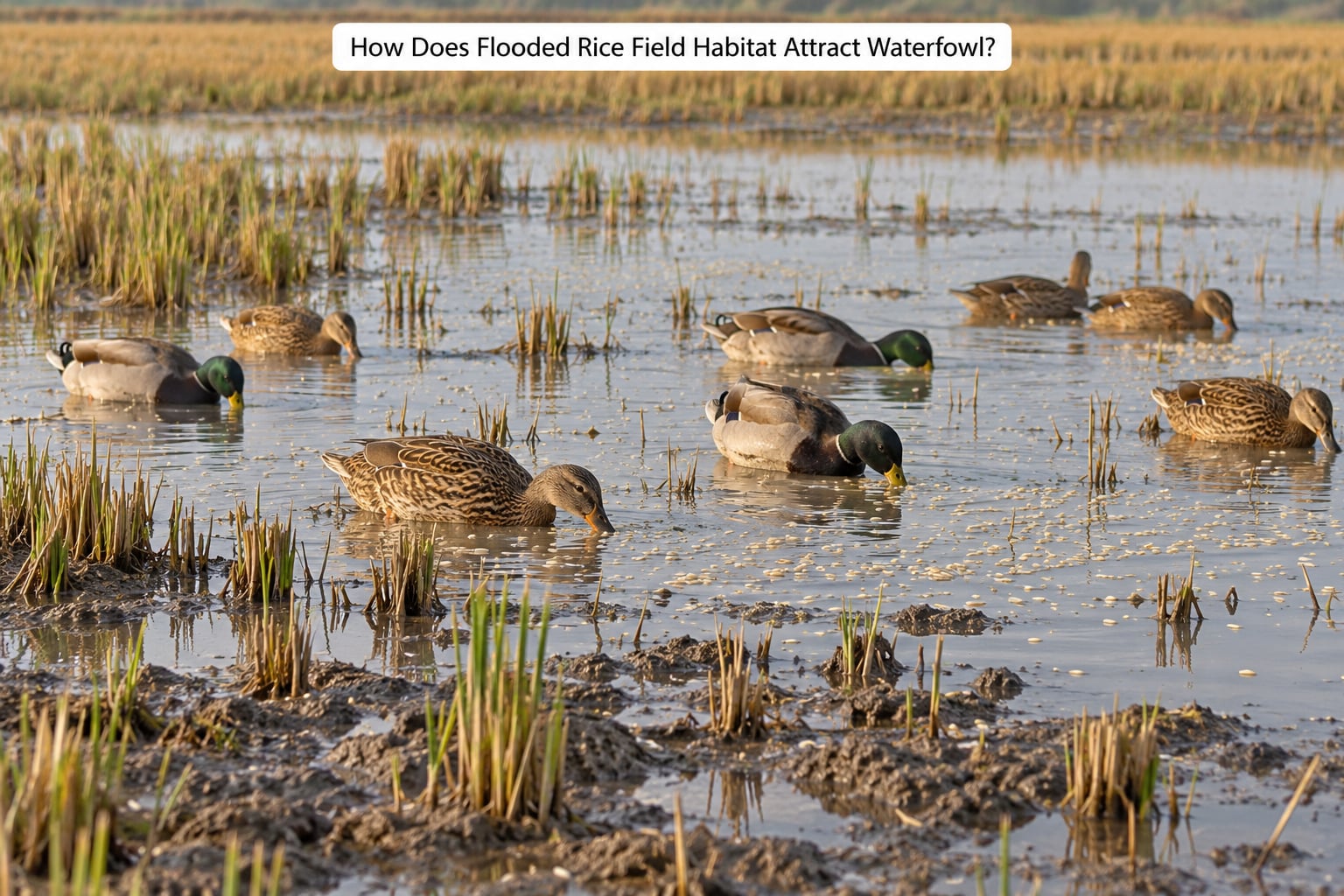
A flooded rice field works because it delivers two different food sources at the same time. The first is waste grain and waste rice, the seed left behind by the combine at harvest. The second is the invertebrate boom that follows, as the standing rice straw breaks down in warm shallow water and everything from midge larvae to beetles moves into the drifting mat of vegetation.
Why flooded rice feeds better than flooded corn
Ducks eat a lot of plant matter but need protein to keep growing through the winter, and invertebrates supply it. Hunters on DuckHuntingChat threads argue endlessly about flooded corn and unharvested standing grain used to hold birds, and much of that argument is really a legal one about baiting rules rather than a nutritional one.
The measured difference is waste grain. Arkansas Game and Fish Commission research, cited by waterfowl biologists including Luke Naylor, puts the food available after a typical harvest at roughly 70 pounds of grain per acre, with a feeding threshold near 50 pounds per acre below which ducks rarely work a field. Efficient modern combines leave less behind than the machines of the 1970s, which is part of the reason wild rice acreage is treated as a conservation concern.
Shallow water matters as much as food. Dabbling ducks need to tip up and probe the surface, and they cannot do that in water deep enough to put them under. A few inches of water over exposed mud and short stubble is the configuration birds rank highest, and flooded field edges are where most of the feeding happens.
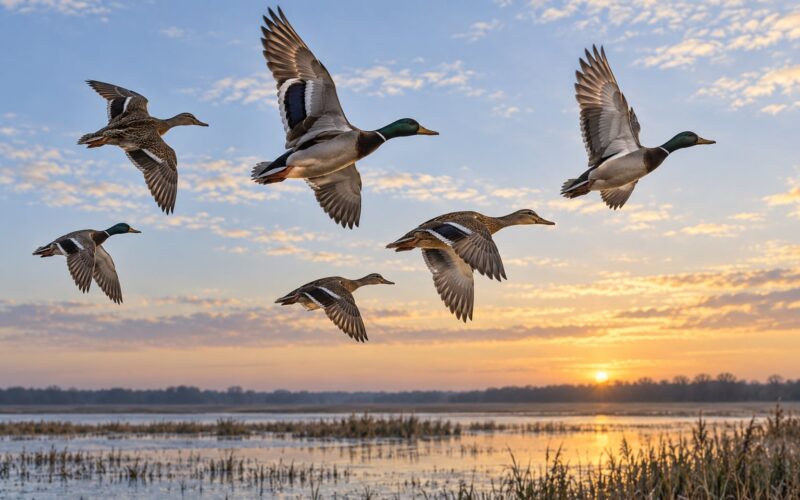
The species list is wider than ducks. Pintails, mallards, green-winged teal, wigeon, gadwall and shoveler work the shallow ground. Snow geese graze the shorter stubble and nearby pasture. Sandhill cranes stage on the same fields, and long-billed shorebirds pick through the exposed mud along the drawdown edges. In the Central Valley, Ducks Unlimited has recorded more than 150 bird species, 28 mammal species and 24 reptile species using winter-flooded rice ground.
Migration timing is the quiet part of it. The November through January window covers the period when birds are moving onto wintering range and burning fat for flights, and flooded fields sit directly on those routes. Field flooding after harvest is also the reason the Grand Prairie near Stuttgart, Arkansas, became a legendary waterfowl area; rice growing there in the early 1900s coincided with large waterfowl population increases.
What Water Depth and Timing Work Best?
There is no single prescription, because the right depth depends on soil, field grade, weather, and which species the landowner wants to attract. Most managers in rice country describe the target as roughly two to four inches, about ankle-deep, held from late fall through early winter.
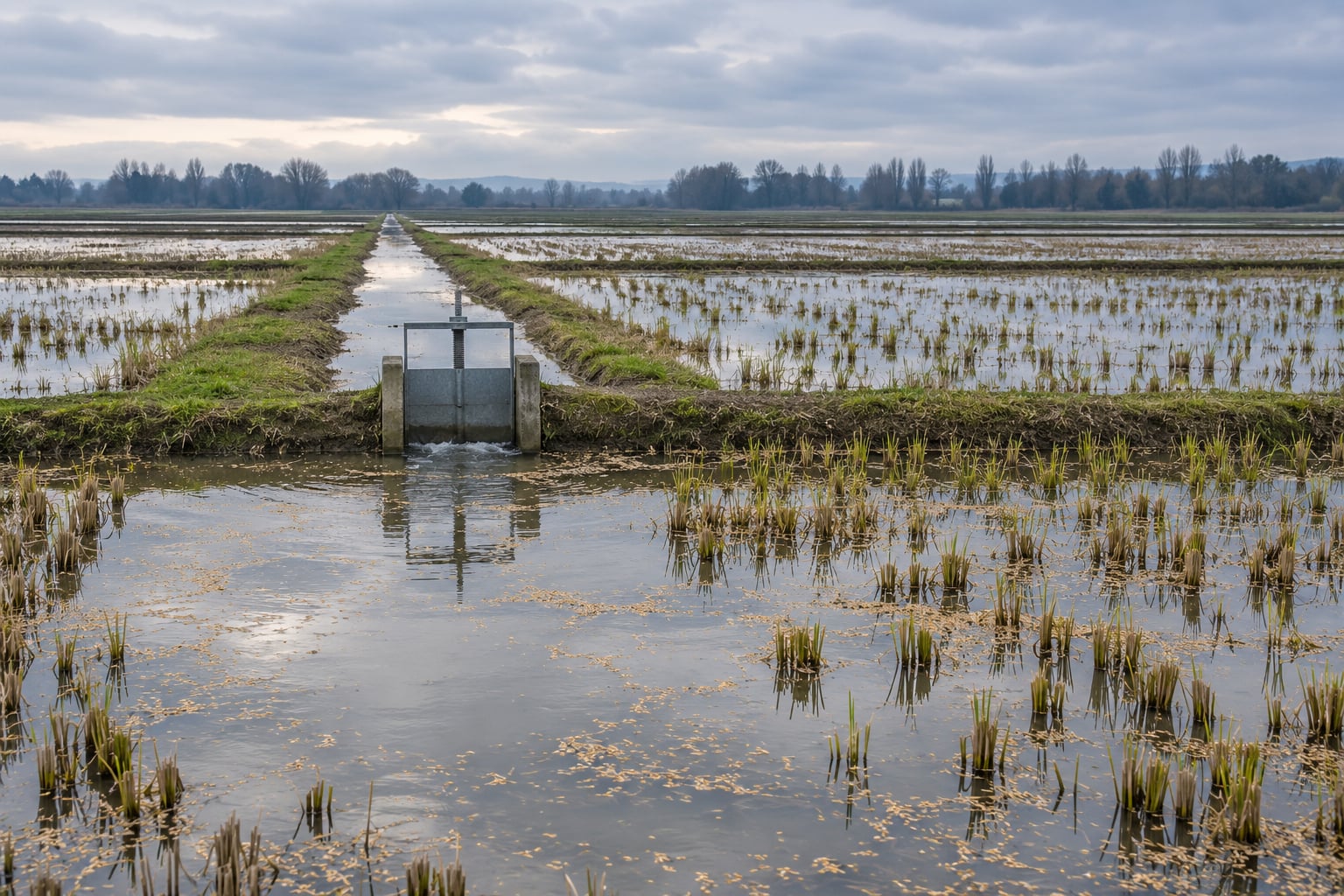
Depth is easier to control in a zero-grade field, which is graded flat so water spreads evenly across the whole surface. Contoured fields follow the land and pool deeper in low spots, which can be a feature, since deep spots hold fish and give diving ducks somewhere to work, and a bug, since the shallow feeding edges may be too small to matter.
- Timing. Most flooding starts after the fall harvest and holds through the coldest part of winter, then draws down before spring field work.
- Duration. Birds use the field best when it has been flooded long enough for invertebrates to establish, which is usually a matter of weeks rather than days.
- Depth. Two to four inches suits dabbling ducks. Deeper water favors diving species and reduces the feeding value for the majority of the flock.
- Stubble condition. Rolling, mowing, or disking the stubble after flooding breaks up the straw mat and exposes grain, though hunters and biologists still disagree about which treatment birds prefer.
- Drawdown. A slow, staged drop leaves a band of exposed mud at the field edge, which shorebirds and early-migrating ducks work heavily.
Rice straw left in a field after harvest decomposes faster under water, which helps feed the invertebrates and keeps the farmer from having to burn or till it. That is one of the quieter arguments for flooding, and it comes up often in growers’ cost calculations.
Rainfall changes all of it. In a naturally wet winter the bonus value of a flooded field drops because birds have plenty of options. In a dry year the same field carries a lot more weight, which is when growers who skipped flooding the previous season tend to wish they hadn’t.
Why Does This Benefit Landowners as Well as Birds?
The wildlife case and the farm case line up more often than people expect, and most growers who flood will point at the second one first.
Lease income and program payments
Flooded rice fields draw hunters off public land and onto private ground, and hunters pay for the privilege. Lease rates vary widely by region, water supply, and access, and forum users ask about per-acre rates constantly because nobody publishes a reliable figure. The honest answer is that rates move with the number of birds a field holds, and a field that floods reliably and dries on schedule is worth more than one that does not.
Then there are the programs, which have names people actually recognize:
- Ducks Unlimited works with growers on cost-share and habitat agreements across all three rice regions.
- Natural Resources Conservation Service offers cost-share through conservation practice standards, generally funded through the conservation title of the Farm Bill.
- State wildlife agencies run their own incentive programs, including the Arkansas Game and Fish Commission WRICE program, which has paid growers since 2018 to hold water on fields and delay fall tillage.
- Industry and corporate funding flows in through groups such as Texas RICE and partnership grants administered by the National Fish and Wildlife Foundation.
- Farmable Wetlands Program and related rental-style initiatives pay annual amounts for holding water rather than covering a one-time cost.
- Agricultural conservation easements can permanently protect the practice, and in exchange the land stays on the farm’s tax roll in many cases.
Program terms change, funding cycles vary, and eligibility rules differ by state and county. Anyone considering this should confirm current terms with the agency directly rather than working from a number they heard a few seasons ago.
Benefits with no birds involved
Holding water over a harvested field suppresses weeds that would otherwise take the winter, reduces wind and rain erosion on exposed soil, and cuts the amount of runoff leaving the field during winter storms. Several of the less obviously useful cases come from the Gulf Coast: flooded rice ground has served as oil spill response habitat, and crawfish producers have found they can co-produce on flooded rice fields, using the standing water as refuge between drain cycles.
Cost is the part that surprises outsiders. Growers repeatedly report that closing the drainage gates for the winter and letting rainfall fill the field is cheaper than actively draining it, which takes pumps, fuel, and labor. That is the whole reason the practice survives in a world where diesel is expensive.
How Is Managed Flooding Different From Natural Marsh Flooding?
A managed rice field imitates several useful features of a natural wetland. It does not replicate one, and anyone who treats the two as interchangeable will be disappointed by the habitat in March.
Natural marsh flooding is driven by tides, stage, and rainfall, and it rises and falls on its own schedule. Managed flooding is a decision. The grower picks a start date, holds water with gates and pipes, and picks a date to drain. That control is an advantage for birds in one way, because a field can be timed to the migration, and a liability in another, because a mistake in October shows up in February.
Vegetation is the bigger difference. Marsh grows a structured plant community, from submerged plants to emergent to scrub, and that vertical variety produces a whole food web. A flooded rice field offers grain, stubble, and the invertebrates attached to straw. Good habitat, but a narrower menu.
Timing and duration do not line up either. Coastal marsh in Louisiana and Texas is frequently flooded much of the year. Winter-flooded rice is seasonal and shallow, then gone by planting season. Deep-water and long-duration flooding also do things a rice field cannot, like keeping fish available through a hot summer, which is why shallow seasonal rice flooding and deeper year-round management are complementary rather than competing.
Wildlife managers tend to describe flooded rice as a surrogate wetland, and the word carries the caveat with it. Losing real marsh cannot be offset by flooding more fields, because the two habitats do not deliver the same species or the same resilience. Flooded rice fills part of the gap the conservation groups acknowledge rather than pretending to close it.
What Challenges and Tradeoffs Do Landowners Manage?
Flooding is simple to describe and awkward to run. The hard parts are all about timing, cost, and what happens after the birds leave.
Cost and water supply
Where rainfall does the work, flooding is cheap. Where a grower has to pump, fuel and well costs decide whether the field gets flooded at all. Deeper wells in areas with declining groundwater add another layer, and in the Central Valley water allocation rules can limit how much a grower can hold back, so winter flooding there competes directly with the following crop.
Spring conflicts
Water held in November is water that has to come off the field before the next planting. A wet March turns a scheduled drawdown into a race, and a field that drains late can cost a stand of rice, which is why lease agreements often address what happens when a field floods out mid-season. That complaint about getting rebateded when acres flood out is one of the most repeated threads on farmer forums.
Vegetation and encroachment
Idle wet ground is an invitation. Salt cedar and Chinese tallow move into abandoned fields and are expensive to remove later, and weeds can take a field that was rested for several seasons. Rolling or mowing the stubble after flooding limits some of that, but it is another pass with equipment and fuel.
Declining rice acreage
This is the biggest conservation risk and it sits outside any single farm’s control. Rice acreage in Louisiana and Texas has fallen from roughly 1.2 million acres to around 577,000, and lower prices, competing crops, and water restrictions keep pushing the number down. Every acre that leaves production is an acre of potential winter habitat that no longer exists, which is why conservation programs have shifted toward keeping existing ground in production rather than restoring ground that was never rice.
Legal and ethical arguments
Not every way of holding ducks is created equal. Hunters on DuckHuntingChat raise a consistent objection, pointing out that unharvested rice cannot be rolled down without the field looking like bait to a game warden, and state rules vary on whether standing crop counts as bait. Flooded harvested ground does not raise the question; flooded standing grain does.
Adjacent property and rules
Water does not respect fence lines. Runoff from a flooded field can reach a neighbor’s land, and drainage timing may fall under a water district rule, a state water law, or a local ordinance rather than anything the landowner writes. Keeping gates, ditches, and turn rows maintained, and telling neighbors before a flood goes on, avoids most of the friction.
How Can a Landowner Start a Waterfowl Habitat Project?
Every farm is different, so treat this as a sequence rather than a plan. Most operations do it in the same order, and most of them started by talking to somebody other than themselves.
- Assess the field. Grade, soil drainage, existing water control structures, water source, and reliable rainfall all set what is possible. A field with no levees or outlets is a much bigger project than one with a working drainage system already in place.
- Talk to extension and wildlife staff. County extension offices, state wildlife agencies, and the Natural Resources Conservation Service all publish guidance for rice-region flooding and can look at the specific field.
- Find the funding first. Cost-share and rental programs generally require application before the water goes on, and some have waiting lists. Applying after the fact usually means missing the season.
- Plan the water controls. Decide where water enters and where it leaves, and how each structure will be operated without backflooding a neighbor.
- Test the schedule. Run one season at a modest depth, hold it through the period you want to test, and draw down on a date you can actually hit.
- Watch the field, not just the birds. Track whether the water held, how the stubble broke down, what showed up, and whether anything showed up that should not have.
- Adjust over time. Most managers change depth, timing, or stubble treatment every few seasons as they learn what the field and the neighbors tolerate.
Local water districts and irrigation districts matter as much as wildlife agencies in some places, because they control when water can be held and when it must move. Get both sets of rules before the first flood, not after.
Frequently Asked Questions
Why do landowners flood rice fields for waterfowl instead of leaving them dry?
A harvested rice field flooded for a few winter months gives ducks and geese shallow water over open ground, leftover grain, and the invertebrates that grow around decomposing straw. Natural wetland of that type has largely disappeared from the Central and Gulf coasts, so winter-flooded rice is one of the last large-scale winter forage sources on private land. Landowners add lease income, cost-share payments, weed suppression and erosion control to make the decision work.
How deep should a rice field be flooded for waterfowl habitat?
Most rice-region managers aim for roughly two to four inches, which is about ankle-deep and lets dabbling ducks tip up and probe the surface. Deeper water reduces feeding value for the majority of the flock but favors diving species, while a slow staged drawdown leaves a band of exposed mud that shorebirds work heavily. Zero-grade fields spread shallow water evenly; contoured fields pool in low spots, so the target depth is harder to hold across the whole field.
Does rice-field flooding help ducks and geese find food?
Yes, and it is the main reason the practice exists. Arkansas Game and Fish Commission research cited by agency biologists puts waste grain after a typical harvest at roughly 70 pounds per acre, with a feeding threshold near 50 pounds per acre below which ducks rarely work a field. Flooding then adds protein, because decomposing rice straw in warm shallow water supports an invertebrate boom that supplies the insects dabbling ducks need through winter.
Does flooding a rice field replace a natural wetland?
No. Managers call flooded rice a surrogate wetland, and the word carries the caveat. A managed field is seasonal, shallow, structurally simple, and gone by planting season, while a real marsh varies with tides and rainfall, holds water far longer, and supports a wider plant and animal community. Flooded rice fills part of the gap left by lost wetland; it does not substitute for restoring it, and the two are best treated as complementary.
Can landowners receive conservation or incentive payments for waterfowl flooding?
Often, yes. Ducks Unlimited, the Natural Resources Conservation Service through Farm Bill conservation cost-share, state wildlife agencies such as the Arkansas Game and Fish Commission, and rental-style programs all pay for holding water on harvested fields. Industry-backed initiatives add more, including Texas RICE and grants run through the National Fish and Wildlife Foundation. Terms, payment types, and eligibility change by state and funding cycle, so confirm current details with the agency before planning a season around them.
How do weather and drainage affect a managed rice-field flooding project?
Weather sets the value of the habitat and the cost of delivering it. In a wet winter, birds have plenty of natural options and the bonus value of a flooded field drops. In a dry winter, the same field carries far more of the flyway. Rainfall also lets a grower flood by closing gates instead of pumping, which is why the practice is cheap in wet regions and expensive where groundwater and fuel are the water source. Drain capacity decides whether the field can be cleared before spring planting.
Conclusion
Start by having the field evaluated rather than by closing a gate. Soils, drainage capacity, water supply, and the landowner’s actual goals determine whether winter flooding is practical, and those four answers come out of a walk with extension staff, a wildlife agency biologist, and the local water district.
Done right, that same evaluation is what turns why landowners flood rice fields for waterfowl from a conservation slogan into a working plan. A shallow, well-timed flood gives migrating birds the food and open water they cannot find anywhere else, and it gives the farm a reason to keep rice in production. Both goals depend on the same thing: a schedule the grower can actually hit every year.