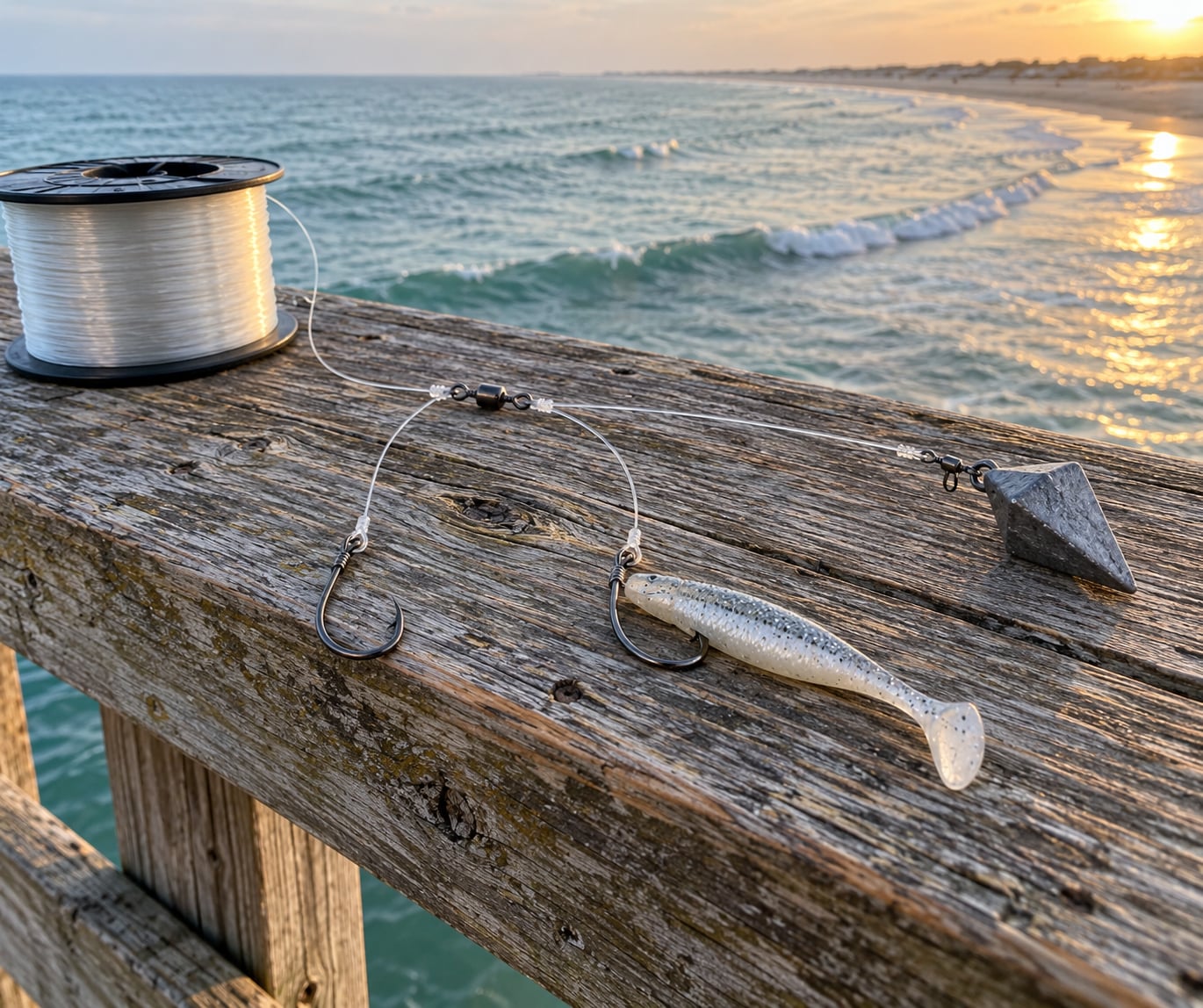
A surf fishing rig is the terminal tackle you hang off the end of your line, and the standard setup is the hi-lo (high-low) rig: two dropper loops holding circle hooks at set heights, a barrel swivel at the top, and a pyramid sinker at the bottom. Learning how to build a surf fishing rig takes about twenty minutes once the knots feel familiar, and it gives you control over hook size, weight and spacing that a pre-tied shop rig never really does.
What follows is the setup I would hand a beginner, plus the variations worth knowing when the surf gets bigger or the target species changes. Nothing on the list is exotic. The whole build comes down to one length of leader, one swivel, two hooks, and a sinker heavy enough to hold the bottom.
Table of Contents
- What You Need
- Step-by-Step: How to Build a Surf Fishing Rig
- Choose the Right Rod and Reel
- Select the Line and Connect the Main Components
- Attach the Weight and Terminal Tackle
- Tie, Test, and Tune the Finished Rig
- Common Mistakes
- Frequently Asked Questions
- What is the best surf fishing rig for beginners?
- How heavy should my surf fishing sinker be?
- Should I use mono or braid for surf fishing?
- What size hook works best for surf fishing?
- How do I keep my line from twisting on a surf rig?
- Can I use a surf fishing rig in strong current?
What You Need
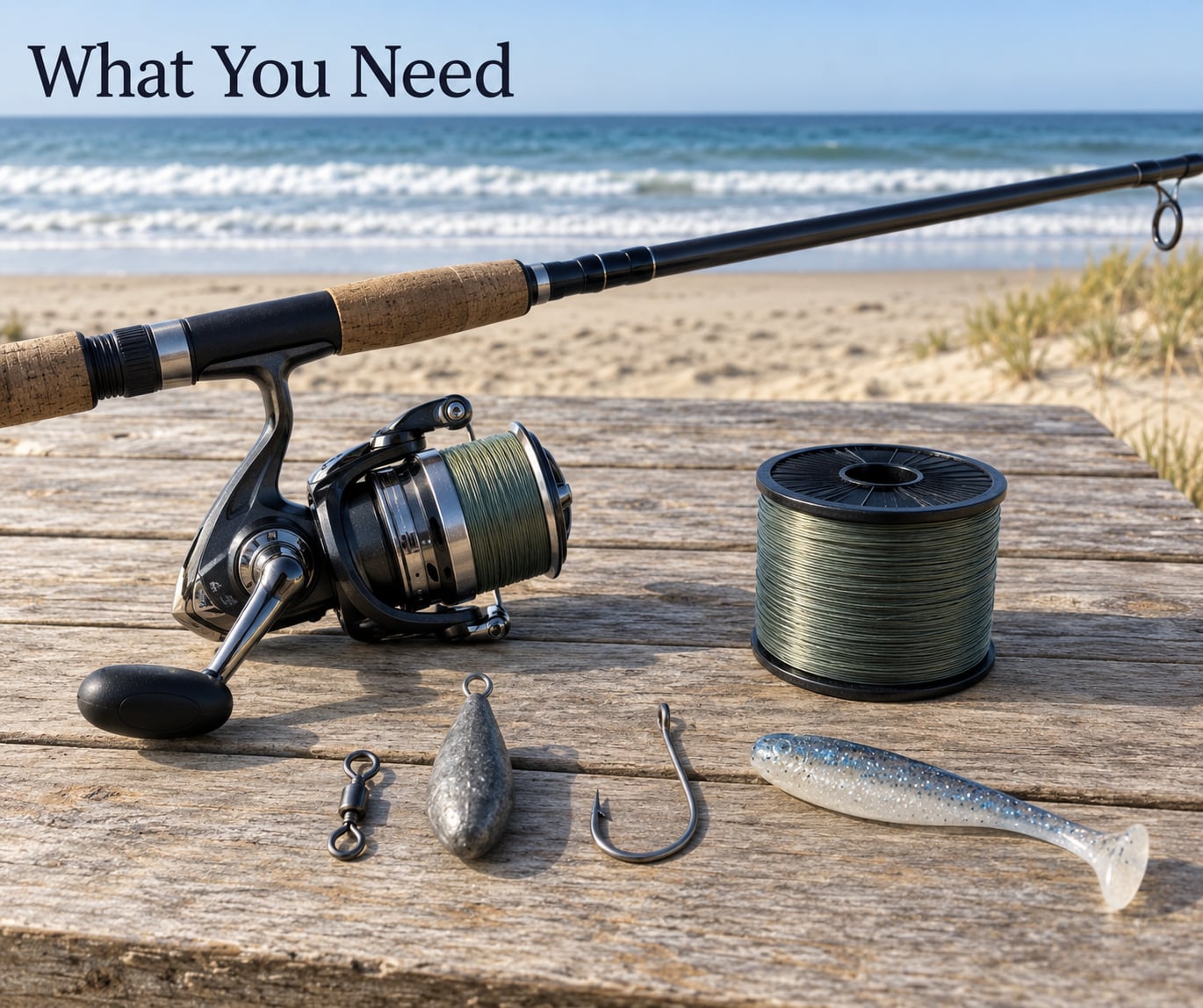
Every component below does one job. The leader holds the hooks at fixed heights, the sinker pins the rig to the seabed, and the swivel stops the line from twisting against itself.
- Rod and reel — a 9 to 10 foot medium-heavy spinning combo for most beach work; a 7 or 8 foot medium rod on a baitcast reel once you are casting 6 ounce sinkers into big surf.
- Main line — 20 to 30 pound mono spooled straight onto the reel, or 30 to 50 pound braid with a shock leader on top.
- Shock leader — 50 to 60 pound fluorocarbon or heavy mono, about 6 to 10 feet long. This is the sacrificial section that absorbs casting shock and abrasion on rocks and shell.
- Leader — 30 to 50 pound mono or fluorocarbon, cut to 3 or 4 feet. This is the part your hooks and sinker live on.
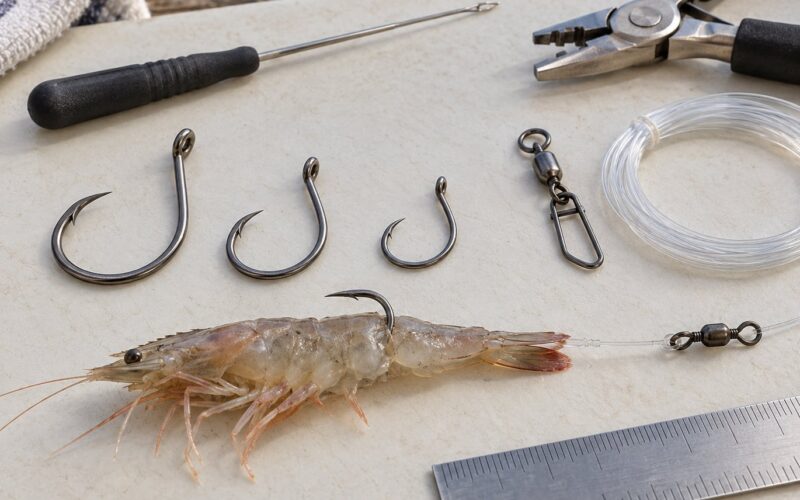
- Barrel swivel — size 5/0 to 7/0, with a breaking strength comfortably above your leader test. A small swivel is the weak link that loses you the rig.
- Circle hooks — 1/0 to 3/0, bent eye. They seat in a fish’s mouth corner and hold without the barb showing much.
- Pyramid sinker — 2 to 4 ounces for calm and moderate beach surf, 6 to 8 ounces when waves are dumping. The point shape digs into sand instead of rolling.
- Optional extras — a bead or two, a foam float, a spare shock leader sleeve, braid or mono for repairs, and a rig board or foam block to wind the finished rig onto.
Read the finished rig from the rod down to the sand, and every piece has a defined position:
- Rod tip — the shock leader, 6 to 10 feet of 50 pound line.
- Top of rig — the barrel swivel.
- 12 to 18 inches below the swivel — the first dropper loop and hook, the high hook.
- Another 12 to 18 inches down — the second dropper loop and hook, the low hook.
- 6 to 10 inches above the bottom — a third dropper loop and hook on a dropper-style build.
- Seabed — the pyramid sinker, 2 to 4 ounces.
Step-by-Step: How to Build a Surf Fishing Rig
The order matters less than the spacing. Build from the swivel down, lay the line out flat, and check your spacing before you cut.
Choose the Right Rod and Reel
Rod power decides how far the rig flies and how much shock the blank absorbs. A medium-heavy rod in the 9 foot range is the sweet spot for a 9 to 10 foot beach: it pushes a 3 ounce sinker past the break without needing a two-handed heave, and it still has enough backbone in the tip to set a hook on a running bluefish.
Reel size mostly matters for line capacity. A size 3000 to 4000 spinning reel holds 200 to 250 yards of 20 pound mono, which is enough to hold bottom in 12 feet of water and still reel a fish back through the surf. Baitcasters in the 2500 to 4000 range suit shorter, heavier rods for rough water and bigger sinkers.
Set the drag before you leave the truck. Turn the star drag until it gives at roughly the line test of your main line, then back it off slightly, because a surf drag set dead even will part your line on the first hard run.
A 9 foot rod is easier to handle in wind and gives more distance; a 10 foot rod keeps the line higher while casting and lifts swell away from you more cleanly. If you cast mostly into a steep bank, go longer. If you fish a wide flat beach, 9 feet feels better all day.
Select the Line and Connect the Main Components
Strip about 200 yards of 20 to 30 pound mono onto the reel, or 30 to 50 pound braid if you want the extra casting distance and low stretch. Braid has almost no give, so pair it with a shock leader. Mono stretches, dulls with UV, and needs replacing each season, but it is easier on the drag and kinder to beginners.
Tie the shock leader to the end of your main line with a double surgeon’s loop. Leave the loop a couple of inches long, wet it with saliva, then tighten it slowly by drawing the standing part down rather than hauling on the knot. A crimp-style sleeve works too if you own one, though the knot is lighter and needs no tool.
Cut 3 to 4 feet of 30 to 50 pound leader for the rig itself. Tie a barrel swivel to the bottom of the shock leader with a Palomar knot, and you now have the top of the rig finished. The swivel is what keeps the dropper loops from winding the leader into a rubber band every time the current hits.
Give the shock leader a hard pull test before you go anywhere near the terminal tackle. If the knot creeps, cut it back and re-tie it. Everything below the swivel is cheap. A parted shock leader in four feet of water means losing the whole rig.
Attach the Weight and Terminal Tackle
For the simplest version, a bottom-hook sinker rig, run the leader through a 1/0 to 3/0 bent eye circle hook, keeping the hook riding point up the leader so the point faces the incoming line. Tie a dropper loop about 6 to 10 inches above the sinker and slide the pyramid sinker on the end.
For the more versatile hi-lo build, add two more hooks. Measure 12 to 18 inches down the leader from the swivel, form a dropper loop, and hang the high hook from it. Repeat 12 to 18 inches lower for the low hook, then a third loop 6 to 10 inches above the sinker if you want three hooks.
Bent eye hooks thread onto a dropper loop in one pass and cannot slide out, which is why most surf anglers use them. Straight eye hooks are easier to swap and work with an FG knot if you prefer, but they need a more careful knot to stay put. On a hard wave, a hook that works loose takes the whole rig with it.
Choose the sinker by the water, not by the fish. Two ounces holds bottom on a flat calm beach. Three to four ounces covers most ordinary surf. If waves are dumping over the spot, go to 6 or 8 ounces, and expect to use a heavier rod to throw it.
A pyramid digs into sand and stays put. A flat sinker or a sliding fish finder weight runs along the bottom, which is better on rock where you would rather the weight move than dig in and cut your leader.
To tie a dropper loop: form a small loop an inch or two up the leader, wrap the tag end around the standing line five or six times, pass the tag end through the loop, wrap it around the standing part another five or six times, back down through the loop, and pull the whole thing closed. Wet it first and tighten it in stages. A dropper loop tied too small will cut into the leader, so leave enough room to slide a finger through.
Tie, Test, and Tune the Finished Rig
Lay the rig straight on a flat surface and check the spacing before it goes on the rod. Shake it lightly. If the dropper loops clatter together and tangle, the spacing is wrong, and no amount of good knots will fix it in the surf.
Load the hooks last. Thread a pea-sized piece of bunker, a strip of squid, a sand worm or a piece of mackerel onto each hook so the point stays covered, and skipper on the sinker if the rig sits on shell. Leave a little slack so the bait can swing.
Beads and floats are optional and they change the rig’s character. A bead adds a click and a flash that can trigger a strike and makes the hook easier to see in dirty water. A foam float holds the bait up off the sand, which matters for pompano and whiting on a flat bottom.
Tune for conditions as you fish. In a strong onshore wind, add weight or move up a size. In a running tide, lighten the sinker so the rig does not drag along the bottom and cut your leader. If bites stop, change the bait before you change the rig.
Common Mistakes
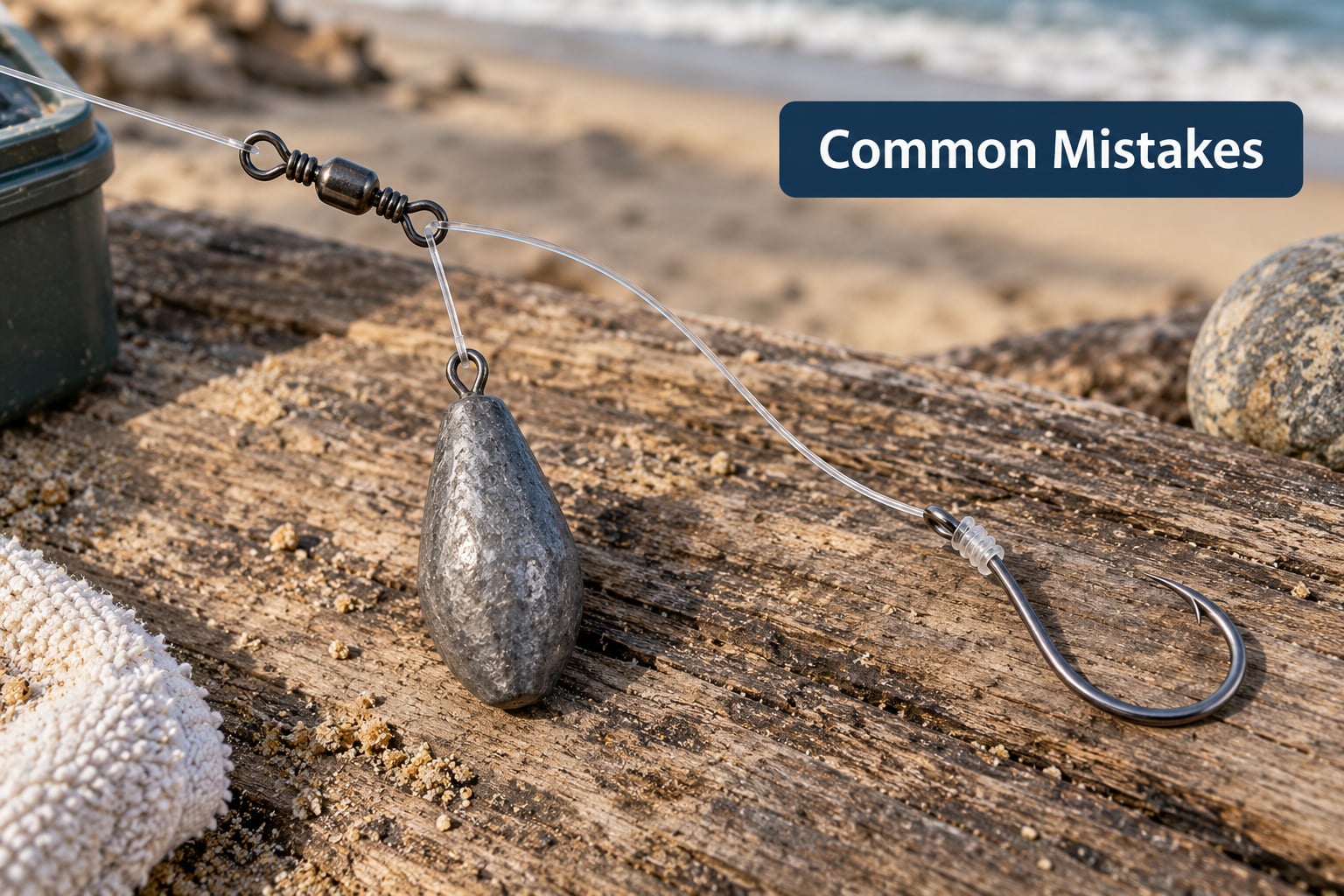
Nearly every lost rig traces back to one of a handful of avoidable errors. Here is what goes wrong, why it costs you fish, and what to change.
Dropper loops too close together. Waves and current fold the loops into each other and the hooks come free. Keep at least 12 inches between hooks, and more in a dumping surf.
Undersized swivel. The swivel is the weakest component on the leader, and it spins the rig into twists. Go one size up from the line test and check it moves freely.
Too little sinker for the water. Light weights bounce along the sand and never present a bait where the fish are. If you cannot feel the weight tap the bottom, go up an ounce or two.
Tying hooks on straight eye hooks with a single overhand knot. Bait thieves and wave pressure pull them free. Use a double surgeon’s loop or an FG knot, or switch to bent eye hooks and dropper loops.
Line twist after every cast. Cast, then let the rig sit in the water for a few seconds and pull the line free before reeling in. A barrel swivel and a slack leader reduce it further.
Cutting leader on rocks and shell. This is what the shock leader is for. If you are fishing structure and skipped the shock leader, add 50 to 60 pound fluorocarbon the same day.
Drag set too tight. Surf fish run hard, and a locked drag parts line on the sand. Set the drag to about the test of your main line, then back off until the spool starts to slip only on a hard pull.
Three habits keep most of that from happening. Wind the finished rig onto a rig board so the leader cannot tangle in the bucket. Check knots and spacing every time you rebuild rather than once a season. And tie everything at the tailgate where you can lay the rig flat, because a knot tied in your lap is where the tangle starts.
Frequently Asked Questions
What is the best surf fishing rig for beginners?
The hi-lo rig is the one to learn first, because every part of it is reusable. A barrel swivel, 3 to 4 feet of 30 to 50 pound leader, two 1/0 or 2/0 bent eye circle hooks on dropper loops, and a 2 to 4 ounce pyramid sinker will fish surf perch, flounder, bluefish and most of what a beginner lands from the beach. A fish finder rig is easier still, but it holds only one bait at a time.
How heavy should my surf fishing sinker be?
Two ounces holds bottom on a calm, flat beach. Three to four ounces covers ordinary surf with a working tide. In dumping waves, a strong onshore wind, or fast-moving water, step up to 6 or 8 ounces and use a heavier rod to throw it. If the weight never taps the bottom, you are light. If your leader keeps cutting, you are dragging it too hard.
Should I use mono or braid for surf fishing?
Mono stretches, which softens the shock of a casting sinker and protects the drag, and it is the easier choice for a first surf setup. Braid casts further and has no stretch, so it needs a 50 to 60 pound shock leader between it and your rig. Many anglers end up running braid with a shock leader once they are casting into wind and heavy water.
What size hook works best for surf fishing?
Size 1/0 to 2/0 circle hooks cover most beach species from surf perch to black drum. Go up to 3/0 for larger fish such as striped bass and shark, and drop to 2/0 or smaller for panfish and sand whiting. Bent eye hooks are the standard for dropper loops because they lock into the loop and will not slide out in a wave.
How do I keep my line from twisting on a surf rig?
A barrel swivel between the shock leader and your rig is the main defense, and the leader should be long enough that the swivel never reaches the rod tip. After each cast, let the rig sit in the water for a few seconds before retrieving so it falls naturally, and reel the slack in before you lift. A tight wound-up leader is what turns a dropper rig into a bird’s nest.
Can I use a surf fishing rig in strong current?
Yes, but match the weight. In a hard-running tide, use a lighter sinker than the surf size would suggest so the rig drifts over the bottom instead of dragging through it, and step up hook and line strength instead. Keep a slack leader, expect abrasion, and carry a spare 50 pound shock leader. Anything heavier than your rod is built to throw will simply break off.
Start with the simple version: a barrel swivel, 3 feet of 30 pound leader, two 1/0 bent eye circle hooks on dropper loops, and a 3 ounce pyramid sinker, tied onto a 50 pound shock leader. Cast it out, let it settle for a few seconds, and watch the leader. Once that rig comes back untangled and the weight is tapping bottom, the only thing left to change is the bait, the hook size, or the sinker weight to match what is biting.