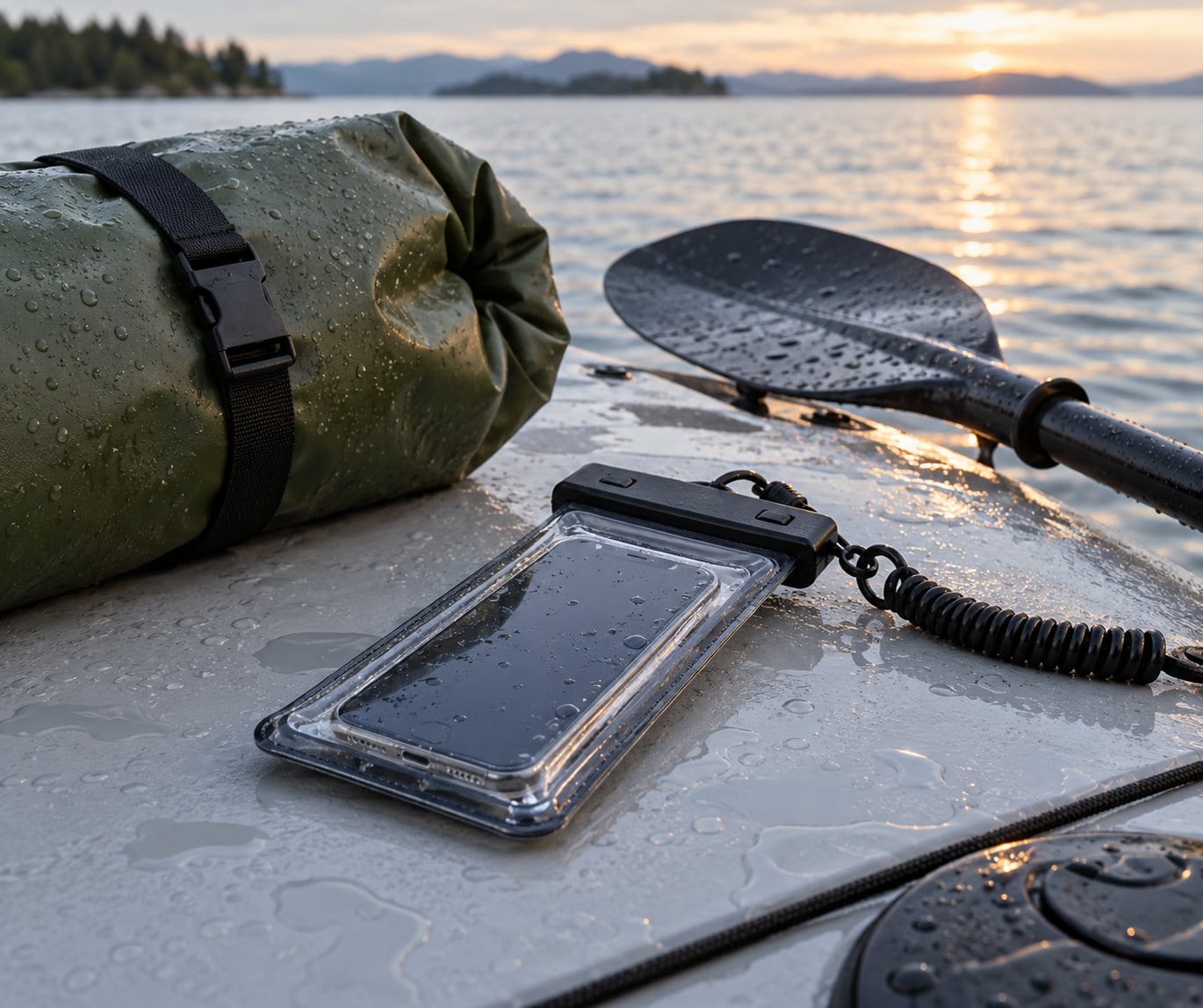
You cannot make a phone itself waterproof for the water. The answer to how to waterproof a phone on the water is simpler: keep it dry inside a sealed enclosure that floats, stays tethered, and gets tested before you launch. Rain, spray, a capsizing kayak and a dock wipeout are all handled by the seal, not by the phone.
The part people skip is the test. Most water damage I have seen came from a pouch that looked fine in the shop and had sand packed into its gasket, or from someone who trusted a box label instead of a tissue test. Give yourself ten minutes before the trip and this becomes a boring, uneventful piece of gear.
Here is the method, step by step, followed by the failures that cause nearly every mishap.
Table of Contents
- What You Need
- Step-by-Step
- 1. Choose the right waterproof phone protection
- 2. Dry and inspect the phone and pouch
- 3. Place the phone inside and close the pouch
- 4. Test the seal before it gets wet
- 5. Secure the pouch where it cannot be lost
- 6. Use, monitor, and dry the phone afterward
- What to do if the phone still ends up wet
- Common Mistakes
- Treating an IP rating as waterproof protection
- Using a damaged or ill-fitting pouch
- Trapping salt or grit at the gasket
- Forcing a cable through a side opening
- Testing only with a splash
- Leaving electronics in wet saltwater
- Opening a cold enclosure too soon
- Frequently Asked Questions
- Can I waterproof my phone in a Ziplock bag?
- Is a waterproof phone pouch safe in saltwater?
- Will my phone work inside a waterproof pouch?
- Can I charge my phone while it is in a waterproof case?
- What should I do if my phone gets wet on the water?
- Conclusion
What You Need
Water-resistant and waterproof are different claims, and the difference decides your whole setup.
An IPX7 rating means the phone survives immersion in fresh water up to about 1 meter for 30 minutes in a lab. IPX8 means a manufacturer-defined deeper or longer dunk, often quoted as 6 feet for 30 minutes. Both are tested in still, fresh water with a bare phone. Salt water, hot water, pressurized spray, and a phone wearing a thick case are all outside that test, which is exactly the environment you are putting it in.
So the phone’s rating is your last line of defense, not your plan. The enclosure does the real work.
Gather this before anything else:
- A properly sized waterproof pouch or dry bag. Buy for your exact phone model, with room to spare. A pouch stretched tight over a case never seals properly.
- The phone, charged, plus a charged power bank. You cannot charge through a sealed enclosure unless it has a designated cable port.
- A dry tissue. This is your seal tester.
- A floating lanyard or a dry-bag tether. A strap that floats, attached to a reinforced eyelet.
- A microfiber cloth for drying hands and screens before you touch a gasket.
Thin disposable food bags are not dependable protection. They tear on rod tips, hooks and paddle hardware, they do not float, and the zip seal on a domestic freezer bag is not a marine seal. If you carry one, carry it doubled inside a proper dry bag as an emergency backup, not as the primary system.
Step-by-Step
Six steps, in order. Most people start at step 4 and wonder why it leaks.
1. Choose the right waterproof phone protection
Match the enclosure to the conditions, and be honest about whether the phone will ever be near the water or merely near the spray.
A sealed floating pouch is enough for rain, windblown spray, and a splash or two while you are actively using the phone. It is the right answer for a cruiser on a calm lake, a SUP session in drizzle, or a trip where the phone stays clipped to your chest and never leaves it.
If there is any realistic chance of full immersion, you want an enclosure with a published IP68 rating and a stated depth, not an unrated marketing claim. That means a hard dry case or a welded-seam pouch you can submerge on purpose without thinking twice.
For kayaking, fishing, boating and beach work, the hardest case wins. Kayak anglers in particular deal with hooks, nets and rod butts that puncture anything soft, so a hard case with a screw-down or triple-lock closure is the safer habit. Knowing how to waterproof a phone on the water starts with this choice, and no amount of careful sealing rescues a soft pouch from a barb.
One more thing to decide now: float or sink. A pouch with built-in foam or an air bladder surfaces if it goes overboard. A non-floating dry bag drops straight down and is usually unrecoverable in current.
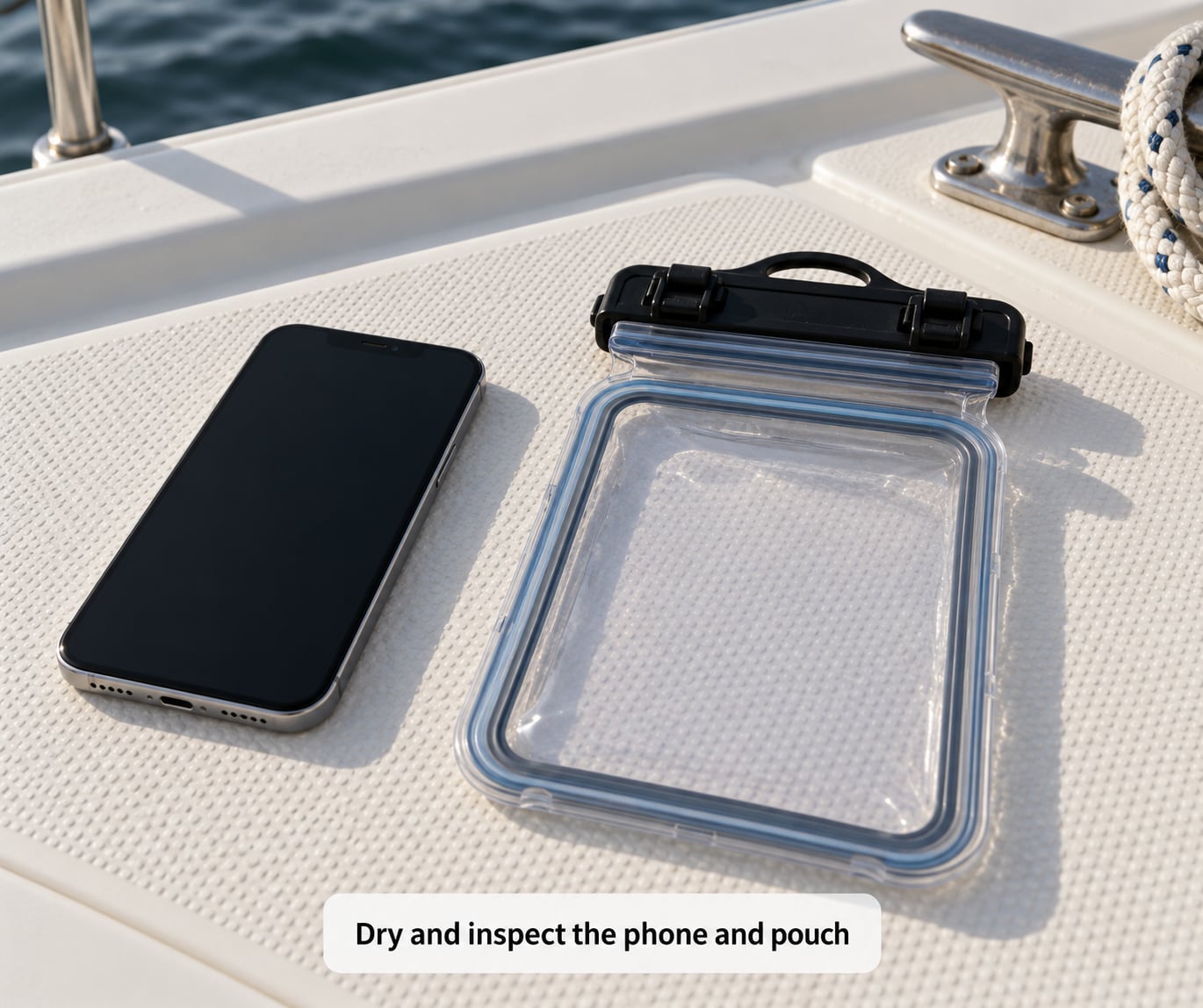
2. Dry and inspect the phone and pouch
Five minutes here prevents most of the failures described later in this article.
Power the phone off and dry it fully, including the charging port and the speaker grille where grit hides. Wipe salt off the phone body and out of any case you intend to leave on.
Then inspect the pouch. Look at the gasket or sealing ring for cracks, warping, a permanent set, or debris pressed into the channel. Check the closure mechanism for a latch that springs open or a hinge that no longer seats. Run a fingernail along heat-sealed or welded seams and look for any separation or whitening in the material.
Finally, put the phone in dry, without closing, and confirm it slides in without force. Forcing a phone into an undersized pouch bends the gasket, and a bent gasket is a failed gasket.
3. Place the phone inside and close the pouch
Loading is where careless seals get created.
Run the phone screen-first, away from the transparent window, so the camera lens sits over the clear panel rather than behind a dark backing. Face the charging port toward any designated cable opening so you are not bending the cable against the seal.
Press the gasket into its channel with clean, dry fingers, running one finger all the way around the ring. Watch for a buckle or a twist that skips a section. It looks closed and is not.
Close the pouch exactly as the manufacturer intends, usually pressing the closure until you feel or hear it seat. No partial closures, no creative use of a zipper left half shut.
Before you seal it, check for anything that can reach through the seam: an open charging port, a case that has come loose, an adapter left plugged in, a fishing hook or a stiff kayak hardware edge pressing against the wall. Anything that can puncture the pouch underwater can puncture it on the deck.
4. Test the seal before it gets wet
Toss a dry tissue inside the pouch and close it as you just did. That is the whole test.
Submerge the sealed pouch in a sink or bucket, or rinse it under a tap, for the time the manufacturer states, then dry the outside completely and open it with dry hands. The tissue tells you everything: dry tissue means the seal held, damp or wet means water got in somewhere and you have a leak to find.
A failed seal usually traces to grit, a twisted gasket, a closure that was not fully seated, or a stretched seam. Clean the gasket channel, dry it thoroughly, load it again, and retest. Do not retry in a damp state, because the tissue will tell you nothing useful.
Run this test at the start of the season and again whenever you change case, replace a strap, or notice any change in how the closure feels. Paddling forum threads repeat the same warning constantly: a seal that fails once and goes back into service without a retest is a seal you will find out about later.
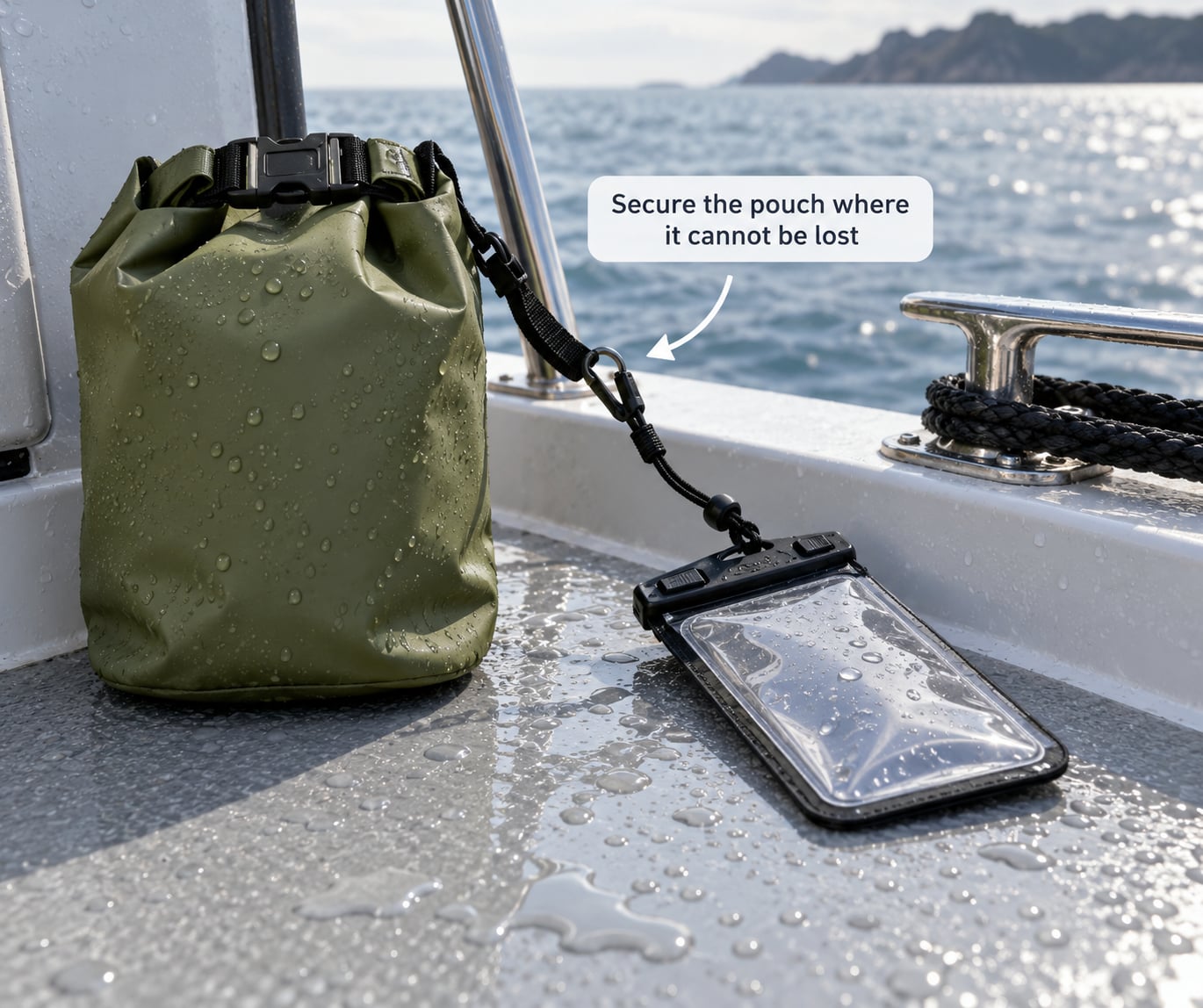
5. Secure the pouch where it cannot be lost
Protection that drifts away is not protection. Attach it before it can move.
On the water, a floating lanyard clipped to a reinforced eyelet works well. Clip it to a life jacket, to a chest lash, or to deck rigging, never to a part of the boat you cannot reach. Keep the tether short enough that you cannot stretch the closure by lifting the pouch to your face, and long enough that the screen stays above the water when you hold it.
Check that the eyelet is reinforced. Lightweight PVC attachments tear out after a season or two of sun and salt, and that failure usually shows up at the worst possible moment.
If you want the phone on the deck or the bow of a kayak, a RAM-Mount style ball-joint holder is the usual answer, with the lanyard still attached as backup insurance. Anglers who fish seriously tend to use both.
6. Use, monitor, and dry the phone afterward
On the water, the best way to protect the seal is to open it as little as possible. Open it at the dock, not mid-catch.
After any rough water, a capsize or a hard landing, glance at the closure to confirm it is still seated. Do not record video while the enclosure is submerged unless the manufacturer rates it for that depth and duration. A pouch that floats can still be swamped by a wave.
Charge from a power bank, not through the enclosure. A cable routed through a side opening is the most common reason a flooded pouch flooded.
After a freshwater trip, rinse the outside and let it air dry before opening if you have seen any leakage. After saltwater, rinse the outside thoroughly with fresh water and dry it fully, because dried salt is abrasive and will chew a gasket in a season or two.
On the boat, condensation appears for the same reason it appears on a window: warm humid air meets a cold surface. Pouches with a felt-style interior absorb a surprising amount of it. Wiping the inside of the window with a dry tissue before you seal helps too, and leaving a desiccant packet in a stowed pouch keeps stored gear from fogging.
What to do if the phone still ends up wet
If it happens, the first five minutes decide a lot more than people expect.
- Get yourself and your crew safe first. In cold water, a phone is never worth a swim or a capsize.
- Recover the phone if it is reachable and recovery is safe. A floating enclosure can be spotted and grabbed in seconds; a sinking one usually cannot.
- Do not put it back in a closed dry bag while it is wet, and skip the rice. Rice does not pull water out of a sealed phone and the starch gets into ports.
- Power it off, then put it in a bag with silica gel desiccant packets and leave it for 48 to 72 hours. Charge it only after it is fully dry.
If the speakers sound muffled afterwards, water is still in the grille. Give it more dry-out time before assuming the board is dead.
Common Mistakes
Almost every soaked phone traces back to one of these seven mistakes.
Treating an IP rating as waterproof protection
The fix: assume water resistance is a backup and put the phone in an enclosure anyway. Lab ratings assume still fresh water and a bare device, and salt water attacks the board faster.
Using a damaged or ill-fitting pouch
The fix: a warped gasket, a hinge that no longer seats, or a pouch that has to be stretched to close will fail. Match the pouch to the phone, case included, and replace anything with visible wear.
Trapping salt or grit at the gasket
The fix: clean and fully dry the gasket channel before every close. Sunscreen and insect repellent are worth watching too, since they are oily and cling to the seal surface.
Forcing a cable through a side opening
The fix: use the designated port, or close the pouch and charge from a power bank. Never shave a notch into a seal to make a cable fit.
Testing only with a splash
The fix: the tissue test takes a minute. A splash never reaches the seam failures that matter, and those only show up under sustained immersion.
Leaving electronics in wet saltwater
The fix: rinse the outside with fresh water and dry it fully. Salt left to crystallise inside a case will keep drawing moisture out of the device.
Opening a cold enclosure too soon
The fix: let a chilled pouch come up to room temperature before opening it. Warm humid air rushing into a cold enclosure produces condensation inside, including on the phone.
Frequently Asked Questions
Can I waterproof my phone in a Ziplock bag?
A single freezer bag is not dependable protection on the water. It tears easily on hooks, rod tips and kayak hardware, it does not float, and the zip is not a marine seal. Doubled bags inside a proper dry bag are a reasonable emergency backup for a short calm paddle. For anything regular, use a manufactured enclosure with a gasket or welded seam and a stated depth rating.
Is a waterproof phone pouch safe in saltwater?
Yes, provided you rinse the outside with fresh water after every trip. Saltwater is far more damaging than freshwater because it corrodes contacts and crystallises as it dries, which then draws moisture out of a sealed device. Rinse the pouch and the phone separately, let both dry fully, and inspect the gasket for salt build-up before the next launch.
Will my phone work inside a waterproof pouch?
Most of the time, yes, with two caveats. Touchscreen response can be slower or occasionally miss taps on thicker pouches, and face unlock is unreliable through nearly every enclosure. Use the side or volume button as a camera shutter and a timer instead of the on-screen control. Test the controls while the phone is in the pouch and closed, not for the first time on the water.
Can I charge my phone while it is in a waterproof case?
Only if the case has a designated cable port that the manufacturer rates for it, and only if the closure is designed to be reopened around the cable. Most are not. The safer habit is a charged power bank carried separately, and a phone at full charge before you leave. Forcing a cable through a side opening is one of the most common reasons a sealed case leaks.
What should I do if my phone gets wet on the water?
Recover it if that is safe, power it off, and skip the rice. Put it in a bag with silica gel desiccant packets for 48 to 72 hours, then charge it only once it is completely dry. Saltwater exposure means a thorough fresh-water rinse first. Knowing how to waterproof a phone on the water is about prevention, but the drying protocol is what saves the device when a seal fails.
Conclusion
Start with the first action and the rest follows: pick a correctly sized enclosure with a manufacturer-stated depth rating, then run a full tissue test before the phone goes anywhere near the water.
After that it is habits, not gear. Keep it sealed while afloat, keep it tethered so a drop becomes a retrieval instead of a loss, charge from a power bank, and rinse fresh after saltwater.
And keep perspective about what you are holding. No waterproof pouch is indestructible. Treat one as the layer that buys you a wet, inconvenient afternoon instead of a lost device, and never let it stand in for a life jacket or a marine radio.