Most anglers who struggle with circle hooks are making one of three errors: they strike at the bite, they bury the hook point in the bait, or the hook is simply too small for the fish that keeps taking it. Get those right and the hook does its own work. This guide walks through how to use circle hooks correctly, step by step, from sizing the hook to tying it on, placing the bait, waiting out the take, and keeping steady tension while the fish fights.
Before the technique, the mechanism matters. A circle hook’s point curves back toward the shank, so when a fish swallows the bait and swims away, the hook rotates on the line until the point slides into the corner of the mouth at the jaw hinge. A fish pulled on a stiff point-tipped J hook already tends to hook that way, but the circle hook does it with slack in the rig, which is why it lands far more fish in that corner and far fewer deep in the throat.
That corner placement is why circle hooks rule for catch-and-release, and why billfish regulations in many waters now require them. Mouth-hooked fish bleed less and survive release at much higher rates than fish that swallowed the hook. If you are still tuning technique as of 2026, this is the piece that usually fixes it.
Table of Contents
- What You Need
- Step-by-Step: How to Use Circle Hooks Correctly
- 1. Choose the Right Circle Hook Size
- 2. Rig the Circle Hook Without Reducing the Gap
- 3. Place the Bait Where the Hook Can Do Its Job
- 4. Set the Hook on a Confident Bite
- 5. Keep Light Tension While the Fish Fights
- Common Mistakes
- Frequently Asked Questions
- Do you have to set the hook with circle hooks?
- How long should I let a fish run before I pick up the rod?
- What size circle hook should I use for my target fish?
- How do I keep the bait from covering the hook point?
- Can you use circle hooks with artificial lures?
- Are inline or offset circle hooks better?
- Conclusion
What You Need
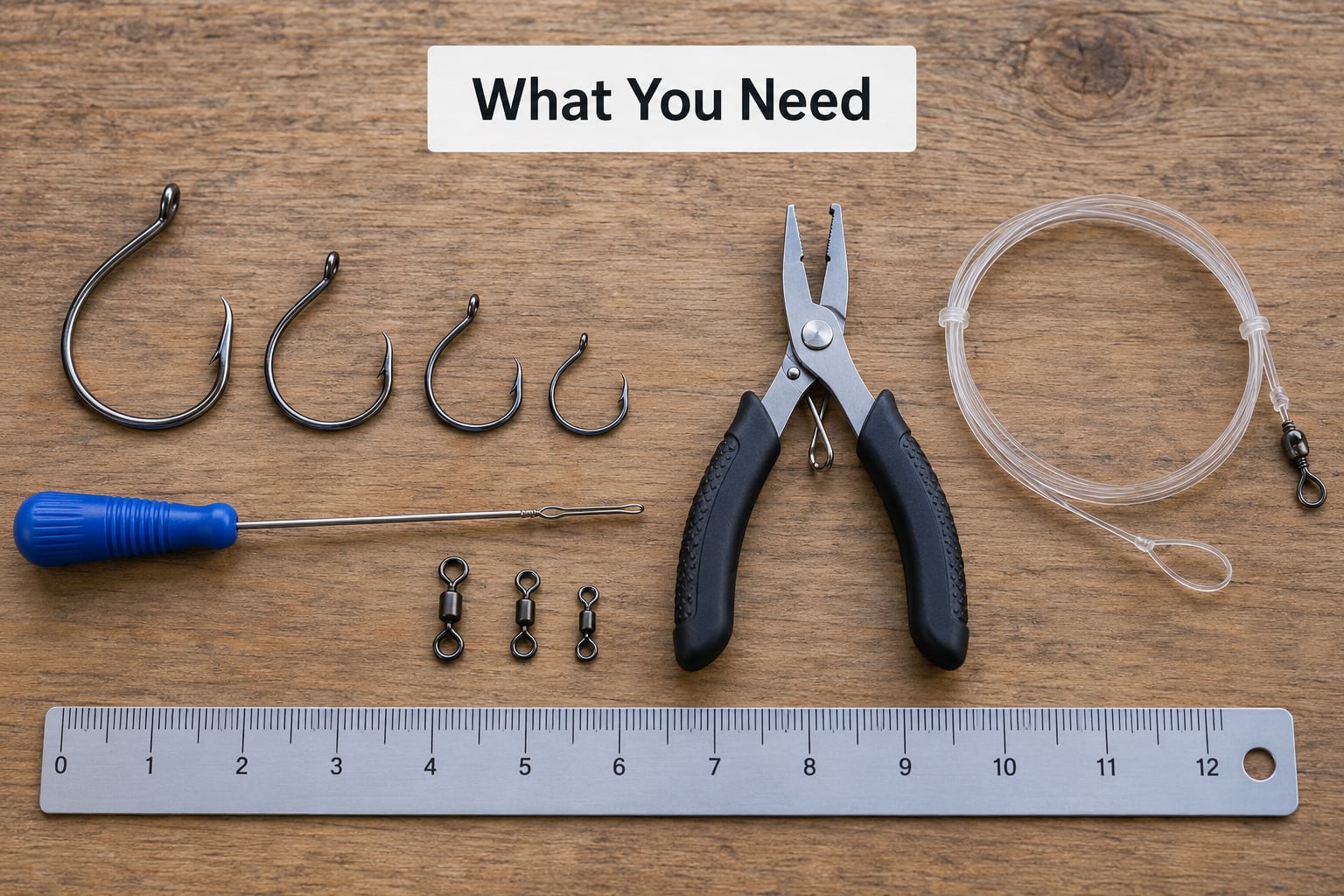
A circle hook is defined by its shape and nothing else. The bend comes back toward the shank, leaving a wide gap between point and shank. That gap is the whole mechanism, so anything that narrows or fills it defeats the hook.
You need three categories of gear, plus the right conditions.
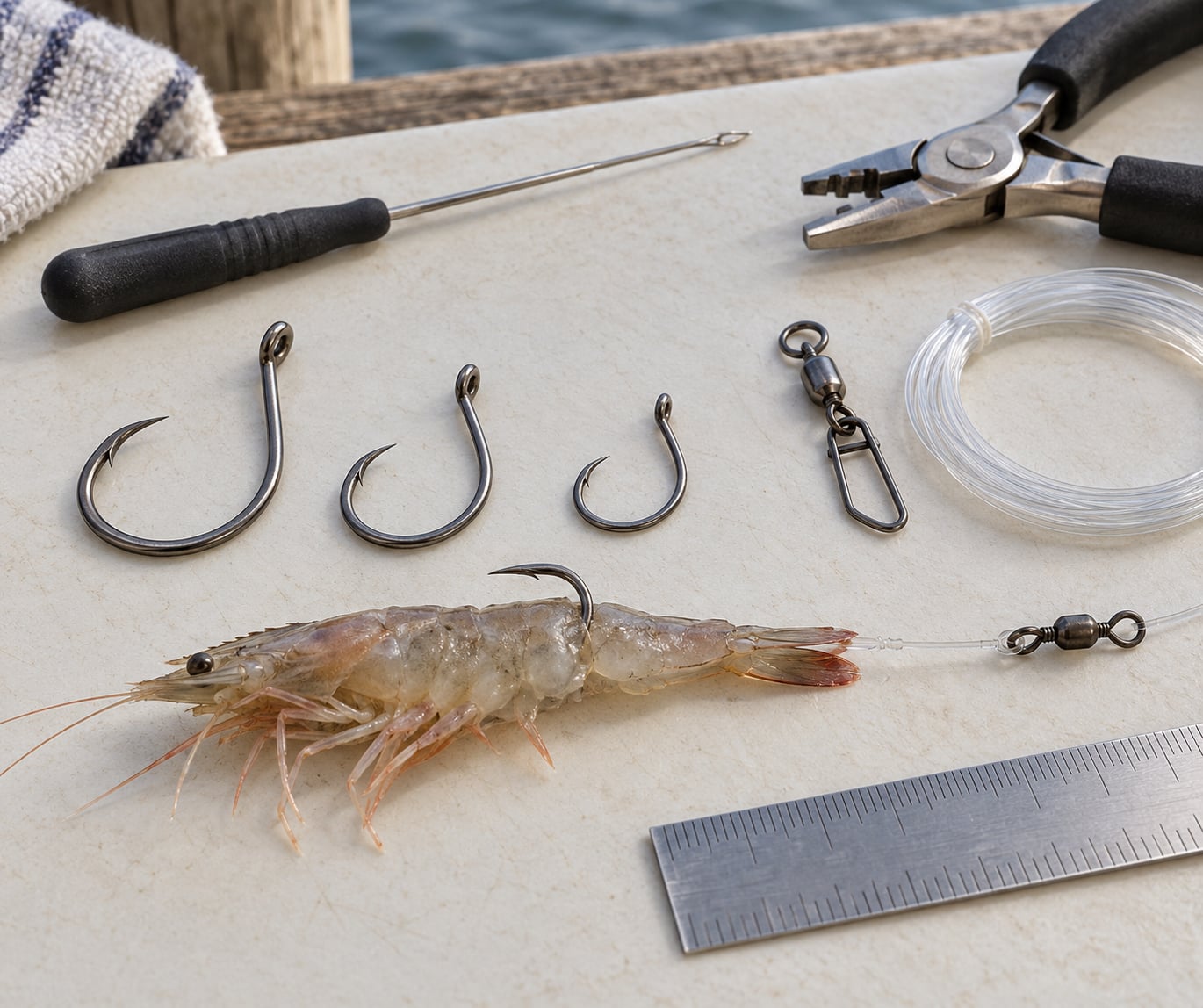
Hooks. Buy the wire weight and gap you need for the fish, and keep the two shapes separate in the box. Non-offset, also called inline, hooks sit straight with the point in line with the shank. Offset hooks push the point away from the shank by a few degrees, which gives the bait more clearance and makes live bait work better. Many billfish and release regulations name inline hooks specifically, so check the rules for the water you fish. Named patterns worth knowing include the Mustad 39960D, Eagle Claw L2004, Owner 5114, and Gamakatsu Octopus Circle.
Hook sizes confuse beginners because two systems run at once. Below a size 1, hooks are numbered, and the higher the number the smaller the hook, so a number 2 is larger than a 4, and a 4 is larger than an 8. From size 1/0 upward, the numbering runs the other way, so 1/0 is smaller than 2/0, and 2/0 is smaller than 4/0. A size 4/0 is roughly a half-inch shank and works for tarpon and large grouper; a size 2 or 4 suits panfish bait.
Terminal tackle. A leader, a swivel, and a knot that lets the hook turn. A quality snap swivel rated for the load keeps the leader from twisting on a long soak. Match your leader to the target, roughly 20 to 30 pound mono or fluoro for inshore species like snapper and grouper, heavier offshore, and no more than your rod can pull. Stiff fluorocarbon can make a good fish lose an otherwise good hookup, so if you feel the rig lock up at the strike, step down a size or change material.
Bait tools. A bait needle for skinning and stringing baits, split-ring or longline pliers, and something to lay baits out on while you thread them. A strip of carpet or a foam board works well for testing rotation, which I will come back to below.
Conditions. Circle hooks earn their keep when the target species swallows the bait whole and pulls away from the angler: snapper, grouper, tarpon, kingfish, the billfish, tuna, salmon, and catfish. They also need a rod and reel you can lower the tip of, and for surf and pier work, a rod holder so the drag can do its job while both hands stay on the bait.
| Target species | Bait pairing | Starting hook size | Rod and line |
|---|---|---|---|
| Bluegill, panfish, small trout | Small live baitfish, shrimp | Number 2 to number 6 | Spinning rod, 6 to 10 pound |
| Bass, crappie | Live bluegill, crawfish | Number 1 to 2/0 | Baitcasting rod, 10 to 15 pound |
| Channel and flathead catfish | Cut bait, live baitfish, shrimp | 2/0 to 4/0 | Baitcaster, 20 to 40 pound |
| Salmon, lake trout | Cut herring, dead bait, plugs | 1/0 to 3/0 | Graphite rod, 20 to 30 pound |
| Redfish, snook, sea trout | Live shrimp, mullet, menhaden | 1/0 to 3/0 | Spinning rod, 15 to 20 pound |
| Snapper, grouper | Live or dead baitfish, cut bait | 2/0 to 6/0 | Baitcaster, 20 to 30 pound |
| Tarpon, kingfish | Live baitfish, slow-pitch jigs with a tail | 3/0 to 6/0 | Baitcaster, 20 to 30 pound |
| Marlin, sailfish | Ballyhoo, rigged squid, bridle bait | 2/0 to 8/0 | 20 pound rod class, 30 pound mono |
Step-by-Step: How to Use Circle Hooks Correctly
1. Choose the Right Circle Hook Size
Size is the single biggest lever. A hook too small for the fish that keeps taking your bait will miss in the jaw hinge every time, because the point never reaches far enough back to catch the jaw. Catfish anglers post this problem constantly, describing heavy rod bends with no hookup at all.
Match the gap to the bait, then match the wire to the fish. The gap in the hook should be just large enough that the point clears the body of the bait and can swing all the way to the shank, but no larger. A number 2 circle hook on a hand-sized baitfish leaves a gap so wide so the point swings free and never commits, while the same hook on a shrimp or a small minnow sits where it should.
Wire strength follows the expected fish weight. Downrigger or bottom fishing for grouper calls for heavier wire and a wider gap than drifting for snapper, and a standard lightweight hook will straighten before a good fish ever gives up.
How do you confirm the fit? Lay the rigged bait on the carpet or on a foam board and pull it slowly across. The hook should rotate freely in line with the bait’s movement, with the point riding just above or along the bait, never swallowed. If the point catches under the belly or the hook drags sideways, the size or the rigging is wrong. Anglers who run that carpet test tell me it catches more problems than anything else they do at the dock.
2. Rig the Circle Hook Without Reducing the Gap
Attach the line to the hook so the hook can turn. That is the entire job of the knot, and it is where most beginner rigs fail.
The standard answer is the snell knot, and for a circle hook the orientation matters more than usual. Run the line from the hook tip back toward the eye, through the eye, around the shank and back through the same eye, then wrap and tuck. Pull it down hard. A poorly dressed snell slips open the moment a fish pulls, and a hook that spins on the leader can never settle into the corner of the mouth.
Power snelling is what offshore anglers mean when they say to snell the hook on with enough force that the knot locks, so the leader pulls straight from the tip of the hook back to the eye. Pull with a leather glove or a cloth, not bare fingers. A perfection loop works too when you want the hook to pivot even more freely, and a double leader with a wind-on knot between two swivels keeps the twist out of a drifting bait.
Then test it. Pull the hook against a piece of carpet by the leader. If the point drags along the shank instead of rolling into line, the snell is dressed backward or too loosely. Nothing else in this guide will rescue a hook that cannot rotate.
One more rigging note worth arguing about: on the World Sea Fishing forum, some experienced anglers point out that a point-tipped J hook rigged stiff already behaves much like a circle, and that circles still outperform it once there is any slack in the rig. That is right, and it is the reason slack is the enemy in the next section.
3. Place the Bait Where the Hook Can Do Its Job
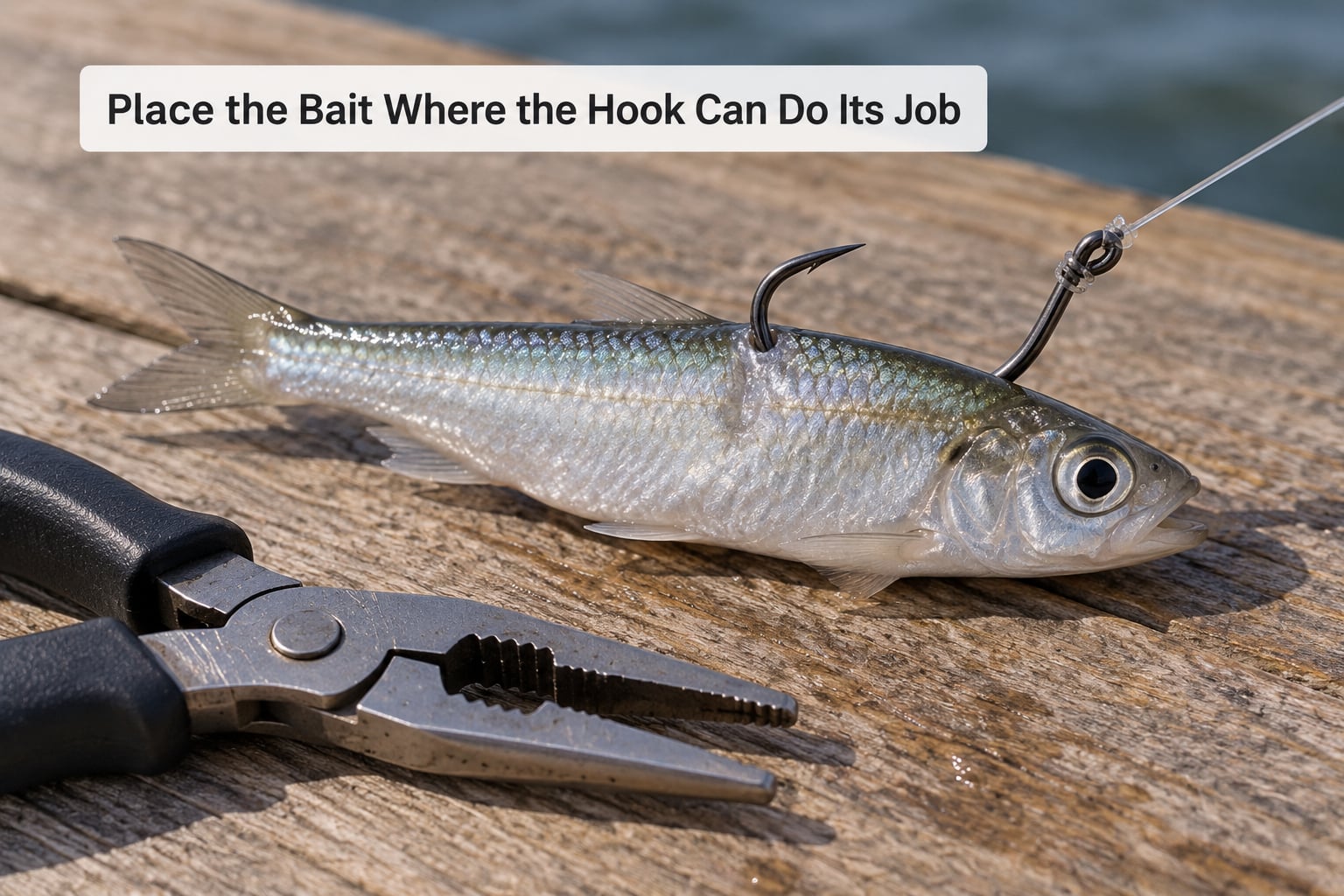
The rule is simple: cover the shank, never the point.
On a live baitfish, most inshore and freshwater anglers run the hook through the mouth, past the gill plate, with the hook shank exiting the top of the head just ahead of the dorsal fin. Nose-hooking gives a better hookup on smaller fish and more swim to bring the bait back to the boat. Back-hooking through the dorsal area works better on larger bait, holds better, and keeps the bait alive longer in livewell heat.
Skinning a bait and stringing it on a needle is the most common method. Enter just under the skin on the back, skin toward the head, and exit near the tail, taking as little meat as you can with the skin. One angler on the Stripers247 forum described skinning just under the belly ridge so the hard edge sits on the beads and holding it with a thread wrap, which keeps the bait from spinning on the hook. Wrapping the thread tight enough to matter and leaving the point clear is what counts.
For shrimp, push the hook through the head or the tail depending on how the shrimp is swimming, and pinch the tail or the shell so the bait keeps some motion. Baitfish rigged on a double leader can sit off the hook’s back and swim freely. Soft plastics get the hook run well into the body with only the bend and point showing, which is as close to bare-hook fishing as you can get.
For hard baits like a rigged ballyhoo or squid, run the hook under the collar or through the head and keep the gap open so the point clears the plastic or feathers on every roll. Before the cast, look at the bait from the side and ask one question: if a fish grabbed it right now, could the point swing into the jaw? If the answer is no, re-rig it.
4. Set the Hook on a Confident Bite
You do not strike. Strike to hook, and you rip the hook straight back out of the mouth. That habit is the single most common circle hook error, and it comes from years of fishing with J hooks.
Instead, learn the difference between a bump and a take. A bump is a nudge, a tap, a bait being repositioned without the line coming tight. A committed take is a hard pull that does not let up, or line peeling away with the drag clicking.
On a committed take, let the fish run. Give it five to ten seconds of free spool with the rod tip low, and let the fish swim away from you on a taut line. If the fish is coming toward the boat, that is a bump or the fish is picking the bait up and dropping it; reel down slowly and wait for the second move. Anglers who switched from snapping the rod at the first tug to holding steady and letting the fish run report the change on almost every river and bay they fish.
On a rod holder, set the hook, lower the tip to the water, and let the drag run. The fish sets the hook as it swims away, and you pick up the rod once the drag stops. Keep the tip down and the line clean. Slack line at the moment of the take is the other reason people watch a fish take a bait and never land it.
5. Keep Light Tension While the Fish Fights
The fight is short if you do less. Rod tip low, pressure steady, no cranking against a running fish.
When the fish runs, give it line. Side pressure from a heavy rod forces the fish to turn rather than run, which is how you steer a fish away from structure, but pulling hard with the drag against a strong fish just pulls the bait or the knot away instead of driving the point deeper. The hook has already set by then; the job now is to keep the point buried and not lose the fish in the air.
Watch for jumps, because that is where circle hook fish come off. Every jump pulls line out at speed and then snaps it slack when the fish lands. Bow to the fish, keep your hand on the spool, and take up the slack as it comes back down. Do not lift the rod above your shoulder to change position. If a fish does throw the hook, the point was probably shallow or the line went slack during the jump.
Do not tighten the drag as the fish tires unless the line is falling behind the hook. A drag that tightens late can pull the hook point out of the jaw and lose a fish that was already won.
When the fish comes alongside, keep light pressure and work the hook back out with pliers rather than yanking on the line. If the hook sits deep in the corner of the mouth and you want the fish released, sliding the point out and the bend straight keeps damage minimal. Bleed the fish in a wet net or glove if you plan to release it, not on the deck.
Common Mistakes
Nearly every lost fish traces back to one of these. Match the symptom to the fix.
| Mistake | What it looks like | The fix |
|---|---|---|
| Striking at the bite | Fish takes hard, hook comes straight back out | Reel down, let the fish run 5 to 10 seconds, then apply pressure |
| Hook point buried in the bait | Good takes with no hookups, bait spinning oddly | Re-thread so the shank is covered and the point rides outside the bait |
| Hook too small for the fish | Fish bends the rod, no hookup, hook straightens | Move up two or three sizes and test the bait on carpet |
| Slack line at the strike | Fish drops the bait or the hook tears free on the jump | Lower the rod tip, keep the line taut, bow to jumping fish |
| Stiff knot or heavy leader | Hook will not rotate, fish turns away at the jaw | Re-snell lighter, drop to a thinner leader or fluoro |
| Wrong leader for the fish | Line parts at the connection on a good fish | Match leader and swivel to the heaviest fish you expect |
| Forcing a hookup after the fish runs | Hook pulled from a fish that was already hooked | Steady pressure, no extra snapping or pumping |
Before you fish, run one check: hold the baited hook at eye level and look straight down the shank. If the point is not visible and the gap is not clear, your bait is wrong and your next cast is wasted. Two minutes of checking beats an hour of blaming the fish.
And be honest about the fish. Circle hooks are poor choices for slashing species such as mackerel and wahoo, for mouth-only feeders like flounder, and for most soft plastic lures where a point-tipped J or kahle-style hook works better. Using them where they do not fit is what gives circle hooks their bad reputation.
Frequently Asked Questions
Do you have to set the hook with circle hooks?
No. A circle hook sets itself because the fish pulls the bait away from you, the line tension rotates the hook, and the point slides into the corner of the mouth at the jaw hinge. Striking at the bite rips the hook back out. On a hard take, drop the rod tip, let the fish run 5 to 10 seconds on a taut line, then apply steady pressure with no snapping.
How long should I let a fish run before I pick up the rod?
Five to ten seconds of free spool with the rod tip low is a good starting point on a hard take. The hook sets during that run, not before it. If the line stops coming, or the fish stops moving and you feel weight on the rod, pick it up and apply pressure. With a rod holder, lower the tip and wait for the drag to stop before you touch the reel.
What size circle hook should I use for my target fish?
Match the hook gap to the bait and the wire to the expected fish weight. Panfish and small trout take a number 2 to number 6, bass and crappie a number 1 to 2/0, catfish 2/0 to 4/0, and snapper, grouper, tarpon, and billfish 2/0 up to 8/0. Below size 1 the numbers run backwards, so a number 2 is larger than a number 4.
How do I keep the bait from covering the hook point?
Cover the shank and leave the point clear. Skin a bait as thinly as you can, enter just under the skin on the back, and exit near the tail, then add a tight thread wrap to hold it. For live bait, run the hook through the mouth and exit at the top of the head. Before each cast, check from the side that the point can still swing into the corner of a mouth.
Can you use circle hooks with artificial lures?
Barely. Circle hooks need a bait the fish picks up and carries away from the angler while line tension stays on the lure. Most soft plastics, spoons, and jigs are pulled toward the fish, so a circle hook rarely rotates into the jaw hinge and the lure slides off the gap. If you like the hook, use it with a slow-pitch jig with a soft tail, or a hollow body the fish picks up and swims with.
Are inline or offset circle hooks better?
Inline, non-offset hooks keep the point in line with the shank, and many billfish and release regulations require them because they land more fish in the corner of the mouth. Offset hooks angle the point away from the shank, which clears bulky baits better and makes live bait easier to rig. Beginners fishing live bait for inshore species often get along with offset; anyone fishing to a rule should check that rule first.
Conclusion
Start with three things on the dock. Pick a circle hook whose gap matches the bait and whose wire matches the fish, snell it so the hook turns freely in line, and cover the shank without covering the point. Then when a fish commits, lower the rod tip and let it run five to ten seconds instead of striking.
Almost every circle hook complaint I hear traces back to a habit, not a bad hook. Bait presentation, clean tension, and patience on the take do the work that the hook shape starts.