A fish slot limit is a fishing regulation that makes one size band of fish off limits to keep, so an angler must release anything that measures inside that band. It exists to protect the big, old breeding fish that produce the most offspring, while still letting people harvest smaller fish.
That is the whole idea, but the rule language gets complicated fast, and it changes from one lake, river or bay to the next. Here is what the terms mean, what a slot limit is actually trying to accomplish, and how to check the rules for your own water before you fish it.
Updated for October 2026. Rules below are used only to show how regulations are commonly written. Always confirm current limits with the agency that manages your water.
Table of Contents
- What Is a Fish Slot Limit?
- Why Do Fisheries Use Fish Slot Limits?
- How Do Fish Slot Limits Work?
- What Is the Purpose of a Fish Slot Limit in Conservation?
- Slot Limit vs. Catch-and-Release Limit
- Examples of How Slot Limits Are Written
- Do Fish Slot Limits Apply to Every Kind of Fishing?
- How to Check and Follow the Rules for Your Water
- Why Do Slot Limits Change?
- Frequently Asked Questions
- Does a fish slot limit mean you can only catch that many fish?
- Do fish that do not meet the size limit count toward a slot?
- Can a fish slot limit change between rivers, lakes, and coastal waters?
- Does a federal or state license mean the same daily slot everywhere?
- What happens if an angler accidentally keeps too many fish?
- Why might a slot limit be stricter during spawning season?
- Conclusion
What Is a Fish Slot Limit?
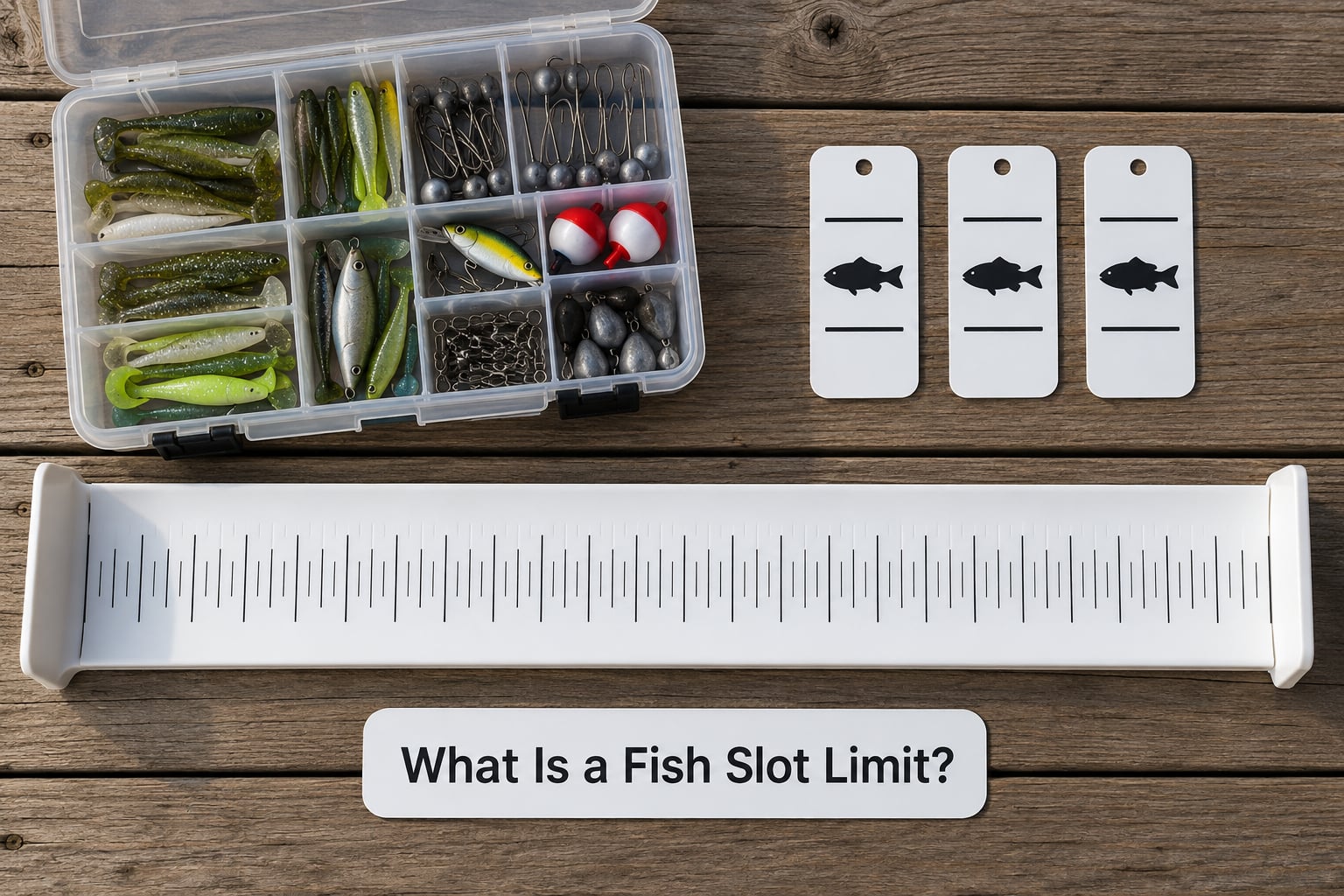
What is a fish slot limit? It is a regulation that sets a lower bound, an upper bound, and sometimes an allowance above that upper bound, creating a band of fish sizes that you may not keep. Anything inside the band has to go back in the water, usually described in the rule text as fish that must be immediately released or that may not be possessed.
Some agencies use the term protected slot. The words mean the same thing: a protected band of sizes carved out of the middle of what would otherwise be legal to harvest.
Three ideas get tangled together constantly, so separate them before you fish anything.
A slot limit governs fish you keep. It says which sizes you may take home out of the sizes that are legal in the first place. It does not stop you from casting, hooking, or landing a fish that falls in the band.
A possession limit is broader. It says how many fish of a species you may have in your possession at one time, and it can reach fish you did not catch that trip, such as a fish a companion kept for you. Slot limits usually sit on top of a possession rule rather than replacing it.
A minimum length limit is the opposite shape. It protects the small end and lets you keep the large end. A slot does the reverse, which is the single most useful thing to remember.
Why Do Fisheries Use Fish Slot Limits?
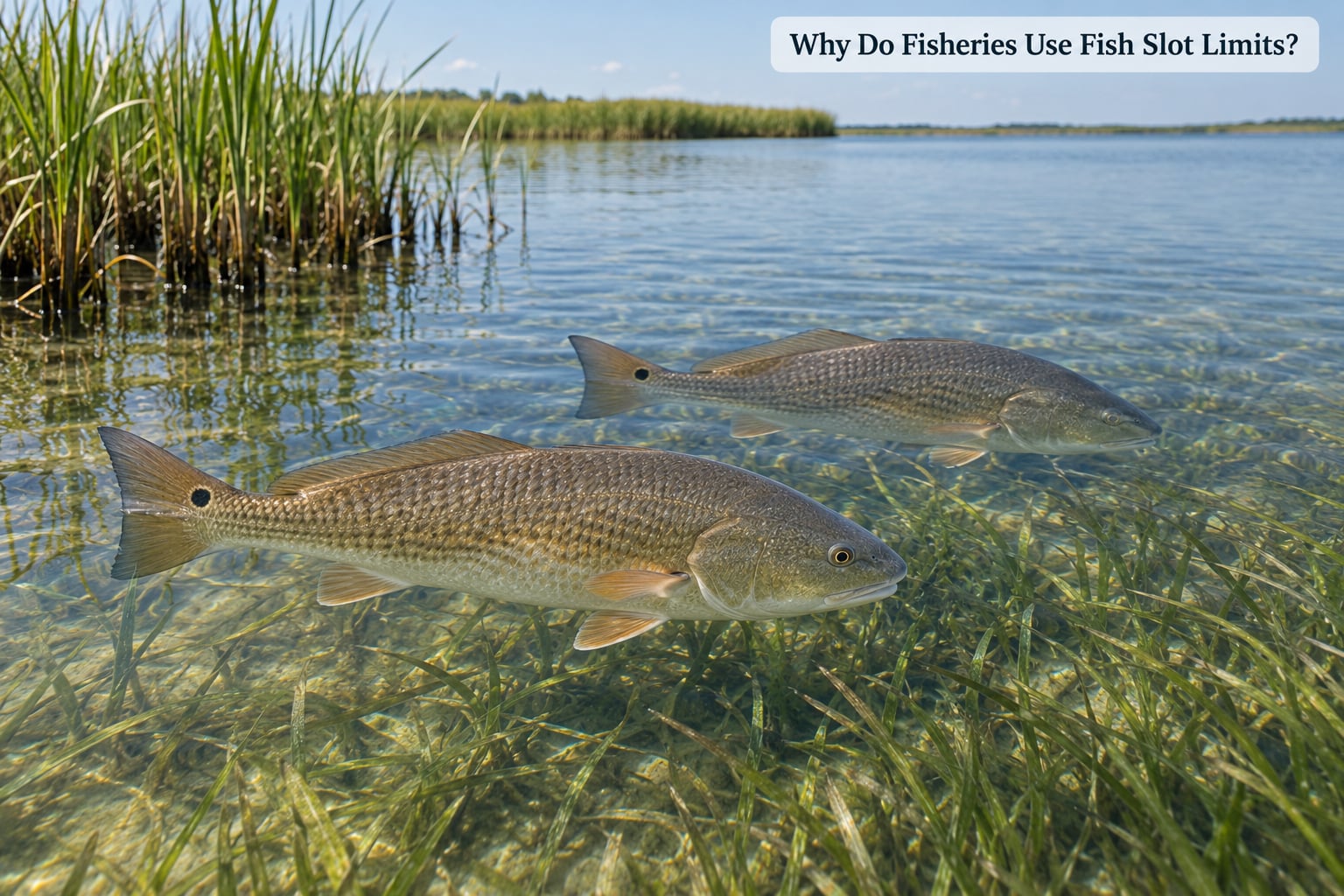
The management reason a slot limit exists is that the largest fish in a population are the most valuable ones to the fishery and the easiest to over-harvest. One big breeding female can produce far more eggs, and often a higher proportion of surviving young, than a fish half her size. Remove too many of them and the population thins out from the top faster than it can replace them.
Biologists who set slot limits are usually working toward a short list of goals.
- Protect large breeding females. The band covers the sizes that do most of the spawning, so the fish producing the next generation stay in the water.
- Hold the size structure. They want a population with a healthy spread of ages and sizes, not one where a few giants hide in a lake with almost nothing beneath them.
- Allow harvest of smaller fish. This is the part anglers notice. A pure minimum length limit leaves the biggest fish wide open, so the alternative lets you take fish below the band and, often, a small number above it.
- Let remaining fish grow faster. With fewer large competitors eating the food supply, fish below the band convert that forage into faster growth and reach larger sizes sooner.
- Help a depleted population rebuild. When surveys show too few large spawners, a slot is a blunt but effective way to buy the stock time to recover.
There is a common belief, repeated on angler forums, that slot limits are set to protect the sport of catching a big fish rather than the resource. The biology points the other way. The fish in the band are exactly the ones whose removal costs the population the most, and that is why the band is placed there.
How Do Fish Slot Limits Work?
A slot limit usually applies to a specific species, on specific waters, for a specific season or year-round, and it is measured in total length, which is the longest measurement of the fish from the tip of the snout to the end of the tail fin. A rule that reads fish from 19.5 through 28 inches must be immediately released means every fish in that inclusive range, with or without an inch to spare, is a release.
Fish inside the band do not count against the number of fish you may keep, and keeping one is still a violation even if you throw it back later. A fish that grows past the upper end of the band, and is under the allowance above it, may be harvested. That single detail answers a question anglers ask constantly: a slot fish is not a protected fish forever, it is a fish temporarily protected by its current size.
Whether the limit applies per person or per boat is set by the agency, not by you. Some waters run creel limits per angler, some cap the whole party, and some combine the two.
| Rule type | What it controls | Typical wording |
|---|---|---|
| Daily slot | Which sizes you may keep at all | Fish from 19.5 through 28 inches must be immediately released |
| Tagged-fish bonus allowance | Extra fish allowed with a special tag or permit | One tagged fish may be kept in addition to the daily limit |
| Possession limit | How many fish of a species you may hold at one time | No person may possess more than the daily limit at any time |
What Is the Purpose of a Fish Slot Limit in Conservation?
Think about the purpose of a fish slot limit in conservation terms: it reduces the number and, crucially, the size of the fish removed from a water body. That changes the population’s reproductive output, its growth rates, and the number of larger fish available in later seasons.
Cutting harvest of the oldest spawners raises the number of eggs produced per year. Protecting the biggest predators reduces pressure on the smaller fish that feed everything above them, so more of that forage grows and survives. The result, when the numbers work, is a population where more fish reach large size over time rather than a lake where the same five giant fish appear every year and nothing new replaces them.
Slot limits are not a guarantee. They are one tool among many, and what a biologist actually uses depends on the species, the survey data and the water.
Slot Limit vs. Catch-and-Release Limit
A catch-and-release limit is a different tool. It permits you to keep nothing of that species, or nothing under a certain size, and everything else comes back. A slot limit says you may keep a great many fish, just not the ones in the band.
Several combinations exist, and real regulations mix them. A water might have a minimum length limit with a protected slot above it, so small fish are released and mid-size fish are released and only the giants are yours. Another might set a slot for one species and full catch-and-release for a different one on the same lake.
Counting a slot and a release rule as the same thing is how people end up in trouble. A common mistake is assuming that a catch-and-release rule means you can keep the fish once you are tired of releasing it. It does not. Another is assuming a fish in the slot would have been fine to keep because the season’s bag limit was not full. The band applies regardless of how much room is left in your limit.
One more thing is worth saying plainly. Catch-and-release is not automatically gentle on fish. Anglers fishing certain deep-water species are warned that the depth a fish is brought up from kills a noticeable share of it after release, which is a good reason to adjust how and where you fish rather than assuming every release is a free action.
Examples of How Slot Limits Are Written
The examples below are illustrative. They show how agencies phrase these rules, not the current regulation on any specific water. The numbers are round numbers chosen to make the structure of a rule visible.
A standard two-fish daily slot with a protected band reads like this: small fish below the band may be kept, two per day; fish inside the band must be immediately released; and one fish above the band may also be kept, counting toward the daily allowance if the regulation says so.
A slot applied only to larger fish of one species reads differently. If the band runs from a high minimum to a maximum, everything from the minimum up to the maximum must be immediately released, the fish below the minimum may be harvested under the normal length rule, and the fish above the maximum may be kept only under a separate trophy allowance with a limited number.
A seasonal slot is the same idea with a date attached. A band that opens with a season and closes when the agency sets a new end date gives you a different answer in June than in September on the same water, with the same fish.
| Scope | Keep allowance | What counts toward it |
|---|---|---|
| Two-fish daily slot with a 19.5 to 28 inch protected band | Two fish under 19.5 inches, plus one over 28 inches | Fish inside the band are release-only and do not use an allowance |
| Large-fish-only slot on one species | Fish under the minimum per the normal length rule | Fish above the maximum need the trophy allowance and may be capped per season |
| Seasonal slot with a published end date | Whatever the season allows while the band is open | Same rule as the daily slot, with the band closing on the published date |
Reading the sentence is most of the work. Look for the word immediately, which is a release instruction, and for the word possessing, which means the count in your livewell or cooler is what matters rather than your intent.
Do Fish Slot Limits Apply to Every Kind of Fishing?
Not always, and the exceptions are where anglers get caught out. A slot on a state-managed lake may cover only boat fishing and leave shore anglers under a different rule, or apply to charter operators under a separate set. Federal waters, tribal waters, national wildlife refuges and state preserves can each run their own regulations, and a boundary water shared by two states can have a different line drawn through the middle of it.
Commercial harvest is governed by separate quotas and permits rather than angler bag rules, though the biology behind them is the same. Special programs, such as tag-and-release programs that let an angler keep one tagged fish over the limit, change the allowance for the people enrolled in them and for nobody else.
The safe assumption is that a recreational slot applies to you unless the rule text specifically says otherwise.
How to Check and Follow the Rules for Your Water
Working through this before the ramp saves a fine and saves the fish.
- Name the water and the jurisdiction. Find out whether it is state, federal, tribal or a specific reservoir, and whether you are on a boundary where two rulebooks apply.
- Read the current agency regulation, not an article about it. The state’s fish and wildlife or natural resources department publishes the authoritative rules, and many lakes also have a water-specific booklet that overrides the general book.
- Write down the three numbers that matter for each species. The band, the allowance above it, and the number you may keep. Angler forums are useful for warnings about enforcement, not for the numbers themselves.
- Bring a ruler and measure as the rule defines it. Most bands use total length, and the difference matters at the edges, especially on a fish sitting at 19.5 inches.
- Decide at the boat, before the fish goes in the livewell. A fish in the band that is measured later, in the parking lot, is still a fish you kept.
- Handle a release properly. Keep handling short, minimize air exposure, and return the fish in water of similar temperature. For a species anglers regularly catch in deep water, match the release depth more carefully.
- Ask staff when an edge case is unclear. A ramp attendant, park ranger or license office can confirm what applies today, and a photo of the current rule page on your phone settles a later argument.
Anglers on angler forums describe the measurement step as the part that creates the most friction, particularly measuring a good fish in front of other boats. A quick call to the agency before you leave settles most of those questions in under a minute.
Why Do Slot Limits Change?
Slot limits are not permanent because the populations they manage are not permanent. Agencies adjust them after stock assessment surveys, when harvest data from licensed anglers shows a trend, when habitat conditions shift, and when weather events such as floods, drought or heat waves affect spawning success. Rules also change when a recovery target is met, when a new species moves into a water, and when a band is widened or narrowed after a few seasons of results.
That is the reason an article like this one cannot give you the rule for your lake. A forum thread or a lakeside page that was accurate five years ago may be describing a band that has since been closed, narrowed, or shifted to a different set of waters. The current agency rules are the only version worth fishing by.
Frequently Asked Questions
Does a fish slot limit mean you can only catch that many fish?
No. A slot limit controls which sizes of fish you may keep, not how many you may catch. You can keep fishing and keep landing fish inside the protected band, but each one must be released. The number of fish you may take home comes from a separate possession or bag limit, and a slot band usually sits on top of that rule rather than replacing it.
Do fish that do not meet the size limit count toward a slot?
It depends on which rule you mean. A fish inside a protected slot band must be released and does not use up one of the fish you are allowed to keep. A fish below a minimum length limit is the opposite case: it is not a legal fish, so it cannot be counted or kept either way. The daily number applies to fish you are actually allowed to harvest.
Can a fish slot limit change between rivers, lakes, and coastal waters?
Yes, and it changes more often than most anglers expect. Each body of water is managed on its own survey data, so a band on one lake may not exist on the next one over, and coastal and river systems follow their own rules. A license covering several waters is not a promise that the same band applies at all of them.
Does a federal or state license mean the same daily slot everywhere?
No. A license gives you permission to fish, not a uniform allowance. State waters, federal waters, tribal waters and managed reserves each publish their own rules, and many water bodies add local booklets with different bands and season dates. Check the rules for the specific water you are standing on, on the day you are standing there.
What happens if an angler accidentally keeps too many fish?
Penalties depend on the state and the water, and they commonly include a fine plus a licence suspension or points on your record for repeat offences. Keeping a single fish from inside a protected band is often treated as its own violation even when your total count is legal. If you realise the mistake, contact the agency before you do anything with the fish.
Why might a slot limit be stricter during spawning season?
Because the fish that matter most for recovery are the ones about to spawn. Protecting those adults through the breeding window costs the fishery very little, because those fish are not usually targeted for harvest in that period anyway. An agency that closes or tightens a band in the spring and loosens it later is protecting spawning success, not punishing anglers.
Conclusion
A fish slot limit is a conservation tool that protects a band of fish sizes from harvest so the largest breeding adults stay in the water, while still allowing you to keep smaller fish and, often, a limited number of very large ones. It governs what you keep, not what you catch, and it is only one piece of a rulebook that also covers minimum lengths, possession limits and seasons.
Before your next trip, name the exact water, find the current rules published by the agency that manages it, and write down the band, the allowance above it and the number of fish you may keep. Then take a ruler. Every rule described here can change between waters and between seasons, so the current agency page beats any article, forum post or lakeside sign you remember from a trip years ago.