Learning how to catch blue crabs with a trap is mostly about three things: a legal trap that suits your water, oily bait that stays put, and the patience to pull the line slowly so the crabs are still inside when the trap surfaces. A first-time crabber can set a trap in about ten minutes and make a full rotation in under an hour.
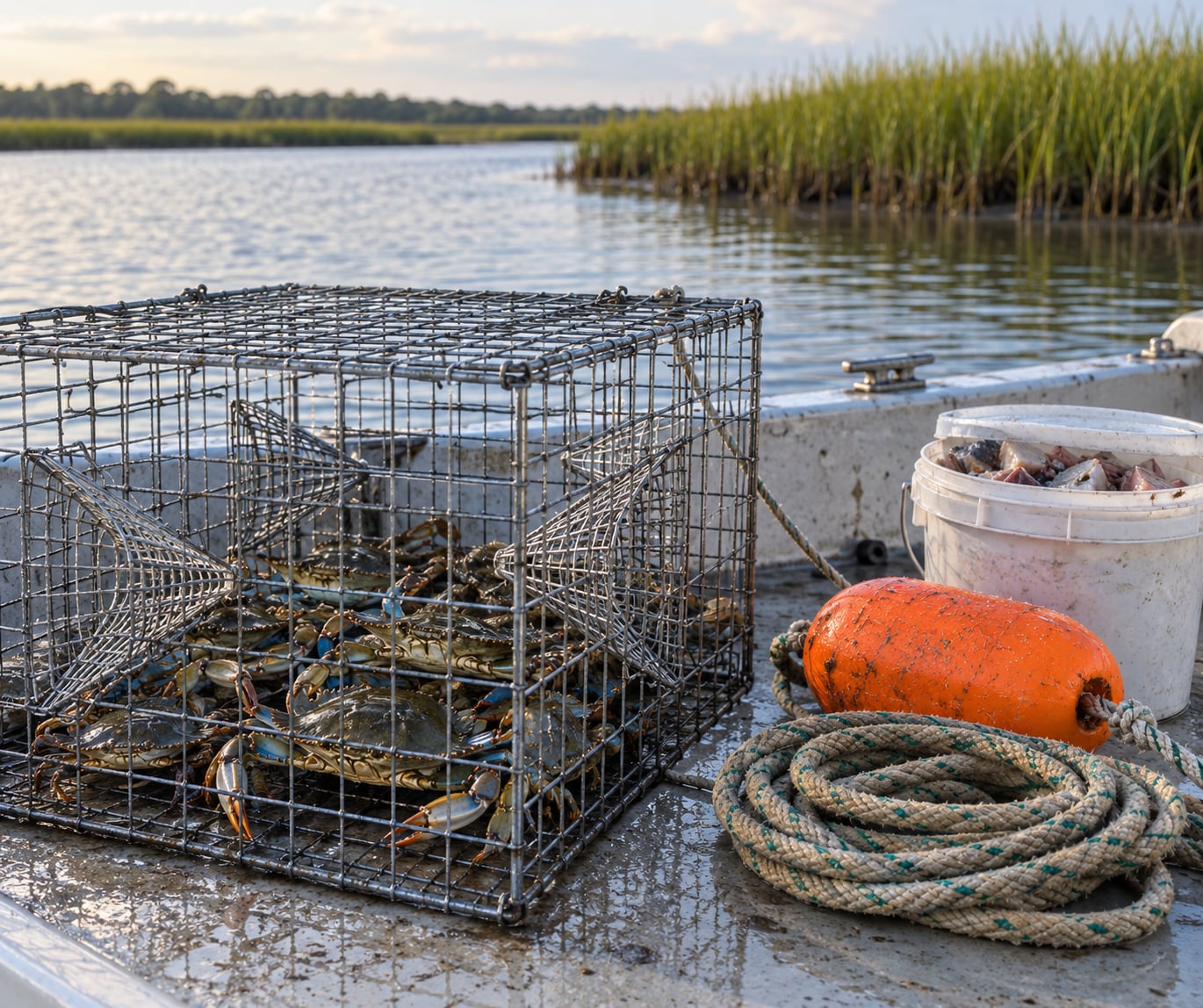
The trap is a wire cage with one-way funnel entrances. You bait it, drop it to the bottom, let it soak, then haul it back up before the catch finds its way out. Done properly it gets crabs out of water too deep to wade, without needing a second person watching a hand line all afternoon.
Table of Contents
- What You Need
- Step-by-Step
- How to Catch Blue Crabs with a Trap: Choose a Legal Location
- How to Catch Blue Crabs with a Trap: Prepare and Bait the Trap
- How to Catch Blue Crabs with a Trap: Set and Secure the Trap
- How to Catch Blue Crabs with a Trap: Check the Trap
- How to Catch Blue Crabs with a Trap: Handle and Store the Catch
- Common Mistakes
- Frequently Asked Questions
- What is the best bait for catching blue crabs in a trap?
- How long should a blue crab trap soak before being checked?
- What depth should I set a blue crab trap?
- Can I use a blue crab trap in protected waters?
- How do I keep blue crabs fresh after catching them?
- Why is my blue crab trap coming up empty?
What You Need
Most beginners can start with a handful of items, and two of them matter far more than the rest: a trap with funnel-style entrances and bait that actually smells like food to a crab.
- A crab trap. Wire cage with one-way funnels and a wire bait basket in the centre. Look for vinyl-coated or galvanized wire so it survives salt water.
- A bright marker buoy carrying your name and a contact number. Unmarked buoys are the single most common reason beginners lose a trap.
- 10 to 12 feet of line, more if you are fishing deep structure. Most crabbers use 100 to 200 lb test mono or braided line.
- A small weight or dive weight if the bottom is soft enough that the trap will not sink on its own.
- Bait: chicken necks and backs, oily fish scraps, menhaden, or squid. Chicken necks are the classic beginner choice.
- A mesh bait bag or small bait box so crabs cannot carry the bait out of the trap.
- A dip net to scoop crabs that come out of the trap at the surface.
- Heavy gloves and crab tongs. A blue crab claw can break a finger, and it will do it fast.
- A lidded cooler or bushel bucket with ice, and a crab caliper for checking size.
- A licence and the current agency rules for the water you plan to fish.
Trap depth and current decide which style you want. Match the style to where the crabs are, not to what looks good in the shop.
| Trap type | Best water | Typical soak | Durability | Beginner fit |
|---|---|---|---|---|
| Ring or drop trap | Shallow, protected bays and channels | 5 to 15 minutes | Low; light wire | Good for short pier trips |
| Box trap | Deeper water, tidal creeks, boat work | 30 to 60 minutes | High; many seasons | Best first upgrade |
| Pyramid or string trap | Deep water, strong current | Several hours or overnight | Low; a few trips only | For commercial-style rigs |
| Collapsible wire cage | Anything; folds flat for storage | Any | Medium | Easiest to stow in a car boot |
Step-by-Step
Six steps, in the order that works. Start at the top each time.
How to Catch Blue Crabs with a Trap: Choose a Legal Location
Read the rules for the exact water you are fishing before you buy anything. Recreational crabbing usually needs a licence, most states cap the number of traps and the daily bag, and several require specific gear hardware.
Confirm which agency applies. Shore and pier harvest often falls under one set of rules while the same water fished from a boat falls under another, and that confusion trips up a lot of newcomers.
Look for water in the 3 to 10 foot range with a soft or muddy bottom, some structure such as a channel edge, eelgrass bed or jetty, and enough current to carry scent. Slacker water and bare flat bottom are the two worst choices you can make.
Tide matters more than the calendar. Set one to two hours before peak tide and pull at peak or just after, when crabs are moving across the bottom.
How to Catch Blue Crabs with a Trap: Prepare and Bait the Trap
Check the wire, the funnels and the escape rings before it goes in the water. A bent funnel or a missing ring turns a good trap into a crab-release device.
If the trap is collapsible, press the panels flat for storage, then pull the two halves apart so it springs open. Shake it to confirm it locks square, then tie your bridle or ring to the bottom eye with a bowline.
Crabs locate food by scent, not sight, so bait quality matters more than bait quantity. Two or three pieces of oily bait beat a bucket of nothing.
Anchor the bait inside the cage in a mesh bag, a bait box, or zip-tied to the bottom wire. This is the fix most beginners miss: loose bait gets stripped within minutes and the trap comes up clean. Crabbers on fishing forums repeat this one constantly, and empty traps are usually the reason.
Use fresh bait when you can and frozen when you cannot. Chicken necks, chicken backs, menhaden heads and oily scraps such as mackerel all work; squid works better in colder water.
How to Catch Blue Crabs with a Trap: Set and Secure the Trap
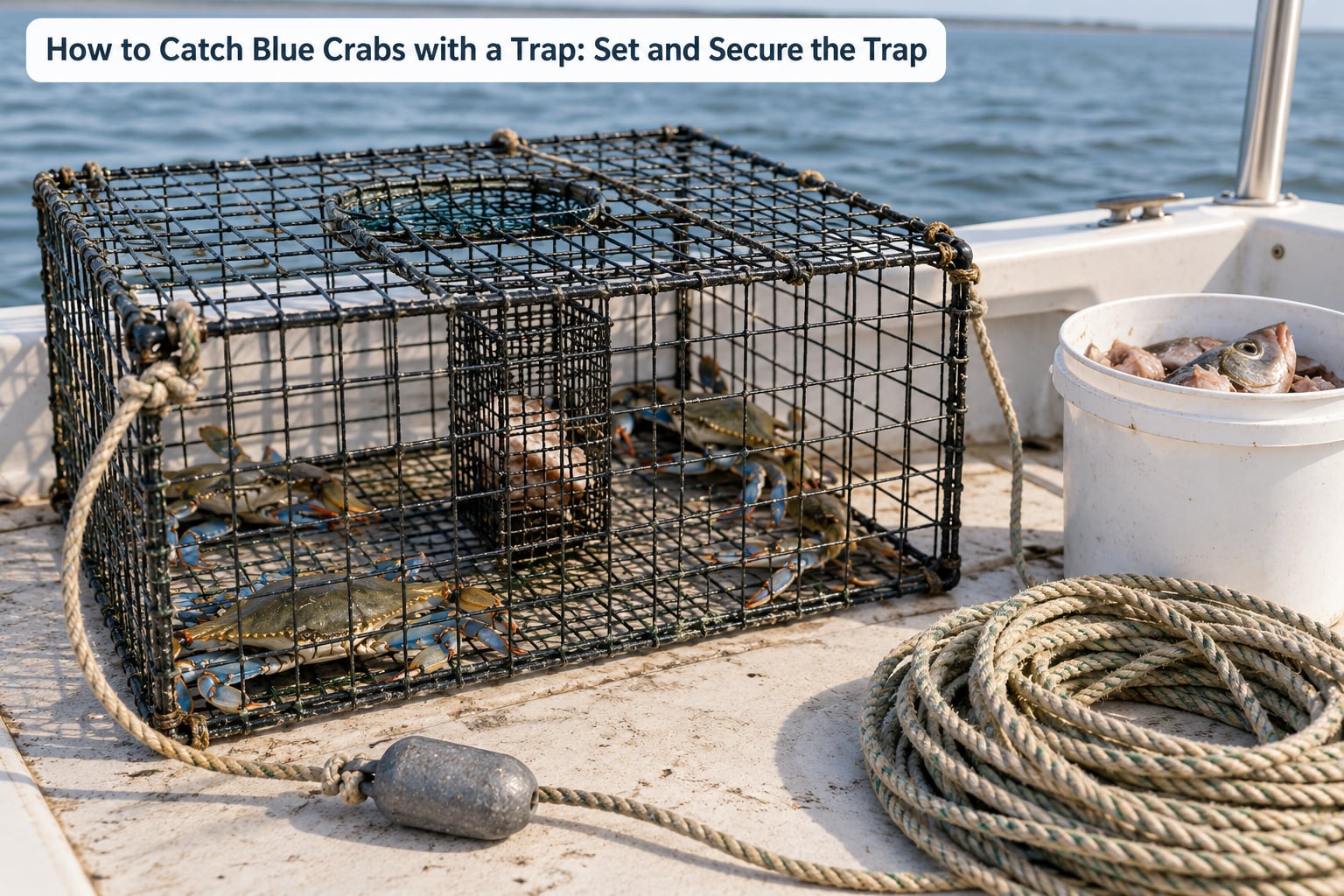
Attach your line to the bridle or the trap ring, leaving 25 to 50 percent more line than the depth so you have scope to pull the trap up clear of the bottom and through any snags.
Tie the other end to the buoy with a bowline. Your name and a phone number on the buoy is not optional in most states, and it is the difference between getting your trap back and explaining yourself to a wildlife officer.
Feed the line out as you move rather than throwing the trap. Orient the funnels into the current so scent washes through the cage instead of past it, and lower the trap so it lands flat.
Write the channel name or a GPS mark on your phone. Losing a trap in open water at dawn because you cannot identify the buoy is a story every experienced crabber has.
How to Catch Blue Crabs with a Trap: Check the Trap
Ring and drop traps are checked in 5 to 15 minutes. Box traps usually run 30 to 60 minutes, and a long soak only pays off on a drop trap or in a well-baited box.
Approach the buoy slowly with the boat already pointed away from the trap, or wade in from the down-current side. Pull the line hand over hand rather than hauling it in fast, so the trap rises gently and the crabs stay inside as it clears the surface. Crabbers mention this retrieval detail more than any other, and it is the difference between a limit and a string of empty funnels.
Have the dip net in your outside hand before the trap breaks the water. Lift it, drop the catch straight into the cooler, and reset only if you are going back to the same water.
If the trap is empty, work through it in order: bait gone or washed out, trap tipped onto its side or upside down, wrong depth, slack water, or a rocky bottom that filled the cage with sand. Fix the first two before you change anything else.
How to Catch Blue Crabs with a Trap: Handle and Store the Catch
Measure the carapace with a caliper, point to point across the shell, before you decide what stays in the cooler. Different states use different minimums and they change, so check the current number on the agency page rather than going by memory.
Keep it simple on the coast: legal hard-shelled crabs above the minimum width, egg-bearing females back in the water every time. A sponge female you keep is one the next person does not get to catch.
Handle from the back of the carapace with tongs, well away from the claws, and never grab a crab by the front of the shell where the claws are.
Most states require turtles to be able to pass through the trap. Maryland and Texas spell out throat and escape-ring dimensions in their gear rules, and other states publish similar specifications, so read them before you buy.
Keep the catch in a lidded cooler with ice and out of standing meltwater, which is the mistake forum crabbers keep naming. Dip them in cool seawater first if you are storing them overnight, and cook or cool them the same day.
Common Mistakes
- Bait stolen or washed out. Tie it in a mesh bag or bait box inside the cage.
- Trap tipped over. Add a small weight and set it in softer bottom.
- Wrong depth. Stay inside the 3 to 10 foot range for blue crabs; they are shallow-water feeders.
- Unmarked or invisible buoy. Use a bright buoy with your name and number on it.
- Pulling the line too fast. Haul slowly, hand over hand, so crabs are inside at the surface.
- Checking far too late. Ring and drop traps need 5 to 15 minutes; a late pull is an empty trap.
- Keeping undersized crabs. Measure every crab with calipers and release the rest.
- Ignoring the rules. Licence, bag limit, gear specs and protected females are all checked, and fines are real.
One more worth naming: wading alone at night in a tidal creek is a drowning risk, not a crabbing risk. Go with someone, carry a light, and know when the tide turns.
Frequently Asked Questions
What is the best bait for catching blue crabs in a trap?
Chicken necks and backs are the reliable beginner choice, because the fat and scent carry through the water. Menhaden heads, mackerel and other oily fish scraps work just as well, and squid does better in cold months. Use two or three pieces, not a full bucket, and always anchor the bait in a mesh bag or bait box inside the cage. Loose bait gets carried out within minutes.
How long should a blue crab trap soak before being checked?
Ring and drop traps go in for 5 to 15 minutes. Box traps usually run 30 to 60 minutes, and longer soaks only work on a well-baited box trap in moving water. Soaking a light trap for hours usually means an empty cage, since blue crabs take the bait and leave. Pull hand over hand so the catch is still inside when the trap reaches the surface.
What depth should I set a blue crab trap?
Most blue crabs are taken in 3 to 10 feet of water over a soft or muddy bottom near structure such as a channel edge, jetty or eelgrass bed. Deeper water holds bigger crabs in late summer, but beginners catch more in the shallows. Check the tide table and fish the first two hours of incoming or outgoing water, when crabs move across the bottom feeding.
Can I use a blue crab trap in protected waters?
Often yes, but the rules are stricter. Many protected waters, state parks and marine reserves limit or ban traps, and most require a licence plus gear that lets small crabs and turtles escape. Shore fishing and boat fishing on the same water can fall under different rules. Check the agency that manages that specific water before you set anything, because the penalties apply to the area, not your home state.
How do I keep blue crabs fresh after catching them?
Measure them, drop them straight into a lidded cooler with ice, and keep them out of standing meltwater, which is what spoils them fastest. Dampen them with seawater first if you are storing them for more than a few hours, then cover the cooler and keep it shaded. Cook them the same day where you can, and never keep an egg-bearing female instead of releasing her.
Why is my blue crab trap coming up empty?
Bait stolen through an open cage is the usual answer, which is why bait belongs in a mesh bag or bait box. Next check whether the trap has tipped on its side so the funnels face the bottom, and whether you fished the right depth over the right bottom. Soft mud, structure and moving water outperform a flat spot at slack tide every time, so move the trap before you blame the bait.
Start with the rules for your water and a box trap with funnel entrances, then fix the two things beginners get wrong: bait anchored inside the cage and a slow, hand-over-hand pull. Pick a channel edge in 3 to 10 feet over soft mud, run it on the tide, and one careful trip will tell you more than any amount of reading.