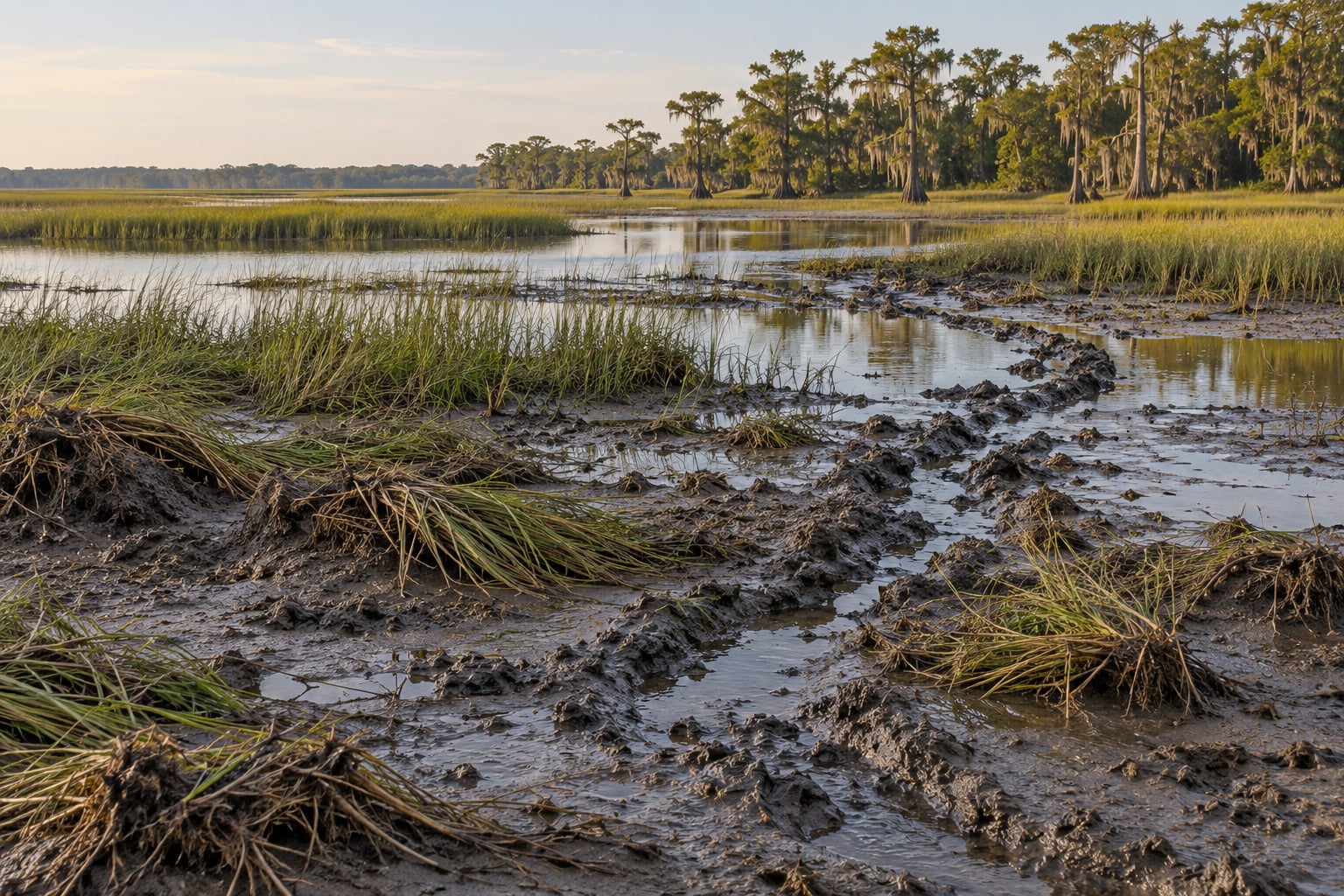
Wild hogs damage wetlands because they dig, wallow, feed and waste in places built for water to sit still. Rooting tears up marsh plants and breaks the soil surface, wallowing churns mud into open pools and breaches pond edges, and the animals defecate in and around the water, adding bacteria and nutrients. The visible result is bare ground, muddier water, and a plant community tipped toward invasive species.
I spend a lot of time around bottomland hardwood swamps, cypress-tupelo sloughs and coastal marshes in the Southeast, and the pattern is the same almost everywhere hogs are established. A ridge that looks fine on a dry August walk is a sheet of exposed mud in April, and a pond edge that held vegetation two seasons ago is now a raw bank shedding soil into the pool.
This is an explainer for anyone who watches that happen: landowners with a pond edge going soft, pond owners puzzled by green water, and conservation-minded readers who want a straight account of what wild hogs actually do to a wetland and what a realistic response looks like. The honest version is that they do more than stomp plants. They change the hydrology, and hydrology is what a wetland is.
Table of Contents
- What Damage Do Wild Hogs Cause in Wetlands?
- Why Are Wetlands Especially Vulnerable to Wild Hogs?
- How Rooting Changes Wetland Soil and Water Flow
- Why wild hogs damage wetlands one rooting site at a time
- What Happens to Native Plants and Wetland Wildlife?
- How Can Wetland Damage Spread Beyond the Hogging Area?
- What Can Landowners and Conservation Groups Do?
- How Do You Tell Whether Wild Hogs Are Damaging a Wetland?
- Frequently Asked Questions
- Do wild hogs destroy entire wetlands?
- Are wild hogs native to the American Southeast?
- Why do hogs wallow in wetlands?
- Can rooting by wild hogs cause erosion?
- What is the best way to control wild hogs near wetlands?
- Do wild hogs help clean up wetlands?
- Start With the Pressure, Not the Plants
What Damage Do Wild Hogs Cause in Wetlands?
Four behaviors do nearly all the damage, and they are easy to tell apart once you have seen each one on the ground. Rooting is excavation. Wallowing is mud construction. Feeding is removal. Movement through the site is compaction and bank collapse. Everything downstream, including the water quality changes, starts with those four.
| Behavior | What the hog does | What the wetland shows |
|---|---|---|
| Rooting | Digs with the snout for tubers, insects and roots, sometimes several inches deep and over a broad area | Upturned sod, exposed mineral soil, uprooted plants, cratered mudflats |
| Wallowing | Uses water and wet mud for cooling and protection, expanding existing wallows or cutting new ones into pond and creek edges | Large muddy pools, scoured banks, blocked flow, churning shallows |
| Feeding | Consumes plant material, seeds, insects, amphibians, crustaceans and anything else available | Missing seed-producing plants, stripped seed beds, fewer small animals |
| Movement and waste | Travels the same routes repeatedly, defecates in and near water, carries pathogens between sites | Braided trails, compacted mud, algal blooms, bacteria in water |
Read that table as a chain rather than four separate problems. Every one of these behaviors ends with more loose soil in the water, and that is the common thread.
Why Are Wetlands Especially Vulnerable to Wild Hogs?
Wetlands have almost no margin. Upland ground can take a season of abuse and grow back, because the soil drains, plants have deep roots, and the surface dries out and firms up. Wetland soil stays saturated, so damage stays exposed. A hoof print in a pasture heals. A hoof print in a flooded flat stays a hole through every wet season, because there is no dry window to settle it.
Add tidal movement to a coastal site and the holes have a current running through them. Every tide picks up a little more loosened material and moves it somewhere else. The same is true along a creek edge where storm flow gets into exposed banks.
Vegetation in a wetland is also fragile in a way upland grass is not. Bunchgrass sends out tillers and recovers from grazing. Many wetland dominants, especially sedges and wet prairie species, spread slowly and depend on stable water levels. When they are pulled out, seed banks in the mud get churned and buried, and regrowth takes far longer than the recovery time people expect.
Wildlife use concentrates, too. Wetlands gather migrating birds, wading birds, amphibian breeding sites, and fish that need flooded vegetation. That concentration is exactly what makes a wetland worth protecting and exactly what suffers when the vegetation goes. Hunters and farmers running into the same problem describe the same frustration: a sow and her piglets can wreck a wet flat in a single night.
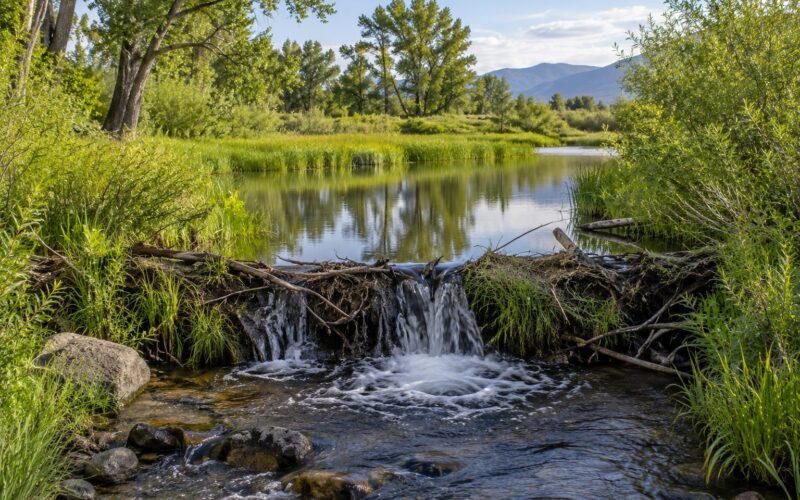
One comparison helps. Beavers also reshape wetlands, and they do it deliberately, and their work tends to hold because it creates ponds that store water and sediment. Hog damage does not hold the same way. It is disturbance without structure, repeated at the same spots, with nothing built back.
How Rooting Changes Wetland Soil and Water Flow
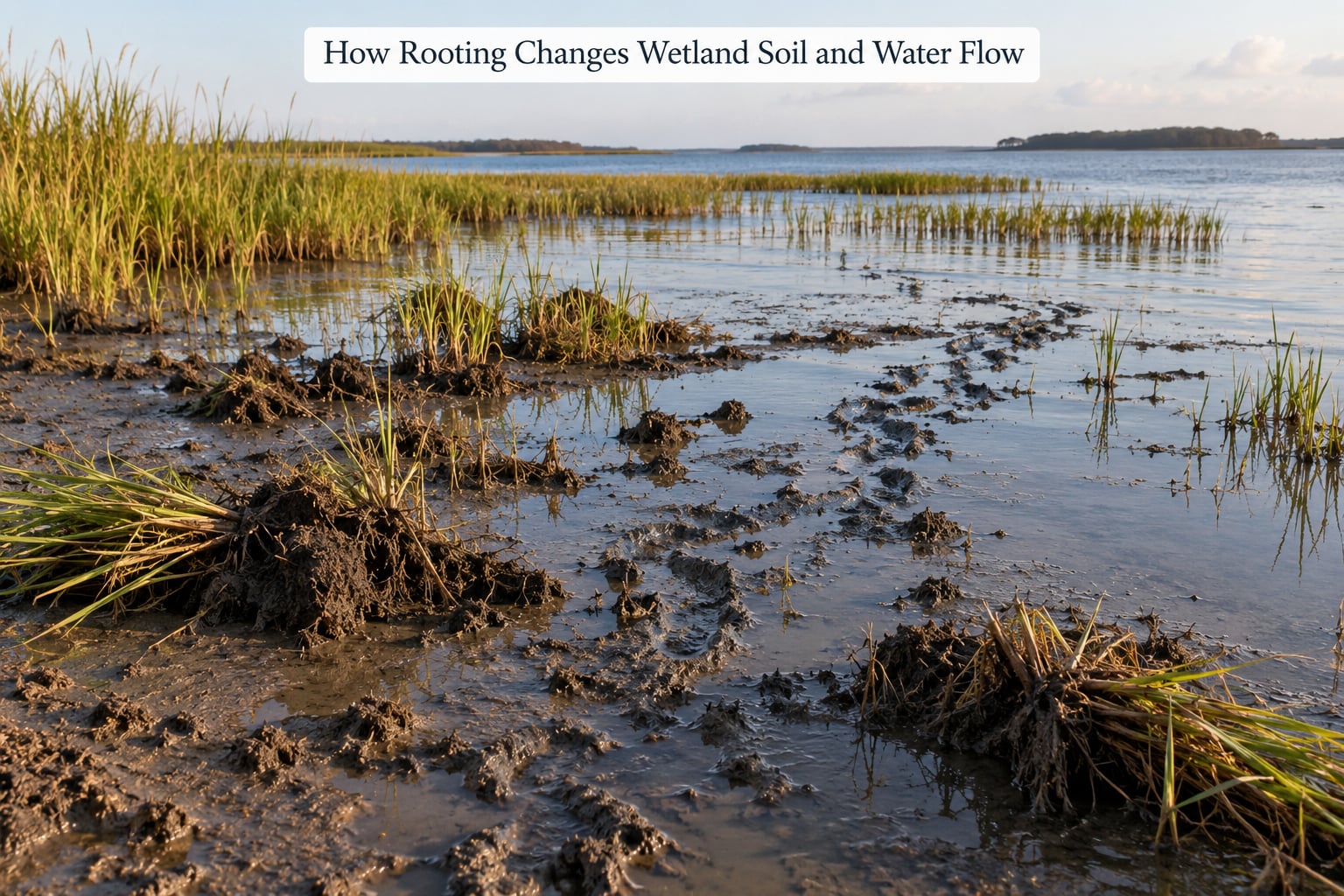
Why wild hogs damage wetlands one rooting site at a time
The snout of a hog is a plowing tool with an excellent sense of smell, and wetland soil is full of things worth finding. A single animal works over an area far larger than most people expect, and a group repeats that work on a schedule. The cascade runs like this:
- Vegetation goes first. Plants are pulled up and eaten, which removes the roots that held the surface together and shaded the soil.
- Mineral soil is exposed. Wet organic mud turns over and dries, and the fine sediment underneath sits loose in the water.
- Sediment moves. Tides, wind and runoff carry that sediment into deeper water. Clarity drops, and what researchers call turbidity climbs.
- Water flow changes. Wallows and root craters intercept sheet flow, cut small channels through the marsh, and shift where water actually goes at high tide.
- The seed bank is buried or lost. Buried seeds cannot germinate, and exposed seeds dry out or wash away. Native recruitment drops right when it is needed most.
- Habitat quality falls. Bare mud is poor cover for small fish and invertebrate communities, and it is poor nesting and brood substrate for birds that depend on that cover.
One Florida cattle ranch that got close study illustrates the measurement problem. A wildlife biologist tracked hog impacts on amphibians and wetlands there using drones for damage mapping, genetic diet analysis, crayfish traps and dip nets. The takeaway for anyone managing ground: this damage is mappable, and the mapping shows how much of a site is disturbed rather than how much damage a single night does.
What Happens to Native Plants and Wetland Wildlife?
Hogs are omnivores with a strong preference for anything with protein in it. In a wetland that means insects, worms, crayfish, frogs and salamander eggs, plus seeds, bulbs and root masses. That diet removes the base of the food web and the reproductive stock of the plants at the same time.
For amphibians, the losses stack. Eggs and tadpoles taken from shallow water cut recruitment. Loss of wet prairie and sedge cover removes the vegetation where larvae shelter. Sediment burial smashes the shallow zones where tadpoles feed. Researchers working on hog and amphibian systems in Florida have used a cattle ranch site precisely because amphibian monitoring and hog monitoring can be run in the same place over the same seasons.
For birds, nesting structure disappears before nesting does. Ground-nesting species lose the clumped, upright vegetation they build in, and the loss of insect prey shows up later in the season as fewer fledglings. Longer term, the plant community itself shifts, because the plants hogs eat or uproot are replaced by species that tolerate disturbance, several of which are themselves non-native.
On a wetland, that shift is hard to walk back. Native wetland plant communities assemble slowly and depend on hydrology, while the tolerant species that arrive after disturbance are usually the fastest colonizers on the site.
How Can Wetland Damage Spread Beyond the Hogging Area?
Wetland damage does not stay inside the wallow. Sediment that leaves the site keeps moving, and that movement is where a lot of the cost shows up.
The usual sequence is that exposed soil erodes, sediment travels downstream and settles out, and shallows fill in. Shallow is where the productivity is. When shallows silt up, submerged vegetation drops out, and forage for fish and waterfowl goes with it. Water that was clear enough to see the bottom comes up looking like coffee.
Bank slumping is the other route. Root loss along a creek edge removes the trees holding the bank, so the bank undercuts and falls. Once a creek has widened from hog activity, it tends to keep widening after the hogs move on.
Then there is the spreading problem in the living community. Disturbance-tolerant plants and the invertebrates that ride in mud on hooves and equipment move into the newly opened ground. That is the standard pathway for invasive plant establishment in a wetland, and it continues whether or not hogs come back.
What Can Landowners and Conservation Groups Do?
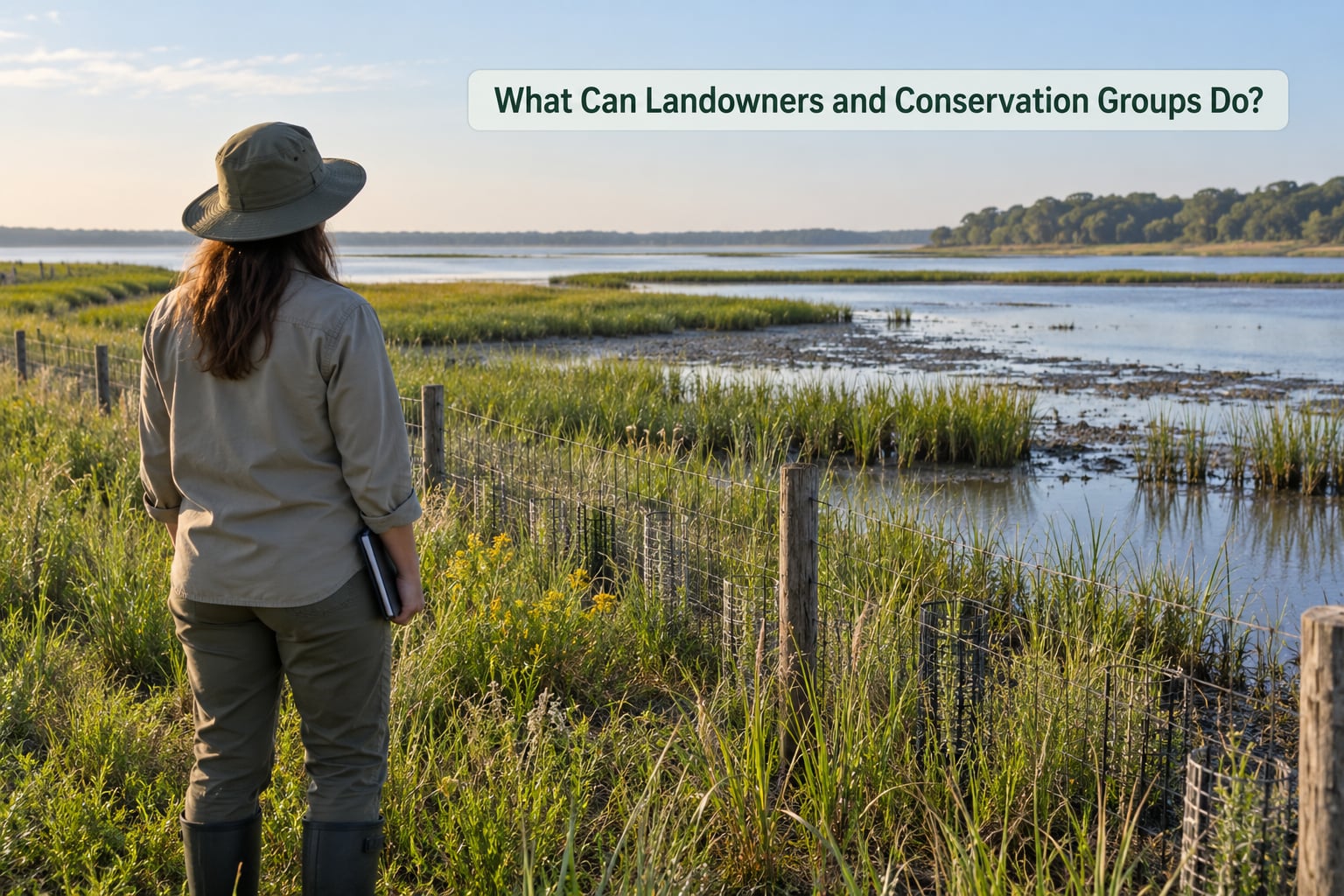
There is no single wetland fix, and anyone selling one is overselling. What works depends on the site, the size of the hog population pressing on it, and whether you are protecting a pond, a creek or a public marsh.
These are the approaches that show up in practice:
- Reduce pressure first. Until the population coming onto the property drops, restoration work gets rebuilt over each season. Hunting, trapping and, where legal and appropriate, aerial operations are usually the foundation of any wetland response.
- Exclude where the site can hold it. Fencing, welded-wire panels and hinged gates work for yard-scale problems and short creek frontages. The approach that fails most often is a fence built too low and too loosely, which teaches the hogs that the boundary is negotiable.
- Work with the water, not against it. Keeping sheet flow where it belongs, blocking the shortcut channels hogs cut, and restoring the low spots that hold water all reduce the convenience of a rooting site.
- Restore natives after pressure drops. Wet prairie and marsh plantings on a site that still has active rooting mostly feed the hogs. Sequence matters: pressure down, hydrology right, then plants.
- Monitor on a schedule. Fixed photo points, drone or satellite imagery on a repeat interval, and periodic water sampling tell you whether the site is improving or just being visited less.
- Coordinate with wildlife and water agencies. Wetland permitting, restoration cost share and regional population data all sit with state and federal contacts, and land managers who work alone usually see the worst version of the problem.
Eradication is worth being careful about. In some settings the goal is a reduced, managed population that stays below the damage threshold. In others, where the wetland is small and the population is high, removal has to be sustained for years before anything meaningful recovers. Wild pigs are among the most productive mammals in North America, and no single tactic holds a population down alone for long.
How Do You Tell Whether Wild Hogs Are Damaging a Wetland?
You do not need an ecologist to spot it. You need to know what a healthy wetland edge looks like so the damage stands out.
Signs to check on a walk:
- Fresh rooting.Ground turned up in patches with visible holes and a smell of turned earth. New rooting is loose and damp underneath; old rooting has dried out.
- Wallows with no vegetation ring.Deep mud pools in pond edges, creek bends and low spots, some of them connected to the water by a churned channel.
- Muddy trails and braided paths.Repeated routes through the shallows that widen as the season goes on.
- Missing vegetation.Seed-producing plants absent from a strip, sedge clumps pulled apart, mud where plants should be.
- Bank slumping.Undercut edges, fallen trees, a creek that is wider at the hog crossing than it is upstream.
- Water clarity and vegetation.Muddy water, frequent algal films and a loss of submerged plants in water that used to be clear to the bottom.
- Evidence of use.Tracks in soft mud, rubs on trees and shrubs, and a disturbed area that is not recovering between visits.
The last one matters most. A single disturbed spot means little. A pattern that looks identical each time you walk it, and looks the same as it did the month before, is a population that is living there.
Frequently Asked Questions
Do wild hogs destroy entire wetlands?
Not usually all of one site at once, but they can convert most of a small wetland over time. Damage concentrates in the wettest, softest ground, and repeat rooting keeps that ground bare so the next visit starts further out. A sow with piglets can rework a wet flat in a single night. Whether the site recovers depends on whether population pressure comes down before the plant community and the hydrology shift too far.
Are wild hogs native to the American Southeast?
No. The hog is a domesticated animal that went feral, and the Southeast is not its native range. Wild boar is native to Europe and Asia, where populations are part of the existing ecosystem, but the pigs found across the Southeast trace back to escaped domestic stock. That is why wildlife agencies classify them as an invasive species rather than a native game animal with a bad reputation.
Why do hogs wallow in wetlands?
Wallowing is a comfort and survival behavior. Hogs have no sweat glands and poor ways to shed heat, so wet mud and shallow water cool them down. The mud also dries into a layer that helps with parasites and insects. In a wetland, that routine means they reuse the same pools and widen them into scoured pits, which is exactly where bank damage and blocked flow come from.
Can rooting by wild hogs cause erosion?
Yes, and it is one of the main ways damage spreads. Rooting strips vegetation and loosens saturated soil that normally stays put. Tides, rain and wind then carry that fine sediment into deeper water, raising turbidity and burying shallow habitat. Along creek edges, lost roots also let banks slump and widen, so the channel keeps changing after the hogs have moved on.
What is the best way to control wild hogs near wetlands?
Reduce the population first, because everything else gets rebuilt until pressure drops. Combine hunting and trapping, add well-built exclusion fencing where the site is small enough to hold one, and restore hydrology and native plants only after the pressure eases. Sequence matters more than any single tactic, and state and federal wildlife agencies are useful contacts for cost share and regional population data.
Do wild hogs help clean up wetlands?
No, even though the repeated disturbance they create can look like natural disturbance. Hogs do not build anything that holds. Beavers create ponds that trap sediment and store water, and their work persists; hog rooting and wallowing remove vegetation, loosen soil and cut flow paths. What survives is mostly the disturbance-tolerant species that people then have to deal with on the same site.
Start With the Pressure, Not the Plants
If you are dealing with hog damage in a wetland, the first move is a walk through it and an honest count of how many rooting and wallow sites there are and whether they change between visits. That tells you whether this is a population problem or a boundary problem.
Understanding why wild hogs damage wetlands comes down to hydrology: they hit the water, the soil and the seed bank at the same time, and none of it repairs itself while they are still there. Reduce pressure first, fix the hydrology next, and plant last. Wetlands come back more often than most people expect, but not while the same animals keep tearing up the seedlings.