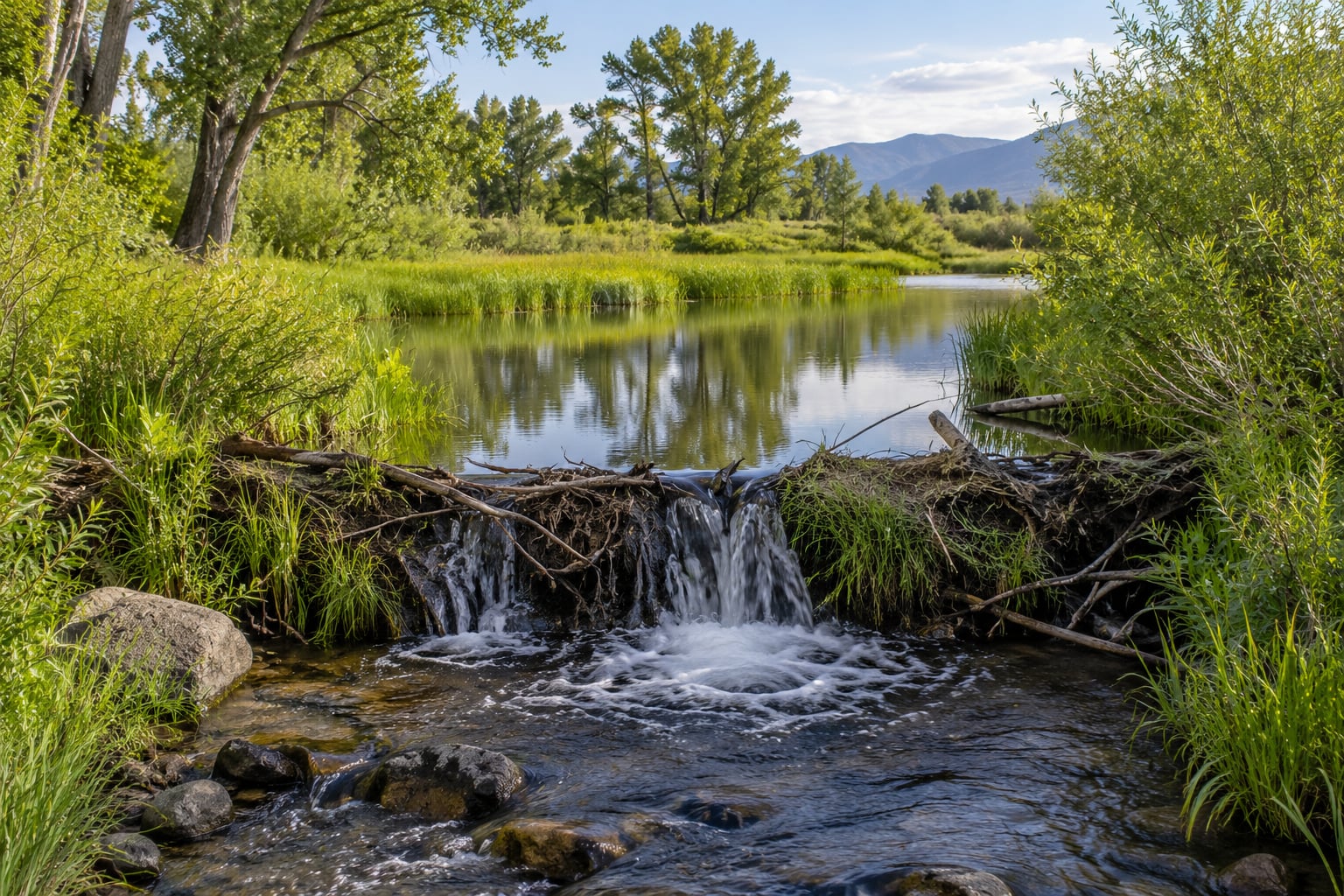
Here is how beavers change a creek system in plain terms: they fell trees and dam small, low-order streams, which slows the current, traps silt, spreads water back onto the floodplain, and holds the water table up through the dry season. One dam starts it. A chain of dams turns a single-thread creek into a pond-and-marsh wetland that behaves nothing like the channel that cut it.
I’ve walked enough of these reaches to know the sequence well: the water looks wrong first, then the willows, then the birds. What surprises people is how much of the change is invisible from the bank — a summer water table that stays three feet higher, a pool that holds cold water through August, a channel that has quietly filled in with the gravel it used to carry downstream.
This guide walks through that cascade in order, then gets honest about the part every landowner asks about in the first five minutes: the flooding. Beavers are enthusiastic ecosystem engineers, and the same structure that builds a wetland can also back water onto a road, a septic field, or a neighbor’s pasture.
Table of Contents
- What Do Beaver Dams Do to a Creek?
- How the Dam Creates a Wetland
- Step one: water backs up and the current dies
- Step two: sediment fills the old bed
- Step three: water spreads out
- Step four: plants and succession take over
- What Happens to Water Flow and Water Quality?
- How Beavers Change a Creek System, Parameter by Parameter
- How Beaver Changes Affect Plants and Animals
- Does a Beaver Dam Always Cause Flooding?
- Why Do Beaver Dams Sometimes Fail?
- How to Tell Whether a Creek Is Being Changed by Beavers
- Frequently Asked Questions
- Do beaver dams make flooding worse?
- How can a beaver change an ecosystem?
- What are the positive effects of beaver dams on the ecosystem?
- Why do we destroy beaver dams?
- Can you legally destroy a beaver dam?
- Is it safe to swim near a beaver dam?
- Key Takeaways
What Do Beaver Dams Do to a Creek?
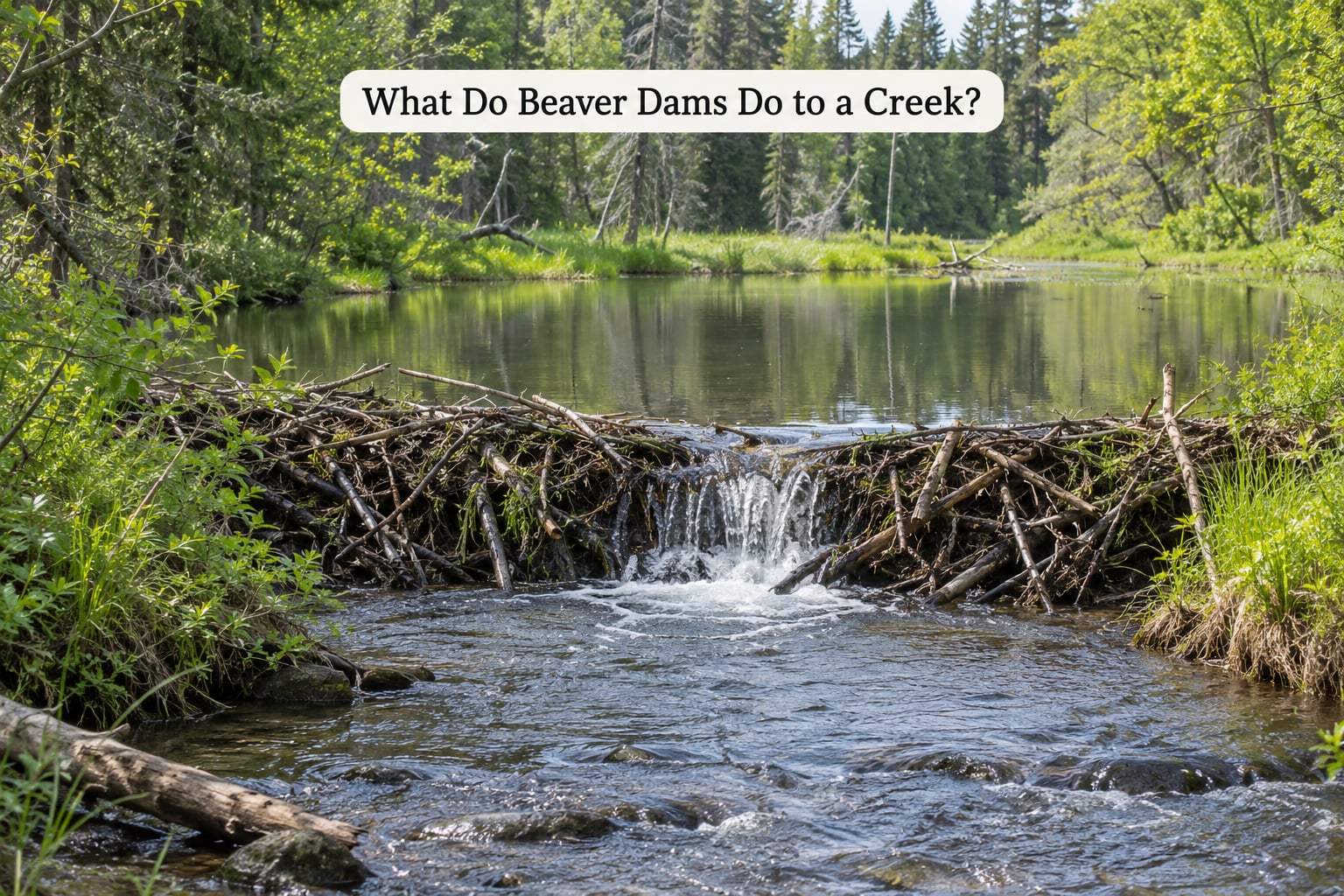
A beaver is an ecosystem engineer — an animal that physically reshapes its habitat rather than just living in it. Its dam raises the water level upstream, and everything downstream of that one change is a knock-on effect. Here is what a beaver dam actually does to a creek, step by step.
- Raises the water level behind the dam by several feet
- Slows the current until suspended sediment drops out
- Deposits gravel, silt, and wood debris in the old channel
- Fills and flattens an incised, straightened channel bed
- Spreads water sideways across the historic floodplain
- Holds the local water table up through the summer
- Recharges groundwater and steadies base flow in dry months
- Creates the pond, marsh, and meadow mosaic other species need
Because of that list, beavers pile dams in the lowest, wettest reaches of a watershed: first-order and second-order streams, gentle slopes, plenty of willow and cottonwood within swimming distance. A steep, fast, rocky creek is a poor candidate. A shallow, slow, drainage-rich one is ideal.
They build because the pond is the pantry and the bunker. Underwater plants and bottom vegetation grow where they never could in a current, cached for winter in a still pond that does not freeze solid; the pond also turns the falling debris pile into a lodge with an underwater entrance. Whatever the beaver experiences it as, the effect downstream is deliberate engineering.
How the Dam Creates a Wetland
The wetland is not built in a season. It forms as a slow physical sequence, and each step makes the next one easier.
Step one: water backs up and the current dies
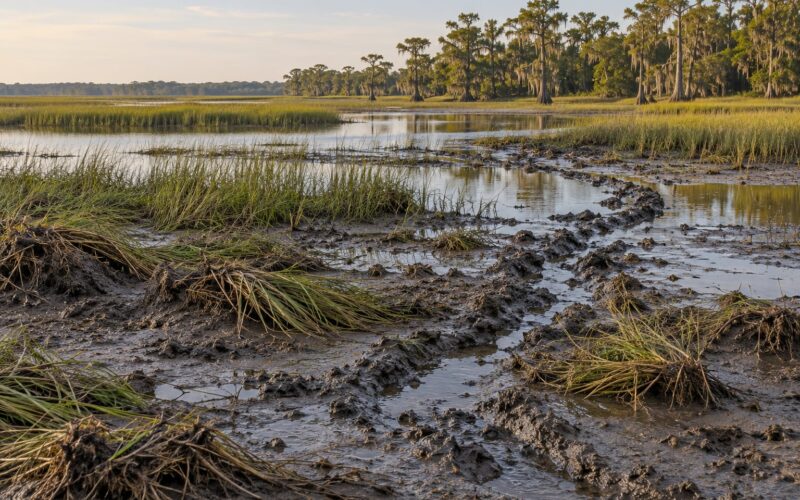
The dam holds back a few feet of head. Current speed drops sharply, and anything the water can no longer carry gets left behind — gravel first, then sand, then fine silt and organic material.
Step two: sediment fills the old bed
On an incised creek, that sediment deposition is literally filling the trench the floodplain used to sit in. The channel shallows, widens, and stops being a ditch. Restoration literature calls this aggradation, and it is the step most people never notice until it is finished.
Step three: water spreads out
Once the bed rises, the pond stops fitting inside the channel and spreads onto the benches beside it. That reconnection is the point of the whole exercise — the floodplain that a straightened creek had abandoned starts doing its old job again.
Step four: plants and succession take over
Sedges and rushes colonize the shallow edges, willow and cottonwood root in the wet soil, and the pond edges silt in until they become marsh. Where water is seasonal rather than permanent, the pond can succeed all the way to wet meadow, which then stays productive through dry summers.
Westbrook and colleagues (2006) found that dams measurably attenuated summer water-table decline across 9 and 12 hectares of a 58-hectare riparian study area. A well-used beaver complex is rarely one pond; it is a staircase of them, each backing up into the next.
What Happens to Water Flow and Water Quality?
How Beavers Change a Creek System, Parameter by Parameter
Surface flow is delayed and spread rather than accelerated and concentrated. The pond holds a volume of water that would otherwise have moved downstream in a single afternoon, and releases it slowly over days and weeks. That stored volume also cuts downstream erosion, because flood peaks arrive lower.
Below the dam, surface water and groundwater become more closely connected: slower flow encourages water to move between them, and the sustained wetness feeds shallow groundwater. The practical result is base flow — the modest flow that keeps a creek running between storms. In a dry year, that difference decides whether the reach is still there in August.
Dittbrenner and colleagues (2018) assessed 5,019 stream kilometers in the Snohomish basin and found only about 33 percent had moderate or high intrinsic potential for beaver dams. They also found that 38 percent of the riparian area along those high-potential streams sits on public land and 17 percent on large private timber tracts. Beaver restoration is a land-management decision, not just a wildlife decision.
Water quality changes in the same direction as water quantity. Settling ponds act as sediment traps and nutrient sinks, taking particulate phosphorus and nitrogen out of the water column before they reach the reach below.
| Parameter | Un-dammed creek | Beaver-influenced creek |
|---|---|---|
| Surface flow | Rises and falls fast with each storm | Delayed, stored, released slowly |
| Water table | Drops through the dry season | Held near the surface year-round |
| Sediment transport | Continues downstream | Settles out and fills the channel |
| Channel shape | Often incised and straightened | Shallow, broad, and multi-threaded |
| Floodplain connection | Cut off by banks and levees | Reconnected and wet in a normal year |
| Summer temperature | Warms fast in open sun | Cool pools and shaded edges persist |
| Dissolved oxygen | Can drop in slow warm reaches | Improved by flow and cooler water |
| Habitat variety | Mostly one channel type | Pond, marsh, meadow, and deadwater mix |
| Carbon storage | Forest soil levels | Wetland soils, often several times higher |
Temperature is the change anglers notice first. A deep, shaded pool holds cold water well into late summer, and slower flow loses less heat than a riffle in full sun. Beaver-created wetlands have been reported storing up to eight times the organic carbon of nearby forest soils — a gain that reverses when dams go dry and the stored carbon is released.
How Beaver Changes Affect Plants and Animals
Habitat variety is the multiplier. A pond complex offers open water, shallow marsh, wet meadow, standing deadwood, and dense willow in one short reach, and different species need each of those.
A 2018 survey by Colorado Wildlife Science found faster willow growth, more food for wildlife, and more songbirds where beavers had returned to suitable ground. At Hallam Lake in Aspen, a beaver-maintained system supported 20 mammal species, more than 150 plant species, and 15 lichen species.
What tends to gain: trout and other cold-water fish using the deep pools as refuge; amphibians in the shallows; wood duck, ducks, and geese on open water; bats hunting over the pond edges at dusk; insects and the birds and fish that eat them; and the willow and cottonwood regeneration that a beaver cuts actually helps by pruning rather than killing.
What can lose: the deep, fast, oxygen-rich riffle that some fish need to spawn in, since ponds replace running water with standing water. And in a large complex the open water can win at the expense of the meadow. Benefits and tradeoffs genuinely depend on the watershed — a small cold creek in a dry range and a lowland tributary behave very differently.
Does a Beaver Dam Always Cause Flooding?
Not in the way the word is usually meant. A beaver pond stores water and releases it slowly, so the dam delays and spreads runoff rather than creating a flood. What you are more likely to see is ponding — water sitting on ground that used to stay dry for most of the summer. That is a real cost to the person standing in it, and it deserves a straight answer rather than a reassurance.
The distinction that matters is between temporary ponding and damaging failure. Ponding is shallow, seasonal, and reversible; it recedes when the rain stops or when water is drawn down through the dam. Infrastructure failure is different — water finds a path it should not, a road embankment washes out, a culvert backs up into a yard, or a foundation drain stops working.
What decides whether a dam causes trouble is mostly not the beaver. Valley shape matters: a broad flat valley backs up a long way behind a short dam, while a narrow V-shaped one does not. Dam height and the number of dams stacked upstream both add to the head. Rainfall on top of that head is the trigger. And human features — undersized culverts, roads built on fill, drainage ditches, a neighbor’s septic field — decide where the water goes when it leaves the pond.
If your yard is ponding, the honest diagnosis is usually a combination: a dam at a given height, on a given valley, on a given property, during a wet spring, with an un-dammed runoff path from somewhere above. Tell the story that way and the fix becomes obvious. Tell it as “beavers cause floods” and you will spend the next season tearing out a dam that the colony rebuilds.
Why Do Beaver Dams Sometimes Fail?
A beaver dam is a living structure with a short service life. A single beaver is not the hardest-working animal in the yard, but the dam is the one thing a beaver will patch before it does anything else — which is why an abandoned dam eventually breaches.
Common causes of failure: high water during snowmelt or a summer storm, a breach point that every flood widens; a single narrow channel concentrating all the flow instead of a broad, low dam; and human alteration, where a road, ditch, or gate redirects the water into a point where it did not concentrate before.
Some dams go down because the colony moved or was removed, and nothing maintains them. Some fail because a big flood simply overwhelms anything a two-hundred-pound animal can build — which is a good reminder of scale.
When a dam breaches, the pond drains in a rush, carrying stored sediment and organic material downstream, and the exposed bed is wet, soft, and full of holes. The reach is not permanently damaged. Beavers frequently rebuild in the same spot, and the deposited sediment makes good substrate for willow.
How to Tell Whether a Creek Is Being Changed by Beavers
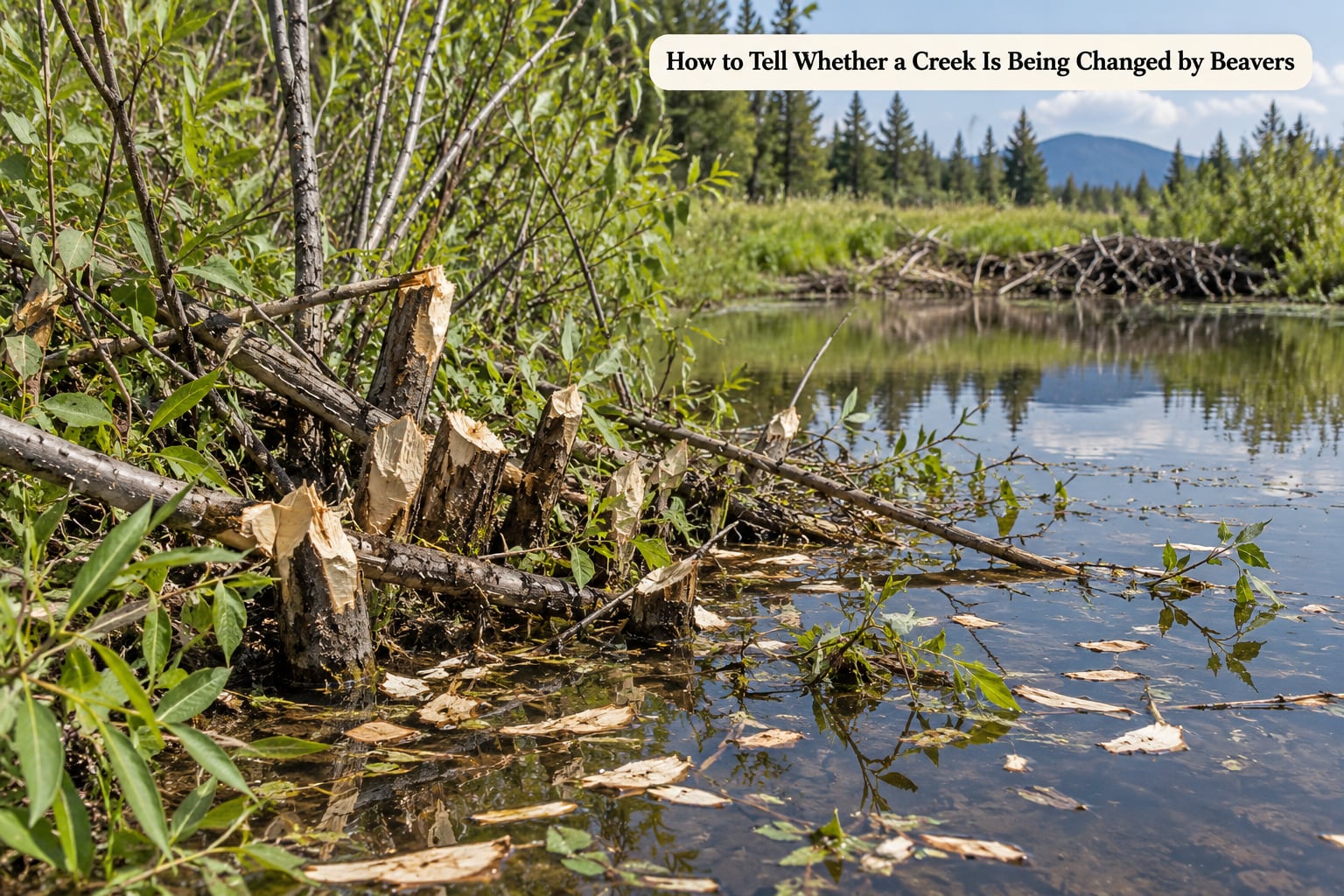
You rarely need to see a dam to know beavers are working a creek. Start downstream at the pond tail — the flat, shallow end where the pond narrows back into a channel — and look for the giveaway: fresh willow and cottonwood stems cut off cleanly near the water line, with bark chips and piles of gnawed discs beside them.
Other signs: a low mound of mud, sticks, and sod spanning the channel; standing water where the map shows a dry bench; a channel that wanders through several threads instead of running straight; flooded shrubs and dead cottonwood standing in still water; and cotton or willow growing thick along the banks, which usually means somebody has been pruning it.
Lodges and bank dens show up as a tangle of sticks with one underwater entrance, usually under an overhang or against a bank cut. Track signs in mud and snow are another giveaway, though a wary beaver will travel well away from water before it feeds.
Stay off the pond tail. Banks behind a dam are saturated and undercut, and they collapse without much warning, especially after a breach. Watch from solid ground with a dog on a lead, and keep out of the water where a released pond can sweep you downstream. Treat any dam on private land as private land, and check your state’s rules before touching, removing, or even walking into one.
Frequently Asked Questions
Do beaver dams make flooding worse?
Not in the sense of causing floods. A beaver dam stores runoff and releases it slowly, which lowers and delays the flood peak downstream. What it can do is hold water on ground that was dry all summer, which reads as flooding if it reaches a road, septic field, or neighbor’s yard. That is ponding, and it is fixable with a pipe through the dam or by changing the crossing.
How can a beaver change an ecosystem?
By felling trees and damming small streams, a beaver converts a single channel into a chain of ponds and wetlands. Slower water traps sediment, fills incised channels, reconnects floodplains, raises the water table, cools summer water, and multiplies habitat for fish, amphibians, birds, insects, and mammals. It is why biologists call the beaver an ecosystem engineer.
What are the positive effects of beaver dams on the ecosystem?
The main benefits are stored water, cleaner water, cooler water, and more habitat. Ponds hold late-season flow, filter sediment and nutrients, act as thermal refuges for cold-water fish, rebuild willow and cottonwood, and add the pond-marsh-meadow mix that many species need. Beaver-created wetlands have been reported storing up to eight times the organic carbon of nearby forest soils.
Why do we destroy beaver dams?
Usually because water backed up into infrastructure: a flooded road, a plugged culvert, a blocked irrigation ditch, damaged trees, or liability for water reaching a neighbor’s property. The problem is that removal is temporary. Colonies usually rebuild within a season or two, so a removed dam often means repeated breach-and-rebuild cycles and more disturbance than leaving it and managing it.
Can you legally destroy a beaver dam?
It varies by state, and this is where most mistakes happen. Beavers are a protected wildlife species in many jurisdictions, and their lodges and young may carry separate protections. Removing a dam can also make you responsible for the released water and sediment downstream. Contact your state wildlife agency before you touch a dam rather than after.
Is it safe to swim near a beaver dam?
Usually, with care. Beavers themselves are not aggressive toward people. The real hazards are the physics: pond tails can collapse without warning, breached dams release water and silt fast, and visibility in silty water can hide holes and stumps. Avoid swimming below a dam, especially after rain, and keep clear of the low, matted bank where the burrow entrance is.
Key Takeaways
The one thing to understand is that beavers reshape a creek by slowing and spreading water. Everything else — the wetland, the cooler pool, the recovering willow, the fish that show up in August — follows from that single change. How beavers change a creek system is not a mystery of behavior but a physics story: back up the water, drop the sediment, spread onto the floodplain, hold the water table.
The honest caveat is that the same physics can pond water where you do not want it. Judge the reach as a whole — valley shape, dam height, rainfall, and where the water goes downstream — rather than blaming or praising a single dam you happen to be standing in front of.