Learning how to identify hawks by flight pattern comes down to three checks, in this order: wing shape, wingbeat rhythm, then tail tip. Look at the outline of the wing and how the bird holds it, watch how it flies, then use the tail and head to settle the call. Those three marks will get you to a group every time, and to a species most of the time.
Most hawks are overhead for two to five seconds, backlit, and never perched within reach. Flight marks are often the only identification you will ever get, so it is worth learning what each one tells you before you need it.
One note on words first. In the UK, “buzzard” means a buteo, the Red-tailed Hawk group. In North America, people use “buzzard” for vultures, which is why a Turkey Vulture gets called a hawk by almost everybody at least once. Everything below treats “hawk” as the three North American raptor families: accipiters, buteos, and falcons and kites.
Table of Contents
- How to Identify Hawks by Flight Pattern
- How to identify hawks by flight pattern: start with the silhouette
- The 7 Clues That Distinguish Hawks in Flight
- Wing Shape and Flight Silhouette
- Buteos: broad, thick, fingered
- Accipiters: short, rounded, with a long tail
- Falcons: long, pointed, torpedo-shaped
- Kites and harriers: their own thing entirely
- Wingbeat Rhythm and Soaring Style
- Tail Shape and the Short-Rippled Display
- Common Hawks and Their Flight Clues
- Red-tailed Hawk: the broad-winged default
- Red-shouldered Hawk: the long-tailed buteo that calls in flight
- Broad-winged Hawk: the short-tailed kettle specialist
- Swainson’s Hawk: long wings, easy to misplace
- Cooper’s Hawk: the chunky accipiter
- Sharp-shinned Hawk: the small, fast accipiter
- Northern Harrier: low, quartering, unmistakable
- Swallow-tailed Hawk: no ambiguity
- Birds that are not hawks
- How to Confirm an Identification in the Field
- Frequently Asked Questions
- What is the easiest way to tell a hawk apart from a falcon?
- How can I identify a hawk when I cannot see its colors?
- Why does a Red-tailed Hawk sometimes fly with flapping wings instead of soaring?
- Do juvenile hawks look different from adults in flight?
- What should I do if I am not sure which hawk I saw?
- Start With Wing Shape and Watch the Second Clue
How to Identify Hawks by Flight Pattern
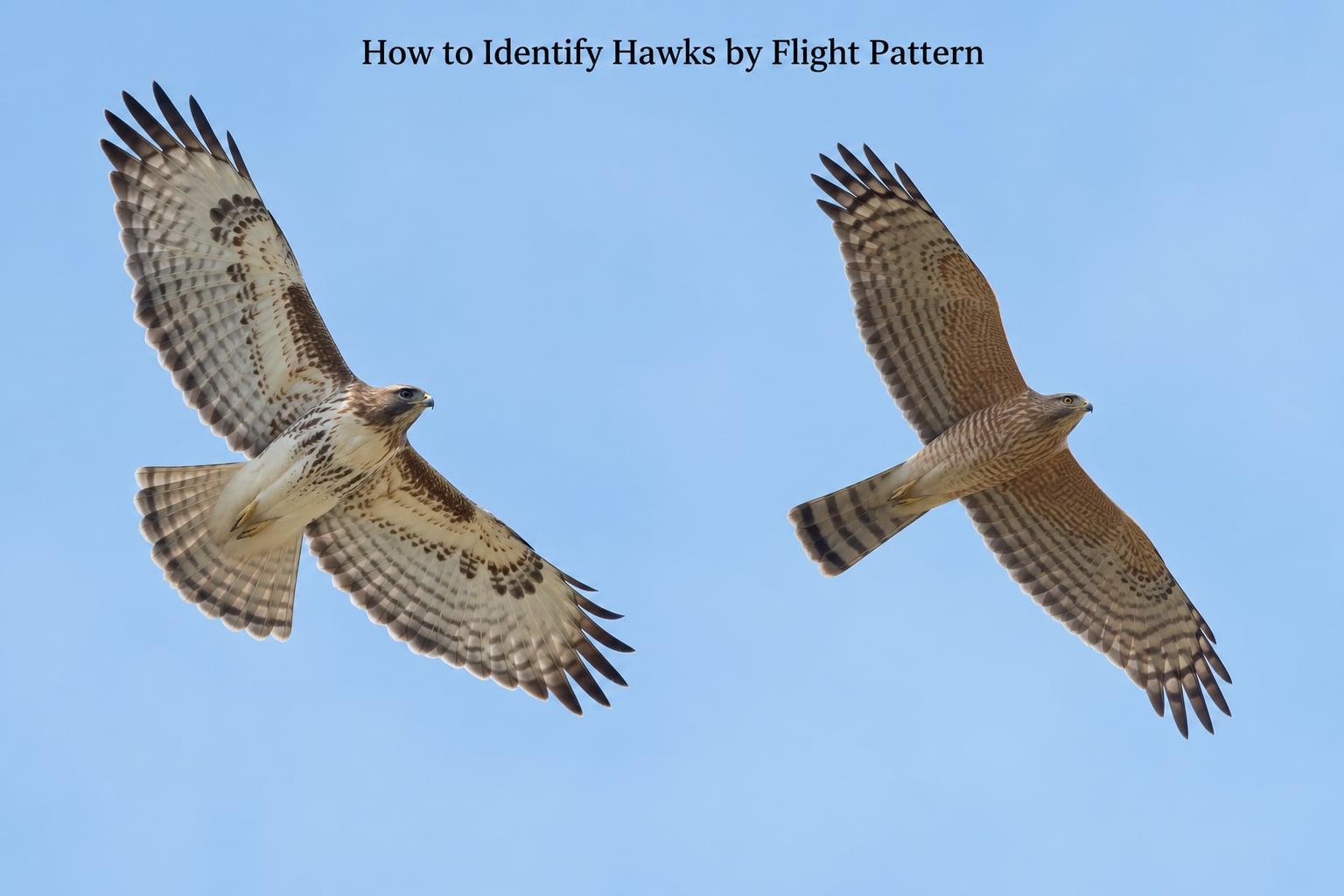
The system below uses seven observable clues: overall silhouette, wing shape, tail shape, wingbeat pattern, soaring behavior, underwing markings, and habitat or seasonal context. The first five are visible on a clean silhouette with no color at all. The last two are what turn a “hawk” into a named species.
Here is the sequence that works when a bird appears with no warning. It takes about three seconds per check and the order matters, because each step narrows the field.
- Wing shape. Broad and fingered, short and rounded, or long and pointed. This puts the bird in a family within about two seconds.
- Wingbeat and glide. Steady flapping, flap-and-glide, or continuous soaring. This separates species inside a family.
- Tail tip. Rounded, squared, notched, or banded, and how long it looks against the wings. This breaks the remaining ties.
- Head projection. Whether the head and neck push out in front of the leading edge, or the bird looks neckless.
- Wing position while soaring. Flat, a shallow V (dihedral), or a drooping tip. This is a strong family and even species clue.
Birders on the major identification forums repeat one rule more than any other: never commit to a name off a single mark. Stack at least three, and if they conflict, say “accipiter species” and move on. That answer is honest and useful, which is better than a confident guess.
How to identify hawks by flight pattern: start with the silhouette
Before naming a shape, check what you are actually looking at. A hawk seen from directly below with wings level looks broad and short. The same hawk banked thirty degrees off shows one wing nearly edge-on, and the body appears to stretch out and narrow.
Establish four things in order: the body, the span relative to that body, where the wingtips sit, and the tail. Build it from the inside out, the way you would sketch it, and the shape stops being a blur.
Three things distort the picture more than anything else. Backlighting against bright cloud erases the trailing edge, so a spread tail can look pointed. A worn or molting adult loses tail length and clean tip shape. And a distant bird without a reference is nearly impossible to size, which is why size is the mark beginners trust first and lose on first.
Glare is the other enemy. A bird crossing in front of the sun shows you almost nothing, and it often doubles back a minute later with the light behind it. If the view is poor, wait for the second pass instead of squeezing the first one.
The 7 Clues That Distinguish Hawks in Flight
This is the reference table to come back to. Each clue points to what it rules in and what it rules out, in the order the clues are most reliable at distance.
| Clue | What to look for | What it tells you |
|---|---|---|
| Overall silhouette | Blocky buteo, slim accipiter, torpedo-shaped falcon | Family, in the first second |
| Wing shape | Fingered and broad, short and rounded, long and pointed | Soaring ability and hunting style |
| Tail shape | Rounded, squared, notched, graduated, banded, long or short | Final tiebreaker between similar species |
| Wingbeat pattern | Steady flaps, flap-flap-glide, long glides, bursts | Species within a family, and age |
| Soaring behavior | Flat wings, shallow V, drooping tips, kettling | Buteo versus kite versus harrier, and migration |
| Underwing pattern | Dark patagial bar, barring on flight feathers, pale underwing | Red-tailed, Cooper’s, accipiter, Osprey |
| Habitat and season | Open country, woods, marsh, coast; date and time of day | Which species are even possible |
Read it top to bottom rather than hunting randomly. A bird that fails the silhouette check is not a hawk, and no amount of tail detail will rescue the call.
Wing Shape and Flight Silhouette
Wing shape is the single most useful mark in hawk identification in flight, because it is the largest feature and the one that survives distance and backlighting. It also predicts behavior, since wings are built for a job.
Buteos: broad, thick, fingered
Red-tailed, Red-shouldered, Broad-winged, Swainson’s, Rough-legged and Harris’s Hawks are all buteos, and they all have the same basic wing plan: broad, thick at the base, and tipped with splayed primary feathers that look like fingers on a hand when the bird is gliding. The fingers are the giveaway. A crow’s wing tip is smooth and rounded no matter how you look at it.
Buteos trade speed for lift, which is why they can hang in a thermal almost motionless and then glide for a long time without flapping. Broad-winged is the most exaggerated of the group, with short wide wings and a short tail that make it look like a plank with fingertips. Red-tailed is a little longer in the tail, and Red-shouldered sits between the two.
Accipiters: short, rounded, with a long tail
Cooper’s, Sharp-shinned and Northern Goshawk have short rounded wings and a tail so long it looks like a rudder. Those wings cannot support soaring, so accipiters flap a lot and glide only briefly between bursts. They are built to accelerate and turn inside cover, and they rarely circle in a thermal the way a buteo does.
The proportions are the field mark. A Sharp-shinned Hawk in flight looks like an unbalanced letter T, because the small head barely reaches the leading edge of the wings. A Cooper’s pushes its head and neck noticeably forward, which gives it a longer, more lopsided look in front and a more compact one behind.
Falcons: long, pointed, torpedo-shaped
Peregrine, Merlin and American Kestrel have long, narrow, sharply pointed wings and a body that tapers to a point behind the wings. They flap steadily and stiffly, glide far less than hawks, and a kestrel will hang in place over a field with rapid flicks of the wings. A falcon’s head is small and pointed forward with no visible neck.
Against a hawk, a falcon reads as fast and clipped. If you see a bird that never seems to stop flapping and holds its wings angled back like a jet, you are probably looking at a falcon.
Kites and harriers: their own thing entirely
White-tailed and Mississippi Kites float with the wings in a shallow V and the tips slightly below the center, holding a position that looks almost weightless. White-tailed Kite hovers and then drifts down onto prey. Northern Harrier flies low over open ground with long wings held in a shallow V, a long tail held at an angle, and a rhythm of flaps and glides that no other hawk copies.
Swallow-tailed and Swainson’s Hawks both have long, narrow, pointed wings more like a falcon’s, but they are built on a buteo body and they do soar. Swainson’s holds the wings in a shallow V with the tips angled back, and it flies with a smooth, effort-free flap-and-glide. Swallow-tailed has the long forked tail that gives it away instantly if you can see it.
One caution on all of this. A buteo seen edge-on against the sun loses its fingers, and a distant accipiter can look pointed simply because the wings are held in a shallow V during a glide. Judge shape across several wingbeats, not on one frame.
Wingbeat Rhythm and Soaring Style
Wing shape narrows the family. Rhythm tells you which species, and sometimes how old it is.
Steady flapping. American Kestrel and Merlin beat in an even, machine-like rhythm, usually with a short glide every few beats. Sharp-shinned Hawk is the fastest flapper of the accipiters, a quick fluttery beat that looks hurried, which is why birders describe it as jerky.
Flap-and-glide. Cooper’s Hawk takes a few deep, slow flaps and then glides, and it repeats that cycle in a steady rhythm. Red-shouldered and Broad-winged do the same, but with fewer, longer glides because their wings carry more lift. Red-tailed often flaps three or four times and then holds a long glide.
Continuous soaring. A buteo in a good thermal barely flaps at all. The wings stay flat or in a very shallow V, the tail is spread and steered, and the bird climbs in slow circles without losing height. That is the pattern to look for when you are scanning a ridgeline in late morning.
Low quartering flight. Northern Harrier flies a few feet off the grass with a distinctive rhythm of about four flaps followed by a glide, wings held in a shallow V, tail angled upward.
Hovering. Kestrel and White-tailed Kite both hang in one spot with wings flicking. Nobody else does this regularly.
Now the part that confuses people: the rhythm you expect can change. There is no lift in still air, so a soaring Red-tailed will flap. Head or tail wind changes glide length. A juvenile flapping hard to keep up with a thermal behaves differently from an adult. And a displaying bird ignores its normal pattern entirely.
I have watched Red-shouldered Hawks climb a tight circle, then tip the nose down and drop through a series of hard flaps, and I still had to double-check what I was looking at. Display flight is worth learning as a set of its own behaviors, because it is a reliable clue rather than a distraction.
Tail Shape and the Short-Rippled Display
Tail shape is the tiebreaker. You use it last, when wing shape and rhythm have narrowed things to two or three species.
An accipiter’s tail is long relative to the wings, squared off, and banded. Cooper’s has a rounded tip, with the outer tail feathers graduated so the corners curve in. Sharp-shinned has a squarer tip with a sharper corner. That is the standard field test, and it fails more often than it succeeds, because a fanned tail, a banking turn, or a crosswind will square off a Cooper’s or round off a Sharpie in an instant. If the bird is banking, ignore the tail.
A buteo’s tail is short and wide. Red-shouldered shows a bold black-and-white banded tail. Broad-winged’s tail is short and can look square-tipped or slightly notched. Red-tailed’s adult tail is red, but you rarely see the color, so the mark people actually use is the dark patagial bar, that dark stripe along the leading edge of the underwing, which forum birders describe as definitive even when the tail is closed.
Swainson’s has a long, narrow, tapered tail that extends well past the wingtips. Swallow-tailed has a deeply forked tail that no other North American hawk can be confused with. Harrier has a long tail with a wide dark band across it, plus a white rump that flashes as the bird turns.
Then there are the displays, which use the tail and wing rhythm together as a signature.
The short rippling descent belongs to the Red-shouldered Hawk. It climbs, tips forward, and works down with a rapid fluttering ripple of partly folded wings, sometimes repeated several times before the bird settles. Worth correcting a common mix-up right here: the Red-tailed does not ripple. Its display is a high dive, climbing steeply and then plunging in a straight line. Broad-winged has a hesitating flap, a series of quick shallow beats between glides, which is part of what distinguishes it in a kettle.
Common Hawks and Their Flight Clues
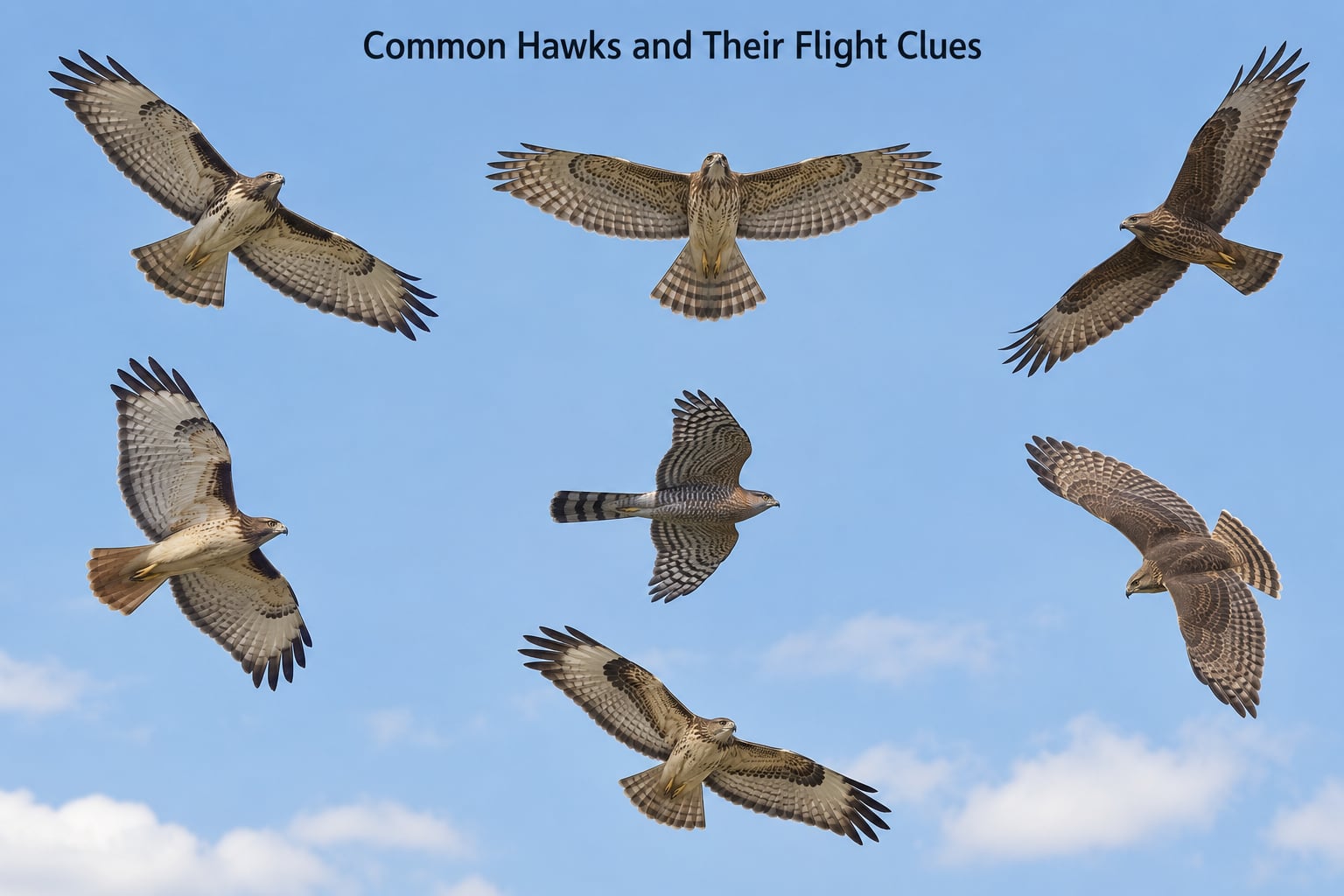
Eight species cover most of what people see over open country and woodland edge in the Southeast and across much of North America. Here is how each one flies, in the order the clues are easiest to use.
Red-tailed Hawk: the broad-winged default
Broad wings with clear fingers, a fairly short wide tail, and a slow rhythm of a few flaps followed by a long glide. Often soars with the wings flat or in a very shallow dihedral. The dark patagial bar on the underwing leading edge is the usable mark from below, and adults show a red tail that you will rarely catch. Juveniles are brown and streaked with a finely banded tail, which is exactly what makes them hard to separate from young Red-shouldered.
Red-shouldered Hawk: the long-tailed buteo that calls in flight
Slightly narrower wings and a noticeably longer, boldly banded tail than a Red-tailed, and it soars with the wings held in a shallow V. It flies in tight circles high above woodland more than most buteos, and it is one of the few hawks you will hear as well as see, with a loud descending screaming call given in flight. The rippling descent described above is its signature.
Broad-winged Hawk: the short-tailed kettle specialist
The most compact buteo, with short wide wings, a short tail, and a heavy look. It soars on flat wings and uses the hesitating flap between glides. In late September, Broad-wingeds pour through in kettles of dozens to hundreds, and that collective behavior is itself a strong clue; local Red-shouldered keep soaring in the same sky but stay in small numbers over their own territory.
Be careful with the juveniles. In spring and summer a streaky brown Broad-winged drifting over a wood edge can be genuinely indistinguishable from a young Red-shouldered, and plenty of experienced birders record it as Buteo sp.
Swainson’s Hawk: long wings, easy to misplace
Long, narrow, pointed wings and a long tapered tail, soaring in a shallow V with the tips angled back, plus a smooth flap-and-glide with long glides. Adults are dark below with a rust-colored bib, though that bib is invisible from below and above. It is a grassland and open-country bird, and outside migration season it is mostly a western species, so a Swainson’s in the East in June should make you reconsider.
Cooper’s Hawk: the chunky accipiter
Slower, deeper wingbeats than a Sharp-shinned, with a long rounded tail and a head that projects in front of the wings. It does glide between bursts of flaps, and on warm days it will occasionally soar. Underwing barring is heavy and the flight feathers are barred, and a broad white terminal band on the tail is often visible from below. The mnemonic most people use is square tail for Sharpie, round for Cooper’s, with the head projection and wingbeat tempo as the confirming marks.
Sharp-shinned Hawk: the small, fast accipiter
Jay-sized, with a quick fluttery wingbeat, a squarer tail, and a small head that barely projects past the wings, giving that unbalanced T shape. It migrates in loose rippling streams along ridgelines rather than in kettles, which is itself a useful family-level clue. In a kettle, any accipiter is out of place, because accipiters do not use thermals in numbers.
Northern Harrier: low, quartering, unmistakable
Long wings held in a shallow V, a long tail held at an angle, a white rump, and a four-flaps-then-glide rhythm a few feet over open ground. If a bird is hunting low over a field with the wings in a V and the body bobbing, harrier is usually the answer, and the long tail plus the white rump confirm it.
Swallow-tailed Hawk: no ambiguity
Long, narrow, angled-back wings and a deeply forked tail. It soars on a shallow dihedral, and at a distance it can look like a large buteo, which causes real confusion in Florida and along the Gulf Coast. The forked tail settles it, and the pale head and dark body pattern help at closer range.
Birds that are not hawks
The most common identification complaint is not a hard hawk ID. It is a bird that was never a hawk. Turkey Vulture holds its wings in a shallow V, almost flat but always slightly raised, flaps almost never, and has a small naked-looking head on a long neck with a short tail. A hawk holds its wings flat or droops the tips, and the head is a solid block. Black Vulture holds its wings dead flat, flaps more often, and shows white patches at the wingtips. Crows and ravens flap in an even, unhurried rhythm with no fingers and never glide in a circle, and a Northern Flicker’s bounding, wave-like flight gives it away instantly. Pigeons flap in fast bursts with almost constant short glides.
How to Confirm an Identification in the Field
Six steps, in order, and they take about as long as the bird stays in view.
- Record the first reliable mark you actually saw, not the one you think you saw. Shape, rhythm, tail.
- Wait for a second, independent clue. A second mark from a different category is worth three of the same mark.
- Check season and habitat. A Swainson’s over a coastal marsh in June is a different problem from one over grassland in October.
- Use the call when it happens. Red-shouldered screams in flight, and a description of the call can settle a sighting you could not resolve visually.
- Glass or camera. For a distant kettle you need real magnification, not more squinting.
- Stop at the honest level. Accipiter species, Buteo species, or a juvenile buteo is a good answer when the marks conflict.
On glass and cameras, keep it simple. Ten-power binoculars will resolve a buteo shape at a couple hundred yards; anything past that and you want twelve-power or a spotting scope. For photographs, the field marks disappear if the bird moves during the exposure, so use a fast shutter speed, roughly 1/1000 second or faster, and follow the bird with continuous autofocus rather than single shots. Every blurred frame is a mark you did not get. If you can only get one image, take it when the bird is banking broadside with both wings visible, not mid-flap.
Watch your thermals and your timing, too. Late morning through early afternoon on a sunny day, wind ridges and open ground produce the most birds. Ridgelines concentrate migrants, coastlines funnel them, and sheltered grassland edges work in poor weather. Migration watching is the fastest way to practice, because each bird passes once and you have to commit to an ID in real time.
Frequently Asked Questions
What is the easiest way to tell a hawk apart from a falcon?
Look at the wing shape and the head. Falcons have long, sharply pointed wings angled back, a small head with no visible neck, and a body that tapers to a point. They flap in a steady, stiff rhythm and glide only briefly. A hawk shows fingered or rounded wings, a blockier head, and a deep flap followed by a real glide. A kestrel hovering over a field is a falcon; anything hanging in a thermal is not.
How can I identify a hawk when I cannot see its colors?
You have everything you need. Work from the outline: broad fingered wings mean a buteo, short rounded wings with a long tail mean an accipiter, long pointed wings mean a falcon, kite, or Swainson’s. Then add the wingbeat rhythm and the tail tip shape. Underwing patterns help too, since the dark patagial bar on a Red-tailed and the barring on a Cooper’s are marks you can see in silhouette or in a flat photograph.
Why does a Red-tailed Hawk sometimes fly with flapping wings instead of soaring?
Because soaring needs lift, and lift depends on rising air. On a still, cloudy day, or when it is flying against a head wind, a Red-tailed cannot hold a thermal and will flap between glides instead. Young birds flapping hard to keep pace with a rising thermal do the same thing. A flapping Red-tailed is not a different species, it is the same bird working harder than the weather allows.
Do juvenile hawks look different from adults in flight?
Yes, and usually in a way you cannot see from below. Most juvenile hawks are brown and streaked where adults show adult plumage, and juvenile tails are finely banded rather than plain or red. The good news is that flight marks barely change. Wing shape, wingbeat rhythm, and tail proportions are structural, so you can still identify a young Red-tailed by its flight and confirm it later from a perched photo.
What should I do if I am not sure which hawk I saw?
Report the level you actually reached. Accipiter species, Buteo species, or juvenile buteo are standard, respected answers and they are more useful than a guess. Write down the two or three marks you did see, add date, time, habitat, and direction of flight, and check a regional guide when you get home. If it was a migrating bird seen once, the record may not be worth reporting at all.
Start With Wing Shape and Watch the Second Clue
Wing shape first, every time. It is the biggest mark, it survives distance and backlighting, and it puts the bird in a family before anything else happens. Then watch the rhythm, and only then look at the tail.
Give the bird a second independent mark before you name it, and let season and habitat break the last tie. When the marks disagree, “accipiter species” is a real answer, not a failure. The habit that builds fastest is watching a kettle on a bright morning, one bird at a time, and deciding before you check the guide.