Hummingbirds are easy to attract in the Southeast once you get the four pieces right: native tubular flowers, clean feeders with plain sugar water, a reliable water source, and a yard that lets them see people coming before they get near a window. Most of the work is timing and upkeep, not buying anything special. A single feeder in full sun with dirty nectar will sit empty through an entire spring migration.
The Southeast is genuinely good for this. Ruby-throated hummingbirds breed across Georgia, Florida, the Carolinas, Alabama, Mississippi, Louisiana, and Tennessee, and your yard can sit right on a route they use every spring and fall. A setup that works here has to survive one thing that ruins hummingbird setups elsewhere: August humidity. Nectar that looks fine on Thursday can be cloudy and slightly boozy by Saturday afternoon.
What follows is the order I would actually work in, from the gear you need to the seasonal habits that keep birds coming back year after year. If you only have an afternoon, start with the first section and come back to the rest when the spring push arrives.
Table of Contents
- What You Need
- How to Attract Hummingbirds in the Southeast
- Choose a Feeder That Matches Your Space
- Place Feeders in Partial Shade
- Make and Replace Nectar Correctly
- Plant Native Flowers for a Longer Season
- Add Clean Water and Perches
- Keep Predators and Windows in Mind
- Maintain the Setup Through the Seasons
- Observe Without Disturbing the Birds
- Common Mistakes
- Frequently Asked Questions
- What is the best way to attract hummingbirds in the Southeast?
- Should I use red nectar or dye in my hummingbird feeders?
- How often should hummingbird nectar be changed in hot Southeast weather?
- What native flowers attract hummingbirds in the Southeast?
- Are hummingbirds harmed by flying into windows?
- How long does it take for hummingbirds to find a new feeder?
- Conclusion
What You Need
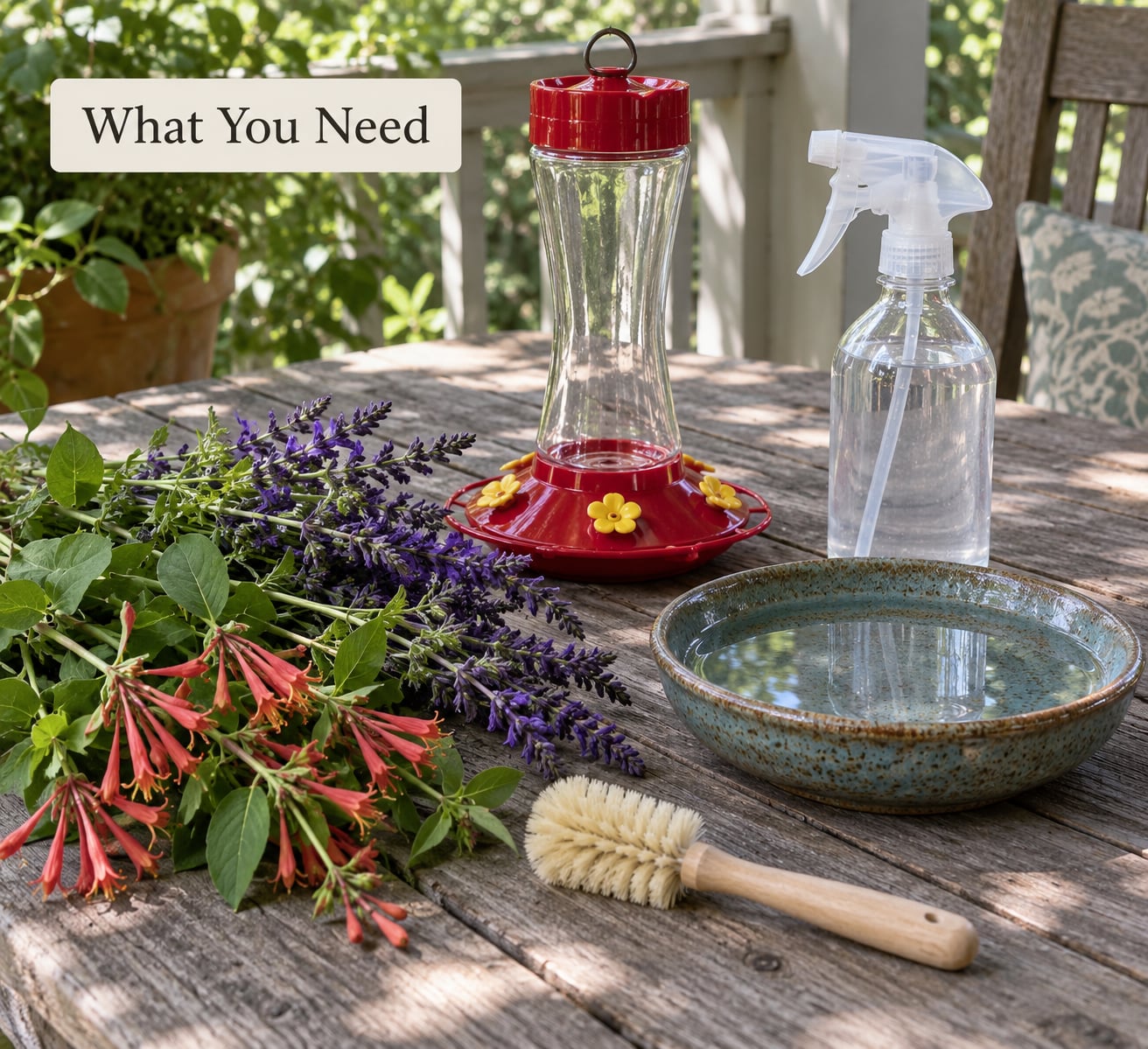
Nothing here is specialized. Most households already own four of the six items.
- A feeder. A simple tube or saucer style is enough to start. Skip the plastic solar-panel novelty feeders; the panels rarely power anything and the ports are harder to reach when you scrub.
- White granulated sugar. Plain table sugar from the grocery aisle. Nothing else belongs in the recipe.
- A pot and a clean towel. For heating water and for drying parts before they go back together.
- A bottle brush or small nylon scrubber. The one tool that turns feeder cleaning from a chore into a two-minute job.
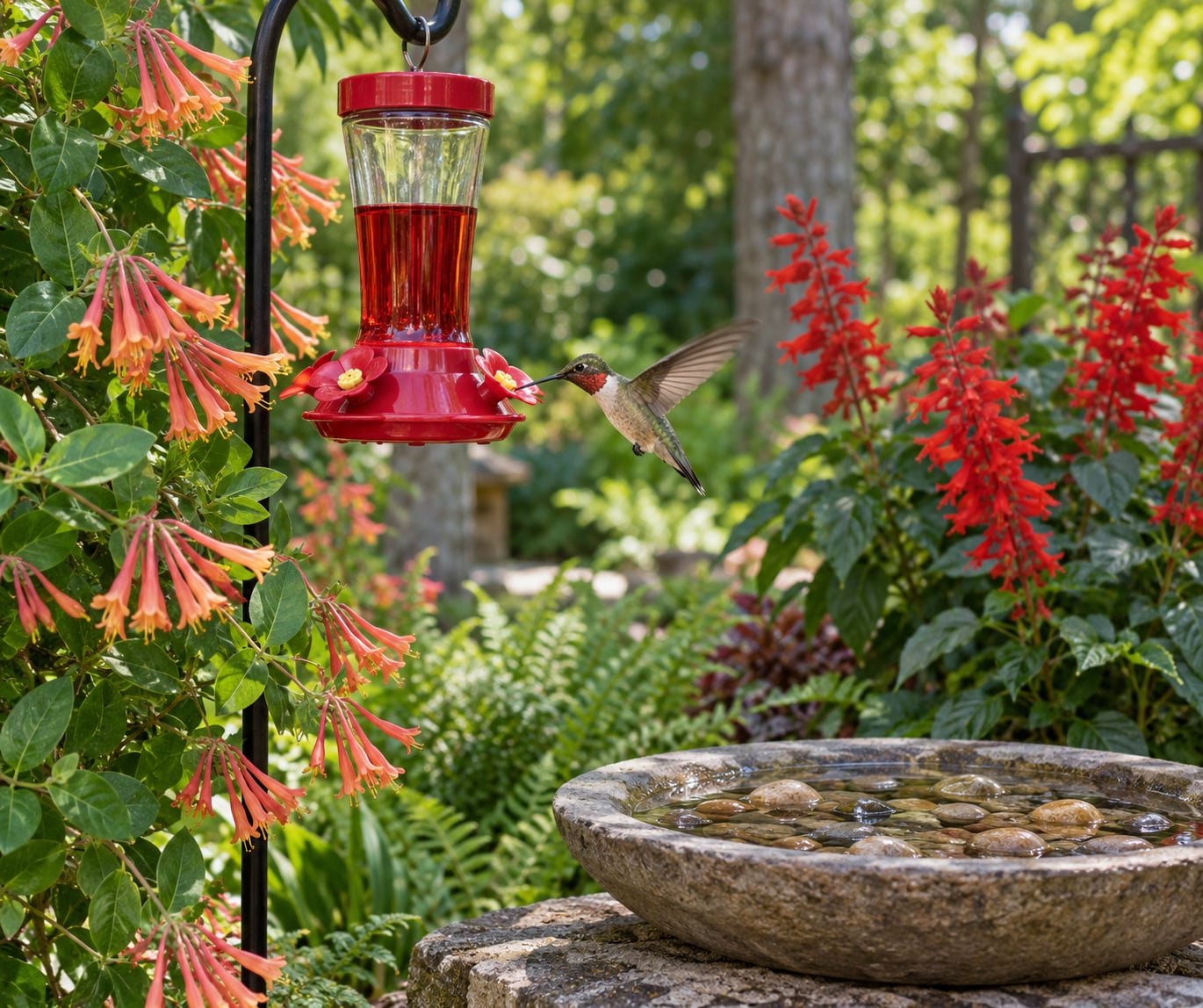
- Native flowering plants. Salvia, coral honeysuckle, bee balm, trumpet vine, and cardinal flower are a solid starting palette.
- A shallow water source. A mister, dripper, or a small dish with pebbles and a dripper tip.
One thing you should also plan for is where the birds can perch between meals. A bare branch, a clothesline, or a bamboo stake within about 10 feet of the feeder saves them energy they would rather spend defending the feeder.
How to Attract Hummingbirds in the Southeast
None of the eight steps below works alone. A beautiful garden with one filthy feeder gets ignored, and a clean feeder with no flowers around it turns into a stop the birds use once a week instead of a place they live. Layer them and the results change within a season.
Choose a Feeder That Matches Your Space
Window feeders suit balconies and porches where you cannot hang anything else. They hold a small amount of nectar, so they need more frequent refills, and they put birds uncomfortably close to glass. Mount them on the window frame itself rather than suction cups, which fail in heat.
Tube feeders are the workhorse: they hold enough for a few days, the reservoir is easy to soak and scrub, and the perch ring keeps birds from clinging to the ports. Saucer feeders sit flat like a dish and hold less, but they are quick to clean and good for people with small yards.
Decorative glass feeders bring more birds to the yard and give you somewhere to watch from the window. The trade-off is fragility and price. Skip feeders painted with food dye. Clear or plain red feeder bases work fine; the birds are not color-dependent the way the old backyard literature suggests.
Whichever style you pick, check that every part comes apart with your hands. If a reservoir has to be scrubbed with a toothbrush to get at the corners, it will get skipped, and skipped feeders are the number one reason hummingbirds move on.
Place Feeders in Partial Shade
Nectar in direct sun goes bad fast. A feeder under a tree edge or on the east side of a house keeps the sugar solution cool enough to last and cuts evaporation in the hottest weeks.
You also want the feeder visible from about 10 to 15 feet away and no closer. Close-up viewing is fine for you, but a hummingbird that cannot see a cat coming will not use the feeder at all. Place it near shrubs or a fence line that gives cover, and keep it away from an open patio where people walk past all day.
Height matters less than most guides claim. Hanging feeders at roughly 5 to 7 feet suits most yards, and window-height feeders work well for the balcony crowd. If cats patrol your property, keep the feeder above their comfortable jumping distance.
Make and Replace Nectar Correctly
The recipe is one part plain white sugar to four parts water. Bring one cup of water to a boil, take it off the heat, stir in a quarter cup of sugar until it dissolves, then let it cool fully before filling the feeder. Some people skip the boiling and it works, but boiling sterilizes the solution and buys you an extra half day in hot weather.
Never use honey. It promotes fungal growth that can damage a bird’s crop, and it sticks to equipment. No red dye, no food coloring, no artificial sweetener. The birds are looking for the shape and flow of the flower, not the paint.
For replacement frequency in the Southeast: every three days in spring and fall, every two days once the thermometer passes 85F, and daily when nights stay warm or a storm soaks the feeder with rain. Two weeks is a common rule elsewhere, and it is far too long down here. Watch for cloudy liquid, black specks, a sour smell, or visible bubbles at the ports and throw it out on sight.
Plant Native Flowers for a Longer Season
Feeders are a supplement. The real answer to how to attract hummingbirds in the Southeast is a planting plan that puts something in bloom from late March through the first hard freeze in October.
Start early with spring coral honeysuckle, red buckeye, and flowering currant, which give arriving migrants their first reliable fuel. Follow with summer salvia, bee balm, Turk’s cap, and cardinal flower, the period when fledglings are learning to feed. Close the season with autumn sage, greentop, and late-blooming sweet pea so departing birds tank up before the Gulf crossing.
Tube shape matters more than color. Red, orange, and pink hold up well, but tubular, trumpet, and flag-shaped blooms are what hummingbirds can actually work. Double flowers bred for show often have the nectar cut out of them, which is an easy mistake to walk past in a nursery.
Why natives? They feed insects that raise chicks, they need no fertilizer or pesticide, and they are adapted to the heat and humidity that kill half of what you buy at a big box store. Local native plant nurseries and your state extension office are far better sources than a rack of annuals.
Add Clean Water and Perches
A mister or dripper does more than a birdbath. Moving water catches birds the way a still dish never does, and backyard birders consistently report misters pulling in more birds within minutes. A single dripper tip over a flat stone is the cheapest version that works.
If you go with a shallow dish, add smooth pebbles so the birds can stand, and scrub it every other day. Algae in a warm Southeast yard shows up fast, and birds will ignore a green birdbath in favor of a dripping spigot half a yard away.
For perches, leave a small bare branch or a length of twine on a pole within 10 feet of the feeder. Resting birds are easy targets for hawks, and a perch gives them somewhere safe to preen and watch for rivals.
Keep Predators and Windows in Mind
Outdoor cats kill more hummingbirds than anything else does. Keeping cats indoors during spring and fall migration is the single highest-impact conservation step a Southeast household can take. If a cat must be outside, a screened porch or catio changes the outcome more than any feeder purchase.
Window strikes are the other big hazard, and they are almost always a visibility problem rather than a reflection problem. Birds see daylight through the glass and the reflected yard behind them, which reads to them as open flight space.
Hang feeders more than 3 feet from any window, or if you want close-up viewing, keep them within about 3 feet so birds treat the glass as a wall they cannot pass. Between those two distances is the danger zone. On an existing window, apply one-inch-wide horizontal decals or a dotted pattern outside the glass so a bird sees a surface. Breaking up the outdoor view with a hedge or trellis at 3 to 5 feet works too.
Aggression is the normal third problem in any yard. One male can guard a single feeder for weeks. Two or three feeders placed where they cannot see each other spreads the pressure out, and a garden with several patches of flowers gives birds a reason to be somewhere else.
Maintain the Setup Through the Seasons
Spring is a fueling stop for birds crossing from Central America. Have feeders out before the first males show up and leave them up. Fall is the same run in reverse and runs through October, with the heaviest traffic in the Southeast during the last two weeks of September and the first two of October. Some backyard birders report not seeing a single bird for most of August and then a sudden crowd once the juveniles start moving.
Once nights turn cold, do not panic. A few Ruby-throated hummingbirds overwinter in Florida and along the Gulf Coast, and Rufous and other western species turn up there more often in late October and November. Leaving a clean feeder up during a freeze does not trap birds, because they do not depend on it. Keep it filled and clean through the winter for the stragglers, and stop worrying about it delaying anyone’s departure.
Give feeders a full disassembly and deep clean once a month, even in mild weather. Parts soak in a solution of white vinegar and water or dilute hydrogen peroxide, then rinse well and air dry completely before reassembly.
Observe Without Disturbing the Birds
Confirming that your setup works takes less than a week in spring. Look for repeated visits within a minute of each other, birds hovering in the area before committing to the feeder, and territorial chases and display dives, which mean the site is good enough to fight over.
An empty feeder means check these in order: sun exposure, nectar age, and window proximity. A feeder with no cover nearby gets used less. A feeder next to a buzzing hose bib or an outdoor speaker gets abandoned fast.
Log sightings in a free platform such as eBird, and you get both a record for your yard and a real contribution to the range maps ornithologists use. If you want more than a checklist, keep a simple notebook with dates, sightings, and weather. After two seasons, the pattern tells you when to have your feeder full and when to let it rest.
Common Mistakes
Using dye or honey. Both are unnecessary and honey is genuinely harmful. One part sugar to four parts water is the whole recipe. If your nectar list has more than two ingredients, cut it back.
Refilling without washing. Washing the reservoir on the same schedule you refill it is what actually keeps birds healthy. Swap nectar every two to three days and scrub on a two-week rotation in warm weather.
Hanging the feeder in full sun. The nectar spoils and the feeder overheats. Move it into the dappled shade near cover within 3 feet of a branch if you have one.
Running a single feeder in open ground. One male owns it and everyone else stays away. Add a second feeder out of sight of the first, ideally 20 feet or more away.
Placing the feeder 3 to 30 feet from a window. That band is where collisions happen. Either pull it back more than 30 feet or mount it within 3 feet of the glass.
Filling the yard with annuals and tropicals. They bloom hard for a few weeks and then leave nothing behind. Swap a share of them for native perennials that return every year and feed the insects chicks need.
Postponing maintenance. A month of good intentions in July becomes a swamp in August. Set the cleaning day on the same day you take out the trash and treat it as non-negotiable.
Frequently Asked Questions
What is the best way to attract hummingbirds in the Southeast?
Combine three things: native tubular flowers that bloom from March through October, at least two clean feeders of fresh 4:1 sugar water placed in shade, and a moving water source such as a mister or dripper. Keep feeders out of wide open ground, hang them near shrubs for safety, and scatter two or three of them where they cannot see each other so one male cannot guard them all.
Should I use red nectar or dye in my hummingbird feeders?
No dye, and no red nectar. Plain sugar water is all a hummingbird feeder needs, and there is no evidence that coloring it helps. Hummingbirds find feeders by the sight of moving liquid and the activity around it rather than by hue. A clear feeder, or one with plain red plastic parts, works well without adding anything to the liquid.
How often should hummingbird nectar be changed in hot Southeast weather?
Every three days in mild weather, every two days above 85 degrees, and daily when nights stay warm, rain soaks the feeder, or several birds use it heavily. Some birders refresh it every morning through July and August, which works fine. Dump it whenever the liquid turns cloudy, shows black specks, smells sour, or bubbles at the ports, however recent the fill was.
What native flowers attract hummingbirds in the Southeast?
The reliable performers are coral honeysuckle, salvia, bee balm, Turk’s cap, cardinal flower, red buckeye, autumn sage, and greentop. Plant a sequence rather than one variety: red buckeye and spring coral honeysuckle in March and April, salvia and bee balm through summer, then autumn sage and greentop into October. Tube shape matters more than color, and single flowers hold more nectar than doubles.
Are hummingbirds harmed by flying into windows?
Yes, and it is a leading cause of hummingbird deaths around homes. Birds see open sky through the glass and the reflected yard behind it, so they fly into what looks like empty air. The fix is distance or proximity, never something in between. Hang feeders more than 30 feet from a window or within 3 feet of it, and put one-inch decals, a dotted pattern, or a screened hedge on the outside of glass birds hit often.
How long does it take for hummingbirds to find a new feeder?
Usually a few days, provided the nectar is fresh and the feeder sits in shade near cover. Hummingbirds scout an area repeatedly before they commit, so an empty feeder on day one is normal. Birds that have used your yard for years will find a new feeder inside about a week. If nothing shows up after two weeks, check sun exposure, nectar age, and distance from glass first.
Conclusion
Pick a shaded spot near a shrub or fence, set out one feeder, and fill it tonight with a quarter cup of white sugar in one cup of boiled water. Hang a second one where the first cannot see it. Then call your state extension office for the native salvia and coral honeysuckle closest to your yard, and set a repeating weekly reminder to clean and refill the feeders.
Plants take a season to establish and birds notice within a week, so put both in motion now and you will have nectar and a feeder running when the first males cross the Gulf in 2026.