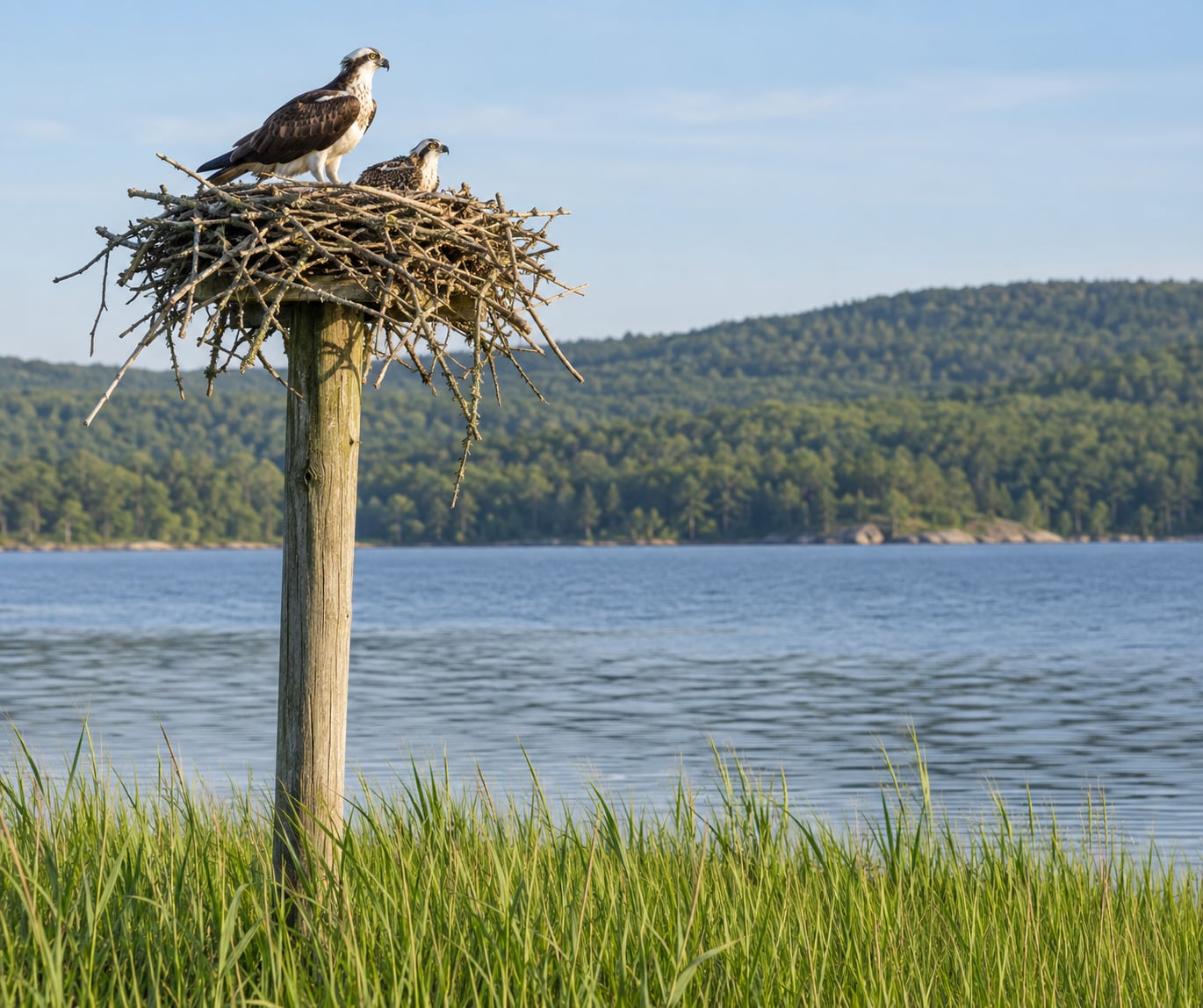
If you want to know how to find nesting ospreys near water, work outward from the fishing water itself. Ospreys almost always nest close to good fishing, on the tallest open structure available, so the fastest route is: find water with fish, scan the skyline above it, then confirm activity with binoculars.
Most people see an osprey before they find the nest, and the nest is the hard part. An adult bird can be quartering a lake a mile from its eyrie, so tracking a flying bird backward to a specific structure takes a little patience and a repeatable order of checks. This guide covers that order, the gear that makes it possible, and the line you should not cross while looking.
Budget 20 minutes at a shoreline, an hour if you are paddling a route, and expect the bird to confirm itself rather than the nest. Most osprey nest checks take under 10 minutes once you know where to look.
Table of Contents
- What You Need
- Step-by-Step
- How to Choose Likely Water and Habitat
- Look for Osprey Flight and Hunting Behavior
- Scan High Nest-Supporting Structures
- Confirm Nest Activity Without Approaching
- Record the Location and Behaviors
- Common Mistakes
- Frequently Asked Questions
- What month do ospreys lay eggs?
- Do ospreys nest in the same spot every year?
- What time of day are ospreys most active?
- What does an osprey nest look like?
- How close can I get to an osprey nest?
- Can ospreys nest without water nearby?
- Conclusion
What You Need
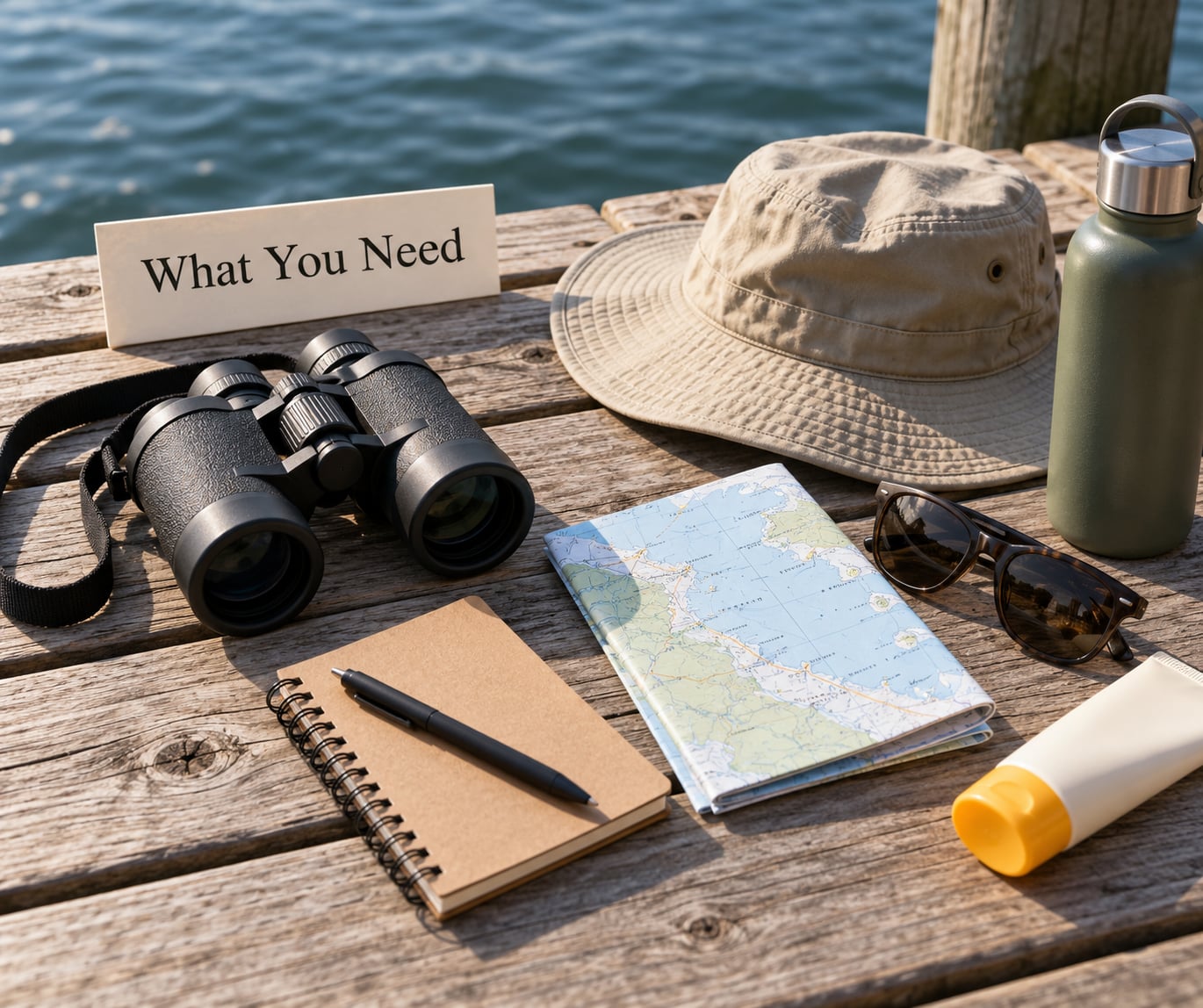
Binoculars are the one piece of gear you cannot skip, and any decent 8×42 or 10×42 pair works. Community nest monitors in Michigan report that binoculars cover nearly every observation, with a spotting scope needed only for the highest structures like cell towers.
- Binoculars in the 8×42 or 10×42 range. Wider is not better here; you want a narrow, bright view that holds steady on a stick nest 300 feet away.
- A spotting scope if your targets are cell towers, water towers, or light poles more than 60 feet up. A compact 12x to 20x scope on a small tripod is enough.
- A camera with reach if you want images. A 200mm-equivalent lens handles shoreline nests; anything on a cell tower wants 400mm or more, and a beanbag on a car seat beats your arms after twenty minutes.
- A shoreline map or app with elevation, so you can spot dead snags and high ground before you arrive rather than while you scan.
- A notebook or phone for the date, coordinates, and behavior notes that make a sighting useful to a biologist.
- Water, sun protection, insect repellent, and a wind layer. Shorelines are exposed and there is nowhere to duck out of the weather.
- A leash for dogs, no exceptions. An unleashed dog at a waterline is a nest-disturbance event every time.
Leave the climbing gear and the drone at home. Both turn a quiet observation into an incident.
Step-by-Step
How to Choose Likely Water and Habitat
Start with water that holds fish, because that single factor decides most of the map. Ospreys are almost entirely fish-eating and hunt within roughly 12 miles of the nest, and they dive no deeper than about three feet, so shallow lakes, rivers, reservoirs, estuaries, and marsh edges beat deep open water.
Score a candidate shoreline on four things: visible fish water, something tall and open within sight of it, low human pressure, and a vantage point that lets you watch without climbing. Lakes, rivers, marshes, ponds, and coastal inlets all host nesting ospreys; bridges, causeways, and river mouths are worth checking because the structures are already there.
Can an osprey nest without water nearby? Yes, a pair can succeed up to about 12 miles from fishing grounds, but every extra mile cuts the available catch and makes the site less likely to hold. Near water is the rule, not the exception.
On the water, work the geometry rather than the open middle. Points, inlets, undercut banks, slow eddies, and the downstream side of bridge piers put you closer to feeding birds than a straight mid-lake crossing does.
Look for Osprey Flight and Hunting Behavior
Recognize an osprey by how it works the water: a steady climb to height, a hover, a fold and plunge, then a rise carrying something. Head-first fish transport is the giveaway, along with long narrow wings that bend at the wrist, white underparts with a dark patch at the wrist, and a white head on adults.
To find the nest, use the pattern. Watch which direction the bird goes after it climbs out of a dive, and follow that line with your eyes rather than your feet. Birds rarely stay over the nest they just fed, but they return to a hunting lane within a mile or so of it, so a repeated departure direction narrows the search area fast.
Perched birds tell you more. An osprey on a bare dead branch over water, a channel marker, or a piling during the middle of the day is usually near an active nest. Listening helps too: the loud whistling chirps carry a long way and are often the first thing you hear when a pair is defending a site.
Scan High Nest-Supporting Structures
Work the skyline from the tallest, most open supports down. Old nests sit 15 to 100 feet above the ground or water, and a mature one can measure 3 to 6 feet across and 10 to 13 feet deep, deep enough that a person could sit in it.
Check in roughly this order of hit probability, based on what community nest checks in Michigan found across 238 checks in 22 counties, where more than 97 percent of nests were on human-built structures:
- Cell towers, high-tension transmission towers, and water towers, which accounted for 56 percent of nests in those Michigan checks and are often visible from public roads or boat ramps.
- Utility poles, light poles, and channel markers, especially over navigable water where the structure was already standing.
- Purpose-built nest platforms and towers, often on islands, in parks, or near ramps, sometimes with a sign and sometimes with none.
- Dead snags and broken-topped live trees, the classic natural site, usually the tallest tree within a short flight of good water.
- Cliff ledges, rock islands, bridges, and duck blinds, where the nest may be a shallow bowl rather than a deep stick pile.
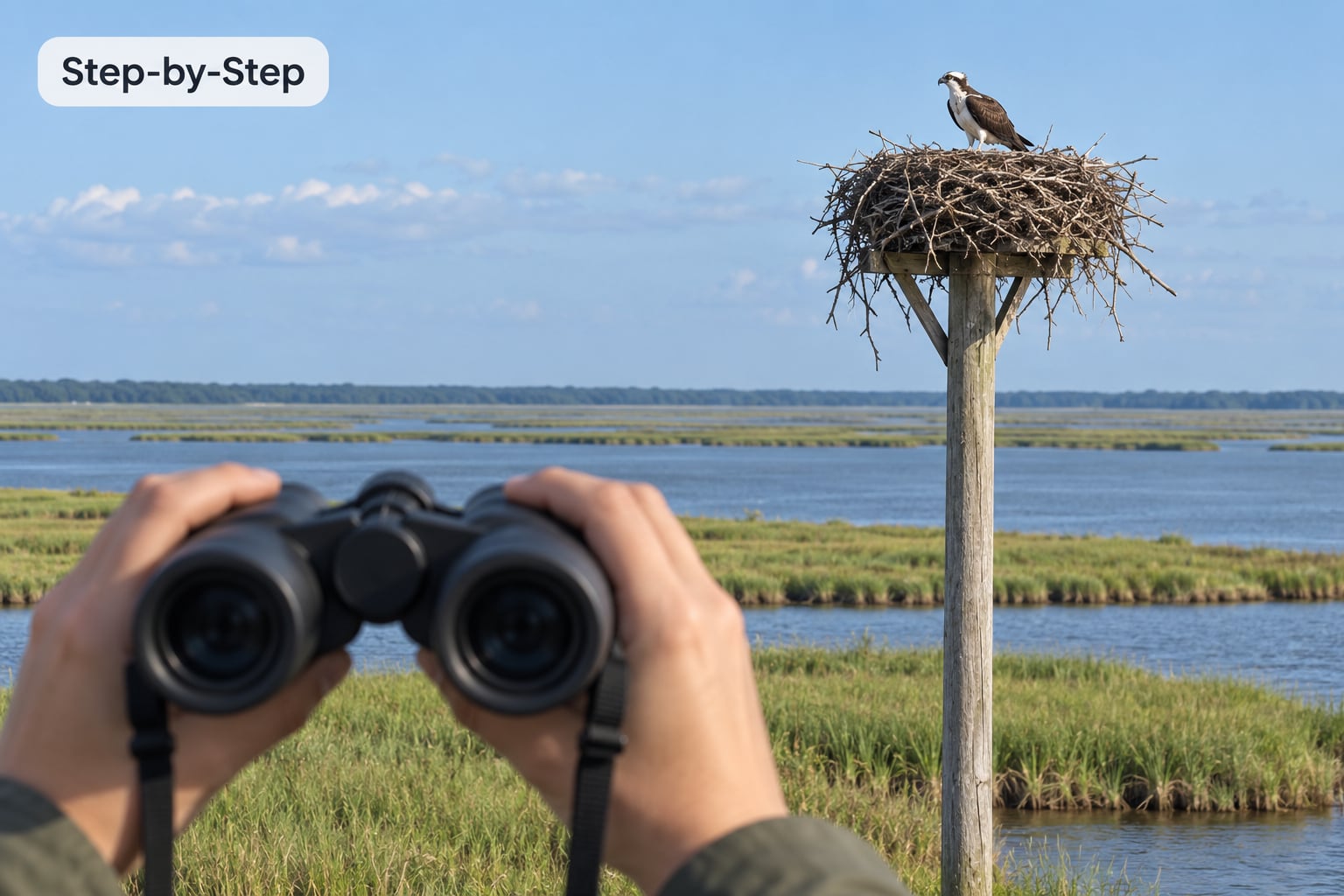
Binoculars handle everything up to a normal utility pole. Above that, steady the scope on a monopod, your pack, or a railing, and give yourself time. A nest is not going anywhere in the ten minutes you spent scanning.
Confirm Nest Activity Without Approaching
An active nest shows a pattern, not a single moment: an adult sitting low and steady, a partner arriving with food, repeated trips, courtship display, or heads rising above the rim once the chicks are big enough. Fresh sticks and fresh whitewash-like droppings on the rim also tell you birds are working the structure this season.
An old structure looks different. It sits weathered and gray, often with weeds growing through the base, no fresh material on the rim, and no white splashing. A large stick nest in spring with nothing on it may be unclaimed, built late, or in use by another species entirely.
From the water or the far end of a trail, judge the stage. Courtship and nest-building runs from arrival through egg laying, incubation lasts roughly 34 to 42 days, eyasts hatch white and fuzzy with dark eye masks, branchers stand on the nest rim but do not leave it, and fledglings make their first flight at about 50 to 55 days, leaving the nest 50 to 60 days after hatching. That stage tells you how much activity to expect in the next week.
Then stop where you are. A clutch is one to four eggs, so a pair that abandons a nest because of repeated disturbance has lost the season entirely. The Migratory Bird Treaty Act protects active nests, and human disturbance is one of the main reasons pairs fail.
Record the Location and Behaviors
Write the observation down while you still have it in front of you. Note the date and time, the water body and which shore you were on, the nest support type and its approximate height above the water, the stage you observed, the behavior you actually saw, and how far away you were.
That last field matters most. A record of an active nest 400 feet offshore on a channel marker is reusable data. A vague note saying ospreys near the lake is not.
Log it in eBird, which lets you add a nest location and supports breeding codes, and send it to the state wildlife agency if you found something unusual. Volunteer programs such as Adopt-A-Nest often want exactly this kind of record, and most run on a simple rhythm: three 30-minute visits per nest from spring through late summer. Nest platforms are monitored the same way, and a live osprey cam is a good way to learn the stages before you go looking for them.
Common Mistakes
Getting too close. The fix is to pick your distance before you start. Stay on the water or on a public path, use binoculars rather than your feet, and treat any reaction from the birds as your cue to back off. A bird leaving the nest when you arrive means you arrived wrong.
Blocking the approach line. Standing under a nest or paddling directly beneath an active one puts you between the birds and their water. Move parallel to the shore instead of toward the structure, and give the flight path room.
Treating every big stick nest as an osprey nest. The fix is to look for osprey traffic. If no osprey visits the structure, it is an old nest or someone else’s. Big and flat points to a hawk; deep stick piles with fish remains and white droppings on the rim point to an osprey.
Assuming a flying bird means the nest is nearby. Birds hunt up to about 12 miles out, so sight of a feeding osprey only tells you the area. The method is to follow the repeated direction of departure until you find a support with birds on or near it.
Searching in the wrong weeks. Ospreys in warm regions start in winter and nest from December through May in Florida, while Great Lakes pairs are active from about May through July in southern Michigan and June through August in the north. Arrive in the wrong window and a perfectly good nest looks abandoned.
Ignoring weather and light. Still, low-wind days put more birds in the air, and flat morning or evening light puts more of them over the water near you. Overcast light also makes a white-and-dark adult easier to pick out than harsh backlight.
Forgetting hazards beyond disturbance. Fishing line, baling twine, and other loose plastic are a leading cause of nest death for ospreys, and predators such as raccoons take eggs and eyasts from reachable nests. Never haul debris out of a nest yourself; report it to the land manager instead.
Assuming last year’s report still holds. Pairs are loyal to a site, sometimes for decades, but storms, nest failure, and tower maintenance all move them. Treat every prior sighting as a place to check first, not a guarantee.
Frequently Asked Questions
What month do ospreys lay eggs?
Timing varies sharply by latitude. Florida pairs lay from roughly March into May during a December-through-May breeding season, while northern and Great Lakes birds lay from late April into June, with activity running May to July in southern Michigan and June to August farther north. If you are after eggs or eyasts rather than courtship, plan your visit for two to four weeks after the pair settles on the nest.
Do ospreys nest in the same spot every year?
Usually, yes. Ospreys show strong site fidelity and return to the same nest structure year after year, adding fresh sticks each season until the pile can reach 3 to 6 feet wide and 10 to 13 feet deep. That habit is the reason old nest records are such a useful starting point. Storms, nest failure, and structure removal still move pairs, so confirm activity rather than trusting last year’s note.
What time of day are ospreys most active?
Ospreys hunt most in mid-morning and mid-afternoon, when fish are near the surface and light is good, and they often rest through the hottest part of the day. Dawn and late afternoon are the best viewing windows because feeding activity is concentrated and the birds are closer to the water. Still, low-wind days carry more traffic than windy ones, and a brooding female can be sitting much of the morning.
What does an osprey nest look like?
It is a large, messy pile of sticks, often 3 to 6 feet across and 10 to 13 feet deep in old nests, with fresh material added on top and white droppings streaking the rim. From below you mostly see a wide dark mass with a flat or slightly domed profile. Nest sites include dead snags, broken-topped live trees, utility poles, light poles, cell towers, bridges, and purpose-built platforms, usually 15 to 100 feet above ground or water.
How close can I get to an osprey nest?
Close enough to see, far enough that the birds do not react. Stay on the water or on public ground, view through binoculars or a scope, and keep well back from the base of any structure supporting a nest. If an adult leaves the nest while you are present or gives repeated alarm calls, you are too close and should withdraw quietly. Repeated disturbance can cause abandonment, and active nests are protected under the Migratory Bird Treaty Act.
Can ospreys nest without water nearby?
They can, but it is unusual and less successful. A pair needs accessible fish, and a clutch is one to four eggs, so a nest more than a few miles from good fishing water is under a real handicap. Most successful nests sit within about 12 miles of a productive fishery, and ospreys dive no deeper than roughly three feet, which favors shallow lakes, rivers, marshes, and coastal inlets over deep open water.
Conclusion
Start with the water, not the bird. Find a shallow lake, river, marsh, or inlet with fish in it, scan the skyline above that water for towers, poles, platforms, and dead snags, then confirm activity with binoculars from wherever you already are. Note what you saw and where, and leave the birds to their season.
That order matters more than any piece of gear. Follow it and finding nesting ospreys near water becomes a quiet twenty-minute scan instead of a hike up a shoreline you were never meant to climb.