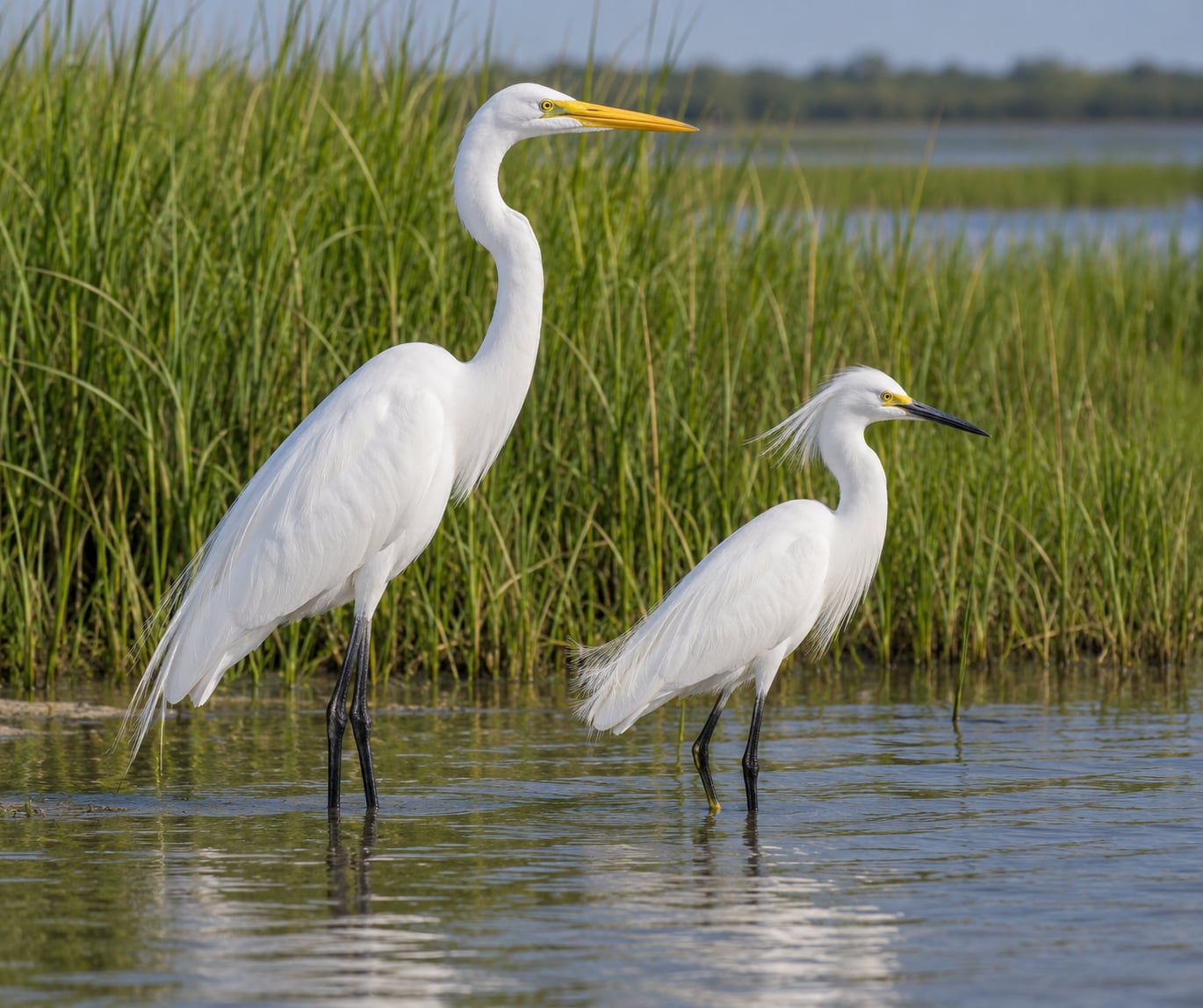
Look at the bill and the feet, in that order. A great egret has a heavy yellow-orange bill and entirely black feet, while a snowy egret has a thinner, all-black bill and bright yellow feet on black legs. The two species run the same color pattern in reverse, so confirming one part automatically confirms the other.
Plumage will not help here. Both birds are pure white year round, and both fish the same marshes, estuaries, and flooded fields along the Atlantic and Gulf coasts. They regularly feed and roost in mixed flocks, which is exactly when an uncertain ID is most likely. Learning how to tell a great egret from a snowy egret is a short process, and the clues hold up at almost any distance.
Table of Contents
- How to Tell a Great Egret From a Snowy Egret at a Glance
- How Size and Body Shape Change the Identification
- How to Tell a Great Egret From a Snowy Egret Without a Scale Reference
- Bill Color Is One of the Best Clues
- Leg Color and Leg Length
- Neck Posture and Hunting Behavior
- Habitat, Range, and Season
- Juvenile and Nonbreeding Birds
- How to Confirm an Identification in the Field
- Which Should You Expect to See?
- Frequently Asked Questions
- Can you tell a great egret and a snowy egret apart from flying?
- What size difference distinguishes a great egret from a snowy egret?
- Are snowy egret legs always yellow?
- Can juvenile great egrets and snowy egrets be identified in winter?
- Do great egrets and snowy egrets use the same habitats?
- Conclusion: Start With the Bill, Then Check Size
How to Tell a Great Egret From a Snowy Egret at a Glance

The table below is the whole identification system in one place. Everything after it is just detail on these same rows.
| Field mark | Great Egret (Ardea alba) | Snowy Egret (Egretta thula) |
|---|---|---|
| Standing height | About 36 to 40 inches | About 24 inches |
| Build | Long-legged, heavy-bodied, elongated | Compact, rounder, shorter-legged |
| Bill color | Yellow to orange-yellow | Black, sometimes greenish in breeding birds |
| Bill shape | Thick, heavy dagger | Thin, slender, needle-like |
| Legs | Long and black | Shorter and black above the foot |
| Feet | Black | Bright yellow, the golden slippers |
| Neck at rest | Long, with a pronounced S-shaped kink | Shorter, held compact or crouched |
| Wingspan | About 49 to 51 inches | About 40 inches |
| Foraging style | Stands still or stalks slowly, works deeper water | More active, runs and stirs the water with its feet |
| Breeding detail | Long lacy aigretts, green lores to a reddish gape | Fine plumes, lores can flush pinkish or reddish |
| Best months for a clean look | Spring and early summer at nesting colonies | Spring and early summer at nesting colonies |
If you only get one look, use the bill. Thickness alone will separate these two more often than any other single trait.
How Size and Body Shape Change the Identification
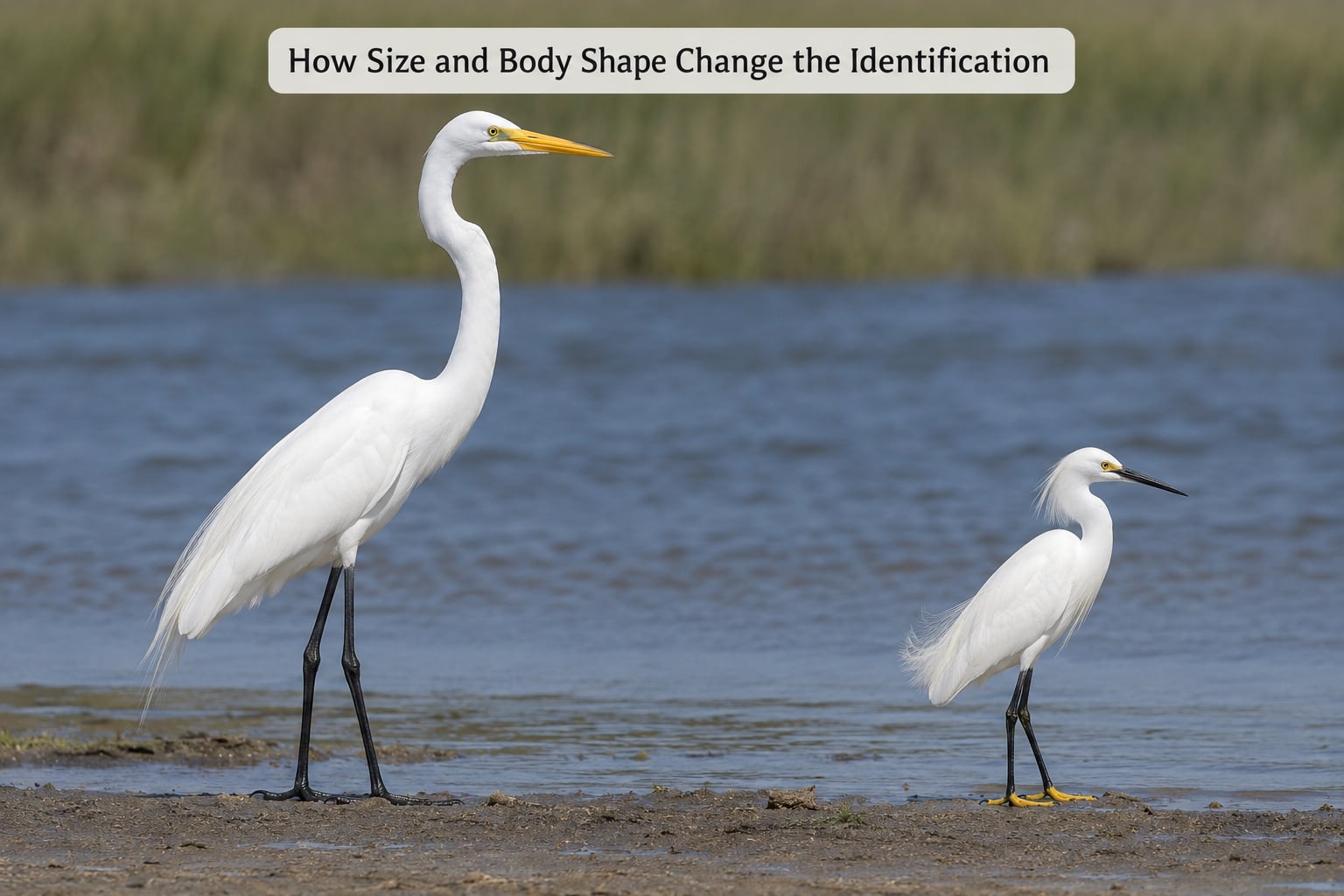
Size is the biggest difference between them and the least reliable one to judge. A great egret stands roughly 36 to 40 inches tall against about 24 inches for a snowy egret, so the great is well over a third taller with a noticeably heavier body. Side by side in the same frame, that gap is obvious and settles the question immediately.
Body shape adds information that raw height does not. A great egret looks stretched, with long legs carrying a long neck and a slim, extended profile. A snowy egret reads as compressed, with a rounder body, shorter legs, and a neck that sits closer to the shoulders.
How to Tell a Great Egret From a Snowy Egret Without a Scale Reference
Size fails in two predictable situations. The first is distance, where a snowy egret at 200 yards and a great egret at 150 yards can project the same silhouette. The second is crowding, where a great egret standing shoulder to shoulder with five snowy egrets makes everyone look smaller than they are.
Use a bird you already know as a ruler instead. A great blue heron is taller and heavier than either species, so a white bird clearly shorter and stockier than the heron nearby is a snowy egret, not a great egret. Failing that, use structure: bill thickness, leg length relative to the body, and how many times the neck seems to fold.
One more caution. If a white egret is standing chest-deep in a marsh channel, its legs are hidden and it will look far smaller than it is. Judge those birds on the bill and the visible head-and-neck proportion, not on how much leg is showing.
Bill Color Is One of the Best Clues
Color of the bill alone splits the two species: yellow-orange on a great egret, black on a snowy egret. Thickness is the stronger signal because it survives bad light. A great egret carries a heavy, straight-sided dagger that looks heavy even at distance, while a snowy egret’s bill is a thin spike that looks narrow under almost any light.
A few things distort the color. Bright sun bleaches a black bill toward gray or brown, and a muddy bird can have a bill that looks olive rather than black. Backlighting turns a yellow bill into a silhouette, which is why thickness matters. And in breeding condition a snowy egret’s bill can take on a greenish cast, so treat color as a fast confirmation and thickness as the primary read.
The line where the upper and lower mandibles meet, the gape line, gives a sharper answer if you have optics. On a snowy egret it ends below the center of the eye. On a great egret it runs back past the rear of the eye. It is a fine detail that rewards patience rather than something to expect on a moving bird.
Leg Color and Leg Length
Here the folk name does the work. A snowy egret has bright yellow feet, the golden slippers, and its legs are black above them. A great egret wears black from the toes to the top of the leg. So the yellow is on the feet, not the legs, and that distinction is where a lot of confusion comes from.
Leg length follows the size difference. Great egrets stand on noticeably longer legs and hunt in deeper water, which is why you often see them in a channel while snowy egrets work the shallow edge. Snowy egrets also use those yellow feet actively, shuffling and running through shallow water to stir prey up.
The honest problem is that feet are frequently invisible. They are underwater, tucked under a sitting bird, or blocked by a bank. When that happens, stop trying to force the feet mark and fall back in this order: bill color and thickness, then size against something known, then neck shape, then behavior.
Juveniles add a wrinkle. An immature snowy egret often has dull yellowish-green legs and a greenish-yellow bill with a dark tip, so the vivid slippers of an adult may be muted. Structure still holds, though: a dull-legged bird that is clearly small is a young snowy egret, not a young great egret.
Neck Posture and Hunting Behavior
The great egret holds its neck in a long S-shaped curve with a visible kink, and it is usually moving slowly or standing absolutely still before a strike. It works deeper water and appears to wait rather than chase, which fits a bird that needs a longer reach and a heavier bill.
The snowy egret usually sits lower, with a compact, crouched posture and a shorter folded neck. It is more likely to be in constant motion, shuffling its feet, running a few steps, and stabbing at disturbed prey. Watch the two in a mixed flock and the rhythm alone separates them before you check any color.
Behavior is supporting evidence, never the primary mark. A feeding bird bent forward with its head down tells you far less than one standing tall with a clear view of the bill.
Habitat, Range, and Season
Both species are established along the Southeastern Atlantic and Gulf coasts, and both are also found well inland on lakes, rivers, reservoirs, and flooded agricultural ground. Neither is restricted to salt marsh, and a snowy egret on a farm pond or a great egret on a tidal flat is entirely ordinary.
The tendencies are still real. Great egrets lean toward deeper water, marsh channels, ponds, and wet fields. Snowy egrets more often work the shallow edges, mudflats, and open saltmarsh channels, sometimes in tight groups. If a white egret is standing in two inches of water on a flat, that leans snowy, but not enough on its own to call it.
Seasonally, spring and early summer at a nesting colony is when both are easiest to study, because breeding adults carry the ornamental aigretts and the strongest bare-parts colors. Outside the breeding season the birds lose those extras and identification depends on the stable structural marks. Range overlaps almost completely, so a habitat claim by itself should never carry an ID.
Juvenile and Nonbreeding Birds
Most reported misidentifications involve birds in dull plumage rather than crisp adults. That is expected, because the easiest marks are seasonal. Plumes, bright lores, and rich bill color all fade or never develop in the first year.
What does not change is the framework. Overall size, the thickness of the bill, the length of the legs, and the depth of the neck fold are structural traits, and they are present on day one. A young great egret is still a big bird with a heavy bill and long legs, even when that bill is darker than an adult’s. A young snowy egret is still compact with a thin bill.
Winter birds are no harder than that, as long as you stop looking for the showy features. If the bird is small and thin-billed, it is a snowy egret. If it is large and heavy-billed, it is a great egret. Everything else confirms.
How to Confirm an Identification in the Field
When a white egret is distant, backlit, or half in the reeds, run this order and stop as soon as two marks agree.
- Establish scale. Compare the bird to a heron, a fence post, a dock cleat, or another bird you have already identified.
- Check the bill. Thick and yellow-orange, or thin and black. Thickness first, color second.
- Read the neck and stance. Long S-curve and tall, or compact and crouched.
- Note the feet if visible. Yellow means snowy egret, black means great egret.
- Add habitat and behavior. Deep water and slow stalking leans great; shallow edges and foot-stirring leans snowy.
- Wait for a second feature. One mark is a guess. Two or three agreeing marks is an identification.
In a mixed flock, do this bird by bird instead of averaging the group. Great egrets and snowy egrets feed happily within a few meters of each other, and the tall ones will stand head and shoulders above the rest.
Which Should You Expect to See?
This is a comparison between two species, not a better bird and a worse one. Both are sharp hunters, both are white, and both show up at good coastal wetland sites in the Southeast. What changes is probability, not possibility.
Expect more snowy egrets where the water is shallow and open, on mudflats, in saltmarsh channels, and along the edges of tidal creeks. Expect more great egrets in deeper water, at ponds, along marsh channels, and inland where flooded fields and river edges give them room. On a good day at a mixed site you will see both, often within a few feet of each other.
Whatever you settle on, put it in a record. A merged flock where a great egret gets logged as a snowy egret corrupts the count, and photo ID tools can be wrong on white birds with hidden feet. A clear photo with the bill and legs visible, submitted to eBird or iNaturalist, is worth more than a quick guess in a field notebook.
Frequently Asked Questions
Can you tell a great egret and a snowy egret apart from flying?
Usually yes, from the feet and the proportions. A snowy egret’s yellow feet stick out well past the tip of the tail and are often visible at surprising range, while a great egret’s black feet blend into the silhouette. A great egret also flies with slower, deeper, more deliberate wingbeats and a much longer neck drawn back in a deep S. Use both cues together, since the yellow can wash out in bright light.
What size difference distinguishes a great egret from a snowy egret?
A great egret stands about 36 to 40 inches tall with a wingspan near 50 inches. A snowy egret stands about 24 inches with a wingspan near 40 inches. That makes the great roughly a third taller and much heavier through the body. The gap is obvious when both birds share a frame, and unreliable when either is distant, since a nearer snowy egret can easily look larger than a farther great egret.
Are snowy egret legs always yellow?
No, and this is the most common mix-up. A snowy egret has black legs with bright yellow feet, the golden slippers, and the yellow stops at the ankle. A great egret is black from the toes upward. Immature snowy egrets are duller still, with yellowish-green legs and a greenish-yellow bill tipped in black, so on a young bird the vivid adult color may be missing altogether.
Can juvenile great egrets and snowy egrets be identified in winter?
Yes, because the reliable marks are structural rather than ornamental. Great egrets keep a large frame, heavy bill, long legs, and a deep S-shaped neck at any age, and snowy egrets keep a compact body and a thin bill. What winter birds lack is the breeding display: aigretts, bright lores, and richer bill color all fade, so work from size, bill thickness, and leg length instead.
Do great egrets and snowy egrets use the same habitats?
Largely, yes. Both use marshes, estuaries, tidal flats, ponds, flooded fields, river edges, and saltwater roosts along the Atlantic and Gulf coasts, and both are regularly found in mixed flocks. The leanings differ slightly: great egrets work deeper water and snowy egrets favor shallow edges and mudflats. Those preferences are useful supporting evidence, but a bird in the wrong habitat is not thereby a different species.
Conclusion: Start With the Bill, Then Check Size
Start with the bill. Thick and yellow-orange, or thin and black, is the fastest and most reliable split, and the feet confirm it when you can see them. That short order is what makes how to tell a great egret from a snowy egret quick in real conditions. Check size against something you know, use the neck curve and foraging style to back it up, and let habitat be supporting evidence rather than the deciding vote.