What to do if a snake bites you in the backcountry comes down to three things: get away from the snake, keep the bitten person calm and still, and get word out so antivenom can reach them. Everything else on the internet, from cutting the wound to tourniquets and suction kits, is either useless or actively harmful. This guide follows US guidance from the Centers for Disease Control and Prevention and the Wilderness Medical Society, written for the situation you are actually in: a trail, no signal, and hours of walking ahead.
Do this right now, in this order:
- Move 15 to 20 feet away from the snake, calmly and slowly. Do not run.
- Sit the bitten person down. Standing and panic cost more time than the bite will.
- Call 911 or your local emergency number. Suspected venomous bites are medical emergencies.
- With no signal, send a partner for service or activate a beacon and report your location.
- Take off rings, watches, bracelets and tight clothing before swelling starts.
- Keep the limb still, ideally splinted, and as close to heart level as the terrain allows.
- Circle the bite and the edge of the swelling with a permanent marker and write the time next to it.
- Walk out for help calmly if the dispatcher tells you to. Do not wait for symptoms to appear.
Medical disclaimer: this article is general outdoor safety information, not medical advice, and it cannot replace a physician or a trained dispatcher. If a snake has bitten anyone, call 911 now and contact Poison Control at 1-800-222-1222. Last reviewed October 2026; sourced from CDC, Wilderness Medical Society clinical practice guidelines, and the American Hiking Society snake safety fact sheet.
Table of Contents
- What You Need
- Step-by-Step
- 1. What to Do If a Snake Bites You in the Backcountry: Move Away
- 2. Call 911 or the Local Emergency Number
- 3. Rest in a Safe Place and Watch for Warning Signs
- 4. Remove Restrictive Items Without Manipulating the Bite
- 5. Prevent Cold, Heat, and Alcohol
- 6. Follow Instructions and Arrange Medical Handoff
- What happens after antivenom, so the walk out feels less open-ended
- Common Mistakes
- Call for Help Early and Follow the Dispatcher
- Frequently Asked Questions
- Should I try to identify the snake after it bites me?
- Can I drive myself to a hospital after a snakebite?
- How soon do symptoms from a venomous snakebite begin?
- What if there is no cell service in the backcountry?
- Should I cut open the bite or try to suck out venom?
- Does the bite still need urgent care if the snake was not venomous?
- Conclusion
What You Need
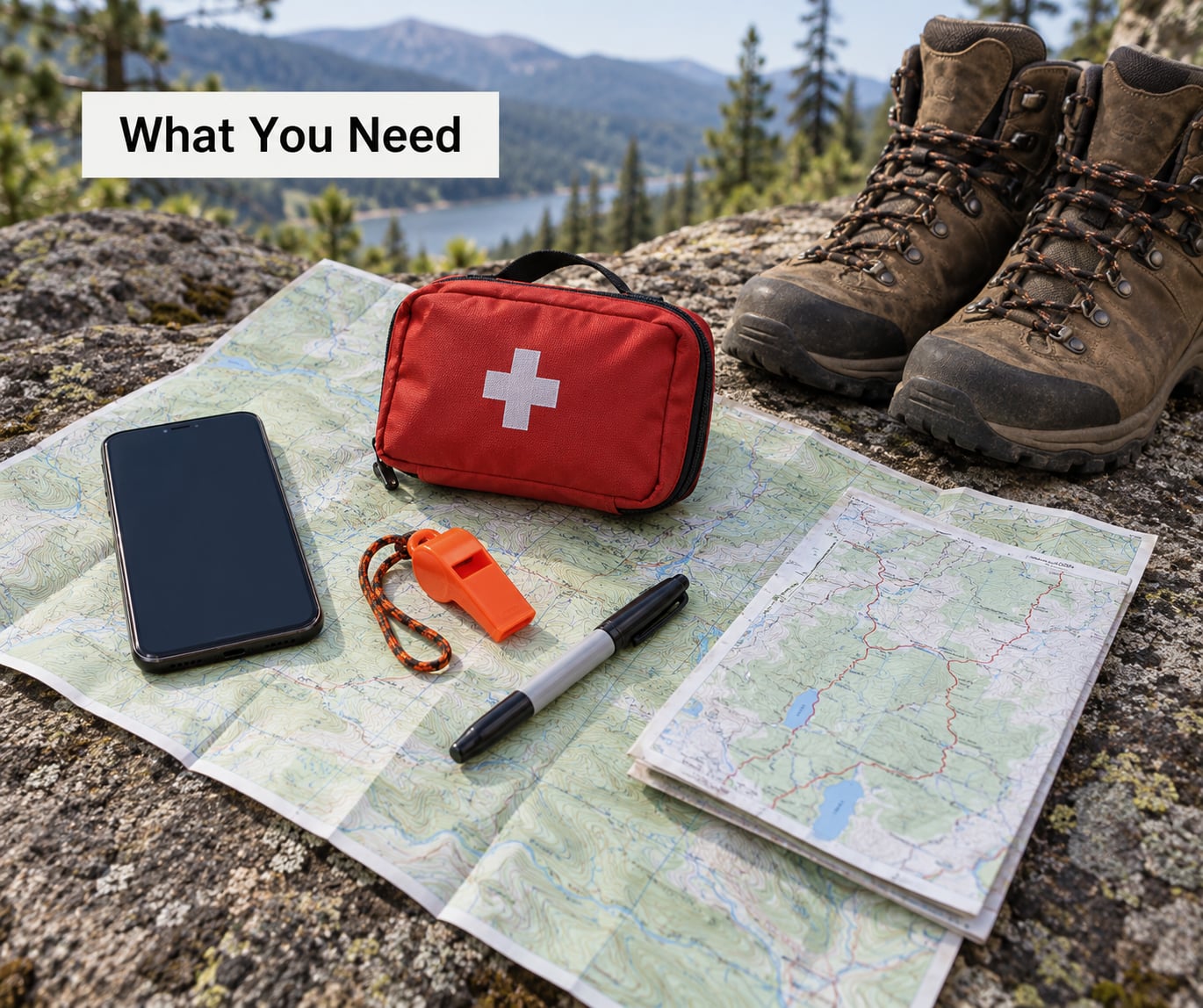
Start with the thing no kit can replace: professional emergency help. Every other item here exists to buy time or to buy communication until help arrives.
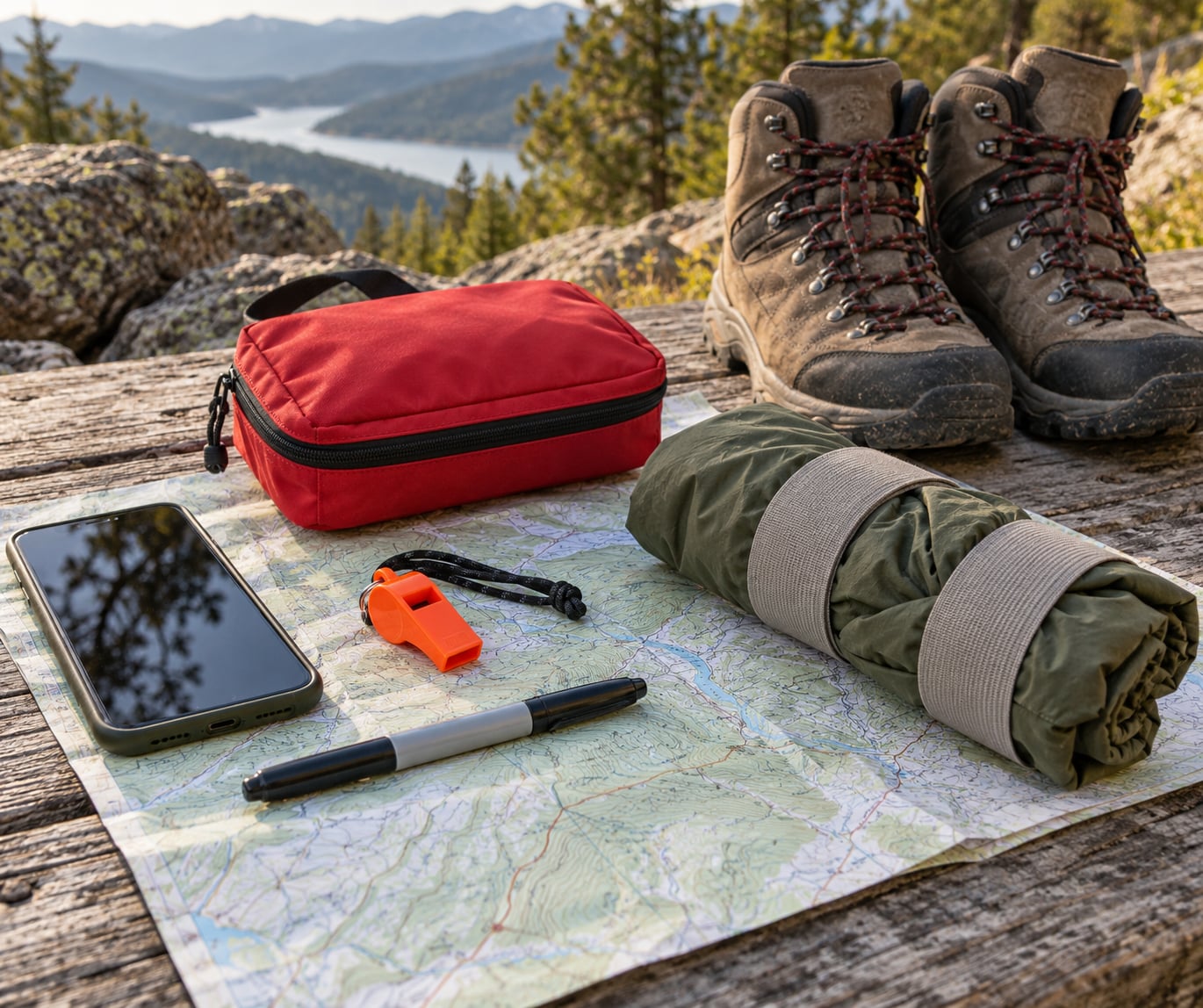
- A charged phone with the location sharing turned on. Battery drain is real, so airplane mode until you need it, and keep it warm inside a pocket rather than on a cold belt.
- Your exact location in words. Trail name, nearest trailhead, mile marker, segment of road or water access, and the access route a responder would take. Dispatchers ask for this and hikers cannot always find it on a map under stress.
- A way to send a signal when the phone cannot. A personal locator beacon or a satellite messenger that sends both a distress alert and two-way messages. The beacon needs no subscription; the messenger does.
- A whistle and a map and compass. Six blasts on a whistle is the international distress signal and travels much farther than a shout.
- A basic first aid kit containing a permanent marker, a roller gauze roll, and tape. The marker is the least obvious and most useful item on the list.
- A trip plan left with someone at home. Route, camps, vehicle, and the date plus time you expect to be out.
Not one of those items treats a venomous bite. A commercial suction extractor kit is the exception worth naming, because hikers buy them for exactly this scenario and no major US medical body recommends them. Antivenom is the only definitive treatment.
Step-by-Step
Run the response in order. The order matters more than any technique, and almost all of the steps take under a minute.
1. What to Do If a Snake Bites You in the Backcountry: Move Away
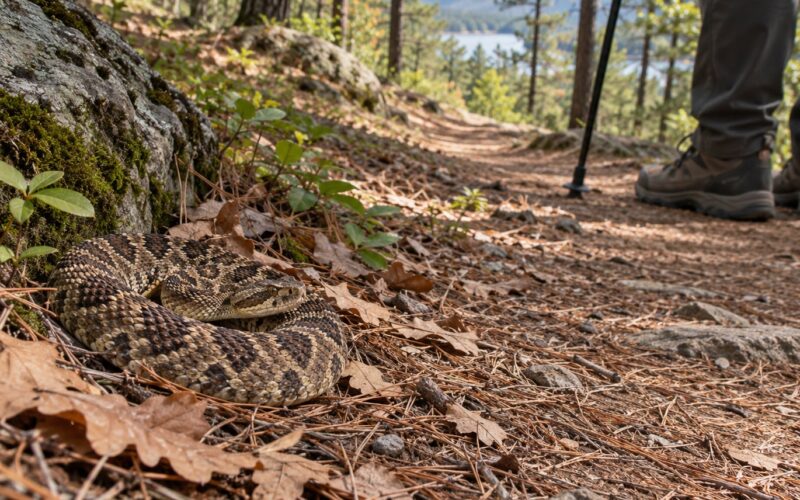
Back away from the snake at a walk, roughly 15 to 20 feet, and put solid ground and a tree or rock between you and it if you can. Do not run, do not swat at it, and do not try to capture, kill or photograph it at close range.
Rattlesnakes and other pit vipers strike when stepped on, cornered or handled, not in pursuit. The strike range of most US rattlesnakes is short, and running increases the chance of a second bite. A large share of snakebite injuries happen to people who tried to handle or kill the snake, so the safest thing you can do for the victim is remove the second risk from the scene.
If more than one person is present, keep the group back and designate one caller. Panic spreading through a group is how people end up with two bites and no signal left.
2. Call 911 or the Local Emergency Number
A suspected venomous bite is a medical emergency. Do not wait to see whether swelling develops before you call, and do not spend twenty minutes debating whether the snake was a rattler or a garter snake.
Have these ready for the dispatcher:
- Your location, read off a map or GPS rather than guessed.
- The access route: trailhead name, road number, gate number, or boat ramp.
- How many people are injured and the bite time, if you know it.
- What the person looks like right now: alert, confused, complaining of pain, swelling visible.
- Your phone number, battery level and whether you have reception.
In the United States, a wilderness branch of 911 can dispatch air or ground resources that know how to reach a trail, which the local hospital switchboard cannot. Text-to-911 works on many phones even at very weak signal because the message rides over the SMS network, so try it if a voice call will not connect. Poison Control at 1-800-222-1222 is free and staffed around the clock, and the medical toxicologist there can answer treatment questions while you are walking out.
If you have no signal and no beacon, the plan is: send a partner for service if the group has one, otherwise start walking out calmly and continuously, following your route. Mark your direction so a searcher reads it the right way. Leaving a marker is not a substitute for staying where you are when the plan is to walk out, because nobody can help you if nobody knows where you went.
3. Rest in a Safe Place and Watch for Warning Signs
Have the person sit or lie down where they are visible and reachable, and stop unnecessary exertion. Shivering, running and panic all move venom faster through muscle; stillness is the one action in this entire list that reliably buys time.
Sit down before you faint. Fainting is common, and a person who passes out on a slope becomes a second casualty.
Then document. Circle the bite itself with the permanent marker, and circle the outer edge of the swelling. Write the time next to both circles. Every 15 to 30 minutes, redraw the second circle and note the time and any new symptom. That log is how a clinician in six hours decides how much antivenom to give, and it costs nothing but a marker and attention.
Warning signs that mean this is progressing fast:
- Swelling that spreads visibly within minutes to hours.
- Pain that is severe or spreading beyond the bite, not just a sharp sting at the moment of the bite.
- Bleeding from the bite site or gums, or unusual bruising.
- Nausea, vomiting, or an escalating headache.
- Difficulty breathing, chest tightness, or a swollen face or tongue.
- Weakness, muscle twitching, confusion, blurred vision, or difficulty swallowing.
- Fainting or collapse.
None of these need to appear before you act. People who feel fine in the first ten minutes can still be envenomed.
Two snake families show up on US trails and they behave differently in the body. A pit viper bite, which covers rattlesnakes, copperheads and cottonmouths, injects venom that is mostly hematotoxic: dramatic swelling, tissue damage, and bleeding and clotting problems. A coral snake, which is an elapid, delivers neurotoxic venom instead, and the early signs are more about muscles and nerves. Pressure immobilization, a firm wrap and splint, is recommended for neurotoxic elapid bites including coral snake, and it is explicitly not recommended for North American pit viper bites. If you saw a banded snake with a black head and are not certain it was a coral, tell the dispatcher that instead of guessing.
The rhyme about red touching yellow is unreliable in the wild. Coral snakes have solid color bands and the rhyme accounts for a few different arrangements. Do not use it to clear a snake of suspicion.
4. Remove Restrictive Items Without Manipulating the Bite
Take off rings, watches, bracelets, tight sleeves, boot laces near the bite, and anything else that presses on the limb. Swelling expands, and a ring that fits now becomes a tourniquet later when nobody is paying attention to the hand.
Do not press, squeeze, cut, scrape, scratch or suck the wound. Do not run it under water, and do not use a suction extractor kit. Nothing you can do at the bite site changes how much venom is already moving, and several of these actions just give the person something to panic about.
If you want the limb more comfortable, splint it in place with a stick and tape or a rolled jacket. A splinted limb uses less energy and hurts less than a free-swinging one. Keep it roughly at heart level if the terrain allows; a limb higher than the heart for a long period is not the standard, and on uneven ground a comfortable position beats an ideal one.
5. Prevent Cold, Heat, and Alcohol
Keep the person warm and dry, out of direct sun, and out of the wind. Hypothermia makes everything worse and makes the walk out slower.
Do not apply ice or cold water. Do not apply a hot compress, hold the limb over a fire, or try any kind of electrical treatment. Do not drink alcohol, and do not take aspirin or ibuprofen, since both interfere with clotting problems you may not yet have noticed.
Move only when moving is necessary. If the walk out is required, walk slowly and steadily with support. Do not run even if the person feels fine, and do not let a group carry a bitten adult by the arms over rough ground unless they truly cannot move.
6. Follow Instructions and Arrange Medical Handoff
Treat the dispatcher as the expert on this incident. They can decide between a helicopter, a ground response team, and a self-evacuation to a trailhead, and they know what the receiving hospital can take. Questioning the call wastes minutes that belong to the person who was bitten.
Do not drive yourself. Venom movement, shock, and swelling can change quickly, and driving a winding backcountry road with either happening is how a survivable bite becomes a crash. Hand the wheel to someone uninjured, or wait for rescue.
Hand off deliberately. Give the responders or the emergency department: the time of the bite, the marked swelling border with its timestamps, the running symptom log, every medication taken in the preceding days including prescriptions and supplements, any allergies, and photos of the snake if you took one safely from a distance. If the nearest hospital does not stock antivenom for that species, they will arrange a transfer, and that transfer is normal rather than a sign the first hospital sent you away.
You do not need the snake. US hospitals select antivenom from the clinical picture and the description, not from a specimen. Once the scene is safe and help is on the way, the snake is not worth another bite.
What happens after antivenom, so the walk out feels less open-ended
Antivenom works best when it is given before the bite has fully declared itself, which is the whole reason speed matters. Once it goes in, most people see the swelling stop progressing within hours. A delayed allergic reaction can happen, and so can serum sickness days later, which is a reason to follow up rather than a reason to panic. How long you were exposed, your weight, the location of the bite and the species all feed the dose decision, which is why your time log matters.
Common Mistakes
Every item below is either ineffective or harmful. None of them is a substitute for getting to antivenom.
| What people do | Why it fails or harms | What to do instead |
|---|---|---|
| Cut the wound and suck out venom | You cannot extract meaningful venom this way, and the incision adds bleeding, infection and tissue damage | Leave the wound alone and keep moving toward help |
| Apply a tourniquet or tight cord above the bite | It concentrates venom, cuts off circulation, and risks damaging the limb permanently | Remove rings and watches, and splint the limb instead |
| Apply ice or cold water | Severe cold can cause its own tissue injury and does nothing to the venom | Keep the person warm, do not cool the limb |
| Use a suction extractor kit | Major US medical guidance does not recommend them; the bite site is rarely a sealed chamber | Skip the kit, spend the time on the phone instead |
| Try electric shock or hold the limb over a fire | No evidence of benefit, real risk of burns and cardiac arrhythmia | Nothing to the bite site at all |
| Drink alcohol or whiskey as an antidote | Alcohol widens blood vessels and makes bleeding and swelling worse | Water and a few calories if the person can eat |
| Take aspirin or ibuprofen | Both interfere with clotting, which is exactly the system some viper venoms damage | Take only what a dispatcher or clinician tells you to take |
| Chase, capture or kill the snake | Many bites happen during exactly this attempt, and a dead snake still has a second bite in it | Retreat and describe the snake from a distance |
| Drive yourself to the hospital | Symptoms can shift while you are behind a wheel on a bad road | Let someone else drive, or wait for rescue |
| Decide a single mark means no venom went in | You cannot assess that in the field, and dry bites still need an evaluation | Treat every suspected venomous bite as an emergency |
Is it possible to remove venom from a bite with any of the methods above? No. That plain answer is the reason this whole table exists, and it is also why the fastest thing you can do is pick up the phone.
Call for Help Early and Follow the Dispatcher
If you take one thing from this article, take this: treat any suspected venomous bite as an emergency, keep the person sitting and still, and let trained dispatchers and clinicians decide what happens next. Calling early costs nothing if the snake turns out to be a garter snake. Calling late is the mistake nobody recovers from.
A few rough numbers to keep panic in proportion. The United States records roughly 7,000 to 8,000 venomous snake bites a year and about five to ten deaths, and most bites are defensive, minor, or do not envenomate at all. Nearly all of those deaths share one feature: time spent without antivenom. Timing is the variable you control.
Frequently Asked Questions
Should I try to identify the snake after it bites me?
Only from a distance, and only if it costs nothing. A photo of the snake or a description of its color and banding is genuinely useful to the treating physician. Handling, capturing or bringing the snake is not, and US hospitals do not need the specimen to select antivenom. Retreating from the snake is the first thing you do, and identification is a byproduct of that, never a substitute for getting word out.
Can I drive myself to a hospital after a snakebite?
Do not, if you possibly can avoid it. Venom movement, shock, nausea and swelling can all change within the hour, and backcountry roads are exactly where that becomes dangerous. If someone else in the group is uninjured, let them drive while the bitten person rests in the back. If you are alone, stay put and work on the signal, or follow a dispatcher who tells you to walk out.
How soon do symptoms from a venomous snakebite begin?
Pain at the bite site is often the first sign, sometimes within minutes. Pit viper swelling usually becomes obvious within one to three hours and can continue expanding over the next day. Coral snake bites can feel deceptively mild at first, with muscle weakness and drooping appearing later. Nobody should use how they feel in the first ten minutes to decide whether this is serious. Call immediately and let the clinicians judge it.
What if there is no cell service in the backcountry?
Try a text message to 911 first, since SMS often gets through when a call will not. Then activate a personal locator beacon or satellite messenger and send your location and plan. With neither, send a partner for service, or start walking out calmly and continuously along your route with someone who can describe the trail. Leave a marker only if someone else is going to follow, and never split the group if there is any way to avoid it.
Should I cut open the bite or try to suck out venom?
No. There is no reliable way to extract venom from a snakebite wound by cutting or suction, and an incision adds bleeding, infection and tissue damage to a bite that damages tissue already. Commercial suction extractor kits are not recommended by major US medical bodies for the same reason. Leave the wound alone, keep the limb still, remove rings and watches, and put your effort into the phone call.
Does the bite still need urgent care if the snake was not venomous?
Yes. You cannot confirm a snake was harmless in the field, a nonvenomous bite can still be treated for infection, and allergic reactions to snakebite are rare but real. Some bites also deliver a small amount of venom without serious envenomation, and only a clinician can tell the difference after observation. If you are not certain, you are certain enough: treat it as venomous and call.
Conclusion
Here is the whole loop. Get away from the snake without running. Call 911, a dispatcher, or activate your beacon with an exact location and access route. Sit the person down, keep them still and warm, and take off rings and watches. Mark the swelling, write the time down, and walk out calmly if that is what you are told to do. Nothing you do to the wound itself will help, and cutting, sucking, tourniquets, ice, extractor kits and alcohol will all make the outcome worse.
If you remember nothing else, remember that fear kills more people here than snakes do. Sit down, breathe, and make the call.