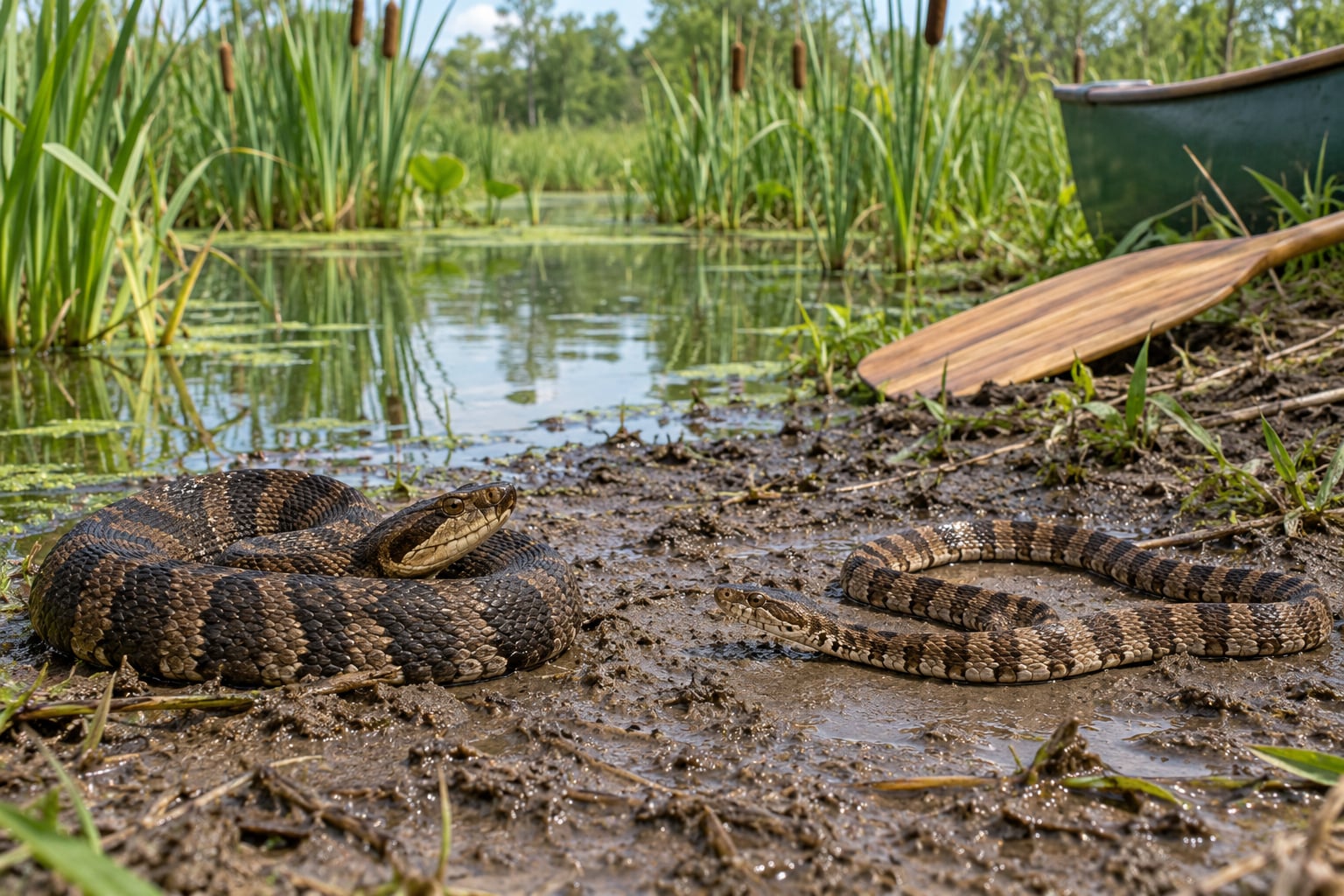
If you need to know how to identify a cottonmouth vs water snake, work from the head down: a cottonmouth’s eyes are hidden from above by a heavy brow ridge, its chin carries a dark stripe running back from the eye instead of vertical bars, and it floats with its whole body on top of the water. A harmless Nerodia water snake shows round eyes you can see from directly overhead, vertical bars on the lip scales, and swims with only its head and neck above the surface before vanishing underwater.
One name clarification first, because it trips people up constantly. Cottonmouth and water moccasin are the same snake, Agkistrodon piscivorus, and it is the only venomous water snake in North America. Anything else you find in a creek, pond, drainage ditch or swamp edge is almost certainly a water snake of the genus Nerodia, which is harmless to people.
None of that matters much if you get close. Nearly every cottonmouth bite happens because someone handled, cornered or tried to kill a snake, not because someone walked past one. Give every snake distance first, identify it second, and treat anything you cannot positively rule out as venomous.
Table of Contents
- How to Identify a Cottonmouth vs Water Snake at a Glance
- Head Shape and Body Features
- Head profile and the neck
- Eyes visible from above, and why that works
- Pupils and the heat-sensing pit
- Body build, tail and adult size
- Color, Markings, and Skin Texture
- Reading the band pattern
- Juveniles and the yellow-green tail
- Scales and texture
- Behavior and Habitat Differences
- Swimming posture
- Flee, or hold ground and gape
- Habitat and range
- Regional variation
- Which Should You Choose?
- If you are watching from a distance
- If you are on foot, creek bank or trail
- If you are in a kayak, canoe or boat
- If it is in your yard
- How to identify a cottonmouth vs water snake from a photo
- If someone is bitten
- Frequently Asked Questions
- What is the fastest way to tell a cottonmouth from a water snake?
- Can you identify a cottonmouth by its head shape alone?
- Do cottonmouths chase people or attack without being provoked?
- What should I do if I see a snake in a kayak or near a boat ramp?
- Are juvenile cottonmouths harder to identify than adults?
- Why do water snakes sometimes look like cottonmouths?
- Conclusion
How to Identify a Cottonmouth vs Water Snake at a Glance
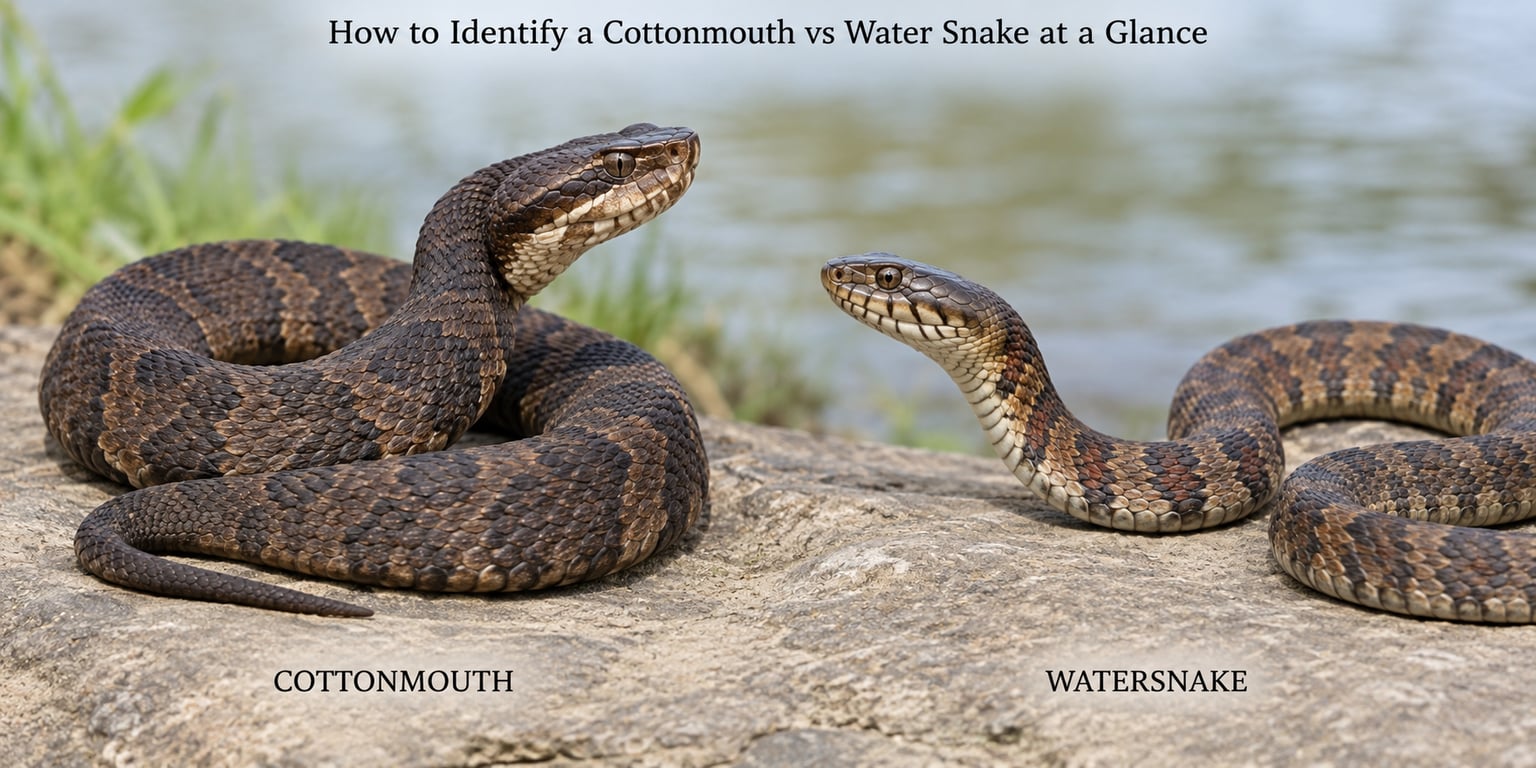
Most identification mistakes come from picking one trait and trusting it. Color, size and even head shape all vary wildly within each species. The table below is built from the marks that hold up most reliably, and you want at least three of them to agree before you feel confident.
| Feature | Water snake (Nerodia, harmless) | Cottonmouth (water moccasin, venomous) |
|---|---|---|
| Head shape | Rounded, only slightly wider than the neck | Blocky and triangular, distinctly wider than the neck |
| Eyes seen from directly above | Clearly visible | Hidden by a heavy brow ridge |
| Pupils | Round | Vertical, cat-eye |
| Heat-sensing pit between eye and nostril | Absent | Present, one on each side |
| Nostril position | Sits high on the snout | Sits about halfway across the snout tip |
| Chin and lip scales | Vertical dark bars on the labial scales | Plain pale chin, dark stripe running back from the eye along the jaw |
| Body build | Slender, graceful | Heavy-bodied, thick through the middle |
| Tail | Long and tapering, roughly a quarter of total length | Short, thick, abruptly tapered |
| Adult size | About 16 to 30 inches | About 20 to 40 inches |
| Pattern | Dark crossbands wider on top, fading toward the belly | Dark crossbands narrower on top, wider down the sides |
| In water | Swims submerged with head and neck showing, dives fast | Floats with the whole body at the surface |
| When threatened | Slides away quickly and quietly | Often holds position, may gape showing a white mouth and vibrate its tail |
If you want the same information as a checklist, the four tests that carry the most weight are:
- Eyes from above. Look straight down at the head. If you can see both eyes clearly, you probably have a water snake. If the head reads as a solid wedge with no visible eyes, treat it as a cottonmouth.
- Chin marks. Vertical bars between the lip scales point to a water snake. A dark stripe running from the eye back along the jaw points to a cottonmouth.
- Body proportion. Slender with a long tapering tail, or thick through the middle with a stubby tail.
- Swimming posture. Whole body riding the surface, or just the head showing before it slips under.
Held together, those four separate the two snakes more reliably than any single feature, which is the approach experienced identifiers on r/whatsthissnake and r/snakes threads use over and over when people post photos.
Head Shape and Body Features
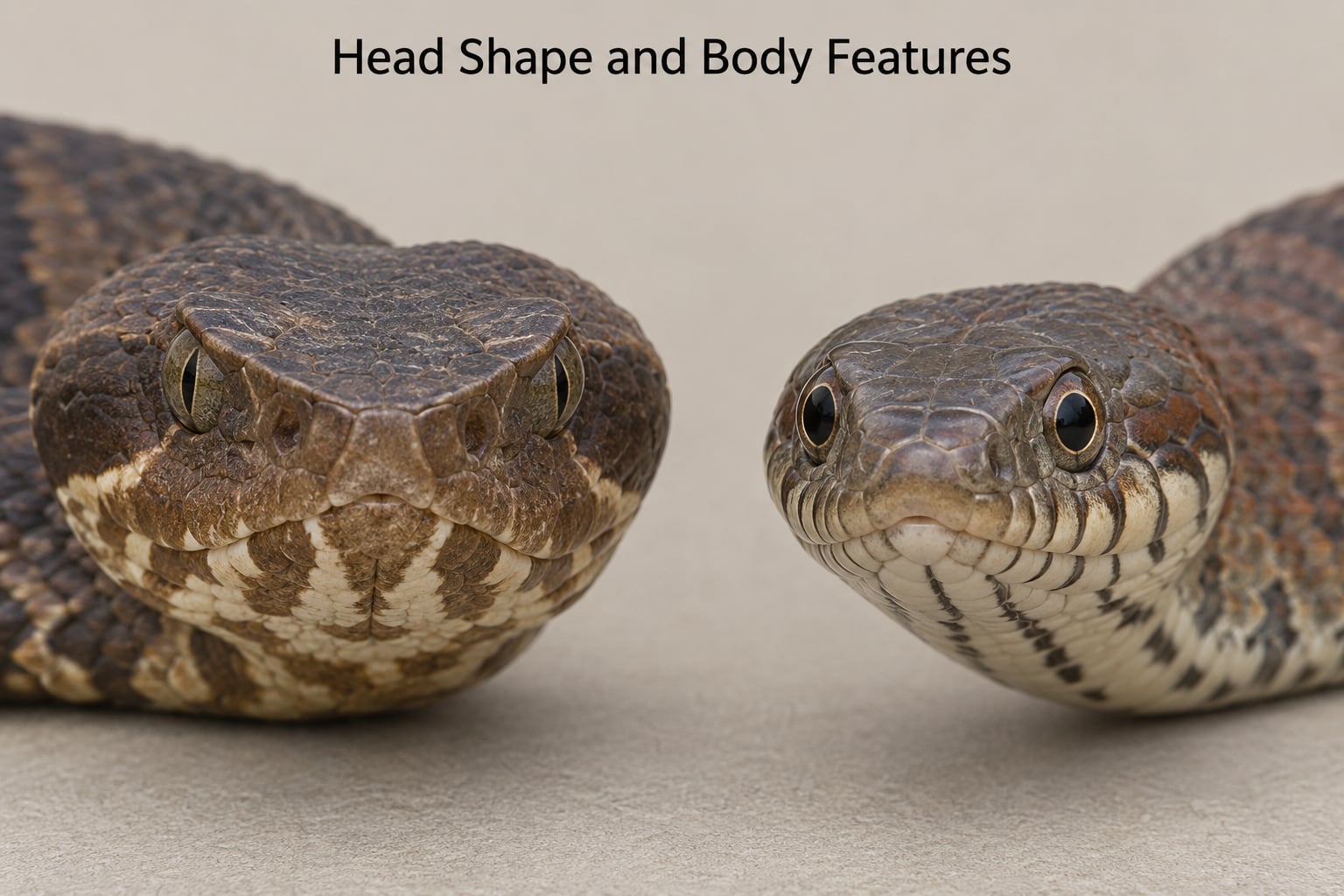
Start with the head, because that is where the anatomy differences are most consistent between adults of both species.
Head profile and the neck
A cottonmouth has a head that reads as distinctly wider than the neck, with a blunt, squared-off snout and a jawline that flares out. Seen from above it looks like a wedge with a heavy brow. A water snake’s head flows almost continuously into its neck, giving it a more even tube-like profile.
That said, a water snake that has just swallowed a frog or a fish can swell the neck and startle you into thinking the head is broader than it is. Get the whole animal in view before trusting head proportions.
Eyes visible from above, and why that works
Look straight down at the head and count the eyes. On a cottonmouth the eyes are often invisible, because the brow ridge projects out over them and shades the socket from above. On a water snake the eyes sit up on the sides of the head where you can see them clearly from overhead.
This is a geometry test, not a behavior test, so it holds even when the snake is motionless. It is the single fastest field mark for cottonmouth vs water snake identification, and the reason it shows up in nearly every state wildlife agency guide.
Pupils and the heat-sensing pit
Cottonmouths are pit vipers. Their pupils are vertical slits, and between the eye and the nostril sits a loreal pit, the organ that senses infrared heat from warm-blooded prey. You can often see the pit as a small dark dot in a photo taken from the side of the head.
Water snakes have round pupils, no loreal pit, and no other heat-sensing organs. If you can resolve the pupil shape, that settles the question on its own.
Body build, tail and adult size
Cottonmouths are stocky. Adults run roughly 20 to 40 inches and carry weight evenly through the body, with a tail that is short relative to the body and tapers quickly. Water snakes are longer and thinner for their length, usually 16 to 30 inches, with a tail that makes up a bigger share of the total.
The posture matters more than the number. A cottonmouth at rest often lies in a loose S with the body stacked beside itself, while a water snake usually lies in a straight line along a branch or the bank.
Color, Markings, and Skin Texture
Color is the worst identifier in this whole comparison, and it is where most confident mistakes come from. Adult cottonmouths range from nearly black through olive to a yellowish tan, with reddish-brown adults in parts of the South. Water snakes run the same full range, and the two overlap almost completely.
Reading the band pattern
Crossbands are more useful than color because they follow a consistent rule. On a water snake the bands are wider on top and fade or break up toward the belly, so the pattern looks stronger from above. On a cottonmouth the bands are narrower along the spine and widen down the sides, which is why the body often looks blotchy from the side.
Juveniles and the yellow-green tail
Young cottonmouths are the hardest calls in this whole guide. Juveniles are darker with brighter, crisper crossbands, and the tail tip is often a striking yellow-green or yellow-orange. Experienced herpetologists think that bright tail tip acts as a lure, attracting frogs and lizards to the tail rather than the head.
Juvenile water snakes look similar, especially when banded watersnake and northern watersnake range together. A brilliant yellow tail tip nudges the odds toward a cottonmouth, but it is a supporting clue, not a verdict.
Scales and texture
Both species have keeled scales, so roughness does not separate them. Cottonmouths have weakly keeled scales toward the front of the body that turn smooth on the rear half, while water snakes stay strongly keeled from head to tail. That distinction is visible on a close photo and is invisible from six feet away, which is where most people actually are.
Behavior and Habitat Differences
Behavior is where the two species feel most different, and it is also the most useful field mark after head and chin.
Swimming posture
A cottonmouth swims like a cork. Its whole body rides on top of the surface with the head and neck raised, and it often moves slowly enough that anglers and pond owners mistake it for floating debris or a dead snake. Texas and Gulf Coast anglers report motionless cottonmouths at the surface often enough that they check the object before casting.
A water snake swims with the rest of the body just under the surface, showing only its head and a short section of neck. Under pressure it dives, and you usually get one quick glimpse before it is gone.
Flee, or hold ground and gape
Water snakes almost always leave. They slip off a branch, slide into the water or crawl into cover, and they are rarely the snake that bit anyone. Cottonmouths are more likely to hold position, flatten the neck and lower the head, and open the mouth to show the bright white cottony lining that gives the snake its name. Disturbed ones also vibrate the tail and release a strong musk.
The gape display is a defensive warning, not an attack. Field experience and forum consensus both point the same way: cottonmouths do not chase people. They defend a spot and back off once you move away.
Habitat and range
Cottonmouths occupy swamps, marshes, bayous, lake edges, drainage ditches and slow creek runs across the southeastern United States, from Virginia south through Florida and west into Texas, Oklahoma and Arkansas. They are almost always tied to permanent or near-permanent water.
Water snakes of the genus Nerodia live in the same places and often in better numbers, which is exactly why so many harmless snakes end up posted as cottonmouths. Northern watersnake, banded watersnake, diamond-backed watersnake, green watersnake and Florida watersnake are the most frequently misidentified species.
Regional variation
The name covers two closely related snakes. Most of the Southeast has Agkistrodon piscivorus, the eastern cottonmouth. Florida and parts of the Gulf Coast have Agkistrodon conanti, which many authorities treat as a separate species, and cottonmouths on the Florida panhandle are often hybrids between the two.
Practical consequence for anyone learning cottonmouth vs water snake ID: look up the local name. Plenty of regions use water moccasin for every brown snake near water, including areas where no cottonmouth has ever been confirmed, so a local sighting report means very different things depending on where you are.
Which Should You Choose?
There is no good reason to choose between these snakes at close range. What you choose instead is an approach: how far away you stay, and what you do while you are there.
If you are watching from a distance
Binoculars, a zoom lens on your phone, and 15 to 20 feet of separation are enough to run all four checks above. Get a photo of the head, a photo of the body from above, and one from the side if the animal stays put. That set of images is enough for a state wildlife biologist to identify with confidence, and safer than any close look.
If you are on foot, creek bank or trail
Stop, back away slowly, and give it a wide berth. Do not step over it, do not try to move it, and do not kill it. Most people who get bitten were trying to help, kill or relocate a snake. Put children behind you, leash the dog, and keep moving along your route.
If you are in a kayak, canoe or boat
Do not reach into the water, and keep your hands aboard and inside the hull rather than trailing them over the edge. If a snake surfaces near the boat, paddle away on the opposite side at a steady pace. Cottonmouths generally hold still rather than boarding, and the species rarely follows a moving craft for any distance.
Never assume a snake has left a boat, dock or float. Anglers get bitten reaching into a livewell or a gap between a float and a piling, and the fish in that well were probably not the target.
If it is in your yard
Leave the dog indoors and the kids inside, then call a licensed wildlife removal professional or your local animal control office. Removing a snake from a yard is not a DIY job in most communities, and an attempt with a pole or a shovel is a large share of the bites that do happen.
How to identify a cottonmouth vs water snake from a photo
Shoot the head at eye level, get one frame with the animal’s full body in view, and include something for scale such as a boat, a paddle or a gloved hand at a distance. Night photos and blurry trail-cam frames usually cannot be resolved far enough to separate the two species, so treat those as unknown rather than guessing.
When the photo is genuinely unclear, report the sighting to your state wildlife agency or a local herpetological society with the location and date. An unidentified snake handled as venomous is the safe default.
If someone is bitten
Call emergency services immediately, then keep the person still and calm with the bitten limb immobilized below heart level. Remove rings, watches and tight clothing before swelling starts.
Do not use a tourniquet, do not cut the wound, and do not try to suck out venom. None of those help and all of them cause harm. Hospital care with antivenom is the treatment that matters, and getting there quickly is what keeps bites from becoming dangerous. Deaths from cottonmouth bites are very rare in records kept by state agencies and the CDC, largely because people get to a hospital in time.
Frequently Asked Questions
What is the fastest way to tell a cottonmouth from a water snake?
Look straight down at the head. A cottonmouth’s eyes are hidden by a heavy brow ridge, while a water snake’s eyes are clearly visible from above. Then check the chin: a dark stripe running back from the eye means cottonmouth, vertical bars between the lip scales mean water snake. Add the body and swimming posture, and you have a solid call in seconds.
Can you identify a cottonmouth by its head shape alone?
No. Head shape is useful but not decisive, because a water snake that has swallowed prey can have a neck swollen wide enough to look blocky, and some water snakes do have heavier heads than you expect. Confirm with at least two more marks, such as eye visibility from above and the chin pattern, before you commit to an identification.
Do cottonmouths chase people or attack without being provoked?
They do not chase people. Cottonmouths are defensive and stationary: they hold their ground, flatten, gape to show the white mouth lining, buzz the tail and musk, then back off when you do. Nearly all recorded bites involve handling, cornering or an attempt to kill the snake. Backing away slowly ends the encounter almost every time.
What should I do if I see a snake in a kayak or near a boat ramp?
Keep your hands inside the hull and off the water, and paddle away steadily from the opposite side. Cottonmouths usually float at the surface and hold still rather than boarding, and they rarely follow a moving boat for any distance. Never reach into a livewell or between a float and a piling, which is where most boating-related bites happen.
Are juvenile cottonmouths harder to identify than adults?
Yes. Juveniles are darker with brighter, crisper crossbands, and many have a yellow-green or yellow-orange tail tip that may act as a lure for prey. Those patterns overlap with juvenile banded and northern water snakes, so use the head marks on juveniles more than body pattern. When in doubt, treat a small dark water snake with vivid bands as venomous and keep away.
Why do water snakes sometimes look like cottonmouths?
They evolved in the same wetlands and defend the same spots, so they converged on similar body plans: brown coloration, keeled scales, crossbands and a flattened head when threatened. A nervous water snake also rears up, gapes, flattens the neck and musk, all of which mimic a cottonmouth display. That mimicry is exactly why behaviour alone is a poor identifier.
Conclusion
Keep your distance before you try anything else, and never handle a snake you cannot rule out as harmless. When you do want a call, combine at least three marks: eyes visible from above or hidden by a brow ridge, a dark eye-to-jaw stripe or vertical chin bars, heavy body or slender body, body on the surface or head-only swimming.
That is the whole method for how to identify a cottonmouth vs water snake. When the marks do not line up, take the photo, give the animal room, and ask your state wildlife agency. Guessing wrong in the direction of caution costs one afternoon. Guessing wrong the other way costs a hospital trip.