Most snake encounters on a trail end without a bite, and the difference is almost always how the first ten seconds go. Knowing how to handle a snake encounter on a trail comes down to one habit: stop moving, put distance between you and the animal, and back away slowly. Never run, never swing a stick, never reach for your phone while you are still close.
I have hiked a lot of the Southeast, where copperheads and cottonmouths are ordinary residents of the trail corridor rather than dramatic events. The people who handle these meetings well are rarely the ones who know every species. They are the ones who freeze first and slow down second.
Snakes sense ground vibration and body heat. Almost every strike happens because a person stepped close, grabbed at the animal, or tried to squeeze past it on a narrow trail. Take away the surprise and you take away most of the risk. This guide walks through what to carry, the six steps of the encounter response in order, the first aid steps after a bite, and the mistakes that turn a harmless meeting into an emergency.
Table of Contents
- What You Need
- Step-by-Step: How to Handle a Snake Encounter on a Trail
- 1. Stop Moving and Assess the Encounter
- 2. Keep a Safe Distance and Avoid Sudden Movement
- 3. Back Away Slowly and Give the Snake an Escape Route
- 4. Keep Children, Pets, and Other Hikers Behind You
- 5. Move Away and Resume the Hike Only When Safe
- 6. Respond to a Bite or Contact Immediately
- Common Mistakes
- Frequently Asked Questions
- Should I kill a snake I find on the trail?
- How far away should I stay from a snake on a trail?
- What should I do if a snake chases me?
- Do snakebite kits and suction devices actually work?
- What information should I give emergency responders after a snakebite?
- What are snakes most afraid of?
What You Need
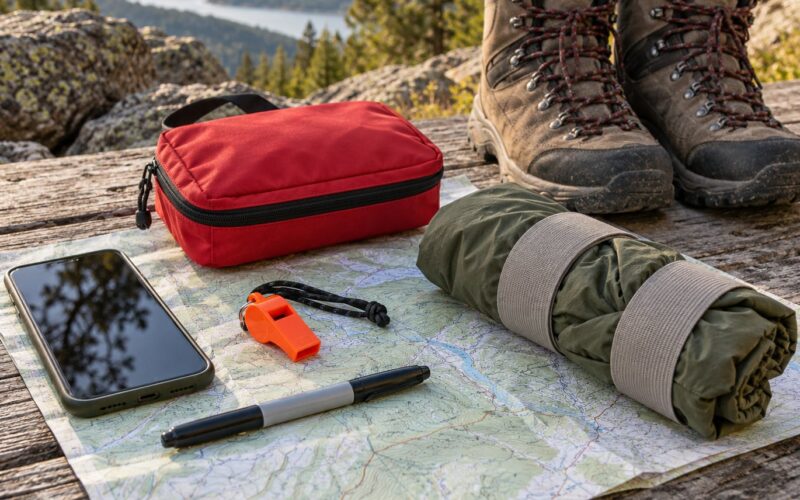
None of the equipment below is snake-specific. It is the same kit that makes any backcountry day safer, and it is enough for essentially every encounter you are likely to have.
- Closed-toe boots and long pants. Over-the-ankle boots give the ankle some coverage, and laced tightly they are the hardest thing on your body to reach through. Gaiters help with brush and give a snake something that is not bare shins, but they do not stop a strike aimed at the ankle bone, and most experienced handlers treat them as a comfort item rather than protection.
- A charged phone, or a satellite messenger if you are out of coverage. This is the single item that changes outcomes. A snakebite emergency is a transport problem, and transport is a communication problem.
- A paper map and compass, plus a screenshot of your route. Cell service drops in exactly the canyons and drainages where bites tend to happen.
- A small first-aid kit with soap and water, clean dressing materials, an elastic wrap wide enough to be useful, a pair of scissors, and a trauma tourniquet you know how to apply. You will not use most of it. You will want it.
- Water and the usual ten essentials. A snake meeting is more likely to derail a day than anything else on the trail, and heading back needs energy.
- Local emergency contacts saved offline. Know the county non-emergency number and the dispatch number for the ranger district you are in. Write them on the map.
- A pocket field guide for the region. It matters less for the encounter and more for the peace of mind afterward, when you want to know what was lying on that rock.
Check your state’s rules before you go. In many states every native snake, venomous or not, is protected, and killing one can carry a fine far larger than the trouble it solves.
Step-by-Step: How to Handle a Snake Encounter on a Trail
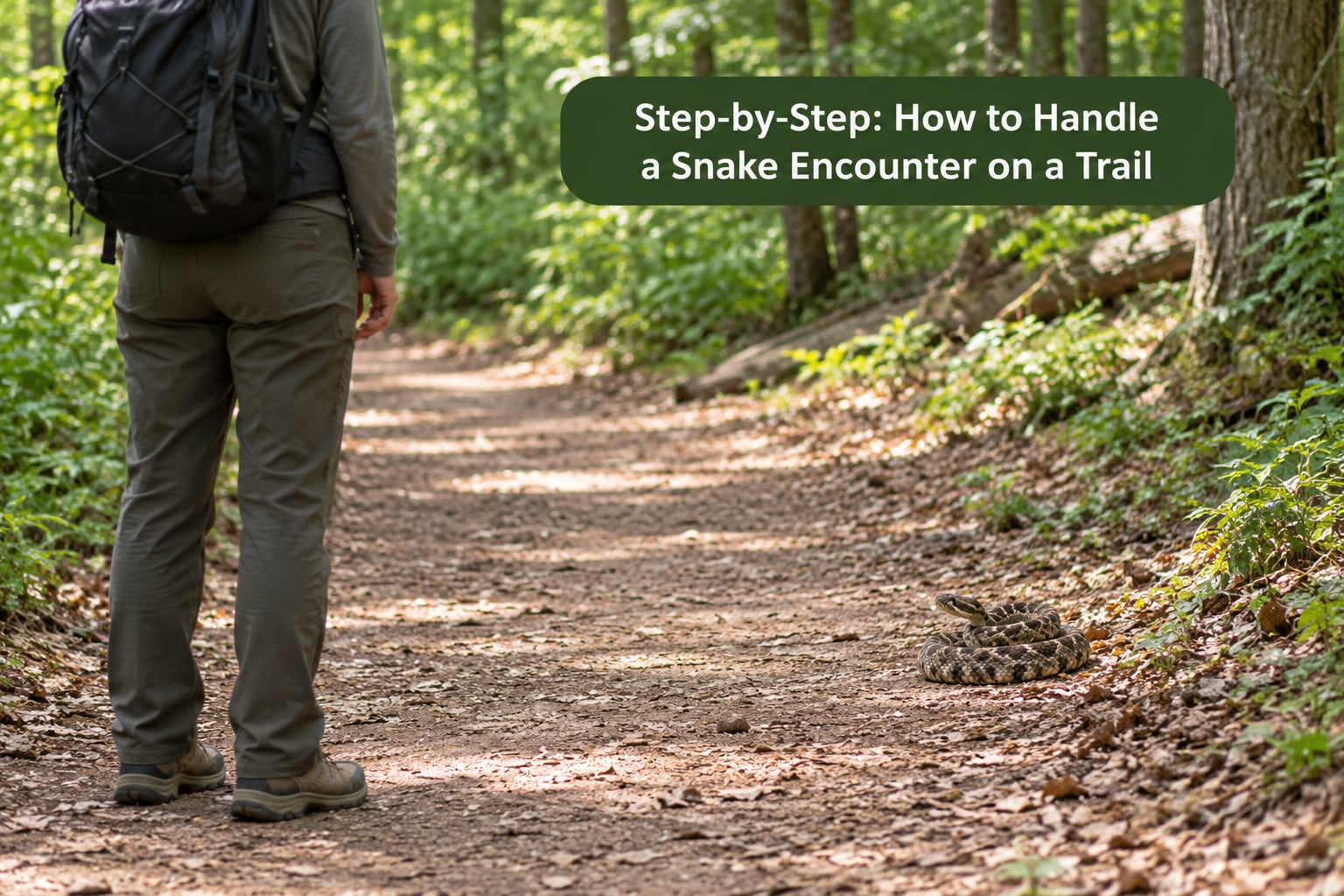
1. Stop Moving and Assess the Encounter
The first thing to do when you see a snake is nothing. Freeze where you are, do not jerk back, and do not say anything loud. Then locate it without closing the distance.
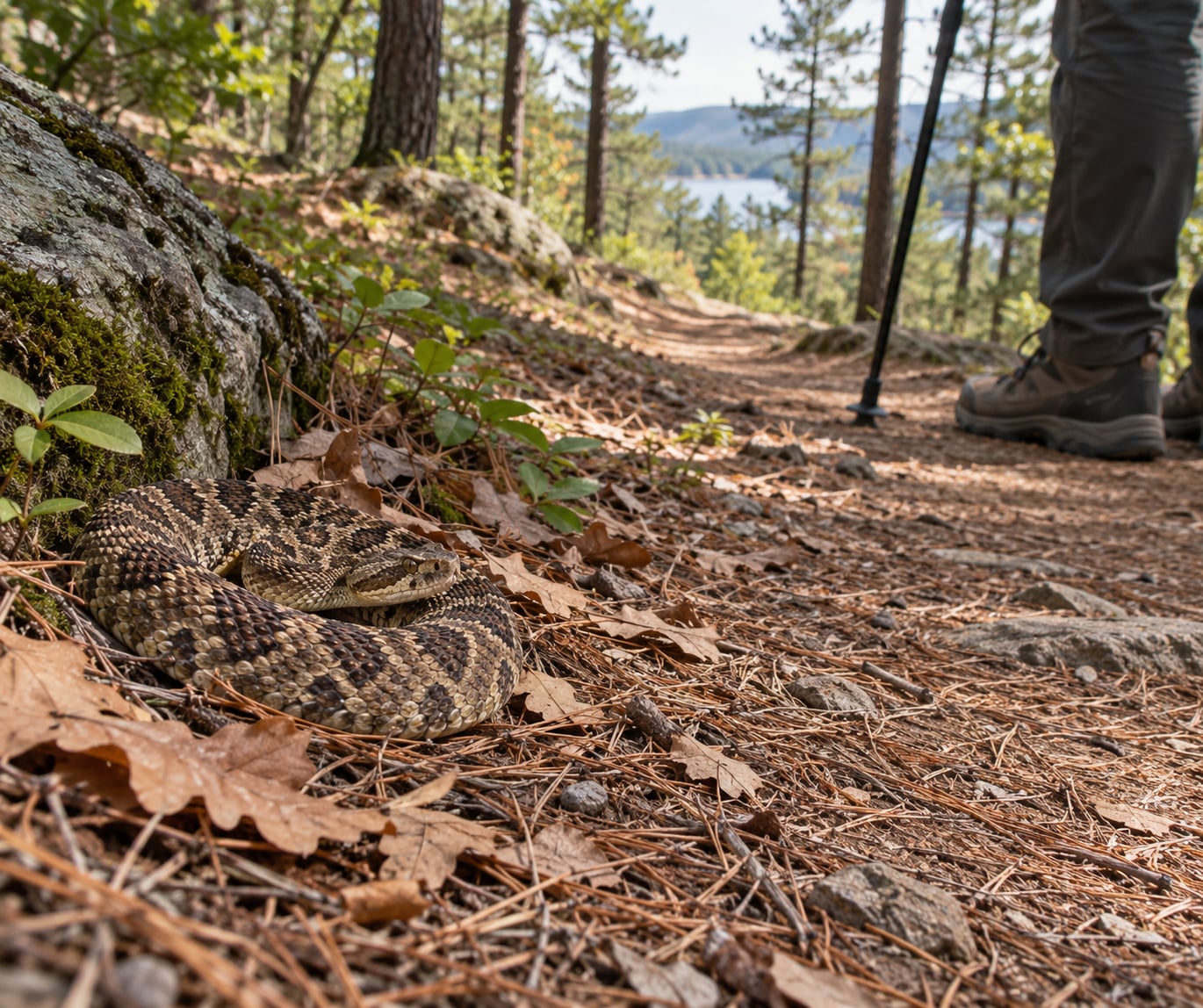
Look for the shape, not the color. Snakes on trail are almost always a stick-colored line across rock, pine straw, or leaf litter, and the eye locks onto movement before it registers species. Once you have it, assess the situation rather than the animal: is the trail wide enough to turn around on, is the footing loose or wet, is a kid two steps behind you, is the dog already interested?
If the snake is already moving away, you have an easy situation. Let it go.
2. Keep a Safe Distance and Avoid Sudden Movement
A snake can strike roughly half its body length, and a coiled snake can launch from that posture in a hurry. Give it four feet at minimum, and eight to fifteen feet whenever the animal is coiled, flattened, or watching you.
Walk fast and the snake’s first instinct is defense. Pivot suddenly, wave a jacket, or crouch to snap a photo and you have reduced the gap to inches while looking directly at the thing that wants to leave. Slow, deliberate movement is what ends encounters.
3. Back Away Slowly and Give the Snake an Escape Route
Walk backwards, slowly, while watching where the animal is. Every step you take away is a signal that the encounter is over, and snakes rarely chase a person for long.
Leave it a path. The mistake I see most often is people edging sideways to get past while the snake is still pointed toward the trail, which leaves it nowhere to go but forward. If the trail is too narrow to pass without coming within a few feet, turn around and walk back the way you came. Losing fifteen minutes costs nothing. Squeezing past a coiled rattlesnake costs a great deal.
If you are on a rock scramble or a ledge where retreating means backing toward an edge, stop and reassess rather than committing to a bad direction.
4. Keep Children, Pets, and Other Hikers Behind You
Gather small children before you move, quietly, with a hand on the shoulder and no shriek. If you pick a kid up while panicking, that motion is exactly what triggers a strike, and now you are holding a struggling child closer to the snake.
Shorten the leash on dogs, and hold the leash rather than letting the dog hold it. Off-leash dogs are the single most common source of bitten pets on trails, because the dog does what you were trained not to do: approach, bark, chase, and grab. If your dog has rattlesnake avoidance training, this is the moment it was built for.
5. Move Away and Resume the Hike Only When Safe
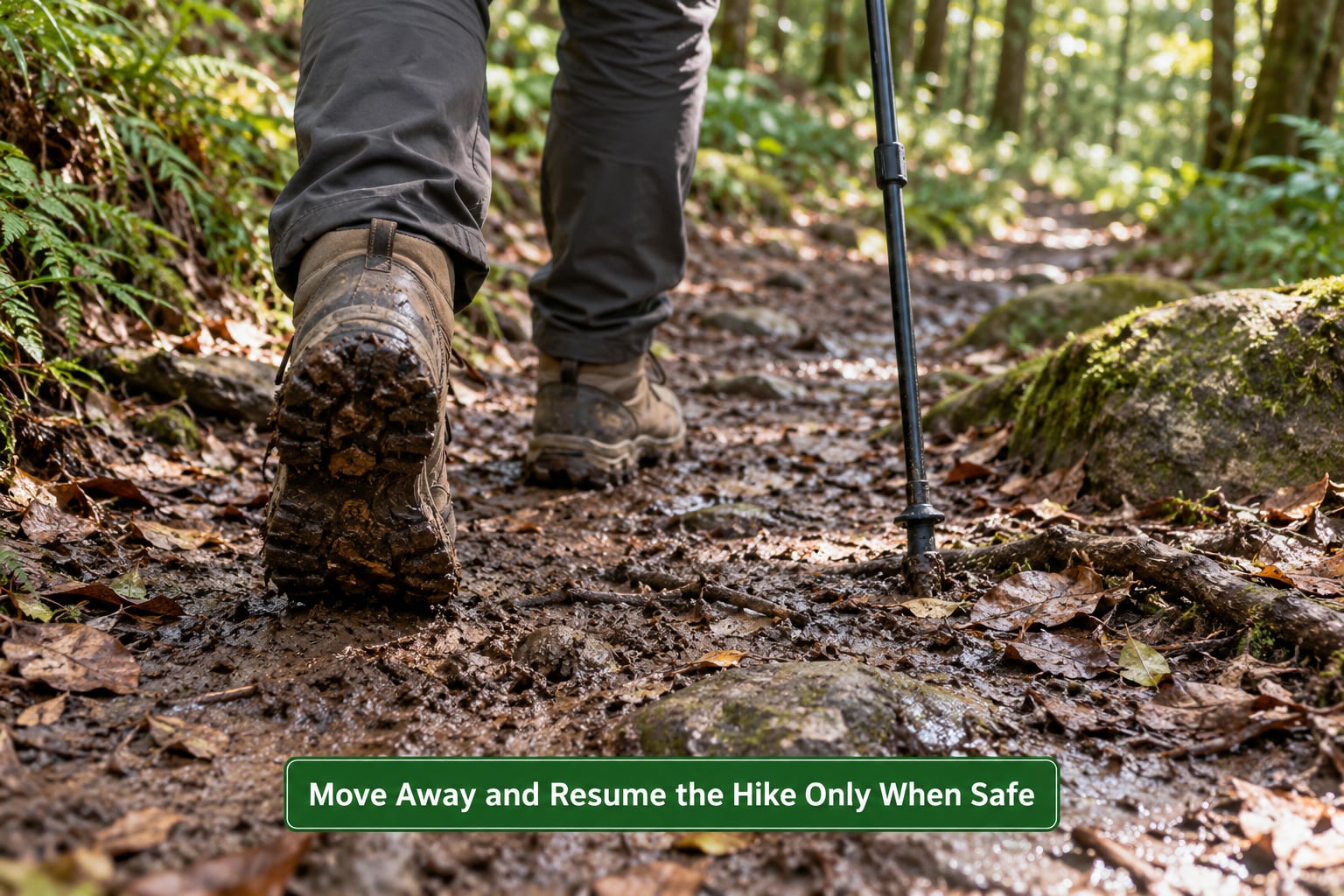
Do not turn your back on the snake until you are well past it and it is out of sight behind you. Then pick a wide route, even if it means walking through grass or taking a slower line.
If you want to note where it happened, do it once you are safe and calm, and mark the spot in your phone so you can mention it later. If a snake repeatedly approaches people or postures defensively without provocation, report it to the land manager, ranger station, or state wildlife agency. That kind of behavior is a data point, and agencies use reports to decide where signage, closures, or hazing are needed.
Expect the encounter to weigh on you more than you expect. Hikers on long trails talk about rattlesnake meetings for years, usually more than the actual minutes involved. Letting it be a thirty-second delay rather than a story about a mistake helps on the next mile.
6. Respond to a Bite or Contact Immediately
A bite is a medical emergency, not a wilderness puzzle. Everything here follows standard wilderness first aid guidance, and the local emergency number is the first call, not the last.
- Get away from the animal. Do not chase it, photograph it, or kill it. Once you are clear of danger, stop worrying about the snake completely.
- Call 911 or your local emergency number. Say “snakebite,” give your location as a coordinate, trail name, or what the GPS reads, and describe your party size. Do not hang up until they tell you to.
- Keep the person calm and still. Moving the limb and walking out spreads venom faster. Sit or lie down and stay put unless the scene is itself unsafe.
- Remove rings, watches, and tight clothing from the bitten limb before swelling starts, since a finger ring can become a tourniquet in minutes.
- Clean the area with soap and water and cover it with a dry, clean dressing. Washing away surface venom is reasonable; scrubbing hard is not.
- Immobilize the limb with a splint or a rigid object and keep it at about heart level, not raised above the head and not hanging down.
- Do not cut, suck, ice, electrocute, or tourniquet the wound. None of these help and several cause harm. A tight tourniquet applied for a rattlesnake bite is a specialized, trained-skill intervention that is not appropriate for a bystander, and one has cost people limbs.
- Mark the bite edge with the time and a pen. Tracking spread over the next few hours is one of the most useful things you can give a clinician.
- Wait for help and keep notes. Time of bite, time of first symptoms, what the snake looked like from a distance. If antivenom is available at a hospital within your reach, that is the definitive treatment and every minute of delay counts.
Many people ask about a pressure immobilization wrap, which is standard practice in some countries and still debated among US medical organizations. The safest advice for a recreational hiker is to follow the protocol taught by your local emergency medical service and to get to a hospital quickly rather than to improvise a technique you have not practiced. Tell the dispatcher what you have done.
If you are alone, the plan is the same with one difference: you have to make the call yourself. Note the time, note coordinates, stay with your phone in your hand, and give dispatch as much detail as you can about where you are. That is why a satellite messenger matters more than any other piece of gear on this list.
Common Mistakes
Killing the snake. This is the one people regret most. Bites happen during the killing, and most states protect every native snake. Stepping around is always faster, safer and legal.
Running. Sprinting invites a defensive strike and turns a walk away into a full-body lunge toward the animal.
Stopping for a photograph. The photo is never worth it. If you want the shot, get the distance and the zoom first, or use a phone on a stick from a long way back.
Using a hiking pole or stick to push it off the trail. It works sometimes, and it puts your hands at the end of a stick close to a frightened animal. It is how defensive strikes happen. Retreat is the reliable move.
Picking up a child in a panic. Lift them calmly, behind you, after the snake has moved on. Urgency spreads to the animal faster than it spreads to the kid.
Letting a dog off leash to “go around.” The dog goes straight at the interesting thing and the leash stays in your hand doing nothing. Shorten it now.
Putting ice on a bite, or elevating the limb above the heart. Both have circulated for decades and both were corrected by medical toxicologists. Old advice that recommends elevating the limb has been formally retracted in favor of keeping it at cardiac level. Keep it at heart level, keep it still, and get to a hospital.
Cutting the wound or trying to suck out venom. You will not remove meaningful venom, and the cut gives infection somewhere to start.
Tight tourniquets for venomous bites. This is advanced trauma care with its own risks, not a field improvisation. Make the call and wait.
Going back to the trail to hunt for the snake afterward. You already lost the one thing that mattered, which was the time between the bite and medical care. Never walk back.
Frequently Asked Questions
Should I kill a snake I find on the trail?
No. Most bites happen while people are trying to kill or move a snake, and in many states all native snakes are protected by law, venomous or not. Back away slowly and leave the animal an escape route. If it is genuinely aggressive and repeatedly approaching people, note the location and time and report it to the land manager or state wildlife agency instead of dealing with it yourself.
How far away should I stay from a snake on a trail?
At least four feet, and eight to fifteen feet when the snake is coiled, flattened, or watching you. A snake can strike roughly half its body length, so a coiled rattlesnake can reach several feet without moving forward. Give the extra margin whenever the animal is on the trail itself, since that is where you would otherwise have to pass it.
What should I do if a snake chases me?
Move away quickly and calmly, keep your eyes on it, and do not run in blind panic or try to grab anything. Most defensive advances stop within a few feet and the snake returns to cover. Get to a clearing, an open door, or your vehicle, keep pets and children close, and note the location. A snake that persistently follows a person is unusual behavior worth reporting.
Do snakebite kits and suction devices actually work?
No. Commercial suction kits, cutaway knives, and the old-style extractor devices have never been shown to remove meaningful venom and can damage tissue. The useful parts of a kit are the soap, the bandage, and the tools for immobilizing a limb. What actually saves lives in the field is staying still, calling emergency services early, and reaching hospital-based antivenom quickly.
What information should I give emergency responders after a snakebite?
Give the time of the bite, the time symptoms started, your location as coordinates, a trail name or a description of where you are, your party size and ages, and anything you did to the wound. Do not spend time describing the snake in detail unless you already know what it was. Keep the phone with you and stay in one place so rescuers can find you.
What are snakes most afraid of?
Snakes are most afraid of being stepped on, grabbed, cornered, and surprised. They cannot see far, they rely on vibration and heat sensing, and most of their apparent aggression is a last-second defense of a hiding spot. Given room and a quiet exit, the overwhelming majority of snakes would rather retreat. Human bodies moving slowly and predictably are simply not interesting to them.
Stop, back up, and give it room. That is the whole answer to how to handle a snake encounter on a trail, and it is one you can practice on every hike so it is not something you have to invent at the moment. If you are bitten, call for help immediately, keep the person still, and get to a hospital. Everything else is detail.