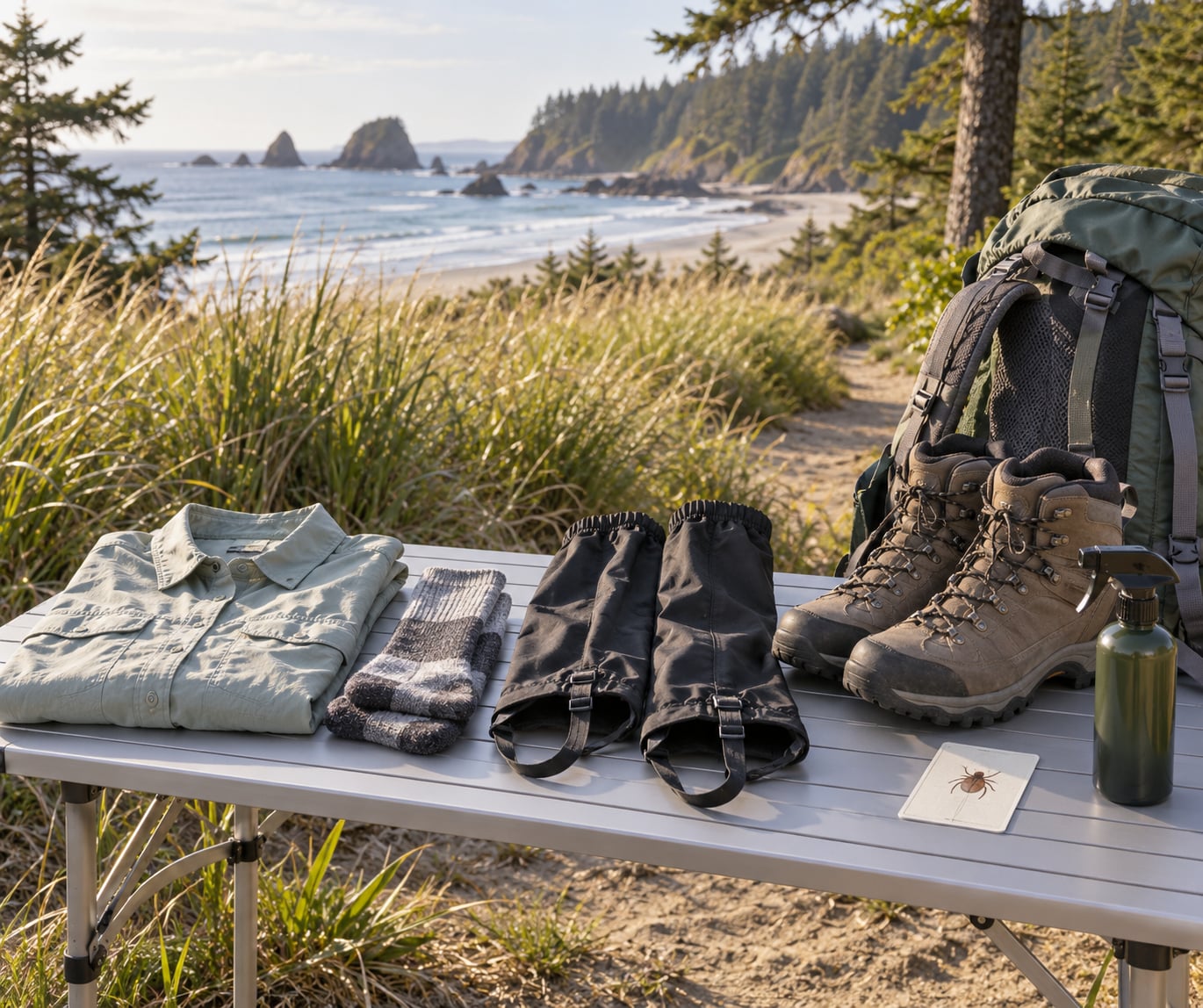
Preventing tick bites in coastal woods comes down to four layers, and they work in order: cover your skin, treat your clothing and gear with permethrin, put an EPA-registered repellent on exposed skin, then do a full-body tick check within a few hours of getting back. Ticks do not jump or fly. They wait on vegetation and grab onto anything warm that brushes past, so the goal is to make yourself a poor target and to catch a latched tick early.
The coast adds two wrinkles most inland advice skips. Salt spray, rain, sweat, and ten-hour days shorten how long repellent protection holds, and maritime forest keeps the damp understory that ticks need to survive. Plan for reapplication and for a proper check, not just for the spray in the pack.
Nothing on this page is medical advice. Follow the label on any repellent, and talk to a clinician if you get a fever, a rash, or flu-like symptoms after being in tick habitat.
Table of Contents
- What You Need to Prevent Tick Bites in Coastal Woods
- Step-by-Step: How to Prevent Tick Bites on Coastal Trips
- 1. Prepare Before Entering Coastal Woods
- 2. Cover Exposed Skin and Treat Clothing
- 3. Reduce Tick Exposure Along Trails and Water
- 4. Perform Regular Tick Checks
- 5. Use a Buddy or Screenshot-and-Save System
- 6. Check Gear, Pets, and the Home After the Trip
- If You Find an Attached Tick
- Common Mistakes
- When Ticks Are Worst in Coastal Woods
- Which Repellent Goes Where
- Frequently Asked Questions
- What is the best way to prevent tick bites in coastal woods?
- How should I use insect repellent on clothing and skin?
- What should I wear to prevent ticks in hot, humid coastal weather?
- How often should I check for ticks while hiking or hunting?
- How do I safely remove an attached tick?
- When should I contact a healthcare professional after a tick bite?
- Conclusion
What You Need to Prevent Tick Bites in Coastal Woods
You need four things before you walk in: clothing that covers skin, a repellent registered with the EPA, a permethrin treatment for fabric and gear, and a way to inspect yourself properly once you are out. Most people bring the first two and forget the last one, which is where bites actually happen.
Clothing
- A lightweight long-sleeve shirt in a pale or light colour, so a dark nymph shows up against the fabric
- Long pants, ideally quick-dry rather than heavy cotton
- Mid-calf socks and closed shoes or boots; sandals and open-toed shoes leave the ankle and toe exposed
- A hat, cap, or buff, because the hairline and behind the ears are common attachment sites
- Gaiters or scratch gaiters if you will kneel, dig, or work in leaf litter
Repellent and treatment
- An EPA-registered repellent with DEET, picaridin, or oil of lemon eucalyptus for exposed skin
- A permethrin spray or soak for clothing, boots, gaiters, pack straps, and netting
- The repellent label itself, so you follow the reapply interval instead of guessing
Check kit
- Fine-tipped tweezers, kept in the pack rather than in a truck at home
- A small mirror and your phone camera, for the back of your neck and your hairline
- A lint roller for clothing and dog coats before anything gets in the vehicle
- A zip bag or large bag for wet, tick-carrying clothing
- Water, which matters more in coastal heat than most people expect
- A written or photographed check list, or a partner who knows the routine
Step-by-Step: How to Prevent Tick Bites on Coastal Trips
1. Prepare Before Entering Coastal Woods
Check the forecast, trail conditions, access rules, and local tick guidance before you leave, then choose clothing and supplies that suit the heat, humidity, insects, and activities you actually have planned. Coastal weather turns fast, and a marine layer plus sweat can strip repellent protection well before the label says it expires.
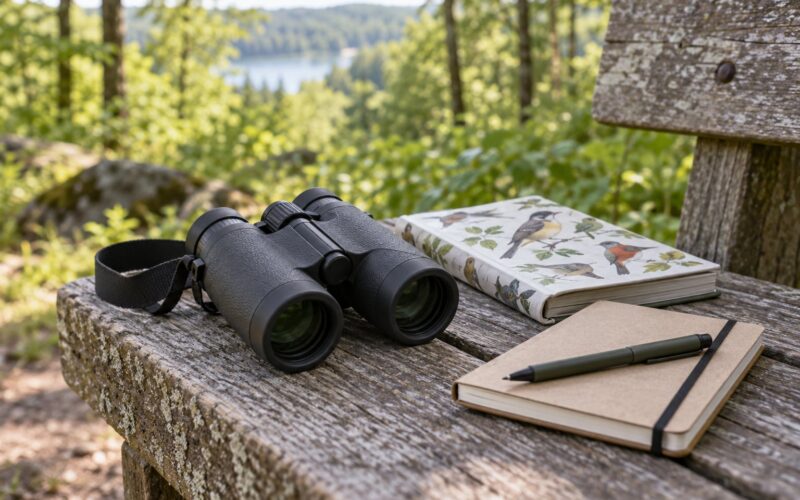
Decide your route with tick exposure in mind. A wooded trail that runs through dense understory and along a marsh edge carries more risk than an open bluff-top path, even when both are in the same forest. If you are scouting with binoculars, hunting, or metal detecting, plan for kneeling in leaf litter rather than standing on a boardwalk.
How you can tell this step worked: you are carrying water, repellent, tweezers, and a check list, and you know when you plan to do your first tick check. If any of those are missing, fix it at the trailhead rather than at dusk.
2. Cover Exposed Skin and Treat Clothing
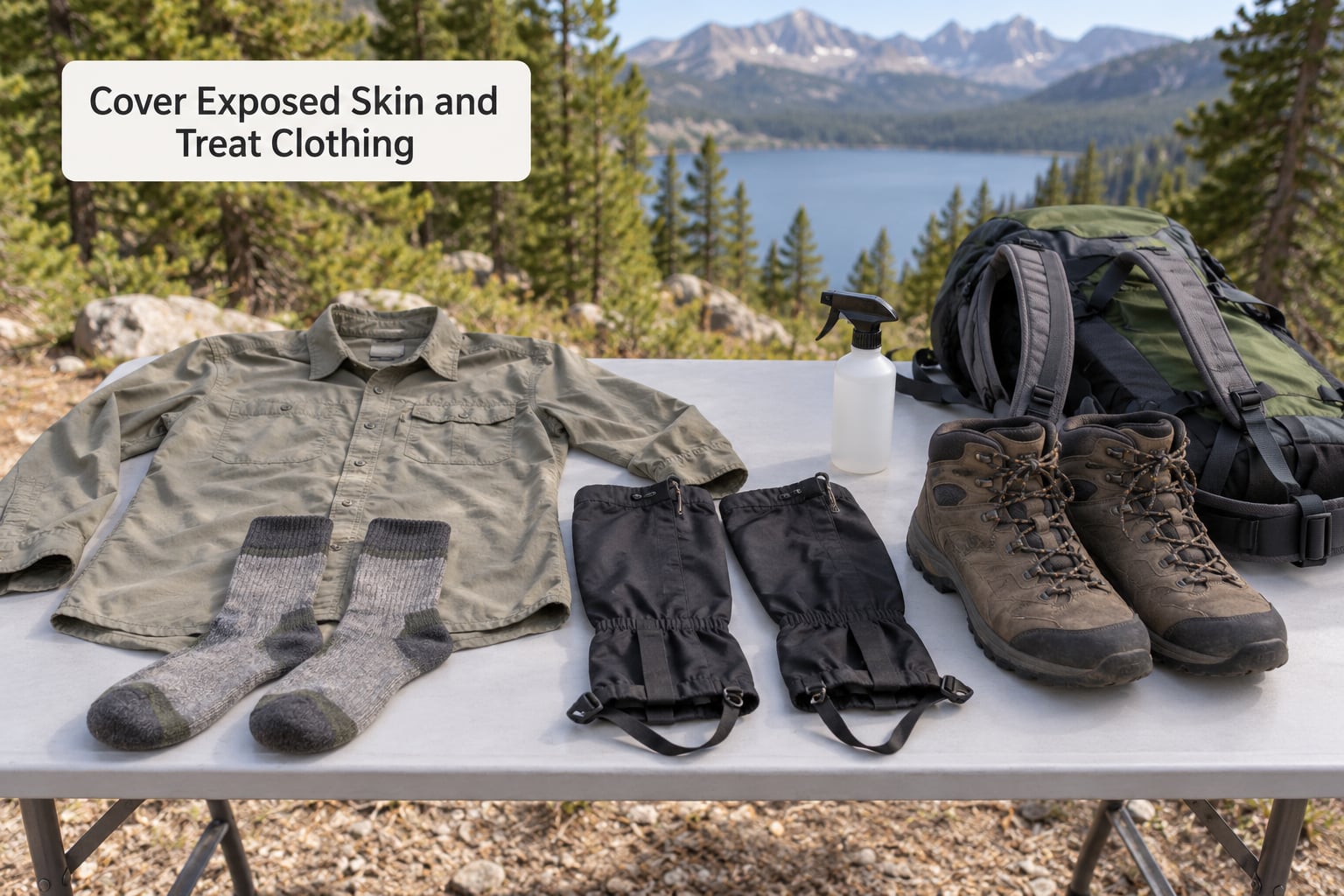
Wear the pale long-sleeve shirt, long pants, socks pulled over the pant cuffs, and closed shoes, and tuck everything in. Apply repellent only to the skin you cannot cover, following the label exactly. DEET at 20 to 30 percent, picaridin at 20 percent, and oil of lemon eucalyptus are the EPA-registered options that work against ticks.
Permethrin is the layer people get wrong. It is a pesticide for fabric and gear, not a skin repellent, so never put it on skin. It is also toxic to cats, so keep treated fabric away from your cat until it is fully dry, and do not spray it on a pet. Let everything dry before you wear it, and skip hats and underwear if you are treating a load of laundry.
Treat gear too: pack straps, gaiters, boot tops, the rim of a landing net, and the seat of a folding chair. Field crews re-treat clothing roughly every six weeks, or after several washes, since the treatment wears off with use and laundering. If rain, saltwater, or sweat soaked your layers today, plan on reapplying skin repellent at your next stop.
3. Reduce Tick Exposure Along Trails and Water
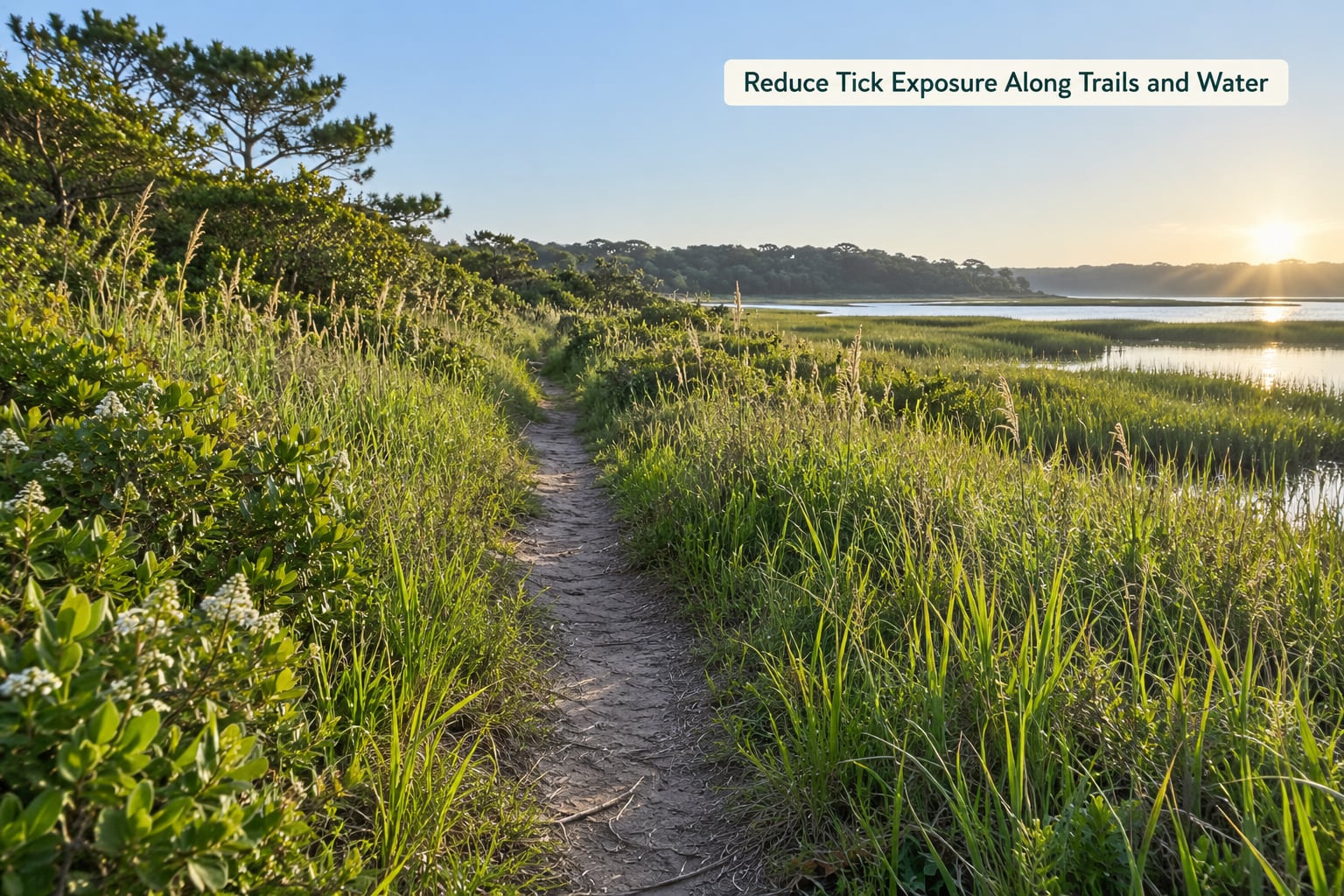
Stay on marked paths and walk the centre of the trail, away from grass tips, low brush, and the shaded edge where the understory thickens. Ticks wait on that vegetation with their front legs outstretched, a behaviour called questing, and they usually need 30 minutes to an hour of climbing before they settle and bite. Moving through quickly on the open side of the trail costs them that window.
Change your behaviour when you stop. Ticks climb when you stand still or sit down, which is exactly what happens at a coastal overlook, a fishing spot, or a picnic table. When you break for 15 minutes, stand up, walk a short loop, brush down your legs and waistband, and check before you settle again.
Avoid flooded areas, dense coastal scrub, deer trails, and wildlife crossings when you can, and do not brush against vegetation to clear a path. It disturbs the habitat and picks ticks up at the same time. In fieldwork, a mesh head net over a hat stops the hardest-to-reach site, the back of the neck.
4. Perform Regular Tick Checks
Run a ten-minute check as soon as you leave tick habitat, then again every few hours if you are out all day, especially after sitting down. Work from the feet upward and use your hands, not just your eyes; a dark nymph on dark fabric is easy to miss. The places that matter most are the waistline, ankles, inside the belt line, groin, armpits, behind the knees, behind the ears, hairline, scalp, and elbows.
Take off the socks and boots before you sit down to rest, and run a hand along the sock line. Small nymphs are about the size of a pinhead or a poppy seed, so anything dark and slightly rounded on skin deserves a closer look before you brush it off. If it is moving, flick it into a sealed container or bag and note the time; if it is attached, follow the removal steps below.
5. Use a Buddy or Screenshot-and-Save System
If you are solo, schedule the check rather than waiting for a reason. Set a phone reminder for a check at a set time and again at the halfway point of the route, and use it. For the back of your neck, your scalp, and behind your ears, use two mirrors or your phone camera, or photograph the area so you can look at the picture rather than squint at a reflection.
In a group, rotate. The person who is least likely to be watched can check the backs and hairlines of everyone else, which is a small ask and catches what a self-check always misses. Hunters, birders, and trail crews who work tick habitat daily tend to keep this as a fixed end-of-task habit rather than an occasional check, and that habit is most of what keeps their bite counts down.
6. Check Gear, Pets, and the Home After the Trip
Run the lint roller over your clothing and your dog’s coat before getting into the car, and shake out everything before it comes indoors. Bag damp clothing in a sealed bag and keep it out of the laundry pile until you can wash it hot and dry it on high heat, which kills any attached ticks. Wash exposed fabrics as soon as you can rather than leaving them in a damp bag for a day.
Check your dog the same way you check yourself: paws between the toes, inside the ears, under the collar, around the tail base, and along the belly. Keep your own tick-checking gear in one pouch by the door so it is ready for the next trip. If a dog is limping, shaking, or licking one area constantly, check it properly before assuming it is a thorn.
If You Find an Attached Tick
Remove it promptly and cleanly. Fine-tipped tweezers are the tool; grasp the tick as close to your skin as you can, pull upward with steady even pressure, and do not twist, jerk, or squeeze the body. Once it is out, clean the area with soap and water and wash your hands. Dispose of the tick in a sealed container or flush it, and note the date and where you were.
Do not put petroleum jelly, oil, dish soap, alcohol, nail polish, or heat on an attached tick. These home remedies do not reliably detach it, and some make the tick regurgitate, which can increase the chance of infection. Do not scrape it with a fingernail or a credit card either.
Most Lyme transmission happens after a tick has been attached for more than about a day or two, so prompt clean removal is the single most useful thing you can do. Watch the bite site for an expanding rash, which often looks like a bull’s-eye and is the main early sign, and keep an eye out for fever, chills, headache, fatigue, or joint and muscle aches in the weeks after a bite. Contact a healthcare professional if you develop any of those, if the rash appears without a known bite, or if the area becomes red, hot, swollen, or drains pus.
Common Mistakes
Relying on repellent alone. Spray is the thinnest layer and it wears off faster than most people expect, especially in coastal heat and humidity. Fix: treat your clothing and gear with permethrin first, and wear coverage over repellent.
Wearing short sleeves because it is hot. Lightweight long sleeves beat a cotton t-shirt, and the fabric can be rinsed and dried for the next trip. Fix: carry the light long-sleeve from the first warm day of the season, not from the day you need it.
Skipping checks after sitting down. Ticks climb while you are stationary, which is why overlooks and picnic stops are high-risk moments. Fix: stand up and walk a short loop at every break, and check before you sit.
Putting permethrin on skin, or on gear near a cat. This is the most common serious mistake, and it is entirely avoidable. Fix: permethrin for fabric and gear only, fully dry before wear, and stored well away from pets.
Bringing gear indoors unchecked. A tick can ride home on a jacket or a boot and reattach indoors, including to pets. Fix: lint roll, shake, bag, wash hot, dry on high heat.
Disturbing habitat to check for ticks. Pushing through coastal scrub to see what is there is how people collect ticks in the first place. Fix: stay on the marked trail, move along the open side, and use binoculars from the trail edge.
When Ticks Are Worst in Coastal Woods
Nymphs are the stage that bites people most, and nymph activity peaks as the seasons warm and cools off. Adult ticks are more visible, so the quieter risk is the small one in early and mid season.
| Period | What you are likely to encounter | Risk level |
|---|---|---|
| Late winter to early spring | Adults overwintering, questing on warm days | Low to moderate |
| Late spring | Nymphs become active, often after a warm spell | Moderate and rising |
| Early to mid summer | Nymph peak; harder to see than adults | High |
| Late summer | More adults, fewer nymphs | High |
| Fall | Adults, including females, questing into leaf litter | Moderate to high |
Local timing shifts with latitude and elevation, so treat this as a pattern rather than a calendar. If you want the honest answer to which month is worst, it is the month with the most nymph activity in your specific coastal woods, and that is usually mid season rather than the deepest heat of July.
Which Repellent Goes Where
Most repellent mistakes come from putting the wrong product on the wrong surface. Use this table to decide where each active ingredient belongs and how long it lasts.
| Product | Apply to | Coverage and timing | Watch for |
|---|---|---|---|
| DEET 20 to 30 percent | Exposed skin only | Long lasting; follow the label interval | Strong smell, sticky feel |
| Picaridin 20 percent | Exposed skin only | Comparable duration to DEET | Less odour than DEET |
| Oil of lemon eucalyptus | Exposed skin only | Effective against ticks; reapply on the label schedule | Not for children under three |
| Permethrin | Clothing, boots, gaiters, gear only | Lasts through several washes; re-treat about every six weeks | Never on skin; toxic to cats |
| Pre-treated clothing | Garments as sold | Ready to wear, no mixing | Check care label for re-treatment |
Sunscreen and repellent both go on skin, and order matters: sunscreen first, then repellent, so the repellent is not blocked. Do not combine products in one application unless a label specifically allows it.
Frequently Asked Questions
What is the best way to prevent tick bites in coastal woods?
Use layers: treat clothing and gear with permethrin, wear light long sleeves and long pants with tucked cuffs, apply an EPA-registered repellent such as DEET, picaridin, or oil of lemon eucalyptus to exposed skin, stay on marked trail away from brush edges, and do a full-body tick check within a few hours of leaving the woods.
How should I use insect repellent on clothing and skin?
Skin repellents such as DEET, picaridin, and oil of lemon eucalyptus go only on exposed skin, applied according to the label and reapplied at the label interval, more often after swimming, heavy sweating, or rain. Permethrin is different: it goes on clothing, boots, and gear only, never on skin, and it is toxic to cats. Let treated fabric dry fully before wearing it.
What should I wear to prevent ticks in hot, humid coastal weather?
Wear a lightweight long-sleeve shirt and long pants in a light colour, socks pulled over the cuffs, closed shoes or boots, and a hat. Permethrin-treated clothing keeps working when sweat and humidity are working against skin repellent. If heat is the problem, pre-treated lightweight garments are the easy answer, since you skip the spray-and-wait step at the trailhead.
How often should I check for ticks while hiking or hunting?
Check once as soon as you leave tick habitat and then every few hours if you are out all day, plus every time you stand up from a rest. Spend about ten minutes covering the waistline, ankles, socks, groin, armpits, behind the knees, behind the ears, hairline, scalp, and elbows. Standing and walking briefly at breaks also moves you out of the spot where ticks climb.
How do I safely remove an attached tick?
Grip the tick as close to your skin as you can with fine-tipped tweezers and pull upward with steady, even pressure. Do not twist, jerk, squeeze, or scrape it. Do not apply petroleum jelly, oil, alcohol, dish soap, or heat, which do not detach it reliably. Wash the area and your hands afterwards, and keep the tick sealed in a container or bag if you want it identified.
When should I contact a healthcare professional after a tick bite?
Reach out if you develop an expanding rash that is not a bull’s-eye but still grows, a fever, chills, headache, severe fatigue, or joint and muscle pain in the days or weeks after a bite. Get urgent care for a rash, fever, and headache together, or for a bite that looks infected. A clinician can advise on testing and treatment, and early treatment works best.
Conclusion
If you only remember four things for coastal woods this season: dress defensively in light long sleeves and long pants with treated clothing on top, apply an EPA-registered repellent to exposed skin and follow the label, run a ten-minute tick check after every outing and every few hours if you are out all day, and lint roll and bag your gear before it enters the house or the car.
Ticks are never fully avoidable, and anyone who spends real time in coastal understory will probably meet one. The point of the routine is to reduce the odds and to find the ones that do attach early, which is when it matters most. Keep tweezers in the pack, not in the truck.