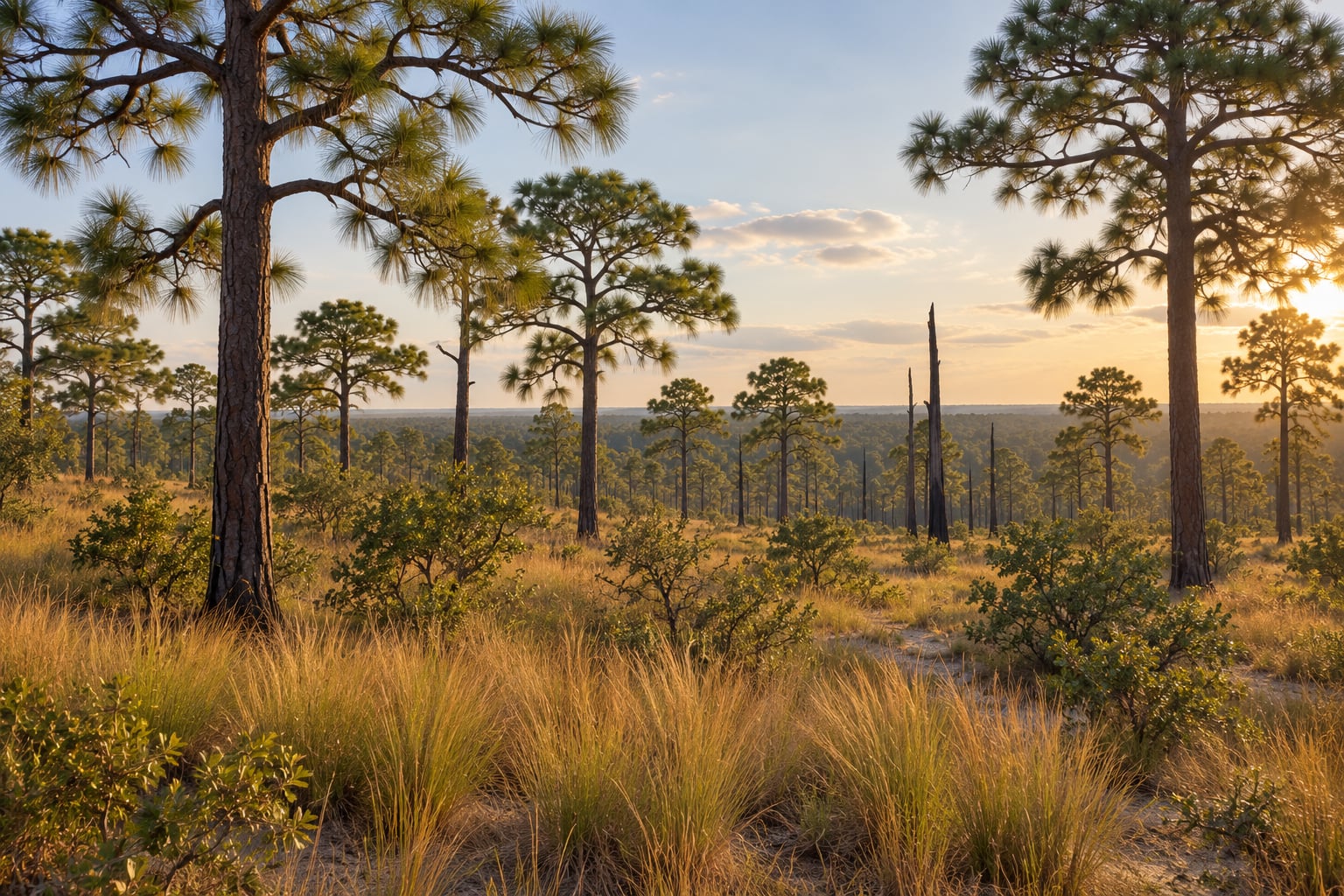
To identify longleaf pine habitat, confirm four things at the same site: an open stand of mature Pinus palustris spaced widely enough to walk between, a dense understory of wiregrass and herbs instead of shrubs, dry nutrient-poor sandy soil, and a fire history that kept the canopy thin. Any one of those can be faked by an open pine forest; together they are diagnostic.
That combination matters more than spotting a single tree. A lone longleaf can grow in a loblolly plantation, and a wide-open stand of slash pine on wet flat ground is not longleaf habitat no matter how park-like it looks. The species gives you a candidate, the site confirms it.
This guide is written for people who will actually stand in the place: hikers crossing a county line, birders working a fire lane, hunters reading a forest edge, naturalists keeping notes, and landowners who suspect their acreage used to be longleaf savanna. Everything below is checkable by eye, by boot, or by digging a soil probe.
Table of Contents
- What Is Longleaf Pine Habitat?
- The 8 Best Signs of Longleaf Pine Habitat
- Look for the Mature Longleaf Pine Crown
- Check the Needles, Bark, and Branching Pattern
- How to identify longleaf pine habitat without mature trees
- Read the Groundcover and Soil Clues
- Use Fire History and Forest Structure
- Where to Look in the American Southeast
- How to Identify and Confirm Longleaf Pine Habitat in Six Steps
- Step 1: Identify at least one mature pine
- Step 2: Check spacing and canopy
- Step 3: Read the understory
- Step 4: Test the soil
- Step 5: Reconstruct the fire history
- Step 6: Rule out the look-alikes
- Common Look-Alikes and Identification Mistakes
- Conservation and Responsible Viewing
- Frequently Asked Questions
- What is the easiest way to identify longleaf pine habitat?
- How tall are mature longleaf pines?
- Does longleaf pine habitat always look like an open forest?
- How can I tell longleaf pine from loblolly or slash pine?
- Why is wiregrass often found in longleaf pine habitat?
- Can young longleaf pine habitat be recognized without mature trees?
- Conclusion
What Is Longleaf Pine Habitat?
Longleaf pine habitat is the fire-dependent, open, park-like forest and savanna of the southeastern Coastal Plain dominated by Pinus palustris. It has nutrient-poor sandy or otherwise well-drained soils, wide-spaced mature pines, a heavy herbaceous understory, and a recurring fire regime of roughly every one to five years.
The name is a trap. The species epithet palustris means “of the marshes,” and it is a misnomer that trips up new readers every season. Longleaf is a dry-site pine. It struggles on wet ground and flourishes where water drains away fast.
Historically it covered something like 90 million acres across the Southeast. Today less than 5% of the original range is intact, and what remains supports close to 900 plant and animal species found nowhere else on Earth. Practitioners on plant-identification forums sometimes call the community its own rainforest of the North, and the odd nickname is not far off.
The habitat takes three broad forms, and they grade into one another:
- Pine savanna. Widest and driest. Canopy pines far apart, wiregrass dominant, few hardwoods, fire often returns within one to three growing seasons.
- Pine woodland. Pines still widely spaced, but scattered oak and hickory in the canopy and a shrub layer appearing. Fire interval of roughly three to five years.
- Pine forest. Denser canopy, real midstory, richer soils. This is where longleaf habitat thins out and where it gets confused with loblolly and slash.
Only the savanna and woodland forms are usually described as longleaf pine habitat in conservation planning. The forest form is a transition, and treating it as the same thing is one of the most common identification errors.
The 8 Best Signs of Longleaf Pine Habitat
Eight signals carry most of the weight, and they split cleanly into things you see in the tree itself and things you see on the ground.
- Mature pines with open, rounded crowns. Tall, flat-topped or rounded, with widely spaced irregular limbs.
- Park-like spacing. Big enough gaps to walk or drive between mature trees without brushing bark.
- Long needle clusters. Needles in bundles of three, commonly 8 to 18 inches long, often drooping in tufts at the branch tips.
- Thick, plated reddish-brown bark. Furrowed into plates, with the crown of mature fire-surviving trees often holding back reddish “grass stage” tufts.
- Heavy wiregrass understory. Clumps of bunch grasses 2 to 4 feet tall that ignite readily and carry fire through the site.
- Open midstory and few shrubs. Regenerating oaks and scattered hardwoods, but no dense tangle of hardwood saplings.
- Dry, sandy, low-nutrient soil. Pale sand, deep and loose, often with a thick duff layer and little organic matter below it.
- Specialist wildlife. Gopher tortoise burrows, red-cockaded woodpecker cavity trees, brown-headed nuthatches, and a bird list that feels unusually specific.
Signs three through six are the ones people get wrong, because a loblolly stand can imitate them for a season or two. Signs one, two, seven, and eight together are much harder to fake.
Look for the Mature Longleaf Pine Crown
Crown shape is the fastest field check and the one that works from a distance. Mature longleaf pines grow tall and straight with a broad, open crown concentrated in the top third of the tree, so the overall silhouette is flat-topped or gently rounded with an umbrella look.
Branches are long, widely spaced, and irregularly angled rather than forming a tidy whorl of short upswept limbs. Foliage sits in tufts at the branch ends, leaving bare branch lengths showing through. That combination reads as airy even when the canopy closes at the very top.
Spacing is the part that gives longleaf stands their reputation. Mature trees often carry heavy crowns on tall clean boles, and mature groves are frequently open enough to drive a truck through. Nothing else in the Coastal Plain pine forest looks the same at a mile.
Two cautions. A suppressed longleaf under a closed canopy grows tall, thin, and scraggly with a short crown, so tree shape reflects competition as well as species. And a stand of mature slash pine can also look park-like, which is why spacing alone is a hint rather than a verdict.
Watch the base of the bole too. Longleaf carries thick plated bark over the full height, and old trees in a burned savanna show fire scars on the lower trunk with the crown growing back above them.
Check the Needles, Bark, and Branching Pattern
Handle a twig before you trust the view. Longleaf needles sit in bundles of three, run 8 to 18 inches, and stay green year-round with a strong pine scent when crushed. The long drooping tufts at shoot ends are practically a giveaway in a hand-held photo.
Bark is thick, scaly, and reddish-brown to orange-brown, broken into irregular plates with shallow to medium furrows. Slash pine bark is orange and platy as well, so color alone will not separate the two. Loblolly bark is thinner, greyer, and less plated on mature trees.
Cones run about 6 to 10 inches, heavy, with prickles that feel sharp and flat at the tip rather than tiny and rounded. Loblolly cones are smaller, roughly 3 to 6 inches, and loblolly cones often stay closed and hang on the tree for years. Slash cones run about 4 to 6 inches.
Branching sets the pattern. Longleaf branches in whorls with long, sparsely needled lengths between tufts, and mature trees lose the lower limbs, leaving a clean trunk under an umbrella crown. Seedlings go through a grass stage, a period of roughly 5 to 12 years when a young pine puts almost all its height into a tall grass clump and produces no limbs at all.
Grass stage is the single most useful clue for confirming a site you can walk through. Grass-stage longleaf pines standing in a bunch of wiregrass, with a distinct dark tuft at the crown and no branches below it, are diagnostic in a way a mature canopy is not. Find one and the stand is longleaf habitat, whatever else grows around it.
Below ground adds a final check. Seedlings carry a deep taproot, often reaching 6 to 10 feet, with a lateral root system spreading wide. On moist sites longleaf sets few or no cones and grows poorly, because the taproot cannot breathe in saturated soil. That is why dry ground is a species clue and not just a soil clue.
How to identify longleaf pine habitat without mature trees
Planted or fire-suppressed sites often hold young longleaf with no mature canopy anywhere near. You can still confirm the habitat from the ground layer and the soil, because wiregrass, the herbaceous community, and the dry sandy profile persist around young trees even when the overstory is gone.
Look for grass-stage pines first, then bunchgrasses 2 to 4 feet tall, then sand. If all three show together on the same site with no competing canopy, that is a longleaf site recovering, not a different habitat. Add any remaining sign from the list and the call is solid.
Read the Groundcover and Soil Clues
The understory is where longleaf habitat announces itself most reliably, because the understory is what the fire regime builds. Understory species in a healthy longleaf site number in the many dozens per acre, dominated by grasses and herbs with relatively few woody shrubs.
Wiregrass is the signature. Species in the genus Aristida grow in dense bunches, commonly 2 to 4 feet tall, and they persist for decades in fire-favored openings. Wiregrass is not proof on its own, since wiregrass grows in many pine types across the range, but wiregrass plus longleaf is a strong pairing.
Oak regeneration is the second clue. Scrubby post oak, live oak, and blackjack oak sprout as low, irregularly spaced individuals in a longleaf stand rather than as a closed hardwood thicket. Where hardwoods are evenly spread and climbing, the site is closing out of longleaf condition.
Palmetto appears in the wetter longleaf types, especially in Florida and the southern Coastal Plain. Its presence narrows the habitat type rather than arguing against it.
You will also meet carnivorous plants, orchids, and a small-host community that specialists point to as nearly unique to this ecosystem. When a site supports pitcher plants and bog orchids under wiregrass, the longleaf hypothesis deserves serious attention.
Soil is the fastest check of all. Push a probe or look at a road cut:
- Deep, loose, pale sand. Sandhills and dry flatwoods run 3 feet or more of it.
- Low fertility and acidic reaction. Longleaf is slow-growing in part because the site is poor.
- A thick layer of unburned needles and grass thatch.
- Almost no clay. Saturated or heavy soils point away from longleaf and toward loblolly or pond pine.
Wet flatwoods are the exception readers ask about, and the answer matters. Longleaf flatwoods can grow on poorly drained clayey or organic soils during the season when water is high. The pine still identifies the site, because the fire regime and open structure remain; the soil rule is a caution, not an absolute.
Check under the litter rather than only at the surface. A soil pit with a clear sand profile, no weeds of high fertility, and a fuel layer that stays dry a few days after rain reads as longleaf country.
Use Fire History and Forest Structure
Longleaf habitat is a fire-maintained habitat, and its structure is the visible record of past fire. Frequent low-intensity fire in the growing season kills woody encroachment, keeps oaks at resprouting size, and holds the canopy open.
What that produces is a specific architecture: mature pines widely spaced, a canopy open enough for sunlight to reach the ground, hardwoods present but small and scattered, no midstory layer between the grass and the overstory, and a fuel bed that carries fire easily and often. You can read the structure in about a minute once you know what to look for.
Evidence of the fire regime includes the oaks with thick, smooth bark and epicormic sprouts low on the trunk, fire-scarred boles on mature pines with crowns surviving above the scar line, scattered standing dead snags, and open spacing that a closed-canopy plantation simply does not have.
Fire history is context rather than proof. A burned slash pine stand can look identical for a few years, and a fresh burn tells you very little on its own. What makes fire useful is that it tells you what is being maintained here and why the understory is open. A site on a two-or-three-year burn rotation with wiregrass and resprouting oak is being managed as something; the tree species tells you what.
When fire has been suppressed for a decade, the signs invert. Shrub layers thicken, hardwoods climb, the canopy closes, and the woodland form disappears into a closed forest. The pines are still longleaf. The habitat condition has degraded, which is the normal starting point for restoration work.
Where to Look in the American Southeast
Longleaf habitat runs from the Coastal Plain of Virginia and the Carolinas west through Georgia, Alabama, and the Florida Panhandle, then south through Florida and west into eastern Texas. The four named habitat types differ by elevation, soil, and fire interval, and the differences tell you which type you are standing in.
| Habitat type | Elevation | Soil and drainage | Canopy | Fire interval | Signature plants |
|---|---|---|---|---|---|
| Coastal Plain | About 130-250 feet above sea level | Deep, dry, well-drained sand and sandy loam | Very open, park-like | Often 1-3 years, growing season | Wiregrass, saw palmetto, longleaf pine |
| Flatwoods | Near sea level, flat ground | Wet sandy or clayey soils, seasonally flooded | Open, scattered hardwoods | Roughly 2-3 years | Bluff hardwood, wiregrass, slash-adjacent pines |
| Sandhills | Rolling, higher ground inland | Deep dry sand, very low fertility | Open, widely spaced | Roughly 2-3 years | Wiregrass, turkey oak, longleaf pine |
| Montane | Upper Coastal Plain and lower Appalachian edge | Shallow, stony, well-drained soils | Open, red oak associates | Roughly 3-5 years | Table mountain pine, rock outcrops, chestnut oak |
A practical shortcut: montane longleaf grows on thin soil over rock and has table mountain pine nearby, while the Coastal Plain and sandhills types run on deep sand. If the soil profile is more than a foot deep and pale, you are probably not in montane habitat.
Where habitat is patchy, check public land boundaries. Many remnant stands survive on preserves, state forests, military installations, and longleaf-pine restoration sites, and those are also the easiest places to see a healthy stand without a private landowner driving you off.
How to Identify and Confirm Longleaf Pine Habitat in Six Steps
This is the repeatable version of the article. Work it in order and stop at the first mismatch, because a mismatch tells you which pine you are probably looking at.
Step 1: Identify at least one mature pine
Confirm needles in bundles of three at 8 to 18 inches, plated reddish-brown bark, and cones around 6 to 10 inches. If the tree does not pass, stop; if the site has other pines that pass, keep going. The species is a candidate, not the habitat.
Step 2: Check spacing and canopy
Measure by eye, not by ruler. Mature longleaf in a habitat stand usually stands far enough apart to see clear sky down to the ground between crowns. A closed canopy means woodland condition, plantation, or a different species.
Step 3: Read the understory
Look for bunchgrasses in the 2-4 foot range, scattered low oaks, and a low count of shrubs. Take a count as you walk a hundred yards: tens of herbaceous species in a small area is the signal. Understory diversity, not tree count, is what distinguishes habitat.
Step 4: Test the soil
Probe for depth, color, and drainage. Deep pale sand is a strong longleaf signal. Heavy or wet soil at the rooting zone argues against it, with the flatwoods exception noted earlier.
Step 5: Reconstruct the fire history
Look for fire scars, resprouting hardwoods, standing snags, and a fuel bed that would carry a growing-season burn. Then ask how long it has been managed this way. Ten years without fire and the structure you are reading is a degraded stand, not the habitat in best condition.
Step 6: Rule out the look-alikes
| Feature | Longleaf pine | Loblolly pine | Slash pine |
|---|---|---|---|
| Needles per bundle | 3 | 3 | 2-3 |
| Needle length | 8-18 inches | 6-9 inches | 7-12 inches |
| Cone size | 6-10 inches | 3-6 inches | 4-6 inches |
| Bark on mature trees | Thick, plated, reddish-brown | Thin, greyish, shallowly furrowed | Thick, plated, orange-brown |
| Crown | Open, flat-topped, widely spaced | Dense, rounded | Full, rounded, dense |
| Preferred site | Dry sandy, fire-maintained sites | Moist, fertile, plantation ground | Wet flatwoods, lower slopes |
Slash pine is the hard one, especially in the Coastal Plain, where the two overlap on wet ground. Needle length and cone size help. Crown habit helps, since slash crowns are fuller and rounder. And the ground cover decides it: wiregrass-dominated dry sites favor longleaf.
Common Look-Alikes and Identification Mistakes
Identifying one tree and calling it habitat. A longleaf sapling survives in almost any pine stand, including a loblolly plantation on good soil. Habitat is a condition of a whole site, not an ID on one trunk.
Assuming every open pine forest is longleaf. Openness is the goal of fire, and many pine types get there. The combination of dry sand, wiregrass, and longleaf’s specific crown and needle characters is what closes the case.
Ignoring young trees. Grass-stage longleaf is the clearest field evidence available and it is missed constantly because it looks like a grass clump. Look at the top of the clump.
Trusting photos alone. On identification forums, people post pine photos expecting a verdict and get told the same thing: longleaf and slash are not that easy to separate from a photo. Needle bundles and cones must be close, and the site context is what settles it.
Reading fire scars as species evidence. Fire scars prove fire, and fire favors longleaf, but they also happen to slash and loblolly. Treat fire as supporting context.
Skipping site history. Historical maps and survey records can confirm former habitat where the trees are gone. Federal land survey plats from the early 1800s often call out soil and timber in specific language, and phrases like thinly spaced oak and pine on deep sandy soil are the kind of detail that settles an old property question. USGS historical topographic maps cover much of the same ground. One landowner in southeast Georgia pieced together exactly this evidence, using survey notes and old topo maps together, to argue that a remnant on his property had been post oak and pine savanna.
Treating open and sandy as proof. Plenty of sandhills in the range hold no longleaf at all. Sand is a clue about the site; it is not a statement about the trees that live on it.
Conservation and Responsible Viewing
Longleaf habitat is scarce and it is still losing ground. What remains is recognized as one of the most species-rich systems in North America, and it is protected under conservation programs at federal, state, and local levels. Recognizing a stand is genuinely useful, because undocumented habitat is habitat nobody plans for.
Practical behavior on public land stays simple. Stay on designated routes and trails, watch for posted burn seasons and closures, and never carve, blaze, tag, or cut into a tree to mark it. On private land, a landowner may well want to manage for longleaf, and a local forester or the state forestry agency can confirm a stand and talk through options. If you suspect you are on a documented restoration site, contacting the group managing it is more useful than posting coordinates publicly.
Specialist species make the stakes concrete. Red-cockaded woodpeckers excavate cavity trees in longleaf pines at least 60 years old and thick enough to drill into, so a mature longleaf grove is not just habitat for one bird but infrastructure that takes decades to rebuild. Gopher tortoise, brown-headed nuthatch, and a long list of plants and invertebrates depend on the same open, burned structure.
On private land, restoration generally means returning to fire, and that runs through prescribed burning with permits, fuel planning, and weather windows that vary by state. Where fire is not feasible, selective mowing and thinning to reopen the canopy can push a stand back in the right direction, with the long term goal of reinstating the fire cycle.
Frequently Asked Questions
What is the easiest way to identify longleaf pine habitat?
Confirm four linked clues at one site rather than trusting a single tree. Look for mature Pinus palustris with open, widely spaced crowns, a wiregrass and herb understory with few shrubs, deep dry sandy soil, and a site burned every one to five years. One clue can be faked by another pine species. All four together are close to diagnostic.
How tall are mature longleaf pines?
Mature longleaf pines commonly top out somewhere between 60 and 100 feet, with a handful of recorded specimens well above that. Growth depends heavily on the site. On dry, nutrient-poor sand trees often grow slowly and stay shorter, while trees in the wettest longleaf positions can be sparse and spindly. Crown shape and needle length usually tell you more than height does.
Does longleaf pine habitat always look like an open forest?
No. Healthy longleaf pine habitat is open by design, but a stand that has missed fire for a decade closes over and starts to look like an ordinary closed pine forest. The pine species can still be longleaf while the habitat condition has degraded. You are looking at savanna or woodland condition, not a different ecosystem, and restoration reopens it.
How can I tell longleaf pine from loblolly or slash pine?
Start with needles and cones. Longleaf has needles in bundles of three, 8 to 18 inches long, and cones of 6 to 10 inches. Loblolly needles run 6 to 9 inches with cones of 3 to 6 inches, and slash cones run 4 to 6 inches on fuller, rounder crowns. Bark, crown habit, and site then finish the call, since color alone separates nothing.
Why is wiregrass often found in longleaf pine habitat?
Wiregrass clumps thrive in open, sunny, frequently burned ground with sandy soil, exactly the conditions longleaf maintains. The grass survives fire and resprouts, while fire smothers competing woody plants, so the bunchgrasses persist for decades. That persistence makes wiregrass a useful habitat marker. It grows under other pines too, so pair it with the tree ID rather than trusting it alone.
Can young longleaf pine habitat be recognized without mature trees?
Yes. Grass-stage young longleaf pines put all their height into a tall grass-like clump for roughly 5 to 12 years and grow almost no branches, which is highly diagnostic. Pair them with bunchgrasses 2 to 4 feet tall and deep pale sand. Together those three features confirm a longleaf site that is regenerating or recovering, even with no mature canopy on site.
Conclusion
Start with the tree, then move outward. Confirm a mature longleaf by its needle bundles, plated bark, and open crown, and look for grass-stage seedlings, which settle the question faster than anything else. Then read the ground: wiregrass bunches, scattered low oaks, and a soil probe that comes up in deep pale sand. Fire history explains why the structure looks the way it does, and historical survey plats can fill in what the trees no longer tell you.
When all of it lines up, you are standing in one of the rarest forest types in North America, and it is worth writing down where you found it.