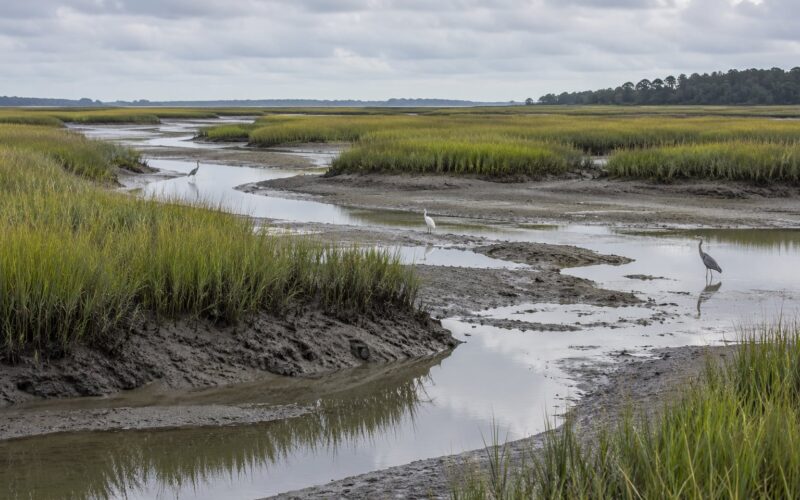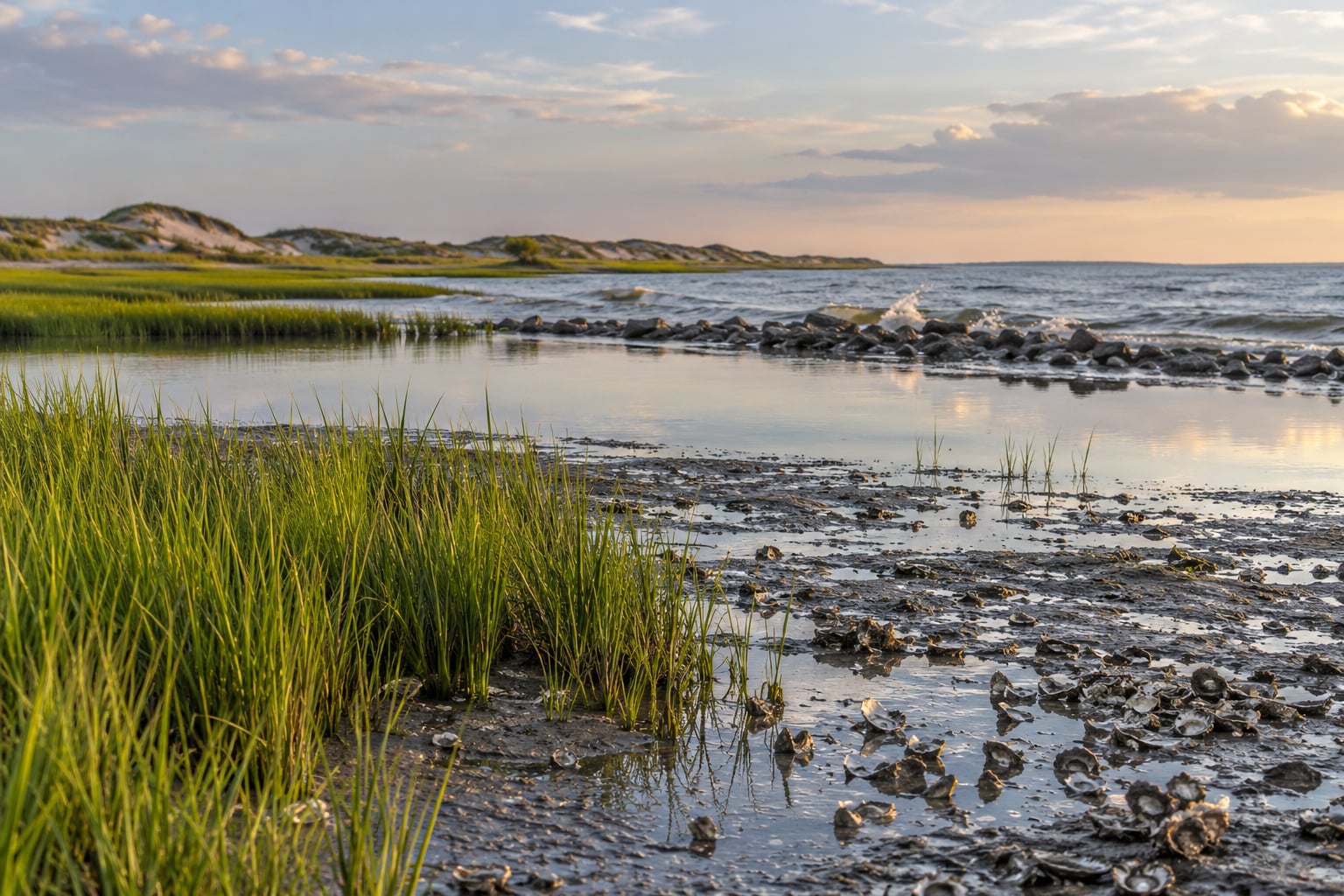
A living shoreline protects land by absorbing wave energy across a wide, shallow slope instead of bouncing it off a vertical concrete face. Waves break over marsh grass and low rock sills, drop their sediment load, and let plant roots bind the bank. Nothing is built to hold the shore back forever, so nothing cracks under it.
That single difference explains most of what separates the two approaches. A seawall is a barrier. A living shoreline is a system that grows, absorbs damage and repairs itself. It also explains why regulators across the US have started steering new projects away from armoring, and why property owners keep showing up at planning meetings asking whether the marsh option actually works before they commit to it.
This guide walks through the mechanics, the three main design types, the honest limits, and the site conditions that decide the outcome. If you want the short version: a living shoreline works best on protected water with low wave energy and enough lateral room to grade a bench. On open ocean frontage or a narrow lot, a hard structure or a hybrid may be the honest answer.
Table of Contents
- What Is a Living Shoreline?
- How Living Shorelines Work Instead of Seawalls
- Why seawalls push the problem somewhere else
- How the Main Living-Shoreline Components Work Together
- Three types of living shoreline, from natural to sill-assisted
- What Benefits Do Living Shorelines Provide?
- Flood and wave attenuation
- Erosion control that improves over time
- Water quality
- Habitat
- Shoreline access and appearance
- Self-repair and storm resilience
- How Do Living Shorelines Compare with Seawalls?
- What Are the Limitations and Failure Risks?
- They need lateral space
- They are not built for open-ocean exposure
- They need sediment
- Soils matter
- The establishment window is genuinely vulnerable
- Invasive species and poor design choices sink projects
- The math changes as water levels change
- When Is a Living Shoreline the Right Choice?
- The hybrid retrofit most people are looking for
- How Are Living Shorelines Designed and Maintained?
- Design and build
- What maintenance actually involves
- How long it takes
- Frequently Asked Questions
- How does a living shoreline work?
- What are the downsides of sea walls?
- What is a living shoreline according to NOAA?
- What effect does a seawall have on a beach?
- How long does a living shoreline take to work?
- How much space do you need for a living shoreline?
- Conclusion
What Is a Living Shoreline?
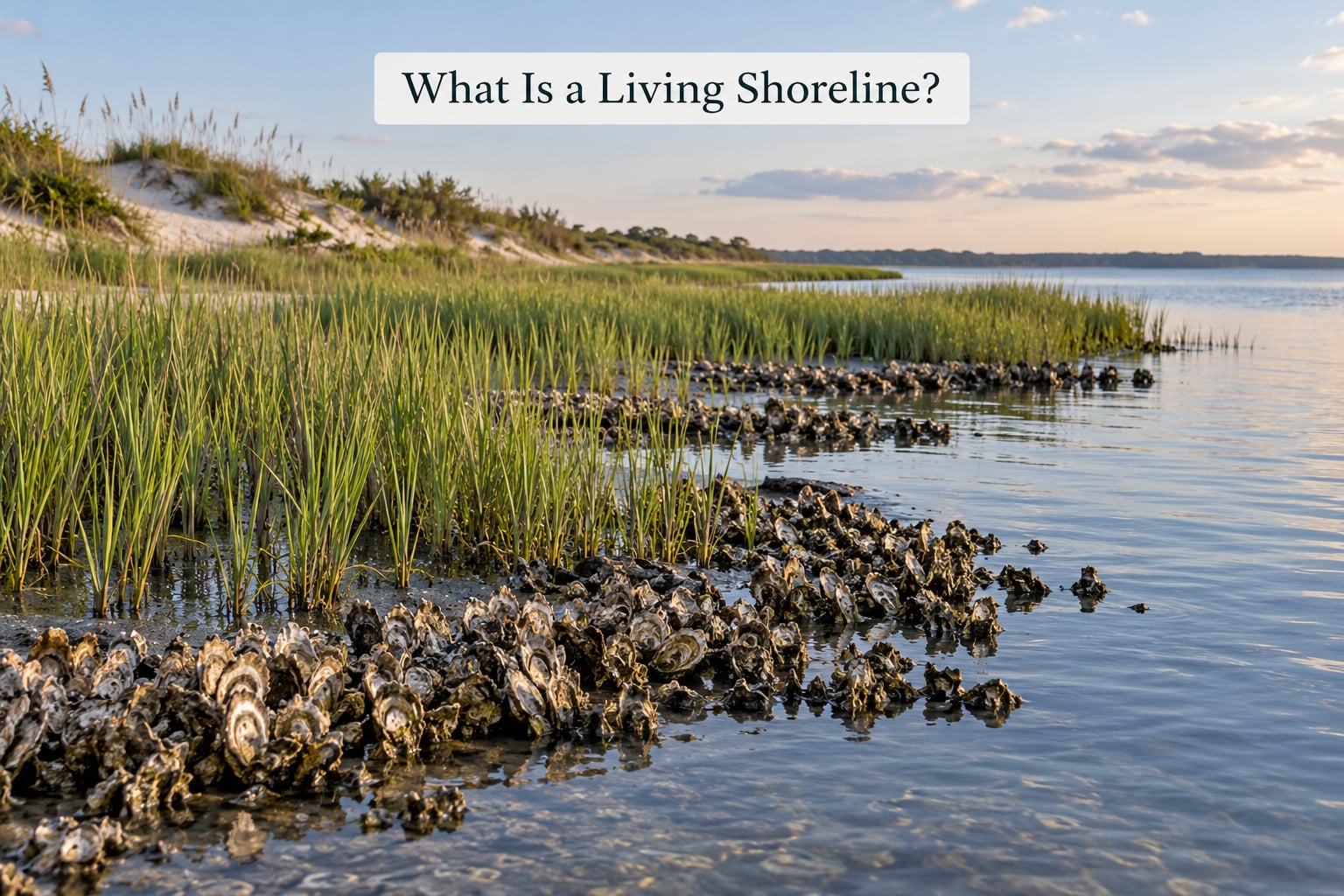
A living shoreline is any shoreline stabilized with natural materials — marsh plants, coir logs, oyster shell, sand, stone — sometimes combined with a low offshore sill. NOAA describes the approach as using natural materials and vegetation to stabilize shorelines and reduce erosion, framing it as nature-based infrastructure rather than as a decorative landscaping choice.
That last part matters. Homeowners often assume a living shoreline is a garden that happens to stop erosion. It is not. When it is designed properly, the marsh platform becomes the flood and wave barrier, much as a dike works in the Netherlands. It is engineered habitat doing an engineering job.
The ecological upside comes along with the protection. Intertidal salt marsh, planted with native cordgrass such as Spartina alterniflora along much of the Atlantic and Gulf coasts, filters sediment, cycles nutrients, buries carbon, and gives juvenile fish and crabs a place to hide. You cannot get those benefits from a sheet pile wall.
How Living Shorelines Work Instead of Seawalls
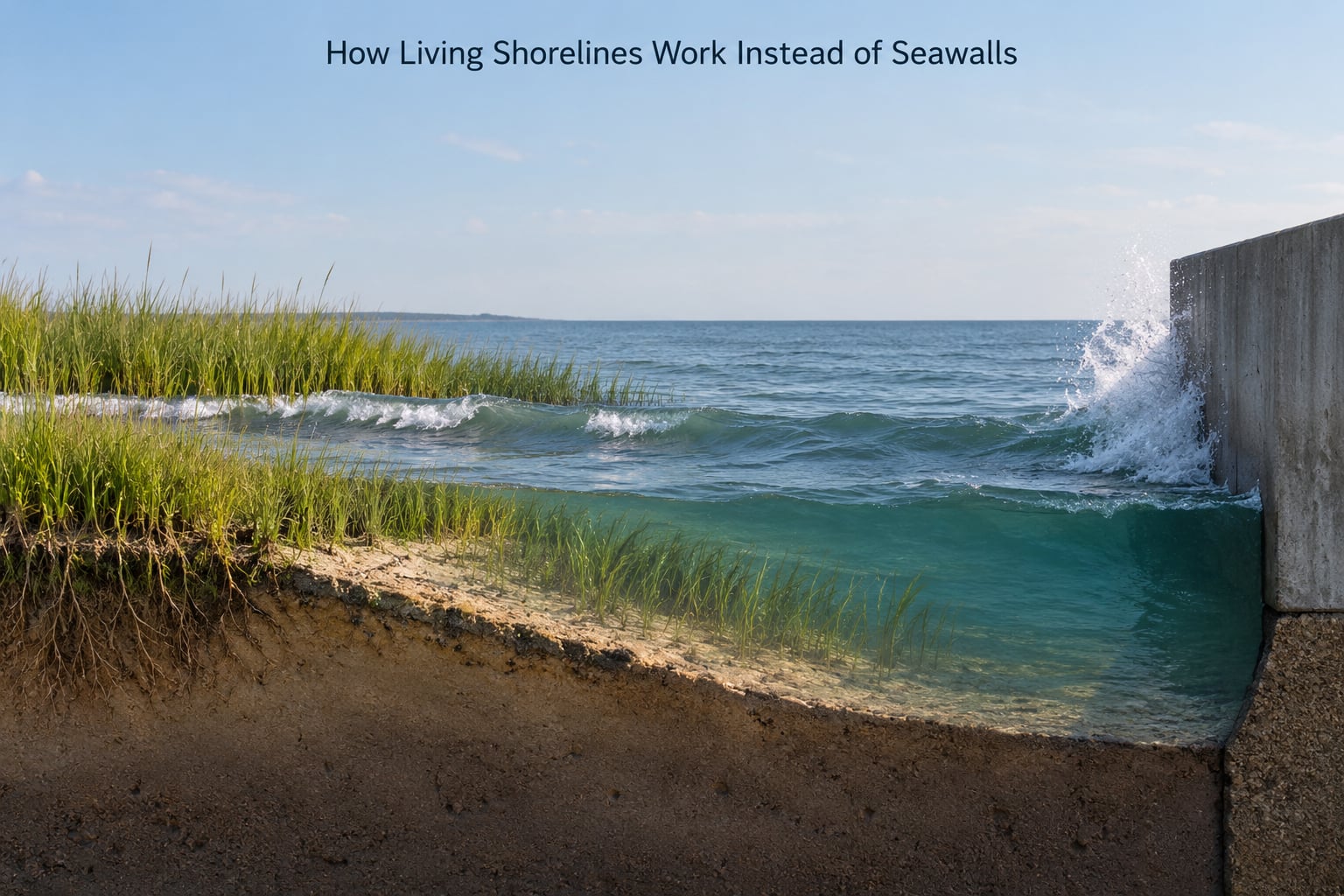
The core mechanic is a change in how energy moves. Wave energy is proportional to the square of wave height, so shaving a wave down matters more than it sounds. Here is the sequence, in order.
- Energy dissipates over distance. A marsh is a shallow, gently sloped surface, not a cliff. Incoming waves feel the bottom, break early, and lose height across many feet of water instead of arriving at full force. A seawall by contrast reflects a large share of that energy straight back offshore.
- The reflection problem is solved. Waves that bounce off a vertical face scour the bed at its base — known as bulkhead toe scour — and return as turbulent water that attacks the beach in front of the structure and the shoreline beside it.
- Suspended sediment settles. Slow water drops what it was carrying. Sediment accumulates in the lee of the sill and in the marsh root mat, and the bank builds outward rather than washing away.
- Roots hold the soil. Dense root mats bind the upper bank against the pull of waves and current, and stems slow near-surface flow between the rhizome network.
- The platform raises itself. Trapped sediment and organic buildup add elevation over time, a process called vertical accretion, so the marsh keeps pace with modest sea-level rise while it has room to move.
- Damage becomes repair. A storm knocks stems flat or cuts a notch in the bank. Living shorelines recover from that over one or two growing seasons. Concrete either stands or it cracks and is rebuilt.
Why seawalls push the problem somewhere else
Armored shorelines cut off the sediment that would naturally travel along the coast. Sand that erodes from upcoast beaches stops at the wall and never reaches the beach downdrift, so those beaches narrow year after year. The marsh behind the wall is also cut off from new sediment, and relative sea-level rise then eats it from the side. Together those two processes are called coastal squeeze, and it is why a single hardened parcel can degrade shoreline several properties away.
On the scale of the whole country, roughly 22,842 km of shoreline — about 14% of the US coastline — is already armored, according to Gittman and colleagues (2015). A large share of that is estuarine and low-energy water, which is exactly where a living shoreline was viable in the first place.
How the Main Living-Shoreline Components Work Together
A functioning system is not one material. It is a sequence, moving from open water toward land, where each layer handles a job the next one cannot.
- Nearshore sill or oyster reef. A low stone sill, sometimes built from oyster baskets or reef balls, sits offshore. Its purpose is to break waves before they reach the bank and to hold enough sediment to build a shoal. Gaps in the sill are deliberate, so water flushes through and fish can move between the bay and the marsh.
- Wetland and marsh platform. A graded bench at the right elevation, planted with site-appropriate natives. This is the flood storage area and the main wave attenuator.
- Upper bank and buffer. A vegetated slope, often with shrubs and canopy, that slows runoff, filters lawn fertilizer, and keeps foot traffic off the marsh edge.
- Beach or cobble front. In higher-energy settings, a small sand or gravel beach in front of the sill gives the system something sacrificial to reshape between storms.
- Live oyster reef (optional). Where oysters are native, reefs add rough surfaces that dissipate wave energy and filter water. Reefs built from mesh cages or reef balls also give stocked juvenile oysters a settlement surface.
- Woody debris (optional). Logs, root wads and coir logs trap sediment in the high-water zone and add the roughness that plants alone do not provide in the first years.
Three types of living shoreline, from natural to sill-assisted
Designers sort these into three practical tiers based on how much wave energy the site sees and how much room the owner has.
| Type | Typical construction | Wave exposure it handles | Time to meaningful protection |
|---|---|---|---|
| 1. Natural / existing buffer | Protecting or restoring what is already there — marsh, dunes, beach, existing vegetation | Very low to low; protected coves, canals, small embayments | Sometimes immediate if vegetation already exists |
| 2. Vegetated | Graded marsh bench, planted natives, coir logs, erosion-control matting | Low to moderate; boat wake erosion, small-lake and bay frontage | Two to three growing seasons |
| 3. Sill-assisted or hybrid | Low stone sill, reef or oyster baskets offshore, marsh planted behind, sometimes a small hard section at the ends | Moderate, at the upper end of what living shorelines handle well | Two to four growing seasons; partial protection from week one |
The honest summary is that type 1 is nearly always worth pursuing first. Most erosion problems on residential water involve a shoreline that was stripped of vegetation decades ago, so putting plants back and giving them room may solve the problem without any construction at all.
What Benefits Do Living Shorelines Provide?
Set against seawalls, the benefits fall into a few groups. Each one is real, and each one depends on site conditions.
Flood and wave attenuation
A wide marsh platform slows water moving across it and stores it temporarily, then releases it slowly. That reduces peak flow and shortens flood duration at the land behind. Studies of marsh restoration consistently find wave height and wave energy dropping across the marsh platform, with the reduction scaling to marsh width and plant density.
Erosion control that improves over time
Unlike a fixed structure whose protection depends entirely on the toe staying buried, a living shoreline gains sediment and root mass each season. Sites that start thin keep improving if sediment supply and elevation are right.
Water quality
Marsh plants slow water enough that suspended sediment drops out, and dense root networks host microbial communities that strip nitrogen and phosphorus from the water column. Plant uptake of nutrients in the lawn and runoff source area matters too, since the buffer intercepts fertilizer before it reaches the estuary.
Habitat
Marsh edge, shallow shoal and structured hard bottom together make good nursery habitat. Scheld and colleagues (2024) found that marshes and living shorelines generated more than three times the annual recreational fishing value of hardened shorelines in a Virginia study. Practically, that shows up as more birds on the water, more structure for fish, and far fewer “dead water” complaints from neighbors.
Shoreline access and appearance
You get a graded, planted edge instead of a concrete cliff. Whether that matters is personal, but for waterfront homes it is often the difference between a view and a wall, and it is commonly the reason owners keep a living shoreline once the engineering case is made.
Self-repair and storm resilience
This is the advantage that shows up in the hardest evidence. Gittman et al. (2014) surveyed the central Outer Banks after Hurricane Irene in 2011 and found 76% of surveyed bulkheads damaged, while no marsh or marsh-with-sill site sustained detectable shoreline damage. After Hurricane Florence in 2018, Polk and colleagues (2022) found living shoreline sites averaged 0.015 m per year of shoreline change, against -0.31 m per year at unprotected control segments.
The pattern repeats: living shorelines lost little, hardened shores took a beating. A more recent look at establishment, Polk and Eulie (2018) checked 17 North Carolina living shoreline projects and found 12 with reduced erosion rates and 6 actively accreting.
How Do Living Shorelines Compare with Seawalls?
Neither option is universally better. This table is the version I would hand a neighbor deciding between them.
| Criterion | Living shoreline | Seawall, bulkhead or revetment |
|---|---|---|
| Wave energy response | Absorbs and attenuates; energy lost across a shallow slope | Reflects a large share back into the water; scours its own toe |
| Speed of protection | Partial from installation; full after two to four growing seasons | Immediate |
| Space required | Generally 25 to 50 feet of horizontal room to grade a workable bench | Minimal; often built on or near the existing property line |
| Upfront cost shape | Higher per foot than hard structure, often offset by grant and cost-share programs | Lower per foot at the start, but heavy design and construction costs |
| Long-run maintenance | Replanting, filling scour holes, removing debris | Toe scour repair, capping, patching or full replacement over time |
| Effect on neighbors | Generally neutral to positive; sediment keeps moving along the coast | Downdrift beaches narrow; blame is a recurring community issue |
| Habitat | Creates marsh edge, shoal and nursery habitat | Removes shallow habitat and replaces it with vertical surface |
| Expected lifespan | Designed to persist as a living system; adapts as conditions change | Fixed design life, then recurring capital expense |
| Permitting | More agencies, longer review, more monitoring requirements | Usually faster in jurisdictions that still allow it |
Owners who read that last row often tell us the permitting timeline is what decided it for them, not the engineering. Multi-agency review for a living shoreline has been reported at roughly 30 to 60 days against closer to a couple of days for a bulkhead in some North Carolina jurisdictions, and regulatory preference for hardening has been shrinking. Tampa Bay has pushed permitting assistance for living shoreline projects specifically because so many owners default to hard structure instead.
That is a real friction point, and it is worth planning for rather than discovering halfway through.
What Are the Limitations and Failure Risks?
Living shorelines get oversold, so here is where they fail. If any of these describe your site, do not fight the numbers.
They need lateral space
This is the most common reason a project dies at the survey stage. You generally cannot build a working marsh bench on a lot with 15 feet between the bulkhead and the house. Narrow waterfront parcels usually only make sense as a hybrid or as a setback-style approach that moves the structure landward.
They are not built for open-ocean exposure
Guidance generally limits living shoreline design to low and moderate wave energy sites — protected bays, coves, creeks, canals and small embayments, plus boat wake erosion on sheltered water. On storm-exposed ocean frontage with breaking surf, a marsh bench would be repeatedly destroyed faster than it recovers, and no amount of planting changes the physics.
They need sediment
A living shoreline accretes only if there is sediment to trap. Where upstream dams have cut supply, or where nearby hardening has starved the system, the marsh may simply sit there and then die back once sea-level rise outpaces vertical accretion.
Soils matter
Loose fill and organic-rich deposits do not hold a graded bench. Some designs need geotextile and imported fill, which changes the cost picture and adds a failure mode if settlement is underestimated.
The establishment window is genuinely vulnerable
This is the deal breaker homeowners name most often. While the marsh root mat is shallow, the bank is more exposed than a finished hard structure would be. Expect two to three growing seasons for a vegetated design and up to four for a sill-assisted one, with partial protection from day one in the hybrid case. Planting can be done in dormancy windows in some climates to shorten the bare period.
Invasive species and poor design choices sink projects
A common failure is specifying plants that will not survive local salinity and inundation, or putting Phragmites into open tidal marsh where it spreads aggressively. Planting timing, mulch management and site selection are where a lot of projects quietly fail.
The math changes as water levels change
A marsh built for today’s tidal range can drown if relative sea-level rise outruns accretion and the site cannot migrate landward. Landward marsh migration needs an unobstructed buffer behind it, which is another reason the space requirement is not negotiable.
When Is a Living Shoreline the Right Choice?
Run through this screening list before you call a designer. It will not replace a site assessment, but it will tell you whether a conversation is worth having.
- Measure your wave exposure. Protected bay, creek, canal or small embayment is good. Open ocean with regular breaking surf is not.
- Check the fetch. Fetch is the distance the wind has to blow across the water to build a wave. Long fetch means bigger waves. On inland water bodies this is often the deciding factor rather than open-ocean exposure.
- Measure your usable width. If you have less than roughly 25 feet from the water’s edge to a building or usable lawn, a marsh bench probably does not fit.
- Look at the boat traffic. Persistent wake on a narrow channel is a classic fit for a vegetated sill design, because wake energy is low-energy but constant.
- Identify your sediment source. Ask where sand comes from on your stretch of shore. If there is none, accretion claims will not hold.
- Test your soil expectation. Find out whether you are dealing with competent coastal sediment or imported fill from 1960s development.
- Count your erosion rate. Shoreline change surveys — RTK-GPS or drone-based — give you meters per year, which is far more useful than a photograph.
- Check the regulatory posture. Some jurisdictions have effectively stopped approving new bulkheads or require a living shoreline demonstration first. Knowing this early saves months.
- Ask about incentives. Many states, NOAA and the EPA fund living shoreline projects through cost-share and grant programs, which changes the cost comparison materially.
- Confirm your timeline. If the bank must be protected before winter storm season, a hybrid with a sill gives partial protection immediately while the marsh establishes.
When the answer is no, that is not a defeat. The right choice may be a revetment or bulkhead, a setback structure, beach nourishment, or a sill behind which a marsh can still be planted. The failure mode is pretending a marsh belongs somewhere it does not, or assuming a bulkhead is the only alternative when a hybrid usually exists.
The hybrid retrofit most people are looking for
If you already have a bulkhead that is not failing, the practical move is often not replacement but augmentation: repair the structure, grade a narrow marsh bench and slope behind it, add coir logs and a low sill offshore, and plant natives. You lose less lawn than a full conversion, you get partial protection right away, and the armoring that is already paid for keeps functioning as a backstop while the plants mature.
How Are Living Shorelines Designed and Maintained?
The process is more involved than a bulkhead job, mostly because it involves reading an ecosystem rather than resisting it.
Design and build
- Assess conditions. Shoreline change rate, wave exposure, fetch, sediment supply, soil borings, existing habitat, submerged aquatic vegetation, drainage and property lines.
- Set goals and pick a type. Decide whether the goal is boat wake control, erosion at a building, habitat improvement, flood storage, or a combination. That answer usually picks the tier.
- Design for elevation and slope. Marsh surface elevation is the single most important number, and it is set relative to local tidal datums and sea-level projections rather than by eye.
- Install hard elements first. Sill or reef construction, then bench grading and any geotextile or fill.
- Plant natives in the right window. Site-appropriate species, correct planting elevations, and mulch management where invasive grass is a risk.
- Add low-level erosion controls. Coir logs, wattles and matting hold the bank through the first winter.
- Monitor and adapt. Bench elevation, shoreline change rate, plant survival, scour depth and marsh edge position.
What maintenance actually involves
Budget for it early rather than treating it as a surprise. Filling scour depressions after storms, replacing failed plugs of vegetation, clearing debris and wrack that blocks the sill, inspecting for breach, keeping an eye on invasive spread, and topping up elevation once vertical accretion falls behind the design rate. None of it is exotic work, but it does have to happen on a schedule.
How long it takes
A natural buffer that already exists gives you protection today. A vegetated design typically needs two to three growing seasons before the root mat holds the bank on its own. A sill-assisted design takes closer to three to four, and the sill does meaningful work the whole time. Plants can be installed in dormancy windows in some climates, which shortens the period when the new bank is most exposed.
Frequently Asked Questions
How does a living shoreline work?
A living shoreline spreads incoming wave energy across a wide, shallow slope rather than a vertical face. Waves break early over the marsh bottom and low rock sill, losing height as they go, while suspended sediment settles in that calmer water. Plant roots bind the bank and hold the accumulated sediment in place, so the marsh platform itself becomes the barrier and rebuilds after storms.
What are the downsides of sea walls?
Seawalls reflect wave energy back offshore instead of absorbing it, scouring the bed at their toe and attacking the beach in front of them. They interrupt longshore sediment movement, so beaches downdrift narrow over time. Marsh behind the wall is cut off from new sediment and is squeezed out as sea level rises. They also remove shallow nursery habitat, need periodic toe and cap repairs, and eventually need costly replacement.
What is a living shoreline according to NOAA?
NOAA describes living shorelines as projects that use natural materials and vegetation to stabilize shorelines and reduce erosion, treating them as nature-based infrastructure. Typical elements include marsh grasses and other native plants, coir logs and other natural erosion-control materials, and low stone sills or oyster reefs. The goal is a functioning coastal habitat that also protects the land behind it.
What effect does a seawall have on a beach?
A seawall usually narrows the beach in front of it and downdrift of it. Wave reflection concentrates energy at the base of the wall, scouring it and removing sand, while the wall physically blocks sand from moving past it to beaches further along the coast. The combined loss of habitat behind and beside the structure is known as coastal squeeze. Beaches in walled stretches routinely end up narrower than neighbouring unwalled ones.
How long does a living shoreline take to work?
It depends on the type. An existing natural buffer protects you immediately. A vegetated marsh bench usually needs two to three growing seasons before the root mat holds the bank on its own. A sill-assisted design takes closer to three to four seasons, though the sill provides real protection from the start. Part of the early period is genuinely vulnerable, so plan for coir logs or matting through the first winter.
How much space do you need for a living shoreline?
You generally need somewhere around 25 to 50 feet of horizontal room to grade a workable marsh bench and slope, measured from the existing shoreline to whatever you are protecting. Sites with less than about 25 feet rarely work for a full conversion. A hybrid retrofit behind an existing bulkhead can succeed with a narrower bench, which is often the most realistic option on a tight waterfront lot.
Conclusion
Start with the site, not the option. Get a shoreline change rate, a wave exposure and fetch reading, a soil check, and a clear statement of what you are trying to protect. Take those numbers, plus your actual usable width and your local regulatory rules, to a qualified coastal engineer or shoreline designer.
From there the choice is usually clearer than people expect. Low-energy water and enough room means a living shoreline will do more for you than a wall ever could. High exposure or a tight lot means a hybrid, a setback, or a hard structure honestly labeled as a hard structure.
Good examples to see in person are easy to find — the Chesapeake Bay, Tampa Bay, Long Island Sound, Narragansett Bay and the Great Lakes all have established projects. Stand at one and look at the marsh edge. That is what protection looks like when it is doing the job instead of blocking it.