Feral hogs are an invasive, non-game species with an open season on nearly all U.S. public land, so a valid hunting license plus a few seasonal exceptions is all most states require. Learning how to hunt feral hogs on public land comes down to three things: read the unit’s specific rules, find fresh sign before you walk in, and work quietly into position. Budget a full day for scouting and a half day for the hunt, and expect fewer pigs and more walking than you would get on private ground.
I want to set expectations honestly first, because this is where most public-ground hunters quit. Public land rarely carries water holes, feeders or standing crops that concentrate hogs the way a private ranch does. The USDA National Wildlife Research Center treats feral hogs as one of the most damaging invasive species in the country, and every agency wants hunters on that ground, but the animals are scattered and you are sharing the unit with strangers.
Table of Contents
- What You Need
- Step-by-Step
- How to check the rules before going
- How to scout without disturbing the hogs
- How to approach and position safely on public land
- How to identify a clean shot opportunity
- How to track, recover, and process responsibly
- Common Mistakes
- Frequently Asked Questions
- Do I need a license to hunt feral hogs on public land?
- Can you shoot feral hogs at night on public land?
- What is the best caliber for feral hogs?
- Are feral hogs good to eat?
- What should I do if I wound a feral hog on public land?
- Conclusion
What You Need
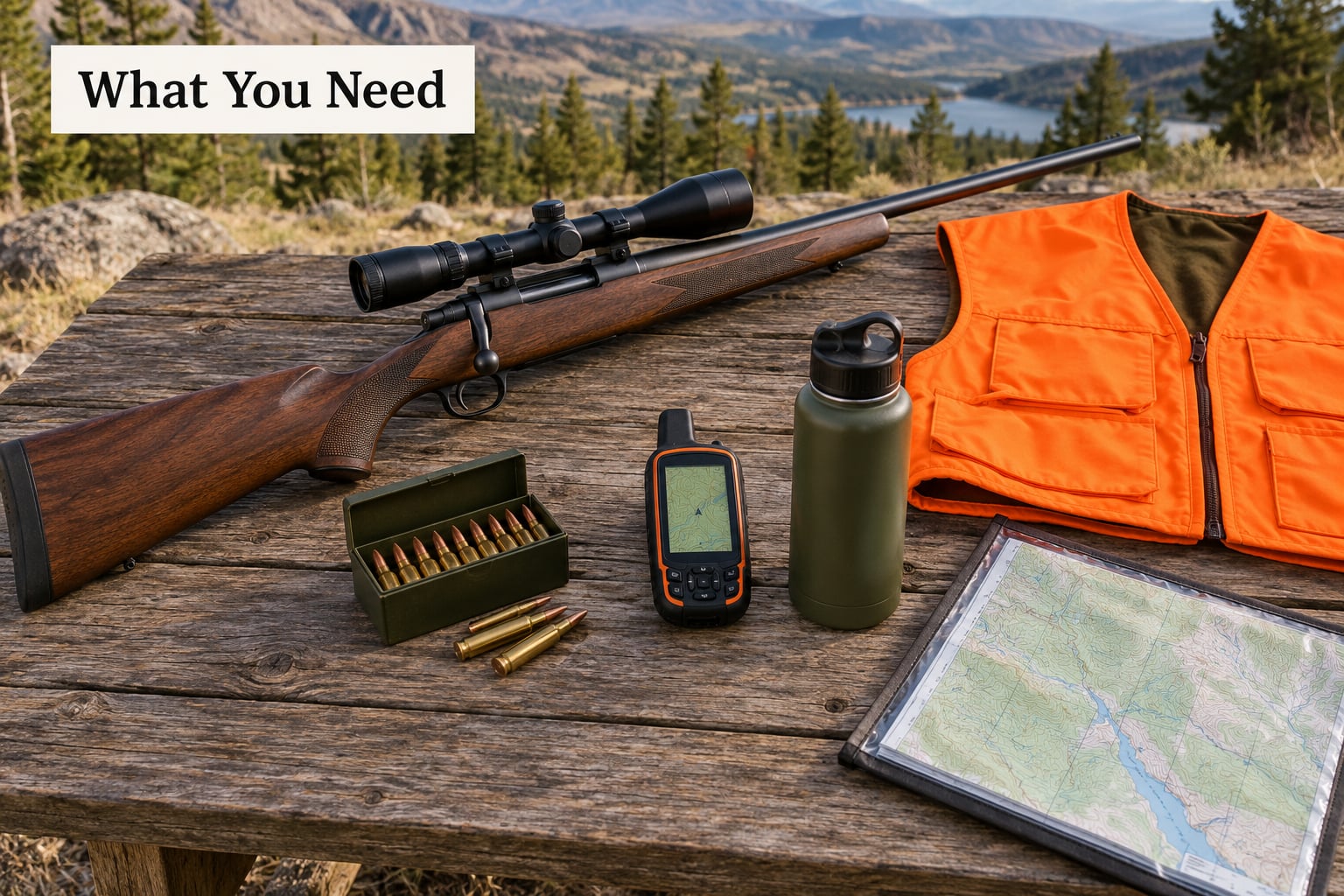
Start with the license, not the rifle. On public ground you need whatever hunting license your state requires for that specific parcel type, and a few states treat public and private land differently. Texas, for example, dropped the license requirement for hogs taken on private land in 2019 but kept it in force on public lands, so the same animal on the same day can be a licensed or unlicensed harvest depending on where you stand.
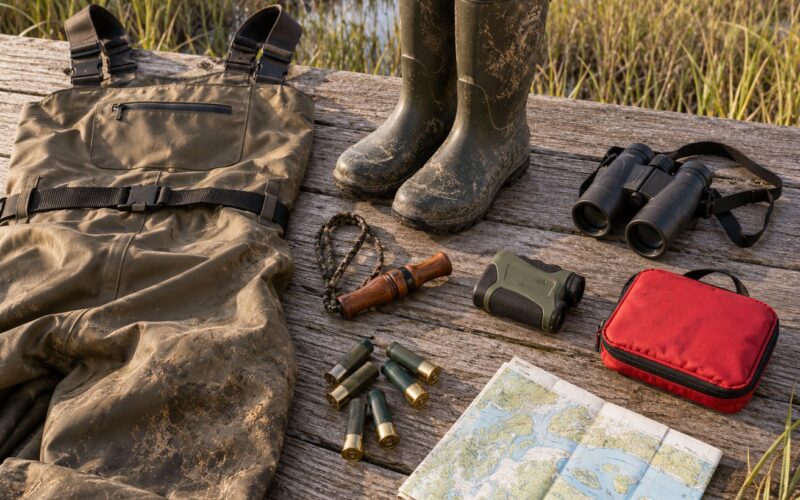
Then work through this list:
- Land-specific rules. The managing agency (state DNR, US Forest Service, BLM, US Fish and Wildlife Service) and the unit’s own special provisions.
- A legal weapon and load. Check caliber minimums, archery or shotgun-only blocks, and whether night-sighting equipment is restricted.
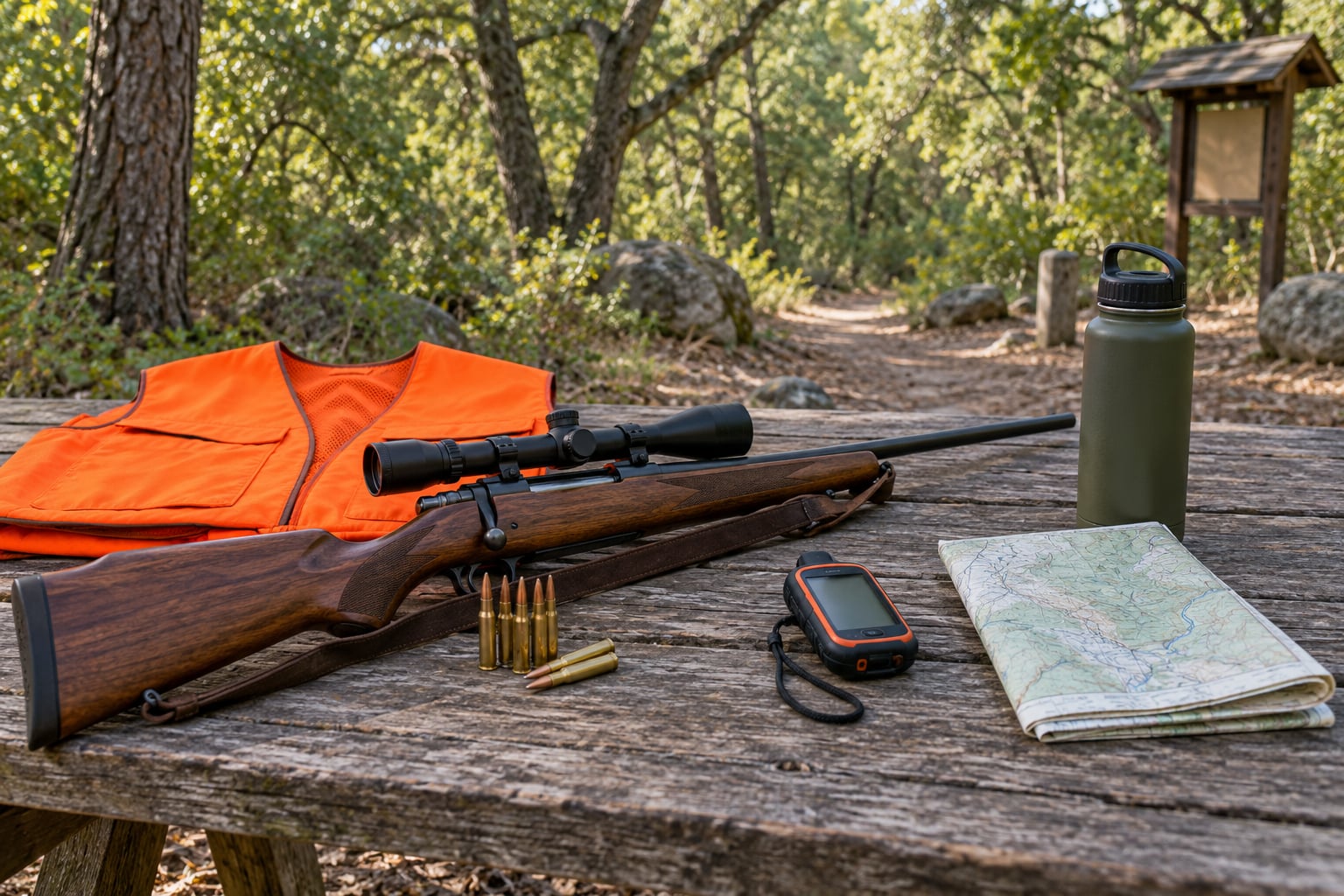
- Blaze orange. Required by many state DNRs and federal units even for hogs, which most hunters do not expect.
- Navigation. A handheld GPS with a downloaded map of the unit, plus a paper backup. Public boundaries are long, straight tree lines that are easy to cross without noticing.
- Field supplies. Water, a sharp gutting knife, game bags, a saw or bolt cutters for transport, a first-aid kit, and a headlamp.
- Weather preparation. Rain in the forecast matters more than most people think, because wet ground resets your sign to zero.
- A communication plan. Someone at home knows the unit name, your access point, and when you are due out.
Step-by-Step
How to check the rules before going
Start with the managing agency, not a general state page, because rules differ by property as well as by state. Wildlife management areas, national forests, BLM districts, state parks and federal refuges each publish their own season dates, weapon restrictions and closures, and a unit-specific special notice will override the general regulation booklet.
Work through the following checklist in order, and save a screenshot of each page you rely on because these documents get rewritten mid-season.
- Season dates. Most Southern states keep hogs open year-round, but some units shut public-land hog hunting during spring months when sows are farrowing with piglets. Confirm the exact open and close dates for your unit.
- License requirement. Verify whether a state hunting license, a federal duck stamp-equivalent stamp, or a WMA permit is needed for the parcel you are entering.
- Bag limits. Feral hogs are non-game in most states, so there is no bag limit. A few states assign a per-hunter limit on specific units, so read the fine print rather than assuming unlimited take.
- Weapon and load rules. Note caliber minimums, straight-wall or shotgun-only blocks, and restrictions on night vision, thermal scopes and artificial light.
- Baiting and feed. Baiting is prohibited on a large share of public ground because of the disease and disease-transmission concerns around deer, and corn or any feed brought in may be an outright violation.
- Daylight hours. Some units require you to be dispatched and recovered within a specific window measured in hours of daylight. If a walk-in is allowed, the clock starts and stops at that dispatch time.
- Vehicle and access rules. Check road closures, gate locks, parking limits, and whether you may park beyond the designated access point.
- Reporting and harvest checks. Some agencies require a successful-harvest check, a field tag, or a report through an online system, even for non-game animals.
- Special closures. Fire, drought, disease outbreak, and habitat work can close a unit for weeks at a time with little notice.
If anything on that list is ambiguous, call the local ranger station or DNR district office. A two-minute call with an agency employee is the final authority, and no forum answer beats it.
How to scout without disturbing the hogs
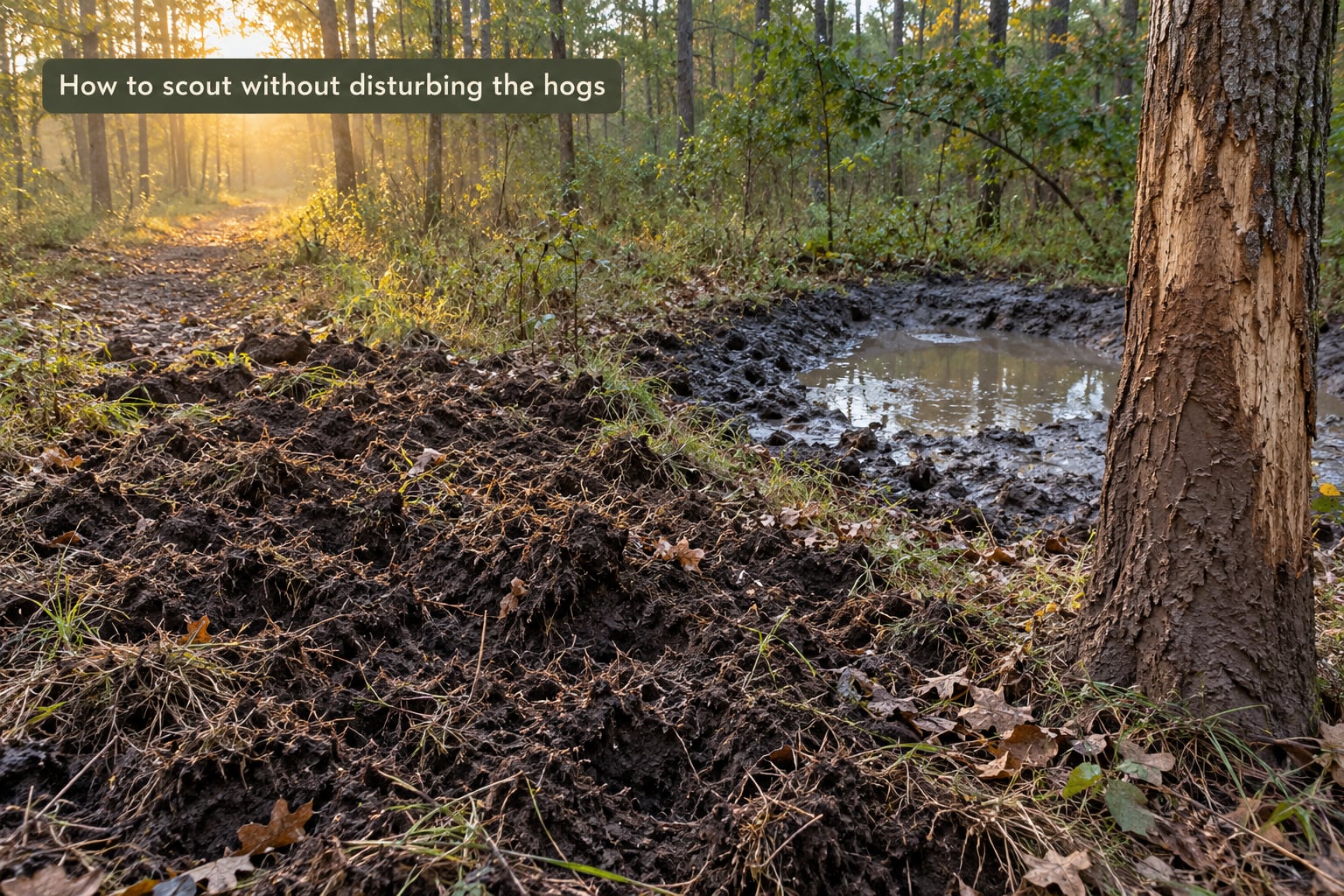
Scout public ground from the trail end and from a distance, because you have no way to control who else is walking the same corridor. Arrive at first light when hogs are moving between bedding and feed, and work the edges rather than the middle.
Look for these signs, freshest first:
- Rooting. Fresh soil turned up in a rough rectangle, often in a damp bottom or an old field. Soil that is still soft and moist is hours old; soil dried and settled is days old.
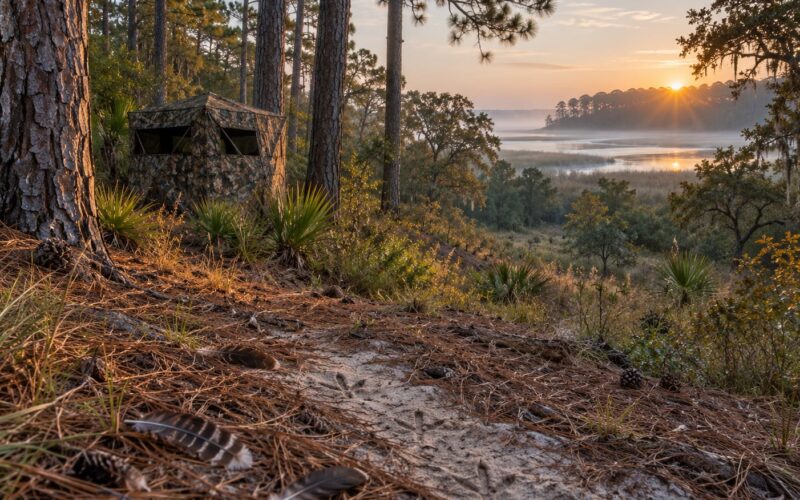
- Tracks. Rounded, blunt, often splayed, and usually in a straight line of two alternating prints. Hoof shape does not splay like a deer’s.
- Wallows. Muddy depressions in creek bottoms and shaded thickets, often with hog hair caught in the mud on the rim.
- Rub trees. Trees with a mud and hair smear on the bark at hog shoulder height, usually on the uphill side of a trail.
- Hair on wire and fence line. Coarse, bristly hair caught on barbed wire where a trail crosses a boundary.
- Feed sign. Acorn scatter under oaks, chewed stubble, or an open hay field edge. Hogs key hard on mast in the fall and shift to water and soft ground in summer.
Pick one travel corridor and set up instead of covering three areas badly. On a large public unit a popular description from hunting forums is roughly a thousand acres per hunter, so an early start and a single committed area beats a long loop.
Rain resets the clock. Walk your corridor the morning after a soaking night and the sign will read as fresh, which makes it a good scouting window and a poor hunting window.
How to approach and position safely on public land
Check the wind before you step out and approach from the upwind side, because a hog’s nose works far better than its eyes and it can be upwind of you while still seeing nothing. Stay on the downwind side of a trail, food source or wallow, and get above the animals whenever terrain allows.
Move slowly and stay audible to yourself. Talk in a normal voice near the truck, then go quiet on the walk, because another hunter or a hound off a neighboring unit can put animals downwind of you without either of you knowing.
Know your exit before you commit to a setup, particularly on ground with steep drainages, sinkholes, or bottomland where the route back is not the route in. Confirm the daylight return time your unit requires, and build your plan backward from it rather than from the time you want to leave.
When conditions are wrong, postpone. Poor light, other hunters moving into your area, a crosswind that will shift mid-encounter, or a shot you cannot see all the way to the animal are all good reasons to wait or to walk out.
How to identify a clean shot opportunity
Identify the animal before you commit. A mature sow and a whitetail doe can look similar in brush at a distance, and shooting a deer by mistake on public ground carries a fine and, in some states, a loss of privileges.
Look for the shape of the animal first: a hog is heavier through the shoulders, low and long-bodied, with a straight back line to a thin tail carried straight out, and it usually moves with its head down rather than flagging and looking back the way a deer does.
Then evaluate the shot lane. A broadside shot with the shoulder shield presenting is the cleanest placement on a boar, with the heart and lungs behind that shield. A head-on or rear-end shot wastes the shield entirely. Do not take an obstructed shot through brush you cannot clear, and do not rush one because you are cold.
From an elevated position, hold your aim a touch higher than the visual center of the chest to account for the downward angle. From the same stand, a deer’s vital zone sits lower and the shot angle is steeper, so transfer what you know about deer to hogs carefully rather than assuming one reticle works for both.
How to track, recover, and process responsibly
After a hit, stay still and listen before you move. Hogs usually run a short distance and stop, and the instinct to charge straight after the animal is how hunters end up running into a wounded boar in thick cover with no shot.
Mark the spot, circle wide, and come back on it with a partner if you can. Work the blood trail, check for a wallow where a wounded hog cools and lies down, and read the ground for a return to the nearest water. If your unit has a recovery window, respect it, and if you cannot locate the animal, do not leave the unit quietly hoping. Some agencies ask you to report an unrecovered wounded hog, and a phone call keeps you on the right side of the rule.
Field dressing is a legal requirement in most places, but where you do it can matter. If the unit requires you to dress in the field, follow that; otherwise keeping the carcass intact until you reach a road is safer and easier. Bring a saw, and remember that a 150-pound sow is an awkward load on uneven ground.
Handle the meat like any wild game. USDA guidance for whole cuts is an internal temperature of 145 degrees Fahrenheit, and 160 degrees for ground product. Keep the carcass cold from recovery to processing, because wild hogs carry parasites and bacteria that heat handles and cool handling does not.
Common Mistakes
These are the errors I would fix first, each with the practical correction.
- Assuming rules from another property. A neighboring unit can have a different season, weapon list and daylight window. Read the specific unit’s notice every single time.
- Ignoring wind. Approach from the downwind side of the trail or food source, and re-check it before every setup.
- Taking the long-range shot to avoid a walk. A hurried shot through brush at an animal you cannot see is the most common way a hunt turns dangerous. Position instead.
- Failing to communicate. Tell someone your unit, access point and expected return. On shared ground, tell a hunting partner when you are setting up.
- Misreading tracks. Hog tracks are rounded and blunt, not heart-shaped like deer or pointed like a coyote’s. Confirm with rooting, hair or a wallow nearby.
- Leaving a recoverable animal behind. Track until you know, and report what you could not recover rather than walking off.
- Neglecting cold-weather handling. In winter the carcass cools fast, but the real risk is freezing water and batteries. Keep batteries warm and treat ice on access roads as a vehicle hazard.
- Overcrowding a stand area. When several hunters work the same corridor, back off and work the second-best setup. Public ground rewards patience more than pressure.
Frequently Asked Questions
Do I need a license to hunt feral hogs on public land?
Almost always, yes. Because feral hogs are non-game in most states, people sometimes assume no license is needed at all, but public ground still requires whatever license covers that parcel type. Texas removed the license requirement for hogs on private land in 2019 while keeping it on public lands. Check your state DNR page for the unit, and call the district office if the wording is unclear.
Can you shoot feral hogs at night on public land?
In some states, yes, and in many units no. Artificial light, night vision and thermal scopes are restricted or banned on a large share of wildlife management areas and national forest parcels, and daylight-only dispatch windows are common. A few states allow night hog hunting with a light on private ground only. Verify the rule for your exact unit before you plan a night approach, because the penalty is usually a citation.
What is the best caliber for feral hogs?
Most states set a minimum around .243 caliber, and many hunters go up from there. For heavy boars, bullets that hold together and penetrate bone matter more than raw energy, so bonded-core or monolithic projectiles are a common choice, and full metal jacket ammunition is usually a poor option. A 6.5 Creedmoor, .308 or similar rifle works well for most public-ground hunting, but shot placement beats caliber every time.
Are feral hogs good to eat?
Yes, and they are one of the most useful harvests on public land. Younger boars and sows are generally the better choice, and many experienced hunters pass on older boars because of toughness and strong flavor. Field dress promptly, keep the meat cold, and cook to USDA temperatures: 145 degrees Fahrenheit for whole cuts and 160 degrees for ground product. Watch the fat, because it carries more of the wild flavor than the lean.
What should I do if I wound a feral hog on public land?
Stay put for a moment and listen, because a wounded hog usually runs a short distance and stops. Mark where you hit, circle wide, and return with a partner to work the trail and any nearby wallow. Respect your unit’s recovery window, and if you cannot find the animal, report the unrecovered hog to the managing agency rather than leaving the unit quietly.
Conclusion
Confirm the current rules for your exact unit first, and call the managing agency when the written language is not clear. Scout one corridor at dawn until you have fresh rooting, tracks or a rub tree to work from, then approach downwind and set up early. Pack the safety gear, recovery tools and a plan for the walk out, and take a shot only when you can see the animal, see your lane, and know the light will last long enough to recover it.