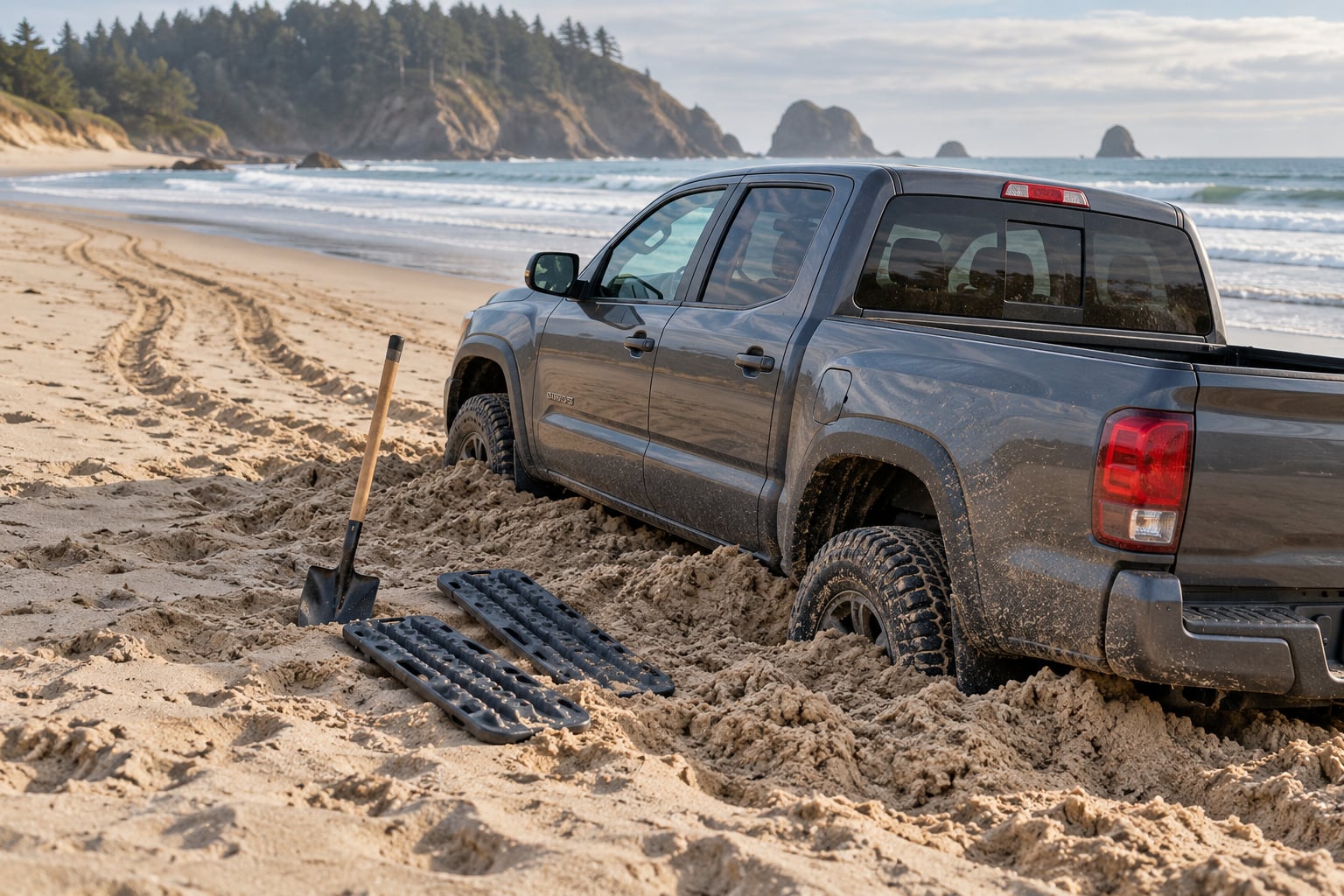
To get a truck out of sand, stop accelerating the moment you feel it bog down, air the tires down so they float instead of dig, clear loose sand from in front of and behind every tire and from under the frame, lay traction boards under the drive tires, then drive out in low range with smooth and steady throttle. Most extractions take 20 to 40 minutes. The ones that turn into an afternoon are the ones where somebody kept spinning the tires.
I have watched this go wrong more times than I care to admit. The truck slides sideways into a dune face, the driver leans on the throttle, and twenty seconds later the frame rails are resting on sand that used to be a clean tire track. Nothing about that is recoverable by trying harder.
So here is the short version before the details. If you remember only five things, remember these.
- Stop. Take your foot off the gas the instant the truck stops moving forward.
- Shift to low range and neutral, then clear sand from in front of and behind every tire and off the undercarriage.
- Air the drive tires down to roughly 15 PSI on soft sand, lower on deep powder, but never low enough to unseat the bead.
- Put traction boards, mats, or boards under the drive tires and back up onto them.
- Use smooth throttle in low range and change direction only if nothing is happening after a full attempt.
Full breakdown below, including what to do when you have no winch, no second truck, and no boards.
Table of Contents
- What You Need
- Step-by-Step: How to Get a Stuck Truck Out of Sand
- 1. Stop and Protect the Scene
- 2. Clear Sand From the Tires and Undercarriage
- 3. Release Tire Pressure for Better Traction
- 4. Create a Firm, Shallow Path
- 5. Use the Right Traction Method
- 6. Recheck the Truck and Prevent the Next Get Stuck
- Common Mistakes
- Spinning the tires
- Digging a deep hole
- Using the tow ball as a recovery point
- Burying the spare tire as a winch anchor
- Rocking forever and burying the vehicle
- Frequently Asked Questions
- Should I let air out of my tires when stuck in sand?
- What is the best tool for getting a truck out of sand?
- Can I use a tow strap or winch to pull my truck out?
- How deep can a truck get in soft sand before it will not recover?
- Is it safe to recover a truck on a beach or in a tidal marsh?
- When should I stop digging and call a professional recovery service?
- Conclusion
What You Need
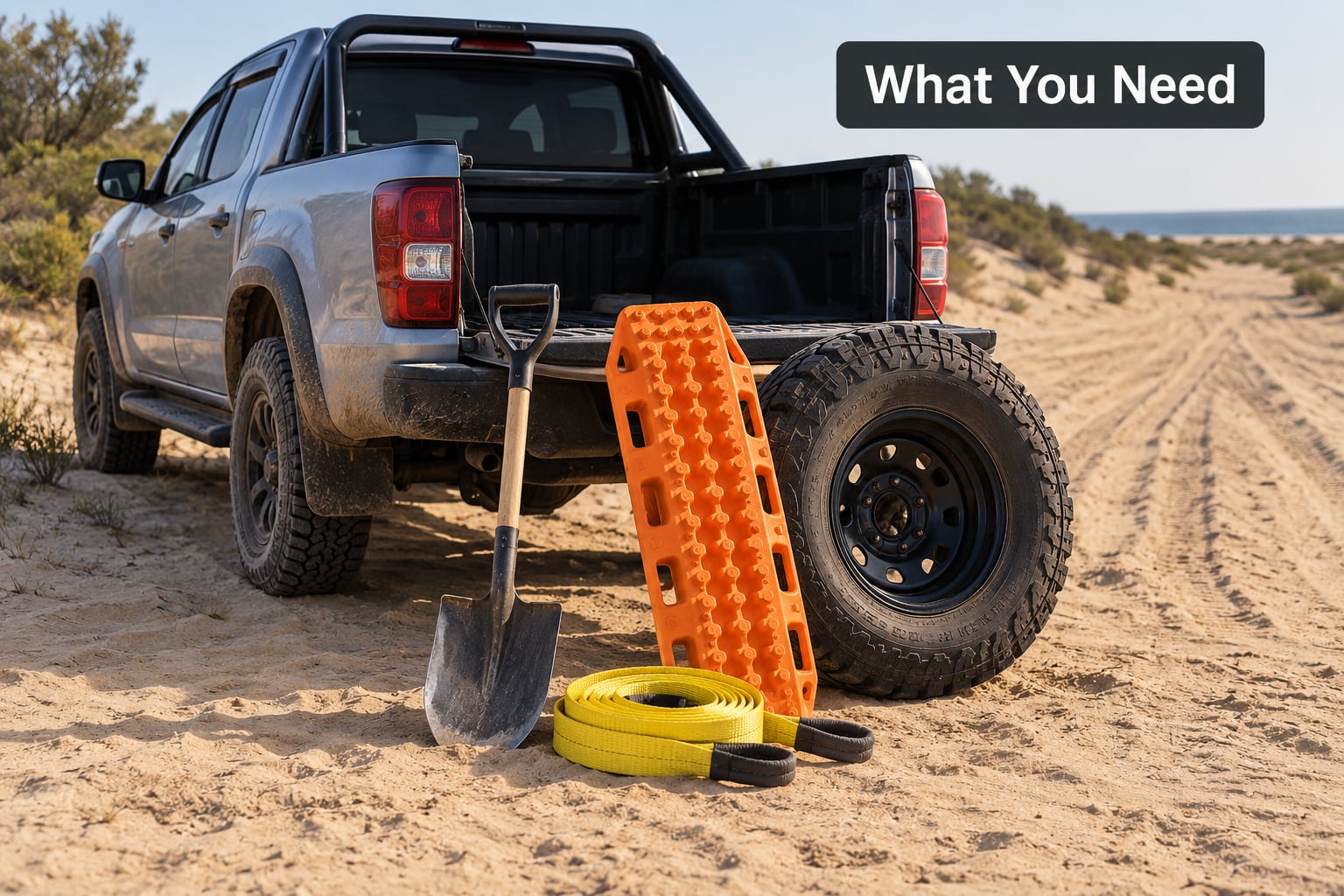
Recovery in soft sand is mostly preparation. Everything on this list is cheap, light, and fits in a single bag, and every one of them saves you from an hour of digging.
- A portable air compressor. You cannot get unstuck in sand without dropping tire pressure, and you cannot re-inflate on hard ground without a compressor. Truck bed hangers and glove-box compressors move roughly one tire a minute, which is plenty. Bring a pencil-style gauge too, not just the compressor gauge, so you can check all four.
- Traction boards or recovery tracks. Wide ramps with molded teeth. They are the single highest-return piece of recovery gear. If you own one set, make them two boards, because you need to catch two tires at a time.
- A long-handle shovel. Not a folding camping trowel. You will move several hundred pounds of sand, and the handle is what saves your back. A square-blade shovel shapes a ramp; a pointed one digs a hole, which is the opposite of what you want.
- Gloves. Sand gets into everything, and your hands will be buried in it for half an hour.
- A tow strap with rated shackles, if you travel solo or far from help. Never a rope, never a bungee, and never a strap with no working load rating printed on it.
- Water and a spotter. Water for you, and a second person whose only job is to watch where you are going.
Unload before you dig. Every passenger and every box of gear you can move out of the bed or cab is weight that no longer has to be carried up the ramp you are about to build. On a soft dune, that difference is often the whole recovery. Anglers and hunters will recognize this one, since a wet cooler and a couple of rods can easily add 150 pounds to the rear axle where the digging is happening.
One more piece of prep that costs nothing: know where the factory recovery points are before you need them. On most trucks they are two forged loops low on the frame rails, sometimes hidden behind a plastic cover. Know where the tow ball is too, because that is the one part of the rear end you will never use for recovery.
Step-by-Step: How to Get a Stuck Truck Out of Sand
1. Stop and Protect the Scene
Put it in park, or in neutral with the brake set if you are on a slope, and take your foot off everything. The instinct to feather the throttle is exactly what digs the hole deeper, because each spinning tire carves a wider and deeper crater and the truck settles into it a little further.
Once the wheels stop, engage the parking brake and shut the engine off while you think. Now check the basics: is anyone behind the truck or below it, is there traffic on the ramp above you, and is there a tide coming in?
That last question matters more than most drivers expect. Sand near water often slopes toward the sea, which means your easy escape route may be downhill and underwater. If you are on a beach, check the tide tables on your phone before anything else. If water is closing in, speed beats technique, and you skip straight to the most aggressive option you have.
Engage four-wheel drive and shift into low range now if you have it, leave it there for the rest of the recovery, and stay out of traction control. Traction control cuts throttle the moment a wheel spins, which is precisely the torque you need to climb out.
2. Clear Sand From the Tires and Undercarriage
Dig out from in front of AND behind all four tires. The front matters because that is the ramp the tire has to climb; the back matters because loose sand behind the tire is what keeps the tread from biting as you pull forward.
Then check underneath. If the frame rails or the belly pan are resting on sand, no amount of traction will help, because the tires are already carrying no load. Feel along the underside with the shovel handle, or lower a jack onto a board and look underneath from the side. On the Expedition Portal self-rescue threads, drivers describe exactly this check as the moment they realized the pressure trick alone was finished.
While you have the shovel out, look for what caused it. A rock, a buried log, a shell layer, or a hard pan that the tires punched through on the way in will defeat every traction method you own. If you find an obstacle, clear it or change your exit line.
Dig shape matters. Cut a shallow ramp at maybe a 15-degree slope, wider than the tires. Do not excavate a deep pit, because a deep pit leaves the truck sitting lower than firm ground all around it.
3. Release Tire Pressure for Better Traction
A tire at road pressure behaves like a wedge and slices into sand. Air it down and the same tire becomes a wide, flat contact patch that floats on top of the sand. This is the single most important step, and it is the step most people skip because they have no idea how low they are allowed to go.
The headline number for soft sand is about 15 PSI. Real drivers report far more range than that. In the forum threads that still rank for this query, you will see 10 PSI on a dig-out, 8 PSI as a long-term desert-camper cruising pressure, 5 PSI on deep powder, and one beach escape at genuinely negative readings on the gauge.
| Surface | Pressure range | Notes |
|---|---|---|
| Packed track, hardpan, firm beach near the waterline | 25 to 30 PSI | Close to road pressure. Only drop enough to feel a difference. |
| Damp, firm beach sand | 15 to 20 PSI | Wet sand holds weight well, so it tolerates more pressure and clings to tires less. |
| Soft dry sand, dune faces | 10 to 15 PSI | The most common extraction scenario and the most forgiving. |
| Deep powdery sand, ruts that collapse | 6 to 10 PSI | Watch the bead. Below roughly 5 PSI the tire can unseave on the rim. |
Drop the drive tires first, since those do the work. If you can, match the others so the truck sits level and does not lean into one rut and dig it further.
Now the part nobody explains properly. If your truck is bellied out, resting on the frame rails with the axles off the ground, pressure changes do nothing. The wheels are not carrying the vehicle, so lowering them just flops the tire out to the side and spits sand. When that happens, extra lift, a ramp, or a second vehicle are the only options, and lowering pressure further is wasted effort.
Re-inflate to your door-jamb pressure as soon as you are back on hard ground, and drive slowly to the tire shop either way. Running at 5 PSI bends the rim on side impacts, and running them soft on pavement at highway speed overheats the sidewalls. Slow and straight for the first few miles.
4. Create a Firm, Shallow Path
The sand already in front of your rear tires is the best traction surface you have, because it has already been compacted by your own weight. Back out along your original ruts rather than trying to power straight ahead.
Reverse along the tracks, then forward, then reverse again, without throttle. Each pass presses the loose sand down harder. On a slope or a beach that is how you get a real track instead of a pair of new holes.
If you have to shape the sand by hand, build a shallow ramp rather than digging down. The error most beginners make is thinking deeper means better, and it means the opposite: every foot you dig lowers the truck further into a pit that you now also have to climb out of.
Clearing your exit line matters too. Look five vehicle lengths ahead and make sure it climbs gently to firmer ground. Reversing out to a better position costs nothing and sometimes saves the entire recovery.
5. Use the Right Traction Method
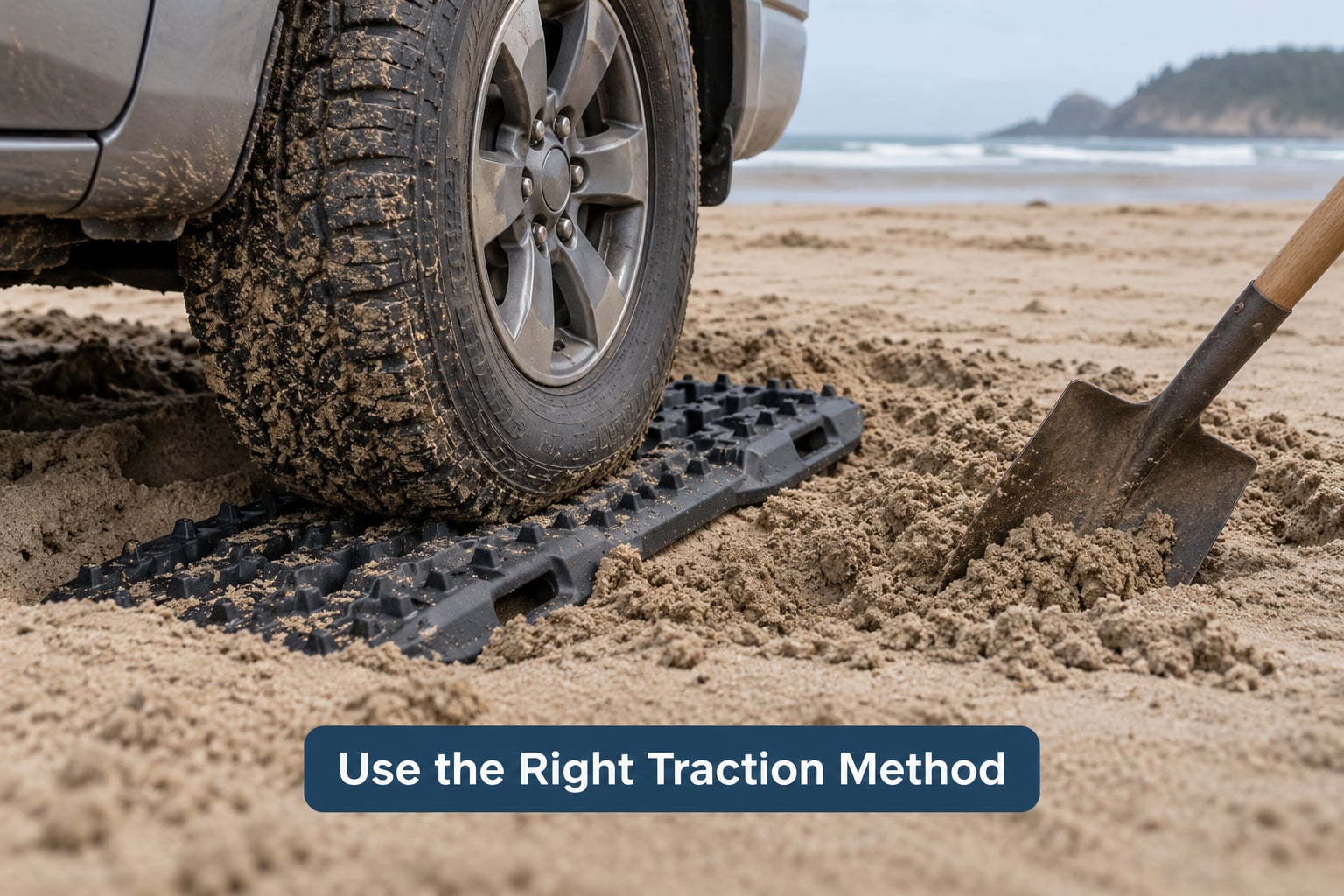
Work up this list in order and stop at the first thing that moves the truck. Escalating out of order is how trucks get destroyed.
- Clear, low pressure, and momentum. Sometimes the answer is simply that you dug enough, aired down enough, and now need steady throttle instead of panic. Build speed on hard ground and carry it into the sand.
- Traction boards. Slide a board under the drive tire, back the tire up onto it until the teeth sit under the tread, then drive forward onto the second board.
- A board strapped across the tread. Strap a short length of board or a length of log to the tire so it sticks out on both sides, then paddle forward. It works when a board cannot get under a tire that is buried too deeply, and MaverickTruckClub has a write-up of a driver who climbed a hill this way on factory suspension.
- Rocking between drive and reverse. In low range, alternate a few feet forward and a few feet back. This compacts the bed of the rut. Limit yourself to four or five cycles; if it is not working by then, it is not going to work.
- A second vehicle. A strap from a second truck’s frame recovery point to yours, both in low range, taking the strain slowly. This is the correct use of a tow strap.
- A winch. Slow, steady line tension onto a proper anchor. If you have one, this is where it gets used, not sooner.
- Professional recovery. The moment you are out of daylight, out of air, out of water margin, or tired.
If you have no boards, no winch, and no second vehicle, you still have options. A folding ladder laid flat works as a sand ladder. A sheet of plywood or a plank works as a ramp. Thick carpet, cardboard, or rubber doormats cut to shape have all worked in the field. A log or a length of 2×4 strapped to the tire is the last-resort version of the same idea.
Water counts as a tool too. Pouring water in front of the tires firms the surface and can create a hard pan for the tread to push against. Carrying a few gallons is cheap and it works surprisingly well on damp sand, where it fills air pockets.
Which method fits depends almost entirely on your drivetrain.
| Drivetrain | Best technique | Watch out for |
|---|---|---|
| 2WD / rear-wheel drive | Momentum and shallow ruts. A single straight pull from firm ground, boards under both drive tires. | Spinning one tire digs a hole and stops all forward progress. Straighten the wheel before every attempt. |
| AWD | Same as 2WD, plus you can rock between front and rear to work different tires. | AWD systems still have a torque limit. It is not a locker and it will not save you. |
| 4WD, high range | Engage 4WD, traction control off, steady moderate throttle. | Do not hammer it. High range spins tires fast and buries them. |
| 4WD with low range and lockers | Lock front and rear differentials, low range, gentle rocking. | With lockers engaged, keep straight lines. Any steering input makes the front axle fight itself. |
One trick that transfers work to a gripping tire: on a vehicle that spins one wheel, some drivers lightly tap the brake while holding a little throttle. The loaded, non-spinning tire then carries the work instead of the spinning one. It is a last-ditch nudge, not a technique.
6. Recheck the Truck and Prevent the Next Get Stuck
Once you are moving, do not accelerate hard through the transition. Get back to firm ground on a straight line and slowly.
Then inspect. Check the undercarriage for anything you dragged, look at all four tires for cuts and bulges, and confirm the bead is still seated. Check oil and coolant underneath the truck, because a long dig at low speed can heat things up. Then test the brakes and steering at walking pace before you rejoin a route.
Prevention is the part that matters most for anyone reading this on public lands or a beach. Carry your speed into soft sand and lift off rather than spinning, which experienced drivers across the van and overland forums repeat more than any other single piece of advice. Pick the high and dry line across a wet flat, since damp sand near the water holds far more weight than the dry stuff up the berm. Air down before you enter soft sand, not after you are in it, and stay well ahead of the tide. Know your route and carry enough air to fix a flat twice over.
And the simplest habit of all: stop the moment you feel the bog. Every forum thread on this subject says the same thing in different words. The time you save by stopping early is the whole recovery.
Common Mistakes
Almost every bad sand recovery is self-inflicted. Here are the five that come up most often, and what to do instead.
Spinning the tires
This is the big one. A spinning tire excavates its own hole, and every second of wheelspin makes the next attempt harder. Correction: stop, dig, and try again. Straighten the wheels before each pull, feather the throttle, and give the truck time to move rather than leaning on it.
Digging a deep hole
People assume they need to excavate down to the tires. You do not. You need a shallow ramp up to firm ground and empty space around the tread. Correction: dig a wide ramp at a gentle angle, and dig away from the truck rather than underneath it.
Using the tow ball as a recovery point
The tow ball is a hitching point, rated for loads in tension along the tow axis. It is not a recovery point, and under a snatch load it becomes a projectile. Correction: use the factory recovery points on the frame rails, or a rated bow shackle in a designed anchor point. Keep people clear of the strap line in any case.
Burying the spare tire as a winch anchor
This one looks clever and fails constantly. A shallowly buried tire simply pulls out of the sand, taking your winch cable with it. Correction: if you are winching, use a tree with a tree saver strap or a buried anchor with enough depth and packing to hold, and only if you are trained to do it. Otherwise, call for help.
Rocking forever and burying the vehicle
Four cycles back and forth is a legitimate technique. Twenty cycles is just churn, and it packs you into a trough. Correction: set a limit, and when you hit it, escalate properly to boards, a second vehicle, or a winch instead of repeating the same attempt.
Two smaller ones worth naming. Rushing a beach extraction with the tide coming in gets people hurt, so check the tide table before you start. And trying to rock a manual-transmission truck while riding the clutch will cook the clutch, which costs far more than a recovery ever would. Use the clutch, use low range, and change gear.
Frequently Asked Questions
Should I let air out of my tires when stuck in sand?
Yes. Dropping pressure widens the contact patch so the tire floats instead of slicing into the sand. Around 15 PSI is the usual target on soft sand, 10 PSI or lower on deep powder, and closer to road pressure on packed or damp firm sand. Check all four tires, and remember that a bellied-out truck gains nothing from extra air loss because the tires carry no load.
What is the best tool for getting a truck out of sand?
Traction boards are the best single tool, and a long-handle shovel is the best partner. Boards give the tread a rigid surface to bite against instead of loose sand, and the shovel lets you clear the ramp in front of and behind the tire. A portable air compressor matters just as much, since without one you cannot re-inflate after the run. Most drivers recover with boards, a shovel, and a compressor alone.
Can I use a tow strap or winch to pull my truck out?
A tow strap between two vehicles works well when both use rated frame recovery points and pull slowly in low range. Never attach to a tow ball, a bumper, or a plastic trim cover. A winch works with slow steady line tension and a proper anchor, and becomes the right answer once digging and boards have failed. Keep everyone well clear of a loaded strap line, since it can snap.
How deep can a truck get in soft sand before it will not recover?
There is no fixed depth, because the deciding factor is whether the frame rails or belly are resting on sand. If the truck is bellied out, the tires carry no load and lower pressure will not help at all. If the axles are still clear of the sand and the surface under the chassis is firm, most trucks walk out. If the frame is on soft sand, you need lift, a ramp, or a second vehicle.
Is it safe to recover a truck on a beach or in a tidal marsh?
It can be, but tide timing decides the outcome. Wet sand near the waterline is firmer and easier to drive on than dry sand up the berm, yet it also means water arrives faster. Check the tide table before you start, work on the firmest sand you can, and never let the truck sit while you dig. A marsh or tidal flat with soft mud under it is a poor place to learn a recovery.
When should I stop digging and call a professional recovery service?
Stop and call for help when you are out of daylight, out of air for the tires, close to water with the tide rising, too tired to work safely, or when the truck is bellied out in soft sand with no second vehicle. Also stop if you have damaged the undercarriage, or if the only remaining option is pulling against the tow ball. A recovery bill is cheaper than a winched truck on its side or a ruined clutch.
Conclusion
The fastest sand recovery is the one you start before the truck sinks any further. Stop the wheels the moment you feel the bog, secure the area and check the tide, clear sand from in front of and behind all four tires and off the undercarriage, air the drive tires down to roughly 15 PSI, then add traction boards and drive out in low range on smooth, steady throttle.
Do not escalate force before you assess risk, because force is what digs you deeper. Work the least aggressive method that can do the job, and when it runs out, step up to a second vehicle or a winch rather than spinning. If you find the frame rails resting in soft sand, extra lift and a ramp are the only things left, and calling for help is a perfectly good answer.