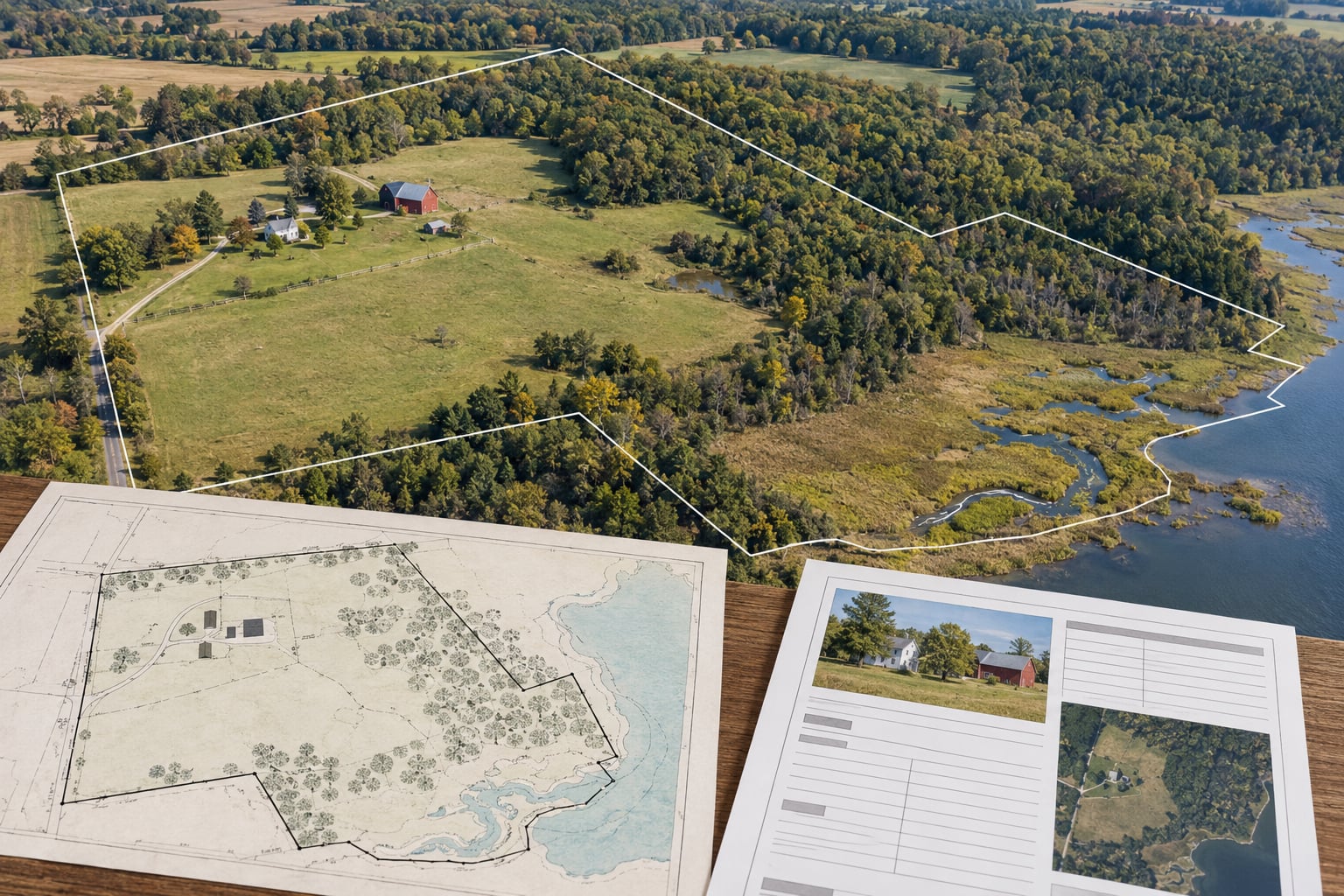
A conservation easement restricts what you can build on your land. It does not, by itself, lower your property tax bill, create an exemption, or transfer the bill to the land trust holding it. You keep paying. Any reduction you eventually see has to come from the county assessor, and that only happens in some states and some counties. Here is how the four separate taxes actually interact.
A conservation easement is a voluntary, typically perpetual agreement recorded against a property, where the owner gives up or limits certain development rights in exchange for protecting the land’s conservation values. Ownership stays with you.
- Property tax. Paid by you, to your county and any special districts. The easement may influence the assessed value, but it never creates an automatic reduction.
- Federal income tax. A charitable deduction for the value of the rights you gave up, claimed under Internal Revenue Code Section 170(h). This is the benefit most people mean when they say an easement “saves you taxes.”
- State income tax credit. A separate credit against state income tax in participating states, often calculated as a percentage of your property taxes paid on the eased land.
- Estate tax. A reduction in the value of land included in your taxable estate, since the land can no longer be developed or sold at its development potential.
Only one of those four is the bill the treasurer sends you. Owners who expect the property tax bill to shrink after signing are usually disappointed, and a few end up paying more.
Table of Contents
- How Conservation Easements Affect Property Taxes
- Can a Conservation Easement Lower the Assessed Value?
- Why a Lower Assessment Does Not Always Mean a Lower Tax Bill
- What Property Taxes Usually Continue After an Easement
- Will a Conservation Easement Affect Property Taxes for the Heirs?
- How the Easement Terms Affect the Tax Outcome
- State Tax Benefits and Exemption Programs
- Can a Conservation Easement Eliminate Property Taxes?
- Why Some Conserved Lands Still Have Large Tax Bills
- How to Estimate the Tax Impact Before Signing
- What Documents to Ask the County or Easement Holder For
- When to Ask a Tax Professional for Advice
- Frequently Asked Questions
- Are conservation easements tax deductible?
- Does donating a conservation easement stop property taxes?
- Are conservation easements federally tax deductible?
- How often is land appraised after a conservation easement?
- Who pays property taxes on land under a conservation easement?
- What to Verify First Before Accepting an Easement
How Conservation Easements Affect Property Taxes
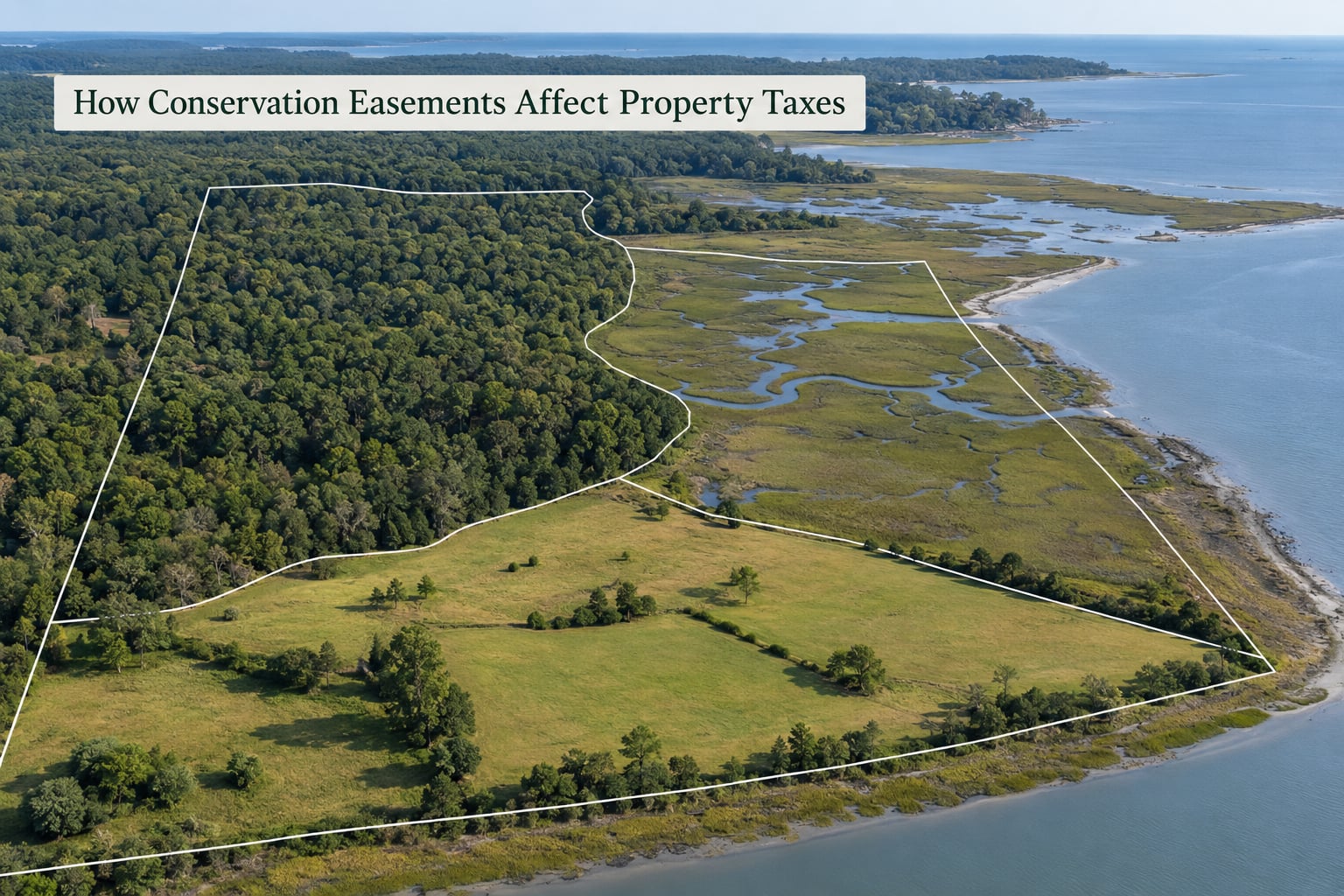
How conservation easements affect property taxes comes down to four separate moving parts, and the easement is only one of them. Keep them apart and the confusion disappears.
- The easement. A contract between you and the holder, usually a land trust or government agency. It binds you, not the assessor.
- The assessment. The assessor’s estimate of market value, or of use value where your state offers that option.
- The rate. A millage set by your county, municipality, school district, and any special district covering the parcel.
- The bill. Assessment multiplied by rate, then adjusted for exemptions, homestead caps, and district overlays.
Restricting development can make land less valuable on paper. Whether that drop shows up in the assessment depends on the assessor, the state statute, and how recently the parcel was reappraised. The easement deed itself does not bind the assessor’s office, which is why land trusts and their staff routinely tell owners to model the property tax effect with the county before signing anything.
Can a Conservation Easement Lower the Assessed Value?
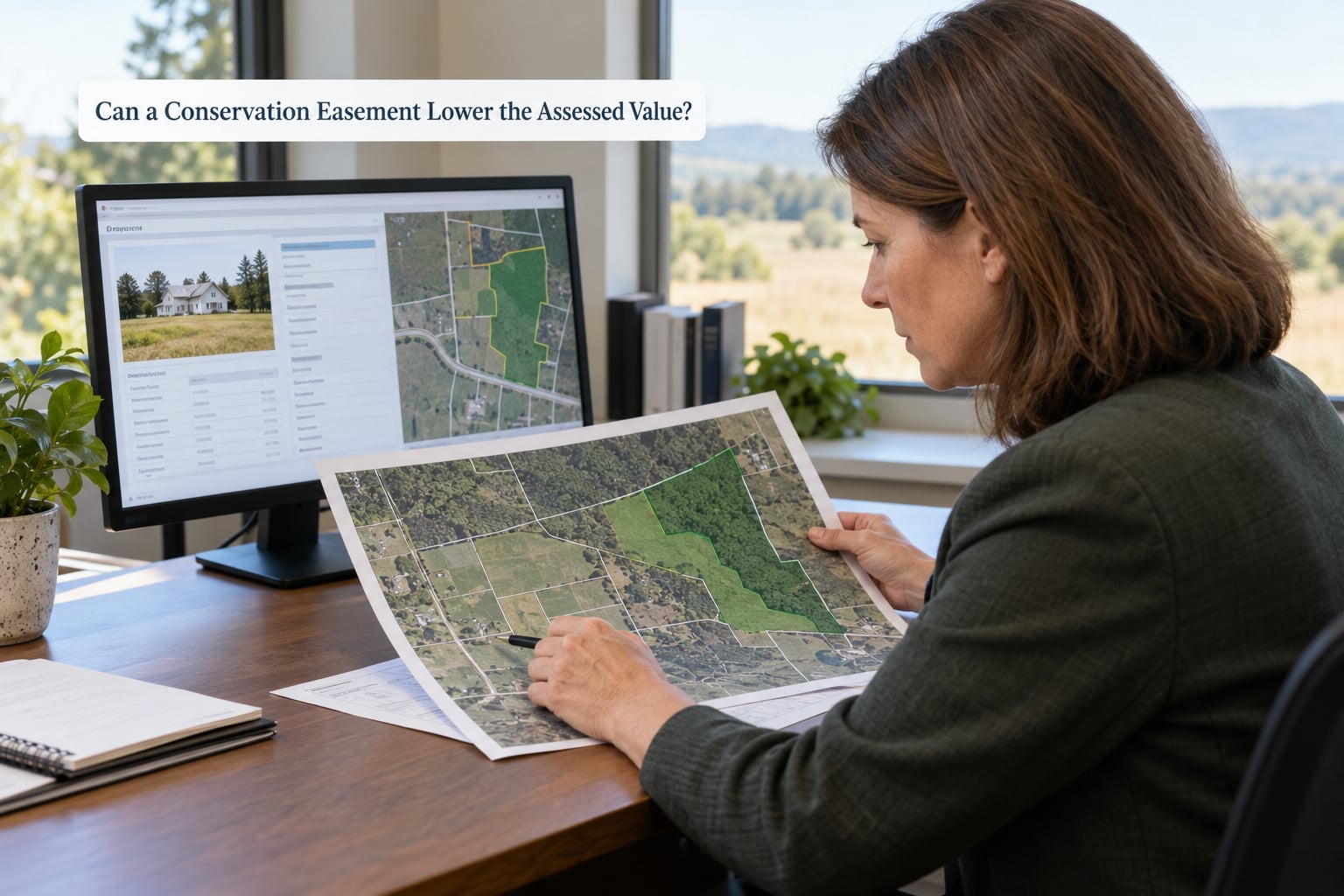
Yes, it can, and in the states that assess land on its highest and best use it often does. But there is no national rule requiring an assessor to reflect an easement, so two neighboring parcels with similar restrictions can get opposite outcomes.
The restrictions that tend to move value most are the concrete ones: an end to subdivision, a cap on the number of dwellings, limits on impervious surface or road construction, or a prohibition on commercial uses. Those take development potential off the table, and development potential is usually what an assessor is pricing.
Open-space, scenic, or wildlife language tends to carry less weight with an assessor on its own. Preserving a view is not the same as removing the ability to build a subdivision, and some assessors treat the two very differently.
Why a Lower Assessment Does Not Always Mean a Lower Tax Bill
A lower assessment is a valuation decision. A lower bill is a separate decision made afterward, and other rules can absorb the reduction before it reaches your checkbook. Homestead caps, senior exemptions, district levies layered on top of the county rate, and a school district that raised its millage for unrelated reasons all have the power to wipe out a modest decrease in assessed value.
Two neighbors can see the same restriction and get different bills because they sit in different school districts. Treat the valuation change as necessary but not sufficient, and model the actual bill with the district rates that will apply in your assessment year.
What Property Taxes Usually Continue After an Easement
All of them, in the ordinary case. The obligation runs with the land, and the easement holder has no duty to pay it. Expect to keep paying:
- Taxes on the land itself, at whatever assessment the county applies
- Taxes on the house, barn, and any other improvements, which are usually assessed separately from the acreage
- Levies from every district that touches the parcel, not just the county
- Any exemption clawback triggered by a change in use or ownership
That last point catches people. A parcel that was receiving an agricultural, forestland, or habitat classification under a use-value program can lose it, and the reassessed land value can be multiples of what it was.
Separately from taxes, conserved land carries holding costs: liability insurance, boundary and vegetation work, annual monitoring visits by the holder, and sometimes a stewardship endowment contribution. Those are real costs of the arrangement, but they are not property taxes, and folding them together in a rough estimate makes the whole picture harder to read.
Will a Conservation Easement Affect Property Taxes for the Heirs?
Yes, and heirs usually notice it later than the grantor did. The assessment generally carries over to the new owner, but a preferential classification held by the original owner may not. An heir who inherits 200 acres of formerly assessed farmland and finds it taxed on open-market value has a real and unpleasant surprise waiting.
State credits are the other loose end. A credit claimed by the original owner is not automatically available to whoever inherits the land, and some states recapture benefits when property changes hands. Ask your state’s revenue department how the specific program treats transfer.
How the Easement Terms Affect the Tax Outcome
The tax consequence follows from what the document actually restricts, and what it lets you keep.
- Duration. A perpetual easement is the most valuable to a holder and is the most common. Shorter terms exist, but most land trusts and most state programs require permanence.
- Scope of restrictions. Narrow restrictions on subdivision and structures produce a clearer valuation story than broad scenic language.
- Reserved rights. Reserved forestry, agricultural, or grazing rights can support a use-value classification, which matters far more to your bill than the conservation language does.
- Public access. An access clause can affect value slightly and may interact with local liability and liability-insurance requirements.
- Holder type. Government and qualified nonprofit holders open different programs; a private holder may qualify for none of them.
- Termination and amendment clauses. A savings clause protecting the holder against extinction for tax foreclosure or condemnation is standard, and it tells you what happens to the land if the owner stops paying.
State Tax Benefits and Exemption Programs
Many states run programs that reassess land on its current use rather than its development potential: farmland, forestland, wildlife habitat, open-space, and conservation easement programs of their own. What the easement grants you is access to a program, not the benefit itself.
Depending on the state, the benefit may take the form of a preferential assessment, a reduced millage on open-space land, a local exemption, or a credit against your state income tax. Some credits are calculated as a share of the property taxes you already paid on the easement acreage, which means the two mechanisms stack: lower bill, then credit on what remains.
Programs change often, and caps, application windows, and documentation rules move with them. Check your state revenue or tax department’s current pages as of 2026 rather than relying on an article, including this one.
Can a Conservation Easement Eliminate Property Taxes?
Not through a private conservation easement. Donating development rights does not make land tax-free, and no land trust will take over your property tax bill as part of the deal.
The limited exceptions all involve public law rather than the easement itself: land owned outright by a government body may be exempt under statute, certain tribal trust land is exempt under federal law, and a few states grant specific exemptions to qualifying holders. Those are narrow situations with narrow documentation, not something to plan an ordinary farm or forest around.
If someone tells you an easement will zero out your property tax, that is the signal to slow down and ask questions.
Why Some Conserved Lands Still Have Large Tax Bills
Conservation status and bill size are only loosely connected. Several ordinary explanations account for the owners who are surprised by what they still owe:
- Scale. A 1,500-acre tract with a small assessed value per acre can carry a bigger bill than a much smaller property in a high-value county.
- Frontage and improvements. Coastal, riverfront, or view parcels carry premiums that survive the restriction, and buildings are assessed on their own.
- Milleage. Counties and school districts with high rates, plus fire, drainage, or recreation district levies, can produce five- and six-figure annual bills on acreage nobody would call valuable.
- Rate increases. Districts fund budgets independently of your easement. A rising school millage raises your bill even as your assessed value falls.
- Prior classification. Land already assessed at use value has little room to fall further, so the restriction changes nothing on the bill.
- Multiple parcels. A conservation corridor bought in pieces over years can leave a landowner holding several separately assessed parcels with separate district lines.
None of these are unusual, and none of them are fixed by the easement deed.
How to Estimate the Tax Impact Before Signing
Work through this in order, before signature, not after.
- Get the actual proposal. Read the draft easement and its baseline documentation report so you know the specific restrictions on this parcel, not the generic description.
- Get the baseline appraisal. This is the qualified appraisal of the property before the restrictions apply. You need it for the income tax deduction anyway, and it anchors the before-and-after comparison.
- Compare before and after. Ask the appraiser for the post-restriction value estimate too, and separate the land from the improvements in both figures.
- Ask the assessor in writing. Request an informal assessment review, and get it in writing. A phone call is not a record; a letter is.
- Identify every taxing district. The parcel’s school district, county, municipality, and any special districts, each with its current millage.
- Model the state program. If your state has a conservation easement credit or a use-value program, calculate what it would pay under today’s rules, and check the annual cap.
- Note the appeal window. Find out when the next reassessment cycle falls and what deadline applies to contesting it. Owners who miss the window often cannot recover the difference later.
What Documents to Ask the County or Easement Holder For
Before you sign, you should be holding or able to request all of these:
- Your current tax bill and the last three years of them
- The parcel’s assessment history, including the year of the last full reappraisal
- Assessment acreage broken out by land use, so you can see how much is classified and how much is not
- Taxing district boundaries and the current millage for each district
- Any existing classification certificate, such as farmland, forestland, or habitat enrollment
- The proposed easement text and the baseline documentation report
- The baseline appraisal and any updated before-and-after valuation
- Any state or local application forms required for the credit or exemption you are counting on
- The county’s informal assessment review procedure and its deadline
If the land trust cannot tell you which of those documents will exist after the grant, that is worth asking about directly before you commit.
When to Ask a Tax Professional for Advice
Bring in a qualified appraiser for the deduction valuation, and a CPA or Enrolled Agent for the income tax filing and any state credit. Add a tax attorney or land attorney when the structure is unusual.
Get help sooner rather than later if the property spans more than one county or district, if you operate a commercial or agricultural business on the land, if the parcel depends on a specialized state program, or if the estate is large enough that federal estate tax is in play.
One warning. In the 2010s, promoters ran syndicated conservation easement schemes that generated billions in deductions from inflated appraisals and produced a wave of Tax Court cases; the IRS has settled several of those claims. Red flags include anyone promising a fixed deduction regardless of the appraisal, pressure to close quickly, and a valuation significantly higher than the sale price of the development rights. The gap between what you were paid and what someone deducts is a frequent audit trigger.
None of this is tax advice for your parcel. Rules and rates vary by state and county and change, so treat it as a map and verify locally.
Frequently Asked Questions
Are conservation easements tax deductible?
Partly, and the answer depends on which tax you mean. A donation of a conservation easement to a qualified organization can produce a federal charitable contribution deduction under Section 170(h), limited to 50 percent of adjusted gross income, or 100 percent for qualifying farmers, with a 15-year carryforward. Participating states offer separate income tax credits. None of that is a property tax reduction. Many states also run separate programs that reassess land at use value, which is where any change to your actual bill would come from.
Does donating a conservation easement stop property taxes?
No. You still receive the property tax bill after the grant. The easement restricts land use; it does not create an exemption and does not move the obligation to the land trust. The bill can drop if the county assessor reflects the loss of development potential in the assessed value, or if your state offers a use-value or open-space program you qualify for. Some owners instead see the bill rise when a preferential classification is lost or a district rate increases. Model the number with the county before signing.
Are conservation easements federally tax deductible?
Yes, when the easement is granted to a qualified organization and is perpetual, with no prohibited uses such as commercial harvesting or industrial activity. The deductible amount is generally the difference between the property’s fair market value before the grant and its value afterward. The taxpayer must obtain a qualified appraisal and file the standard charitable contribution forms, and the deduction must be reduced by any state credit received for the same easement. Appraisal rules have tightened considerably and the IRS is auditing older transactions.
How often is land appraised after a conservation easement?
It depends on the county, not the easement. Many jurisdictions reassess every year, others on a multi-year cycle, and a few only on a sale or a change in ownership. Some states set minimum reassessment intervals. If the parcel is inside a cycle, the restriction may not reach your bill for several years. That timing is why owners are told to check the reassessment schedule and the appeal deadline before signing, since the window to contest a value is short and often passes unnoticed.
Who pays property taxes on land under a conservation easement?
The owner does, in virtually every case. The easement holder, whether a land trust, nonprofit, or government agency, has no obligation to pay property taxes on land it does not own. The bill runs with the land, so a buyer or heir assumes it. What changes with a transfer is usually not the assessment itself, which often carries over, but the preferential classification or state credit the previous owner used, which frequently does not. Ask the county and the state revenue department about that before closing.
What to Verify First Before Accepting an Easement
Start with the county assessor, and start before you sign. Ask, in writing, how the specific parcel would be assessed under the exact restrictions proposed, including what happens to any current classification, and what your district rates would do to the bill.
Then put that answer next to a qualified appraisal’s before-and-after figures. If the two do not line up, you want to know that now, not at the first reassessment five years out.
Everything else, the federal deduction, the state credit, the estate effect, is secondary to that one question: what will this land actually be taxed, in this county, under these terms.