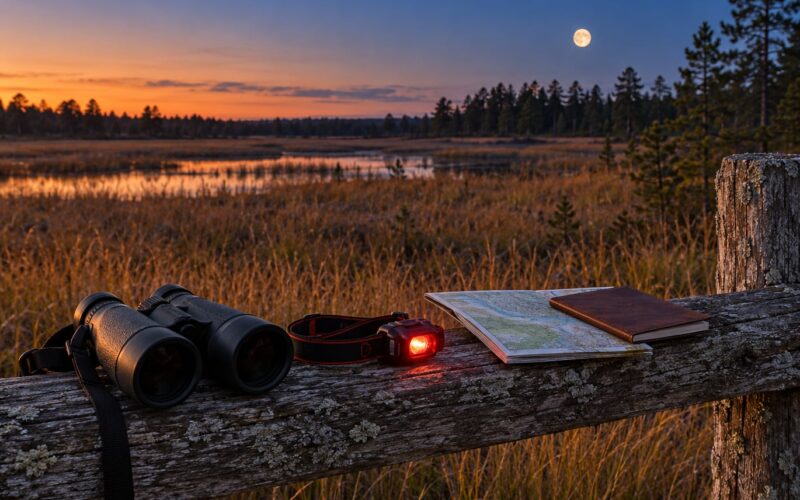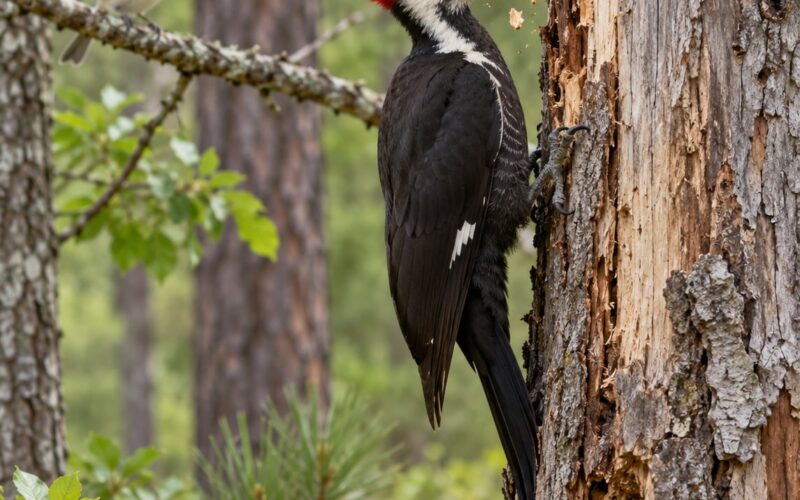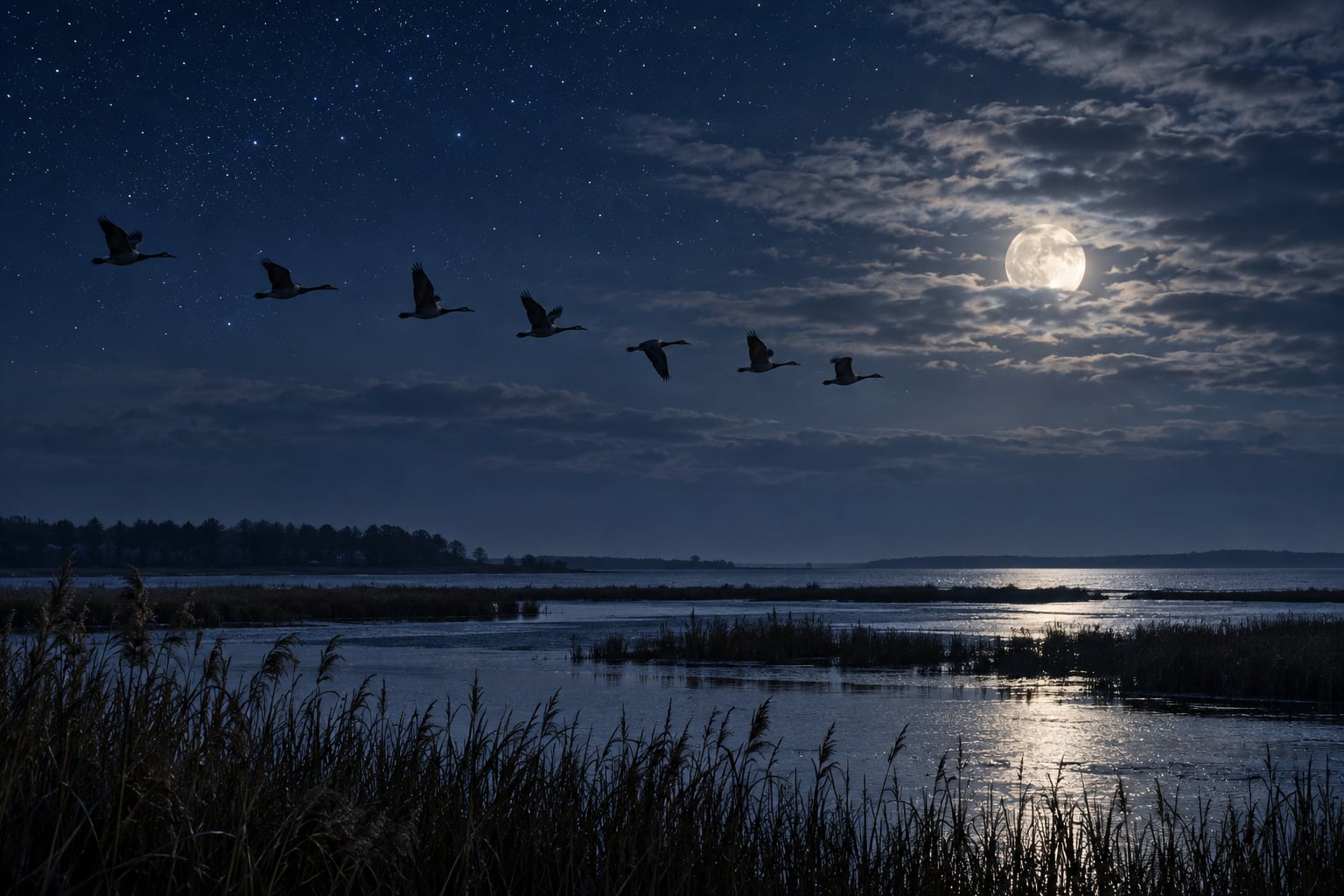
The short version: some birds migrate at night because darkness is cheaper, safer and easier to steer by than daylight. Warblers, thrushes, vireos and sparrows are the classic night fliers, while geese, cranes and most hawks do their migrating in daylight.
That split is not random, and it is the part most explainers skip. A 12-gram warbler crossing a continent and a 4-kilogram goose flying a flyway face completely different problems, so they solve them at different hours. Here is how the timing works, what a night migrant actually navigates with, and what you can hear and see from the ground.
Table of Contents
- Why Do Some Birds Migrate at Night?
- What Advantages Does Flying at Night Give Birds?
- Cooler, denser air that costs less to push through
- Daytime predators are mostly absent
- A star compass unavailable at noon
- Less insect traffic and no daytime turbulence
- How Do Birds Navigate During a Night Migration?
- Why Do Some Birds Migrate During the Day Instead?
- Does Weather Affect Why Birds Migrate at Night?
- How Can Birders Spot Nocturnal Migrants?
- Frequently Asked Questions
- Why do some birds migrate at night but others fly during the day?
- Do all migratory birds fly at night?
- How does the moon affect bird migration?
- Can you hear birds migrating at night?
- Do birds get lost on cloudy nights?
- How long can birds fly in one migration journey?
- Conclusion
Why Do Some Birds Migrate at Night?
Most nocturnal migrants are small, insect-eating songbirds, and they choose the dark for three connected reasons: night air is cooler and steadier so flying costs less energy, daytime predators are off the hunt, and the starry sky rotates around one fixed point that works as a compass. Different species lean on different reasons, which is why birds flying at night sound and behave nothing alike.
- Cheaper air. Cool night air is denser and less turbulent, so a bird spends less energy per mile.
- Fewer predators. Hawks, falcons and other hunters that chase small birds in daylight are roosting or hunting elsewhere by night.
- A usable sky. The stars around the celestial pole give a night migrant a directional reference that vanishes at noon.
- Calmer airspace. No thermals, no midday convective roughening, and far fewer insects to collide with.
- Fewer people. No traffic, no disturbance, no buildings full of people to avoid.
The advantage stacks up fastest for the smallest birds. A warbler weighs about as much as two sheets of paper, so every gram of fat it burns is a gram it cannot put into crossing water. It also has no business being visible in open sky above a hawk, which is why the night strategy shows up most often in the small species.
What Advantages Does Flying at Night Give Birds?
Cooler, denser air that costs less to push through
Warm air is thinner, and thin air is expensive. Birds crossing large distances at night are working in air that is denser and closer to the temperature their bodies can handle, which lowers the power needed to stay aloft. Day migrants also chase rising warm air, but that trick works only in daylight, so huge birds and soaring raptors gain more from flying high in the sun than from flying cool and calm at night.
Daytime predators are mostly absent
A perched Sharp-shinned Hawk can pick a warbler off a branch without lifting a wing. Take the same hawk at 2 a.m. and the hunting advantage largely disappears. Nocturnal migration removes the single largest source of mortality for small birds, at no cost to the migrant, since it is flying anyway.
A star compass unavailable at noon
The night sky turns around the celestial pole, the point in the northern sky where the stars appear to pivot. A bird that learns that axis keeps its heading for hours without checking anything else. Daylight washes that cue out entirely, so it only helps after dark.
Less insect traffic and no daytime turbulence
Insects are thickest near dusk and dawn and thin out overnight, and daytime convection makes the air choppy in ways that cost a small bird energy and balance. A night fly-through is a smoother, quieter corridor.
None of these is the reason on its own. Take the predator argument away and the energy saving still stands. Take the energy saving away and the star compass still argues for dark. The night wins because the benefits stack.
How Do Birds Navigate During a Night Migration?
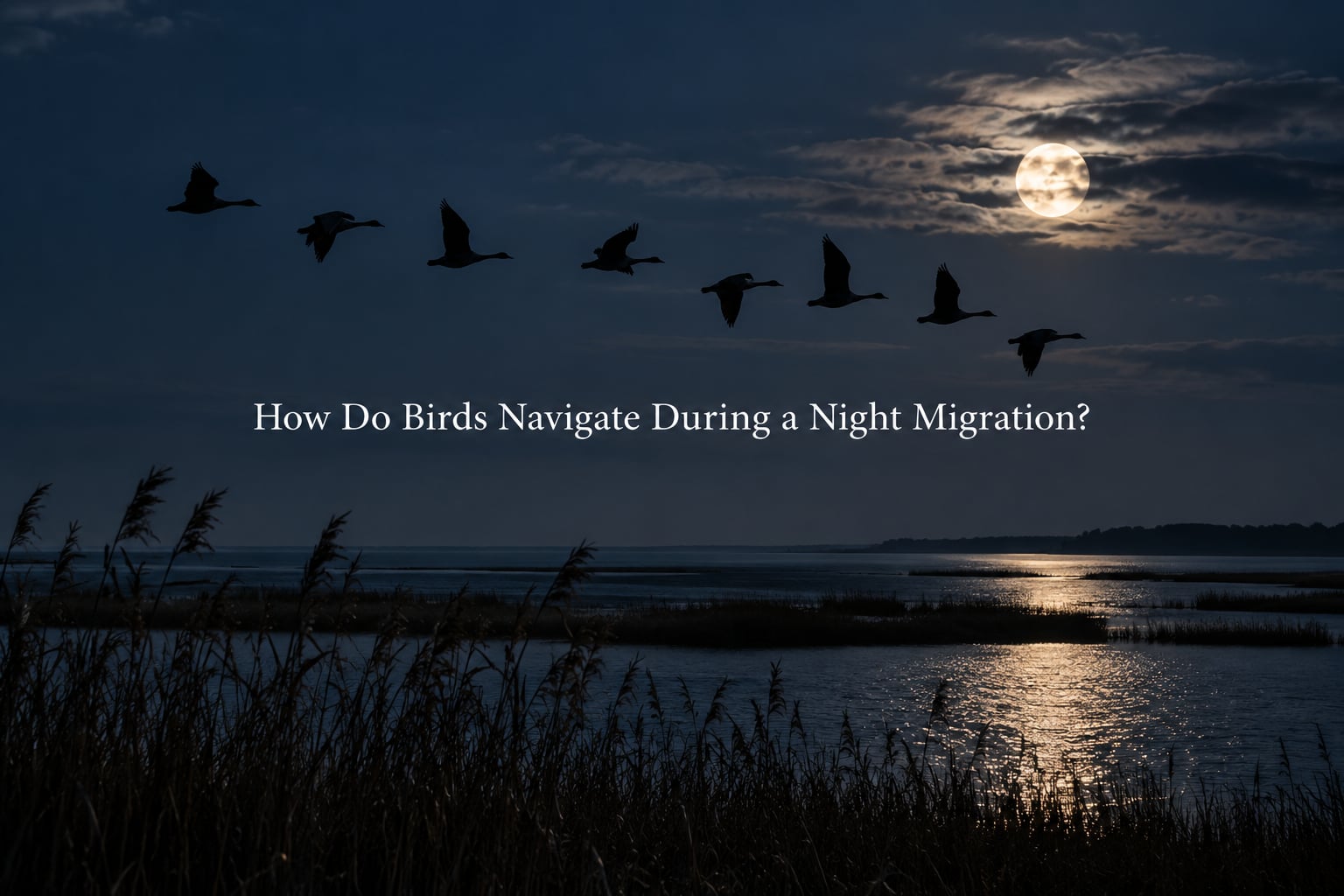
No single sense explains every species, and the honest answer is that most night migrants run several systems at once. Researchers have pieced together at least five.
The magnetic compass. Birds detect the Earth’s geomagnetic field, a sense called magnetoreception. It works day or night, in clear sky or thick cloud, which makes it the one navigational cue that never fails. How the sense is physically achieved is still argued over; the leading candidate involves iron-bearing particles in tissue connected to the optic nerve, so the eye may be doing double duty as a radar dish.
The star compass. Birds do not learn individual constellations. Experiments with rotated planetariums show migrants orienting to the star pattern around the celestial pole, effectively reading the rotation of the night sky as a compass bearing. Cloud cover degrades this but does not erase it.
The sunset line. Many species set their first heading from the bearing of the sunset on their first night out, then correct using the compass systems. Even a bird that spends the night flying has one reliable directional moment right after dusk.
Landmarks, wind and smell. Coastlines, mountain ranges and river valleys anchor the route. Birds also detect wind direction and speed, and some species, including petrels and shearwaters, use smell to find land or open ocean after dark.
Experience. A bird migrating for the first time inherits a rough compass and a rough map. Older birds return to specific wintering grounds and stopover sites they have used before, which is why experienced individuals make fewer navigational errors on unfamiliar routes.
Why Do Some Birds Migrate During the Day Instead?
Geese, cranes, plovers, swans and most migrating raptors move in daylight. So do a striking number of the birds most people picture as day fliers, including many shorebirds. There are three good reasons, and one of them is about size.
Soaring birds need rising air. A hawk or a vulture gains height in thermal currents that only exist under a sunlit sky, so daytime is the only time that strategy pays. Second, large birds navigate visually. A goose crossing fog or darkness has no way to find a coastline it can see from 2,000 feet, so it flies when it can look. Third, big birds feed and rest on schedule. They gain height by eating and resting in short bouts, and daylight lets them do that while still making progress.
A third group sits in between and confuses most people: swifts, swallows and some shorebirds fly around the clock. Barn Swallows may start a southbound leg at dusk and keep going through the night, catching insects that only come out after dark. That strategy trades the safety of night for a longer working day, and it is why nocturnal migration is a spectrum rather than a switch.
| Migration strategy | Typical species | When they fly | Main navigation cue | Calling in flight |
|---|---|---|---|---|
| Night fliers | Warblers, thrushes, vireos, waterthrushes, flycatchers, many sparrows | After sunset, sometimes through the night | Stars, magnetic field | Constant short chips and chews overhead |
| Day fliers | Geese, cranes, swans, plovers, most migrating raptors | Daylight, often in flocks | Landmarks, sun, wind | Quacks and honks at takeoff and roosting |
| Round-the-clock fliers | Barn Swallow, swifts, some shorebirds | Day and night in long legs | Landmarks and magnetic field | Variable, often quiet on long legs |
Fat load varies the same way. Long-distance songbirds often nearly double their body weight in fat before departure. A Bar-tailed Godwit going the other direction, straight across the Pacific with no refuel, grows a bigger heart and flight muscle and shrinks its gut instead, and does the crossing in daylight.
Does Weather Affect Why Birds Migrate at Night?
Weather does not decide which species fly at night, but it decides whether they go tonight. A bird that has built a fat load over two weeks of feeding will wait rather than spend that fuel in a headwind or a squall. Pressure falling ahead of a storm is one trigger; Veeries have been observed delaying open-water crossings ahead of hurricanes, and the effect of barometric change on migratory restlessness is well documented.
Wind matters more than anything else. Headwinds raise the energy bill, tailwinds cut it, and birds pick nights accordingly. Moon phase affects light levels, and a full moon changes what is visible on a busy night. Research led by Susanne Åkesson at Lund University found European Nightjars more likely to start migrating after a full moon than after a new moon, presumably because the extra light makes departure and descent safer for a bird that hunts on the wing.
| Condition | Likely effect on migration |
|---|---|
| Favorable tailwinds | Strong nights of departure and long flight legs |
| Strong headwinds or gale | Departures delayed; birds hold at stopover |
| Approaching storm, falling pressure | Restlessness rises, then birds wait it out |
| Clear night | Best conditions for star and magnetic navigation |
| Overcast, no moon | Fewer visual cues; departure still possible |
| Full moon | Brighter nights; some species delay departure |
| Warm, calm night | Lower energy cost, good for fuel-limited migrants |
How Can Birders Spot Nocturnal Migrants?
Listening beats looking, because the birds themselves broadcast all night. On peak nights a strong flight-call passage sounds like a thin, shifting static that comes from everywhere at once. Each species has its own signature: most warblers give a soft upslurred chip, thrushes give a lower, sweeter call, and sparrows and finches are louder and scratchier. People often assume that sound is an owl, a bat or an aircraft, and it is worth naming the difference, because the resident night birds around you are a small and predictable cast: owls, whip-poor-wills, nighthawks and mockingbirds. Migrants are numerous, varied, seasonal and moving through.
Radar covers the scale you cannot hear. The Cornell Lab’s BirdCast project turns weather surveillance radar into migration maps, with an intensity forecast issued about three hours after local sunset, so you can see whether tonight is a big night before dark arrives. Watching a slow-moving band of biological echoes cross your county on a map is the fastest way to understand scale: a single clear night can move millions of birds.
At dawn, the evidence is on the ground. Exhausted migrants turn up at beaches, lake edges, and sheltered woods after ocean or long-water crossings, including Ruby-throated Hummingbirds and Blackpoll Warblers. Leave a bird alone unless it is clearly injured or in immediate danger, keep cats indoors, and let it recover. Early morning birding right after a peak night can be astonishing.
Two habits make this better for the birds as well as for you. Turn off unnecessary outdoor lights between 11 p.m. and 6 a.m. during peak seasons, when migrants are most disoriented by artificial light and most likely to collide with buildings and cell towers. Close curtains or blinds at night, so lit windows do not act as attractants, and add decals or tape to windows in your path. It is the least effortful conservation action available to most households.
Frequently Asked Questions
Why do some birds migrate at night but others fly during the day?
Size and foraging strategy decide it. Small songbirds like warblers and vireos burn fat fast, need to eat insects they cannot catch in daylight, and are easy prey for hawks, so night flying saves energy, cuts predation and gives them a star compass. Geese, cranes and migrating hawks are large, feed on plants, navigate by landmarks and need sunlit thermals to soar, so daylight is worth more to them.
Do all migratory birds fly at night?
No. Night flight is one strategy among several. Geese, cranes, swans and plovers migrate by day, and soaring birds such as hawks and falcons need daytime thermal currents. Barn Swallows and swifts fly through both day and night on long legs. A few species switch strategies by season or age, flying at night in spring and preferring daylight in autumn. Which hour a bird chooses tells you as much about its size as about its species.
How does the moon affect bird migration?
A full moon brightens a night that is normally black, which helps some species see while flying and landing, and it can shift departure dates. Research from Lund University found European Nightjars more likely to begin migrating after a full moon than after a new moon. Bright nights also mean you are more likely to spot birds crossing the moon yourself, and moonlit nights are a popular birding window.
Can you hear birds migrating at night?
Yes, and it is the best way to detect migration without leaving the house. Most nocturnal migrants call while flying, and a busy night produces a continuous shifting chatter overhead that many people mistake for static, insects or distant aircraft. Each group has a recognizable call, with warblers giving a soft upslurred chip and thrushes a lower, sweeter note. On radar nights, the sound volume matches the forecast intensity.
Do birds get lost on cloudy nights?
Cloud cover weakens the star compass, since birds orient to the pattern of stars around the celestial pole, but it does not remove magnetic navigation, which works in any sky. Birds also use landmarks, wind and the sunset line to correct, and experienced migrants follow known routes. That combination is why cloudy nights still produce normal migration, though departures can be slightly later and birds may fly lower.
How long can birds fly in one migration journey?
A single nonstop leg can be extraordinary. A Bar-tailed Godwit crosses the Pacific in one flight of more than 7,000 miles after shrinking its gut and building a bigger heart and flight muscle. Ruby-throated Hummingbirds cross the Gulf of Mexico nonstop, roughly 500 miles over open water, after building fat reserves that can approach half their body weight. Most songbirds migrate in shorter legs and refuel at stopover sites.
Conclusion
Some birds migrate at night because darkness stacks three advantages at once: cheaper, steadier air to fly through, a sky with almost no predators awake, and a rotating star pattern that works as a compass. The species that take that deal are the small, insect-eating songbirds with the least room for error, while large birds that navigate visually and rely on warm rising air keep to daylight.
If you want to understand why some birds migrate at night, start with three things: the timing of local peaks, the wind on a given night, and the species in the air. Track those together on a BirdCast map, listen up on the nights the forecast calls for a big flight, and check beaches at first light the next morning. Keep your lights off between 11 p.m. and 6 a.m. in peak season, and the birds on that map get a better chance of seeing the next one.