A wading bird tells you a lot about what it is before you ever see plumage detail. Watch what it does: stand motionless and strike, run and spin through the shallows, flick a wing to shade the water, probe deep mud, or sweep a spoon-shaped bill from side to side. That is how to identify wading birds by their feeding style, and it is the one trait that still reads clearly at 200 metres, in fog, or with the sun behind the bird.
The rest of this guide gives you a repeatable five-step routine, the main feeding styles you will run into on marshes, mudflats and estuaries, and a lookup table that takes you from behaviour straight to a family of birds. It takes about ten minutes to read through and a season of practice before it becomes automatic.
Last reviewed: October 2026
Table of Contents
- What You Need
- Step-by-Step
- Step 1: Observe the bird before naming it
- Step 2: Learn the main feeding styles
- Step 3: Match feeding style to bill and body design
- Step 4: Use habitat, water depth and tide to narrow the options
- Step 5: Confirm with field marks and behaviour
- Common Wading-Bird Feeding Behaviors
- Common Mistakes
- Frequently Asked Questions
- Can you identify a wading bird by its feeding style alone?
- What is the difference between a heron and an egret when both are feeding?
- Which wading birds probe mud with long bills?
- How can I identify shorebirds on a mudflat?
- What time of day is best for seeing wading birds feed?
- How do I know whether a bird is probing or simply pecking?
- Conclusion
What You Need
You do not need a notebook and a hand lens to start. You need to see the bird’s whole body, and you need to see it long enough to watch one complete feeding cycle.
- Binoculars. Any 8×42 pair works for a heron at 40 metres. For mudflat shorebirds at 150 metres, 8×42 is about the limit, so get close legally or use a scope.
- A spotting scope or a camera with a zoom lens. A 400-600mm equivalent lens covers mudflat flocks. A scope lets you watch without disturbing anything.
- A field guide or an identification app. Behaviour gets you to a family in seconds; the guide settles the species. The Wildlife Trusts run good free UK identification resources, and most North American apps include a feeding-style filter.
- A tide reference. A free tide chart for your estuary matters more than most people expect. Falling tide opens feeding ground that is underwater at high water.
- Neutral, dull clothing. Grey, olive and khaki. Bright colours and white at the water’s edge push feeding birds off the good patches.
- A safe viewing position. A firm stance, a windbreak behind you, and a line of retreat that does not cross the birds’ approach path.
One thing to hold on to: feeding style narrows the field, it does not close it. Habitat, water depth, season and plumage are the cross-checks that turn a guess into an identification.
Step-by-Step
Five steps, in order. Most of the work is in steps 1 and 2, and the reason so many birders get a long-legged bird wrong is that they name it before they have watched it.
Step 1: Observe the bird before naming it
Pick one bird, commit to it, and watch for 30 to 60 seconds without looking at the app. Note where it is relative to the water and the shore: standing in open water, at the edge, on a mud bar, or up in a reed.
Before anything else, take in the whole silhouette. Leg length sets the scale. Is the neck held in a loose S or pulled straight back? How long is the bill relative to the head, and what shape is it? Those three answers already cut most of a marsh’s species list down to a handful.
What the bird is doing comes next. Two birds of the same size in the same water can be feeding in completely different ways, and that difference is often more reliable than colour in poor light.
Step 2: Learn the main feeding styles
Eight styles cover the overwhelming majority of what you will see in shallow water and soft mud. Recognise the action first, then name the bird.
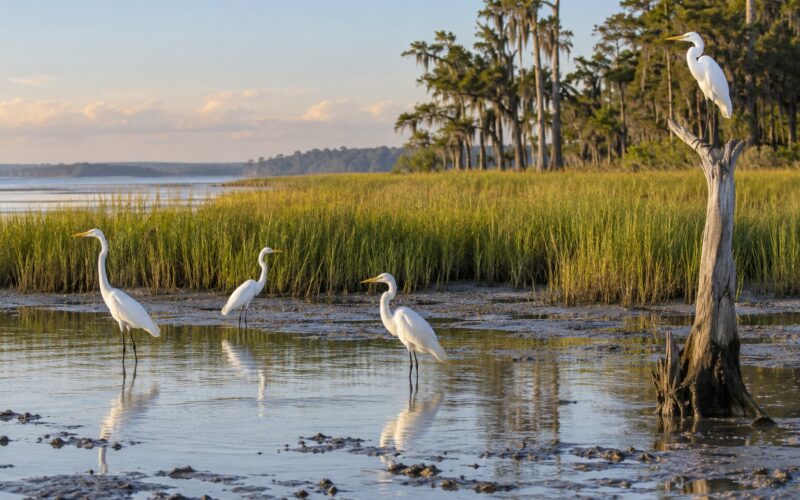
- Stand-and-strike. The bird stands almost motionless, then shoots its bill down. This is the classic heron method, used by Great Blue Heron, Great Egret, Black-crowned Night-Heron, American Bittern, Wood Stork and Sandhill Crane.
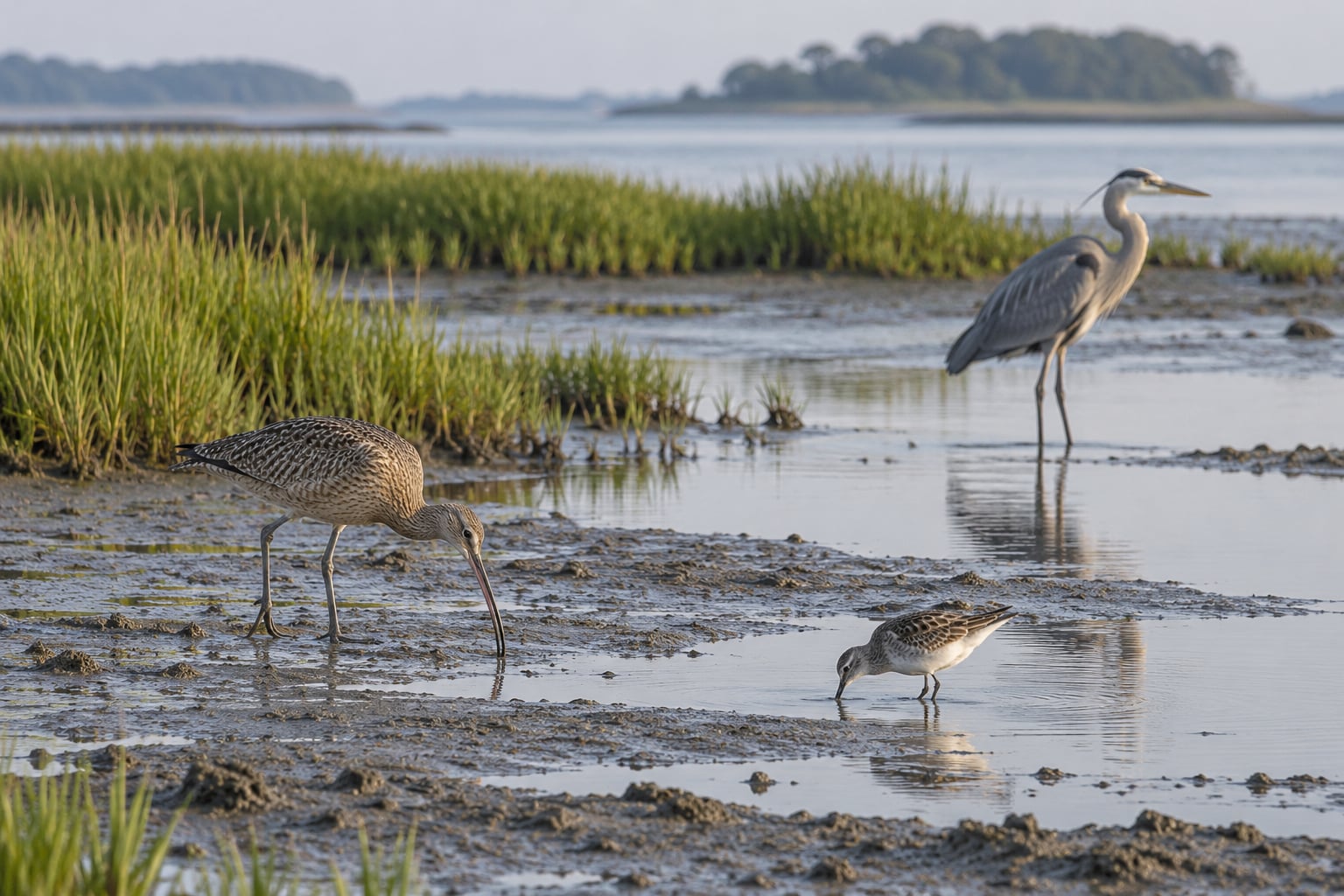
- Probing. Repeated deep thrusts into soft substrate, bill often held partly open. Curlew, Marbled Godwit, Willet, dowitchers, Dunlin, Least Sandpiper, Spotted Sandpiper and Snipe all do this. The National Park Service at Big Cypress describes waders sweeping a partly open bill from side to side and feeling for prey with sensitive nerve endings at the tip; that tactile approach is what separates a probing bird from a visual hunter.
- Surface pecking. Short, quick, repeated pecks at the water surface or a thin film over mud. Least and Semipalmated Sandpipers work this way in tight, restless groups.
- Gleaning. Picking prey off a surface rather than out of it: the water’s edge, a floating mat of vegetation, a salt-marsh stem. Black-necked Stilt, Pied-billed Grebe and rails glean rather than stab.
- Visual chasing. Moving prey sighted above the water, pursued on foot. American Avocet, Reddish Egret and Pied-billed Grebe run or swim after what they can see.
- Foot-stirring and bill-raking. The bird lifts a foot and shakes it, or drags its bill through the substrate, to flush hidden invertebrates. Egrets stir, sandpipers rake, and American Avocet sweeps a fine upturned bill side to side through shallow water.
- Flight feeding and plunge-diving. Feeding from the air, sometimes hitting the water. Snowy Egret flies low and drags its feet, Black Tern plunge-dives, and terns generally hover or hover-dip before dropping onto small fish.
- Filter feeding. Head submerged, bill open, water pushed past the gills. Roseate Spoonbill does this in deeper channels, sweeping its spatulate bill through a school of small fish.
Prey theft, or kleptoparasitism, sits on top of all of these. A Great Blue Heron has been photographed lunging into grass to take a frog from an American Bittern. It is common behaviour and it tells you nothing useful about ID, so note it and move on.
Step 3: Match feeding style to bill and body design
Behaviour and anatomy are the same story told twice. Bill shape is the tool; feeding style is how the bird uses it.
- Dagger bill, straight and heavy. Spearing fish and frogs from below, then gripping. Herons, egrets, bitterns and storks.
- Spear bill, longer and finer. Reaching crabs and shrimp in soft mud. Cranes, ibises and Limpkin, whose bill is unusually long and slightly curved for prising apple snails from the shallows.
- Sickle bill, decurved. Probing deep in mud where a straight bill would not reach. Long-billed Curlew, Black-tailed Godwit, Willet and Glossy or White Ibis.
- Spoon-shaped bill. Sweeping side to side through water or soft mud. Roseate Spoonbill.
- Upturned, slender bill. Skimming the surface of shallow water for small crustaceans. American Avocet, whose grey-blue legs and upcurved black bill are the quickest field pairing on this list.
- Short, stout bill. Seed and invertebrate picking on the surface. Plovers, rails, Ruff at a disturbed pool, Cattle Egret on land.
Leg length follows the same logic. A bird whose legs can reach the bottom of 30 cm of water is working a channel; a bird standing with its toes just touching is on a shallow flat. Great Blue Heron, Great Egret and Black-necked Stilt will wade noticeably deeper than a plover will.
Neck shape is the third confirmation. Herons fold the neck into an S when striking and straighten it to swallow, so an extended or recoiling neck mid-strike is a good heron-family signal.
Step 4: Use habitat, water depth and tide to narrow the options
Where you are standing removes more species than anything you can see. Each setting has its own short list.
- Exposed mudflat at low tide. Curlew, godwits, Willet, dowitchers, Dunlin, Semipalmated and Least Sandpipers, plovers, Black-necked Stilt, American Avocet. Probing and pecking dominate here because nothing can hide.
- Shallow brackish channel. Little Blue Heron, Tricolored Heron, Green Heron, White Ibis, Roseate Spoonbill, and in deeper water, Black Tern and least terns.
- Marsh edge with reeds. Green Heron and Least Bittern, which often feed clinging to vertical stems rather than standing on the bottom.
- Floating vegetation and lily pads. Least Bittern, Pied-billed Grebe, rails, and Limpkin where apple snails reach the surface.
- Open water and drop-offs. Birds that do not wade at all: grebes, coots, gulls, Black Tern, Wood Stork on a fish kill.
Water chemistry is another filter. Limpkin and Snipe push inland to freshwater and brackish areas. White Ibis and Glossy Ibis range widely but lean coastal. Willet and Marbled Godwit are essentially salt-marsh birds. American Avocet holds up in alkaline and brackish pools as well as the coast.
And check the tide before you walk out. Spring tides expose the flats that hold the biggest shorebird concentrations; neap tides keep water over them and push feeding birds onto the edges and the wrack line, where they are far easier to see.
Step 5: Confirm with field marks and behaviour
You now have a family. Finish the identification on the details that behaviour cannot give you: overall size, wing and tail shape, leg and bill colour, the colour of the head, and the call. Lesser Yellow-legged and Greater Yellow-legged Gulls separate on leg colour and bill length, and on call. Rufous and Black-bellied Sandpipers overlap heavily in non-breeding plumage and usually need a clear view.
Watch for one more behaviour before you commit. If the bird repeats the same action consistently across several cycles, you are on solid ground. If it did one strange thing once, it may have been reacting to a disturbance or a rival rather than feeding normally.
Being straight about this: feeding style is an ID shortcut that works at range and in bad light, not a substitute for field marks. Treat it as the first filter, never the last.
Common Wading-Bird Feeding Behaviors
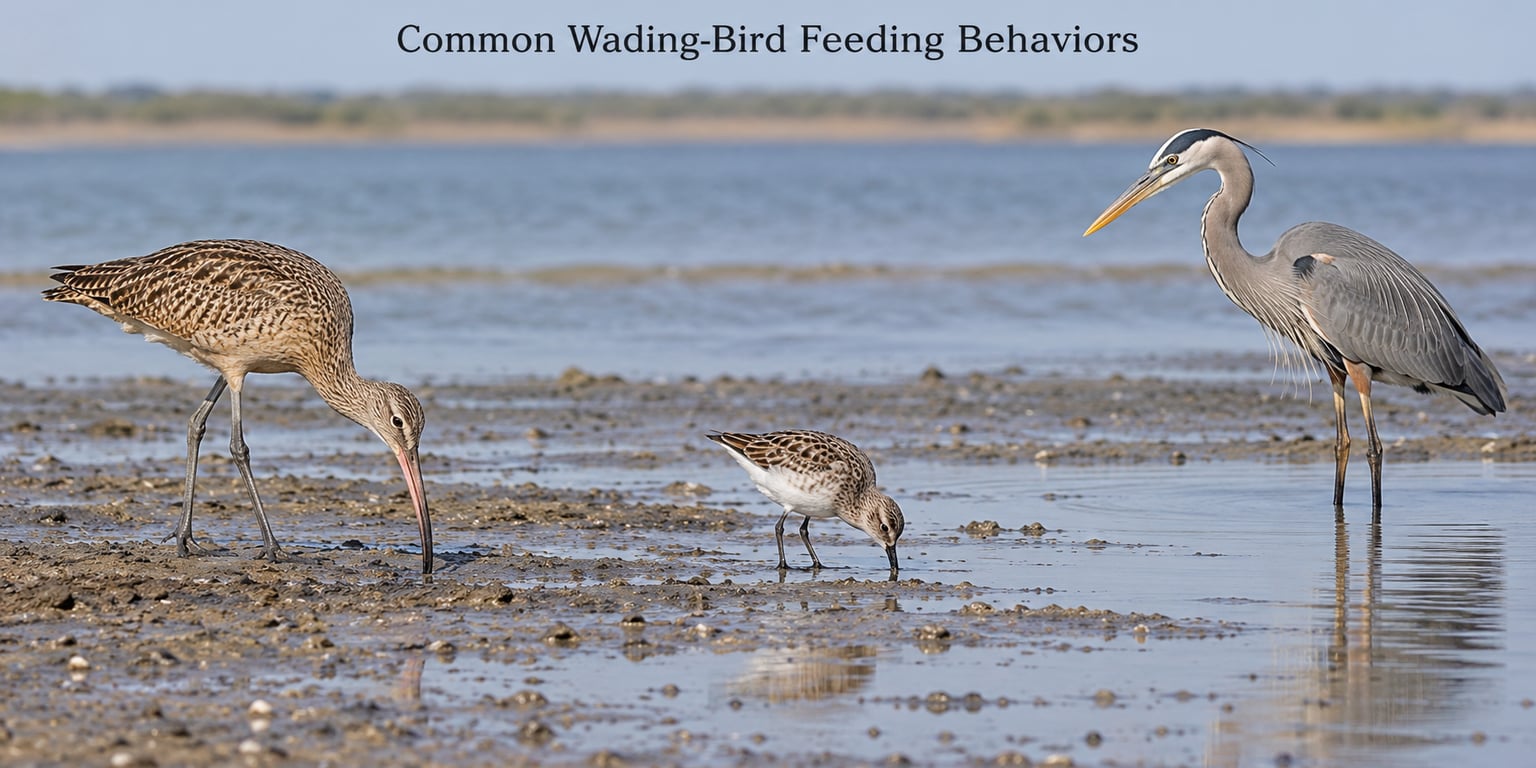
This is the table to hold in your head. Find the row that matches what the bird just did, and the last column gives you the candidates.
| Feeding style | What you see | Where it happens | Physical clue | Likely birds |
|---|---|---|---|---|
| Stand-and-strike | Motionless wait, then a fast downward stab | Shallow water, pool edge | Long legs, dagger bill, S-folded neck | Great Blue Heron, Great Egret, Black-crowned Night-Heron, American Bittern |
| Probing | Repeated deep bill thrusts into soft mud | Exposed mudflat, soft bank | Long decurved or stout bill | Long-billed Curlew, Marbled Godwit, Willet, dowitchers, Dunlin |
| Surface pecking | Short, rapid pecks at the film of water | Very shallow water, wet sand | Short fine bill, small body | Least and Semipalmated Sandpipers, plovers |
| Gleaning | Picking prey off a surface, no stab | Water edge, floating plants | Very long legs, short bill | Black-necked Stilt, Pied-billed Grebe, Snipe |
| Visual chasing | Running or swimming after sighted prey | Shallow water over sand | Broad feet, upturned or stout bill | Reddish Egret, American Avocet, Pied-billed Grebe |
| Foot-stirring and raking | Foot lifted and shaken, bill dragged through substrate | Shallow water, soft mud | Broad feet used as tools | Snowy Egret, Little Egret, egrets and sandpipers generally |
| Flight feeding and plunge-diving | Low flight, feet trailing, or a hover then drop | Open water, channel edge | Short legs, pointed wings | Snowy Egret, Black Tern, least terns |
| Filter feeding | Bill open and swept side to side with head in water | Deeper channel or pool | Wide flattened bill | Roseate Spoonbill, ducks and coots |
Two regional notes worth carrying. Across the UK and Europe the same behaviours belong to Eurasian Curlew, Ruff, Black-tailed Godwit, Redshank, Greenshank, Dunlin, Snipe, Little Egret and Grey Heron, and Greenshank against a Marsh Sandpiper or a small godwit is settled in the field more often by bill length and feeding posture than by colour alone.
Common Mistakes
Naming the bird before you have watched it. One glimpse is not an identification. Give it 30 seconds and one complete feeding cycle.
Assuming every long-legged bird is a heron. Ibises, spoonbills, cranes, storks, rails, avocets and stilt all wade, and each has its own bill shape and feeding style.
Confusing a quick peck with a probing thrust. A peck is short, shallow and repeated in one spot. A probe is deep, slow to start, often with the bill held partly open, and the bird usually pulls something out.
Ignoring habitat, depth and tide. Species lists are short per setting. Checking where you are standing first saves you the identification entirely more often than the glasses do.
Measuring bill length from an angle. A bird facing you foreshortens its bill to nothing. Get a side-on view before judging bill proportions.
Reading disturbance as behaviour. A bird jabbing at grass because a dog walked past is not foot-stirring. Watch several cycles in calm conditions before you build a case.
While you are there: keep your distance, move slowly, and never bait or deliberately flush a feeding flock. A bird forced to leave and re-find a safe feeding spot spends energy it needed for the next day, and the whole flock stops feeding for a while. Standing still and watching from the bank costs nothing and teaches you more anyway.
Frequently Asked Questions
Can you identify a wading bird by its feeding style alone?
No, but it gets you most of the way. Stand-and-strike points to herons, bitterns and cranes; probing points to curlews, godwits and sandpipers; running and spinning points to a Reddish Egret. Confirm with bill shape, leg length, size and habitat before you commit.
What is the difference between a heron and an egret when both are feeding?
Mostly size and bill, not behaviour. Both stand motionless and strike. Egrets are slimmer, hold the neck in a tighter curve and usually have a thinner, darker bill in non-breeding plumage; herons are bulkier with heavier yellow or greenish bills. A Great Egret is as tall as a Great Blue Heron but much finer through the middle.
Which wading birds probe mud with long bills?
Curlews, godwits, Willet, dowitchers, Dunlin, Long-billed Dowitchers, ibises and Limpkin. They push the bill straight or decurved into soft substrate, often partly open, and locate prey by touch through sensitive nerve endings at the bill tip rather than by sight.
How can I identify shorebirds on a mudflat?
Watch how they feed first. Constant probing means curlew or godwit, quick shallow pecks mean sandpipers, upright stop-run-stop with plovers means a plover, and side-to-side bill sweeping in shallow water means an American Avocet. Then check leg and bill colour, size against a known bird, and whether the flock mixes species.
What time of day is best for seeing wading birds feed?
The first few hours after sunrise and the last hour before sunset, when light rakes across the water and reveals shallow prey, plus any stretch where the water is falling and draining. Species differ: American Avocet and Black-necked Stilt feed more in the morning, while Little Blue Heron often hunts around dusk and carries prey to a roost.
How do I know whether a bird is probing or simply pecking?
A probe is slow to begin and goes deep into mud or soft substrate, usually with the bill partly open so the bird can feel prey. A peck is a short, quick tap at the surface, repeated in the same small area. Probing birds often hold a heavy, decurved bill; peckers are smaller with a fine, short one.
Conclusion
The method is short enough to remember on a windy bank: watch the feeding action, note the substrate and the water depth, check the bill and leg proportions, then confirm with habitat, season and field marks. Do that for a hundred birds and you will stop guessing.
Keep a simple field notebook or an app log of what you saw, where the bird was standing and what it caught. Marsh, estuary and mudflat trips in 2026 will teach you faster than any guide, because the behaviour repeats and the mistakes stick to you for years.