To identify bird tracks on a mudflat, read five things in order: how many toes point forward, how many point back, whether webbing fills the gaps between the front toes, how far the toes splay, and how big the whole print is. Add the track line on top of that and you can usually name the bird group in about two minutes.
It takes a bit of practice, mostly because the mud on a tidal flat keeps moving under your feet and a rising tide erases evidence on a schedule. The birds themselves are also hard to see at distance on a wide flat. A track is often the only thing telling you what is feeding there.
Field guide updated October 2026. Measurements are given as ranges because body size varies by sex, age, subspecies and how wet the mud was when the bird stepped.
Table of Contents
- What You Need
- Step-by-Step: How to Identify Bird Tracks on a Mudflat
- 1. Find a Track Pattern in the Right Habitat
- 2. Measure the Track Without Disturbing It
- 3. Read Toe Number, Shape, and Spacing
- 4. Match the Track to Common Coastal Birds
- 5. Use Stride and Feeding Behavior as Clues
- 6. Confirm the Identification in the Field
- Common Mistakes
- Frequently Asked Questions
- How do you tell a plover track from a sandpiper track?
- How do you tell a duck track from a gull track in mud?
- What is a long-legged wading bird with splayed toe prints called?
- How long do bird tracks last on a tidal mudflat?
- Is there an app that can identify a bird track from a photo?
- Can you identify a bird species from its footprint alone?
- Conclusion
What You Need
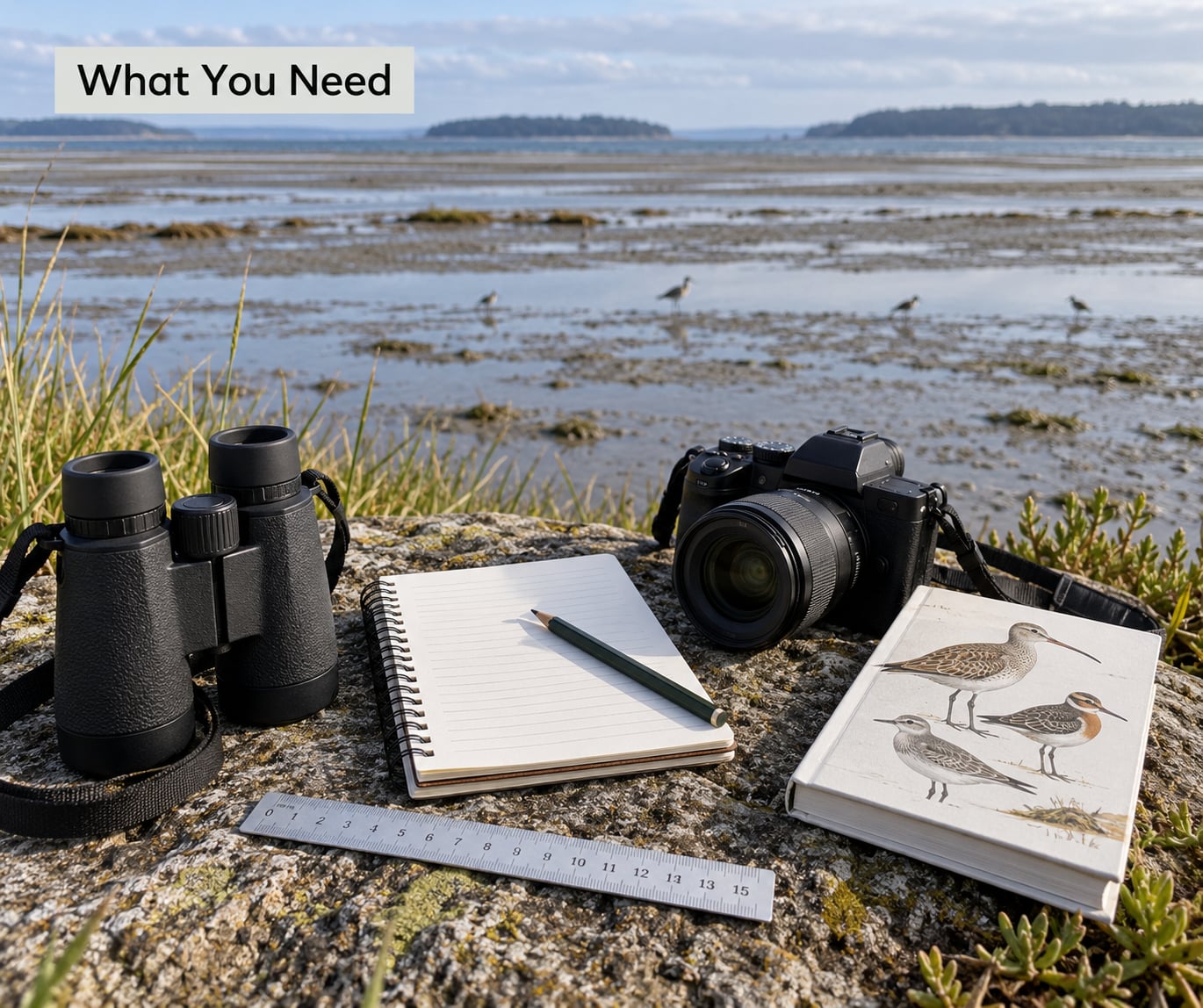
You need very little. The whole kit fits in a coat pocket, and most of it is optional.
- A ruler or a small tape measure. Millimetres matter more than inches here, because the difference between a peep and a plover is a few of them.
- A card, coin, or unfamiliar object for scale. If you forget the ruler, a US quarter or a poker chip laid beside the print gives you a known reference in the photo.
- A waterproof notebook and a pencil. Wet paper pens fail at the worst moment. Note the size, the toe count, the track line, and the date before the tide finishes the job.
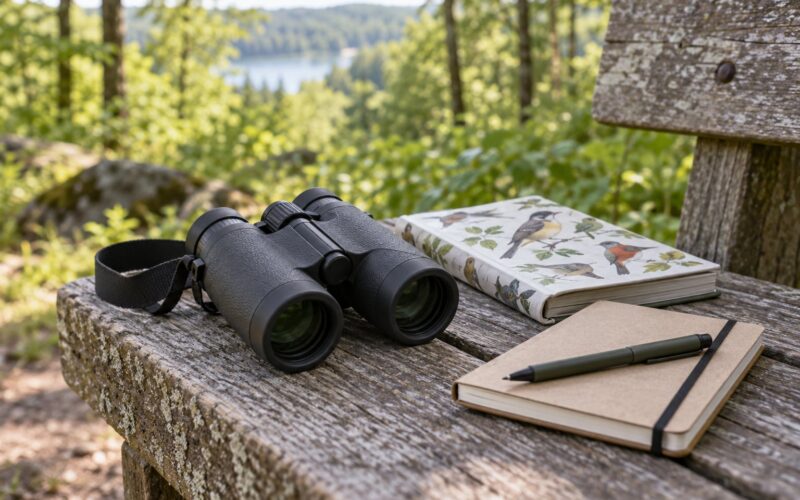
- Binoculars. You will use them to find the bird the tracks belong to, from well back.
- A camera with a macro setting or a close-focus lens. Photograph straight down, include a scale, and use flash if the shadow is longer than the print.
- A tide table for your flat. Not optional in practice. You need to know when the water comes back over your tracks.
- A soft brush or a spray bottle of water. For clearing a rim of silt off the edges of an older print. Keep it light.
- A regional bird field guide or a shorebird identification guide. A photo guide beats a text guide for this, because you will be matching size and shape rather than reading plumage.
Step-by-Step: How to Identify Bird Tracks on a Mudflat
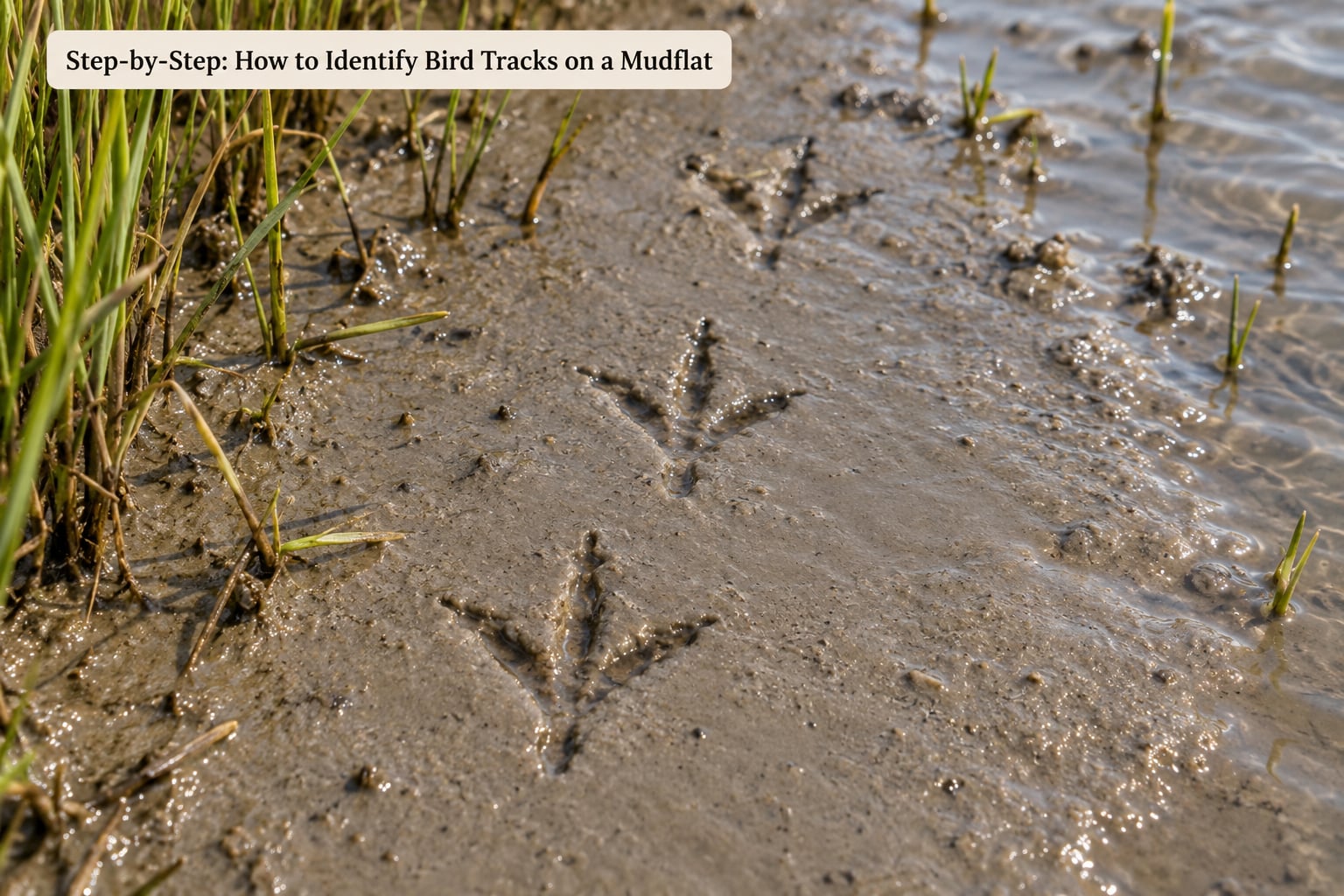
1. Find a Track Pattern in the Right Habitat
Look where birds actually stand still. Waders use the firm edge of a channel, the margin where wet mud meets shallow water, the top of a small rise, and any patch of exposed silt left by the falling tide.
Skip deep soft ooze. A bird with long toes spreads its weight across a wide area, so it can walk on mud you would sink into, but you will not read the print well and neither will the bird. Firm, damp, recently exposed silt gives the cleanest impression.
Timing beats technique. Tracks appear as the flat drains, last through roughly one tidal cycle, and get softened or erased when the water returns. Arrive within a couple of hours of low tide and you will find sharp-edged prints; arrive late and you are reading ghosts.
Judge freshness by the edges. A fresh print has a crisp lip and stands proud of the mud. An hour-old print has slumped, with the rim rounded and the toe grooves fading. Once a thin water film has run over it, a print usually will not survive much longer.
2. Measure the Track Without Disturbing It
Measure the print, not the stride, first. Stride depends on the bird’s speed and mood, while print length is fixed by anatomy and is the number you can compare against a guide.
Lay the ruler across the print without touching the impression. Record the total length from the tip of the longest toe to the rear of the print, the width across the splayed outer toes, and whether a hind toe registered behind the other three.
Then measure the spacing between one print and the next. Walking birds leave prints roughly evenly spaced along a line. Running birds leave prints grouped on either side of a central path, in paired clusters. That single measurement often narrows the list faster than size does.
Photograph with a scale in frame before you touch anything. Place the ruler or coin in the plane of the print, shoot straight down, and take a second frame from a low angle to show the depth.
3. Read Toe Number, Shape, and Spacing
Toe count and layout come first, because they split birds into groups that no other feature crosses.
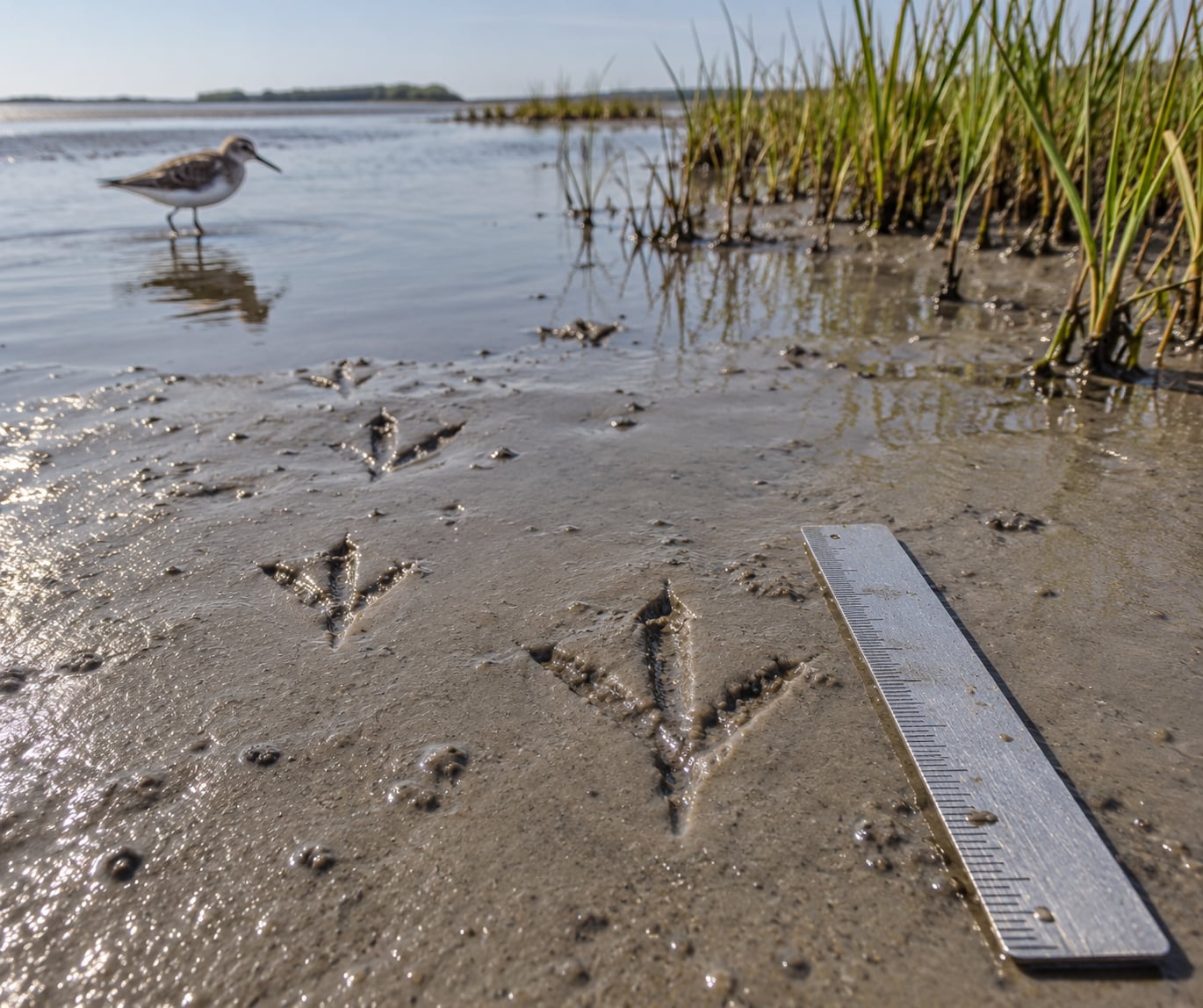
Most perching birds are anisodactyl: three toes forward, one toe back. That backward toe is the hallux, and on a mudflat bird it usually registers as a small mark behind the print or as a drag between two prints.
Most shorebirds and other waders are tridactyl: three toes forward and no hind toe at all. A small dark dot or short drag behind a three-toed print may be the hallux of a perching bird rather than a fourth toe on a wader.
Woodpeckers are the famous exception, with two toes forward and two back. You will not meet one on a mudflat, but knowing the rule has an exception keeps you from over-generalising.
Toe shape separates waders from everything else. A heron or egret leaves long, thin, widely splayed toes with a wide divarication angle, the spread between the outer toes, and a large gap of blank mud in the middle of the print. Plovers and sandpipers leave short, thick, compact toes bunched close together.
Webbing is a matter of extent, not presence. A duck pushes a full triangle of web forward, showing as a solid outline or a filled membrane between the front toes. A goose shows a more open arrangement with the web set back from the toe tips. A gull has the toes partly webbed with lobed or fringed edges, so the front of the print shows separate toe tips rather than a solid paddle.
| Bird group | Toes forward / back | Webbing | Track pattern | Typical print length |
|---|---|---|---|---|
| Small sandpipers and peeps | 3 forward, no hind toe | None | Fine close-set prints in a wandering or zigzag line | roughly 20-30 mm |
| Plovers | 3 forward, no hind toe | None | Broad heavy prints in short bursts with gaps between | roughly 30-45 mm |
| Yellowlegs, godwits, dowitchers | 3 forward, no hind toe | None | Larger prints in an even walking line, often fairly straight | roughly 40-60 mm |
| Avocet | 3 forward, no hind toe | None, slight webbing between outer toes | Straight purposeful line across open flats | roughly 50-65 mm |
| Herons and egrets | 4 forward, long thin toes | None | Big splayed prints, deep at the toe tips, irregular turn-around points | roughly 90-130 mm |
| Ibises and spoonbills | 3-4 forward, long thin toes | None | Wide-splayed prints with long trailing toe marks | roughly 80-120 mm |
| Ducks | 3 forward, small hallux | Full webbing | Chunky paddle prints, often in a wobbling line | roughly 45-70 mm |
| Geese | 3 forward, small hallux | Webbing set back from tips | Large heavy prints in a straight line, often with a droppings trail | roughly 75-110 mm |
| Gulls and terns | 3 forward, small hallux | Lobed or partial web | Striding prints, often a meandering line along the water edge | roughly 50-90 mm |
4. Match the Track to Common Coastal Birds
Work down the table rather than across it. Find the toe layout first, then the webbing, then use size to pick a species or a close relative.
Herons and egrets are the easiest big prints on a flat to recognise and the easiest to over-call. A great blue heron leaves prints roughly the length of your hand with long thin toes and a wide spread. Snowy egrets are lighter, shallower, and roughly a third smaller. Size and depth separate them more reliably than shape does, because the layout is nearly identical.
For cranes, ibises, spoonbills, and avocets, look at the third toe. Avocets leave a middle toe that is short relative to the outer two, giving a distinctly unequal spread, and their line is purposeful and straight across open water. Ibises and spoonbills leave prints where the long toes trail far behind the body line and the bird walked slowly rather than ran.
Among the shorebirds, the plover-sandpiper split is the hardest and the most useful. Plovers leave broader, heavier, more widely splayed prints and often leave a small mark behind the print from a small hallux. Sandpipers leave finer prints with toes bunched together and no hind mark. When both occur on the same flat, the behaviour usually gives it away before the ruler does.
For gulls, terns, and cormorants, which are everywhere on mudflats and rarely covered in general tracking guides, the giveaway is the toe detail. Terns leave prints with noticeably long outer toes and a slender overall shape, and gulls leave a broader print with the hallux dot behind the toes. Cormorant and anhinga tracks, which show up on creek edges and old oyster beds, are webbed with a sharp heel and a heavy stride.
Say honestly how precise your answer is. Group level, plover versus sandpiper, heron versus egret: those are routinely achievable from tracks. Species level usually is not, because tracks vary with age and sex and the field marks that split two similar species are often in the bill shape and the plumage, not the foot.
5. Use Stride and Feeding Behavior as Clues
The single print tells you about the bird’s foot. The track line tells you what it was doing, and that is often the difference between two species you cannot separate by size.
Plovers run in short bursts with pauses, which produces clusters of prints separated by clear gaps. Sandpipers and peeps move in a steadier, more continuous line, often weaving as they probe, so the line looks scattered or zig-zagged rather than clean.
Dowitchers probe with a sewing-machine motion, sweeping the bill side to side, and their tracks show the bird advancing steadily a step or two at a time. Godwits make deeper holes and more forceful marks. Yellowlegs walk with a purposeful pace and leave a fairly straight, evenly spaced line.
Count the number of track lines crossing an area. Dense, layered, overlapping lines mean a feeding aggregation is working that spot, and you can often find the flock ahead of the tracks by scanning in the direction of travel. A single wandering line with a wide splay and a deep centre is more likely one heron patrolling a channel edge.
Watch for drag marks between prints. A continuous groove usually comes from a toe or the hallux touching down during a lunge or a run. Three- and four-toed drag patterns at a probing bird suggest ibis or spoonbill rather than a plover.
6. Confirm the Identification in the Field
Tracks are evidence, not proof. A confident call comes from combining four independent things: the print measurement, the track line, the habitat and season, and the bird itself.
Use season and habitat to prune. Arctic-breeding shorebirds pass through on migration and leave the least familiar prints on a flat, so a peep-sized track in spring may be a species you have never seen locally. Winter residents like gulls, ducks, and geese are present year-round and account for most of the large prints.
Then find the bird. Scan ahead along the line of tracks with binoculars, stay low, and approach from the side with the wind rather than head on. On a wide flat you can often identify a flock before you are within identification distance of it, and confirming the group is the real payoff.
Record what you actually know. A field note that reads “wader, likely heron, tracks about 110 mm, foraging at channel edge” is far more useful later than a confident species name with no measurements attached.
Common Mistakes
Measuring the wrong impression. The clearest print in a trackway is often a half print at the edge where a foot slipped. Measure a complete print where every toe tip registered, and measure twice.
Reading a drag mark as a fourth toe. Long grooves between prints come from toes touching down during a lunge, a run, or a probe. A real toe ends inside a print. Check whether the mark is continuous and directional before you count it.
Assuming every three-toed print is a shorebird. Three forward toes also shows up in many perching birds and in some rails and moorhens. If the print is small, the toes are thin and long, and it came from a vegetated edge rather than open mud, you may be looking at something that only landed briefly.
Treating webbing as yes or no. The old rule of webbed means waterfowl will send you to a duck when you are looking at a gull. Look at how far the web extends: a solid paddle front for ducks, a set-back triangle for geese, separated or lobed toe tips for gulls and terns.
Over-claiming the species. Most of the difficulty in this hobby comes from expecting a name when the evidence only supports a group. Say “peep” when the print is 22 mm and you cannot rule out a semipalmated sandpiper, and you will be right far more often.
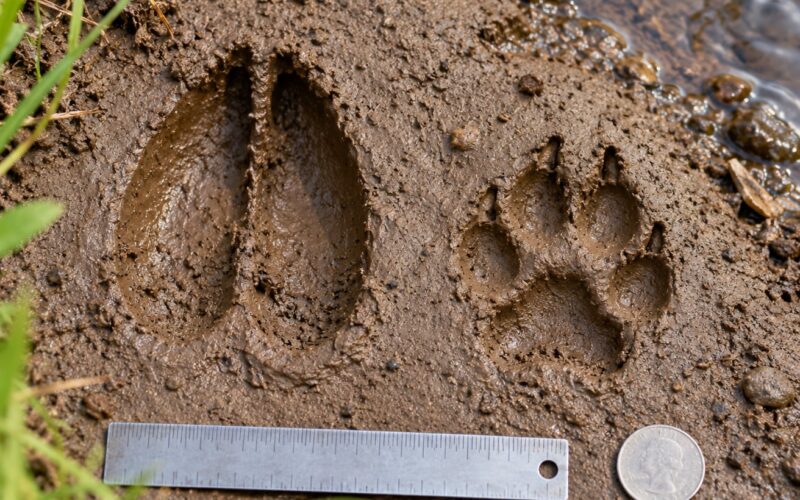
Ignoring the mammal tracks. Raccoons work tidal edges hard and leave a distinctive five-toed print with a broad, rounded hand-like pad. Foxes and stray dogs leave four-toed prints with a heel pad and claw marks, on a diagonal walk. If the toe count is four with a pad behind, it is not a bird.
Ruining the flat and the birds. Do not walk across a trackway to get a better angle; follow it from the side instead. Soft tidal silt takes years to recover from footprints, and a bird flushed off a roost island may not return to it that day. Stay on firm edges and salt marsh, keep your group small and quiet, and leave the birds where they are.
Getting cut off by the tide. Check the tide table before you commit to a flat, and remember that soft mud slows you down far more than a beach does. Local tide times shift, so use a current table for the specific flat rather than a general rule of thumb.
Frequently Asked Questions
How do you tell a plover track from a sandpiper track?
Plover prints are broader, heavier, and more widely splayed, and a small hallux mark often shows behind them. Sandpiper prints are finer with toes bunched together and no mark behind. The track line settles it: plovers run in short bursts and leave clusters with gaps, while sandpipers move steadily in a continuous or zig-zag line.
How do you tell a duck track from a gull track in mud?
Look at how far the webbing extends. A duck pushes a full solid triangle of web forward, so the front of the print reads as one paddle. A gull’s webbing is lobed and set back, so you see three separate toe tips with fringed edges between them. Gulls also usually show a small hallux dot behind the print, which a duck print often lacks.
What is a long-legged wading bird with splayed toe prints called?
That is a wader, or wading bird, and the group includes herons, egrets, cranes, ibises, spoonbills, and avocets. Their tracks are the easiest to recognise on a flat: long, thin toes spread very wide with a large blank gap in the middle of the print, and deep tips where the toes pressed hardest. Most total somewhere between 80 and 130 mm long.
How long do bird tracks last on a tidal mudflat?
Roughly one tidal cycle on a normal flat. Tracks appear as the mud drains, stay sharp for a few hours around low tide, and start to slump and blur once the water returns. Wind, rain, and soft silt shorten that window further. The practical rule is to read fresh prints first and treat anything softened at the edges as partly erased evidence.
Is there an app that can identify a bird track from a photo?
There are track identification apps, and they are useful for recording measurements and comparing against a library, but bird-track coverage is thin compared with mammal tracking. They will not settle a plover versus sandpiper call from a photo. Measure the print yourself with a ruler and a scale in frame, then use the app to check your measurement rather than your guess.
Can you identify a bird species from its footprint alone?
Usually not, and pretending otherwise is the most common mistake in this hobby. Tracks reliably give you a group, then a subgroup, then a behaviour. Size plus season will often narrow a shorebird to a handful of candidates, and you need the bird itself, or its bill shape and plumage, to close the gap. Record the group and the measurements and stay honest about the rest.
Conclusion
Find a clean, complete print on firm mud near the falling tide. Measure its length and toe spread, count the toes and check for webbing or a hallux, then follow the track line to see whether the bird ran in bursts, probed steadily, or waded slowly. Match all of it against the reference table, confirm with the bird itself at range, and record the group you are sure of along with the measurements that got you there.