Learning how to call a spring gobbler for beginners comes down to four things: call less than you think you should, match your volume to the distance, learn one call properly before you buy another, and stay quiet when a tom is already walking toward you. A hen never runs to a gobbler, so calling is often the only thing that closes the last stretch of open ground.
The good news is that the sounds a hen makes are simple, and most beginners get a response inside the first few mornings. It takes about a full season before calling feels natural, and an hour of quiet practice a week for a month will get you further than any gear upgrade.
Everything below assumes spring turkey rules where the season is split into an archery portion, a youth portion and a firearm portion, with most states setting the firearm opener a few days before or after the archery opener. Confirm your dates and any season length limits with your state wildlife agency before you plan a morning.
Table of Contents
- What You Need
- How to Call a Spring Gobbler for Beginners: Step-by-Step
- How to Call a Spring Gobbler for Beginners: Practice the Basics
- 1. Scout a Safe and Legal Hunting Area
- 2. Set Up Within a Comfortable Shooting Range
- 3. Begin With a Soft Hen Purr
- 4. Respond to Gobbler Activity
- 5. Use Decoys and Movement Deliberately
- 6. Close Within Effective Shot Distance
- 7. Finish the Hunt Ethically
- Common Mistakes
- Frequently Asked Questions
- What is the easiest turkey call for a beginner to use?
- How far away can a beginner effectively call a spring gobbler?
- What should I do if no turkeys answer my calls?
- Are more decoys better when turkey hunting?
- How does wind direction affect where I should set up for a spring gobbler?
- Conclusion
What You Need
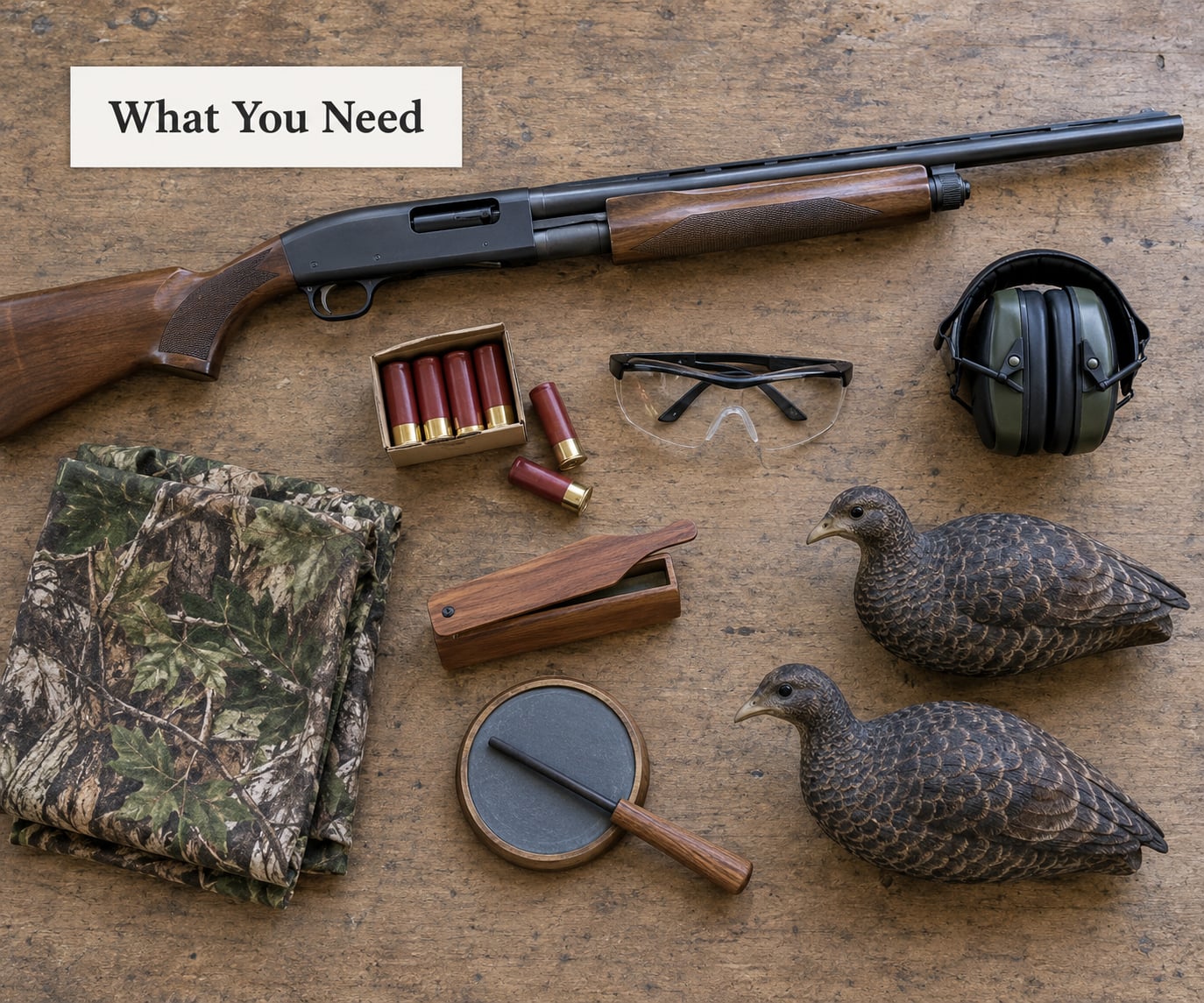
Start with the legal and safety side, because nothing else matters until that is settled. You need a valid hunting license, the required hunter education certificate for your state, and a clear understanding of where you may shoot. Many states also require you to check in or report a harvest, and a few restrict the number of toms you may take per spring.
Bring a firearm or bow you are already proficient with, the ammunition or arrows you have practiced with, and eye and hearing protection. Camouflage clothing is legal in most states but not all, so look up the rule rather than assuming. A ground blind, a portable blind, or a sit-down spot behind natural cover all work; the cover matters far more than the fabric.
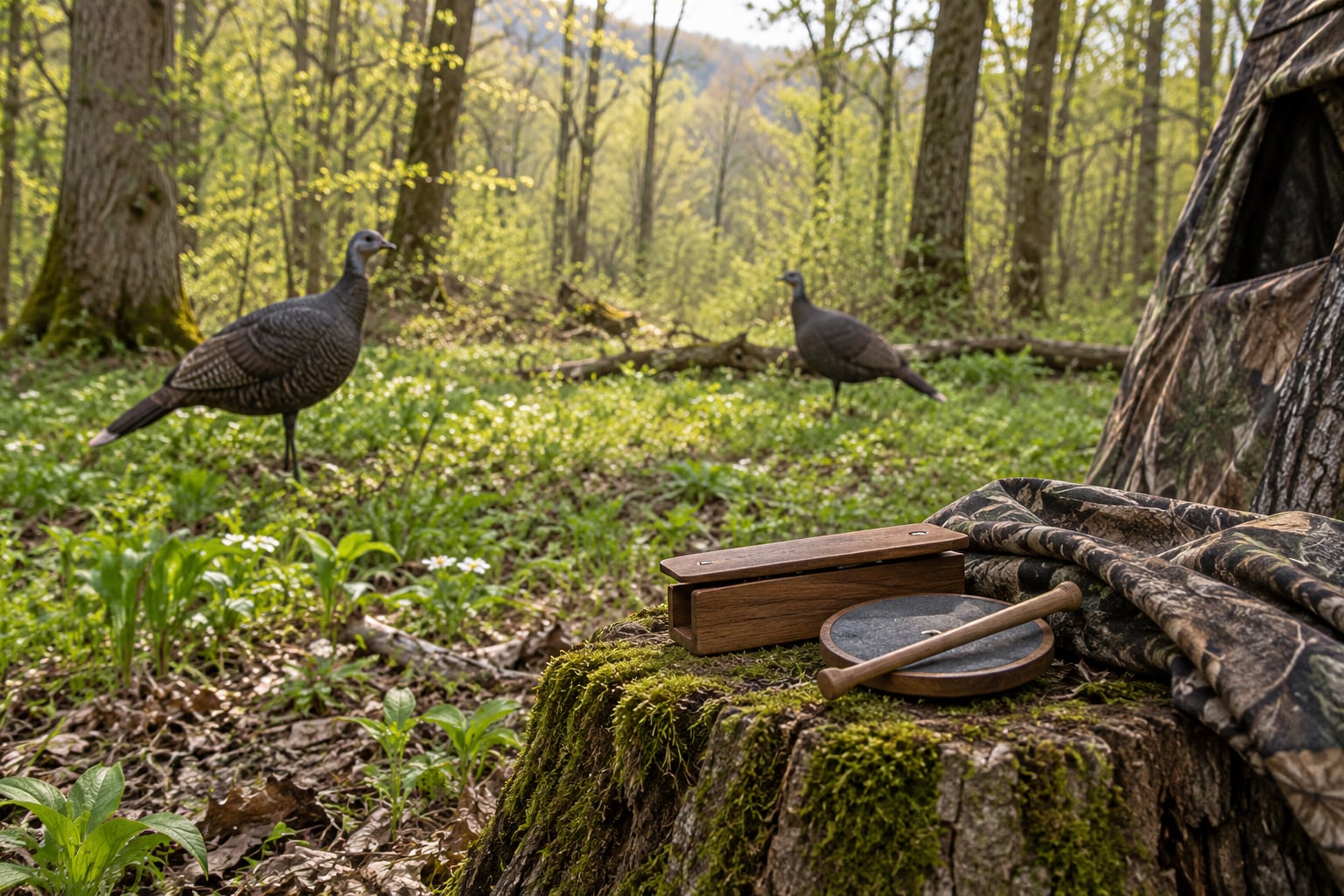
For calls, buy one to start with. A box call is the easiest sound to make and the loudest, a slate or pot call gives you the softest tone with the most control, and a diaphragm call is the only option that leaves both hands free. Add decoys later, and only a few.
How to Call a Spring Gobbler for Beginners: Step-by-Step
The sequence below runs from arriving in the dark to finishing the bird, and it works because the calling has a job at every stage. Early calls locate and reassure. Middle calls draw a bird into visual range without spooking him. Late calls happen less and less often, because by then the hen you are pretending to be has already been found.
Four variables decide whether it works: timing, volume, patience, and how you respond to what you hear. Get those right and even an imperfect sound pulls birds. Get them wrong and a perfect sound drives them off.
How to Call a Spring Gobbler for Beginners: Practice the Basics
Pick one call and stay with it. A slate call is forgiving because you drag the striker across the surface rather than blow into it, so a small error still produces sound. A box call needs a firm pull of the handle and an even stroke along the top of the box. A diaphragm call takes the longest to learn because it lives entirely in your mouth, throat and diaphragm.
Start with the purr. Chalk the slate lightly if it is slippery, brace your forearm against your body, and drag the striker steadily rather than scrubbing it back and forth. The sound should be even and low. If you hear the rasp, ease the pressure. If you barely hear it, press harder.
From the purr, lift into a yelp. On a slate, stop the drag and let the surface rebound with a sharp upward pull. On a box, flick the handle at the end of the stroke. Practice both seated, because beginners who start by walking around the yard sound busy rather than calm. Once the sound is clean in a chair, add movement.
1. Scout a Safe and Legal Hunting Area
Scout in daylight, several days before opening day, and walk the boundaries rather than trusting a map or a satellite image. Note access points, private property lines, gates, closed roads and any posted signs, and confirm whether you need permission from a landowner to cross or hunt.
Look for fresh turkey sign: tracks in soft ground, feathers, scratching, a dusting area with bare earth and feathers, or droppings under a roosting tree. Note the wind direction at your likely setup, and check the escape routes behind and beside you before you commit to a blind.
Identify the backstop. You want open ground in front and something solid behind you, plus knowledge of any fence lines, roads or other hunters nearby. Talk to neighbors and check where people are working. Walking onto another hunter’s setup is the fastest way to lose a season’s goodwill.
2. Set Up Within a Comfortable Shooting Range
A good setup lets you see a wide arc in front of you, has a solid backstop behind, gives you natural cover at eye level, and leaves enough room to work a shotgun without the barrel touching anything. If you are squeezed between two stumps, you will flinch on the first shot.
Position yourself with your back to the wind when you can. That carries your scent away from the birds and, just as importantly, carries the call toward the birds that are downwind of you. Wind that shifts mid-morning matters, so check it again once the sun is up.
Keep decoy placement simple. A hen decoy or two in front of you at a believable distance is plenty, angled so they face the direction you expect the tom to approach from. No arrangement works everywhere, and a big spread in the wrong place is easier for a turkey to read than a single decoy.
3. Begin With a Soft Hen Purr
Open with a soft purr, then stop. Wait thirty seconds or a minute, then a few soft yelps, then silence again. That is your entire opening, and it is more than most beginners need.
Volume is the hardest thing for a new hunter to judge. Your ears are twenty yards from your face, but the call needs to sound like it is coming from the birds’ distance. Call quieter than feels useful. A hen does not call while she walks toward a gobbler, so a soft sound with a long pause reads as confident and available, while a loud one reads as a decoy or a mistake.
Imperfections help too. Real hens begin mid-stride and miss the start of each yelp. A yelp that starts softly and fades is more convincing than one that hits at full volume on the first syllable.
4. Respond to Gobbler Activity
Sort out what you are hearing before you answer. Roosted birds gobble in a long, structured series, usually close to first light and again before the birds leave the tree. A walking gobbler gives single gobbles that sound farther away and more spaced out. Drumming is the soft, rolling sound of a bird on the ground, and it usually means he is already up and moving. Hens give short, rising yelps that are easier to imitate than a gobble.
When a roosted gobbler gobbles, give one soft yelp and wait. When a walking gobbler gobbles closer, answer with a short purr. If he is already coming, say nothing at all. Hunters frequently talk themselves out of a bird they were about to have, and the most common cause is calling during the final approach.
Match the number of yelps to the hens you hear. If two hens are yelping, answer with about the same number of yelps, then stop.
5. Use Decoys and Movement Deliberately
A small spread of realistic hen decoys gives a bird something to aim at while the calls give him something to walk toward. One or two full-body decoys and a couple of jakes is plenty for most situations.
The call type still matters even with decoys out. A slate lets you run quiet, hands-free volume while you stay still. A box call is louder and easier to hit from a distance but needs two hands, so use it before the bird is close rather than during the last twenty yards. A push-pin or push-button call gives a short, sharp sound with one hand and works well for cutting and for answering single gobbles.
Movement should be slow and rare. A slow shoulder turn, a slight shift of weight, or a short decoy shuffle reads as a hen feeding. Standing up to reach for a call at the wrong moment is how birds get busted at ten yards.
6. Close Within Effective Shot Distance
Estimate range honestly. A gobble heard through timber is carrying a long way. A hen yelp that sounds harsh and close is close. Use the sound plus the bird’s apparent size against trees, fence posts or a known landmark, and remember that a strutting tom presents a much smaller target than he looks.
Do not rush. The instinct is to creep forward the instant you see him, and that instinct is wrong. A bird at thirty yards who has not seen you is a bird you will likely get closer to by being still. Set the shotgun down on a shooting rest or a folded pack, keep the muzzle pointed somewhere safe, and wait for him to step into a clean head-and-shoulder view.
Follow your state’s rules on what constitutes a legal and ethical shot, including the rule against shooting a turkey with the rim of the range, and follow your own comfort limits about how close you are willing to work a bird.
7. Finish the Hunt Ethically
Recover the bird where it falls, and follow your state’s rules for field care and transport, including cooling requirements. Bag and tag according to your state, mark the tag where required, and check the reporting or check-in requirement before you leave the area.
Respect the ground you hunted. Leave no scattered feathers or shell casings that do not belong to you, close any gate you opened, and ask the landowner before disposing of anything. A clean recovery and an accurate report are the last part of a good hunt, not the paperwork after it.
And keep the goal straight. Answering a gobbler is a success on a morning when nothing else goes right. Taking a bird is the outcome you hunt for, not the only measure of the morning.
Common Mistakes
Every disappointing morning traces back to one of a handful of errors. The fix is almost always to call less, not to call differently.
- Calling too loudly. Fix: turn the volume down until you can barely hear it at arm’s length, then call a little softer than that.
- Calling too often. Fix: set a rhythm of one sequence, then silence, then wait five to ten minutes before the next.
- Ignoring the wind. Fix: check it again after sunrise, and move your decoys and your shooting position rather than fighting it.
- Using too many decoys. Fix: cut the spread down to one or two hens until you know what the birds are reacting to.
- Moving when the bird is close. Fix: freeze, keep calling to a minimum, and only shift when the bird stops or drifts away.
- Poor range estimation. Fix: use landmarks and compare apparent bird size to a known object before deciding on a shot.
- Unrealistic vocalizations. Fix: record yourself and compare against real hen audio. A soft, slightly imperfect yelp beats a loud, clean one.
- Buying four calls before mastering one. Fix: work one call for a full season, then add a second type for a specific job.
A few habits help more than any single technique. Talk to the birds, not to yourself, and answer hens the way a dominant hen would. Wait longer than feels reasonable before you leave a spot, since scattered birds often show up after most people have packed up. Two calls used together, a diaphragm and a box or slate, can sound like a pair of hens, but only after you can run one cleanly. And if a bird goes completely quiet after you spooked him, stop working him and go find another.
Frequently Asked Questions
What is the easiest turkey call for a beginner to use?
A slate or pot call is usually the easiest place to start. You drag a striker across a flat surface, so even an imperfect stroke produces sound, and the tone stays quiet, which is what most spring gobblers prefer at close range. A box call is louder and takes only a minute to learn, but it needs two hands and more volume control. Skip the diaphragm until you can make a clean purr on something else.
How far away can a beginner effectively call a spring gobbler?
Treat roughly a quarter mile as a realistic working distance for a soft hen call, and closer for clean, consistent results. Quiet calls fade fast in wind, rain and open hardwoods, which is why most hunters locate birds with a gobbler response first and use hen calls at shorter range. If a hen yelp sounds faint and thin to you, assume the bird is farther away than you think.
What should I do if no turkeys answer my calls?
Stop calling for ten minutes, then try one soft sequence at a different volume. If that gets nothing, change your setup rather than working harder. Check that you are downwind of the birds, confirm you are within legal range of where you heard gobbling, and try a short locator sound such as an owl or crow call to find birds that are not talking. Most silent mornings are a location problem, not a calling problem.
Are more decoys better when turkey hunting?
No. One or two full-body hen decoys plus a small number of jakes is usually plenty, and a tight spread can look wrong if it is bunched or facing the wrong direction. Place decoys at a believable distance in front of you and angle them toward where you expect the bird to approach. More decoys mainly help when the ground is open and birds need a long visual commit.
How does wind direction affect where I should set up for a spring gobbler?
Set up with your back to the wind whenever you can. Your scent then travels away from the birds you are calling, and your calls carry toward birds that are downwind of you. Wind that blows from the birds toward you will carry your scent straight to them no matter how quiet you are. Check the wind again after sunrise, since morning conditions often shift as the ground warms.
Conclusion
Start this week by making a quiet, even purr on a slate call and then lifting into a single yelp, ten minutes a day until it sounds repeatable. Read your state regulations and hunt your first morning with someone who has taken birds in your area.
On opening day, bring one call, one or two decoys, and more patience than you think you need. The hunters who kill birds in 2026 are rarely the loudest callers in the woods. They are the ones who waited through the silence.