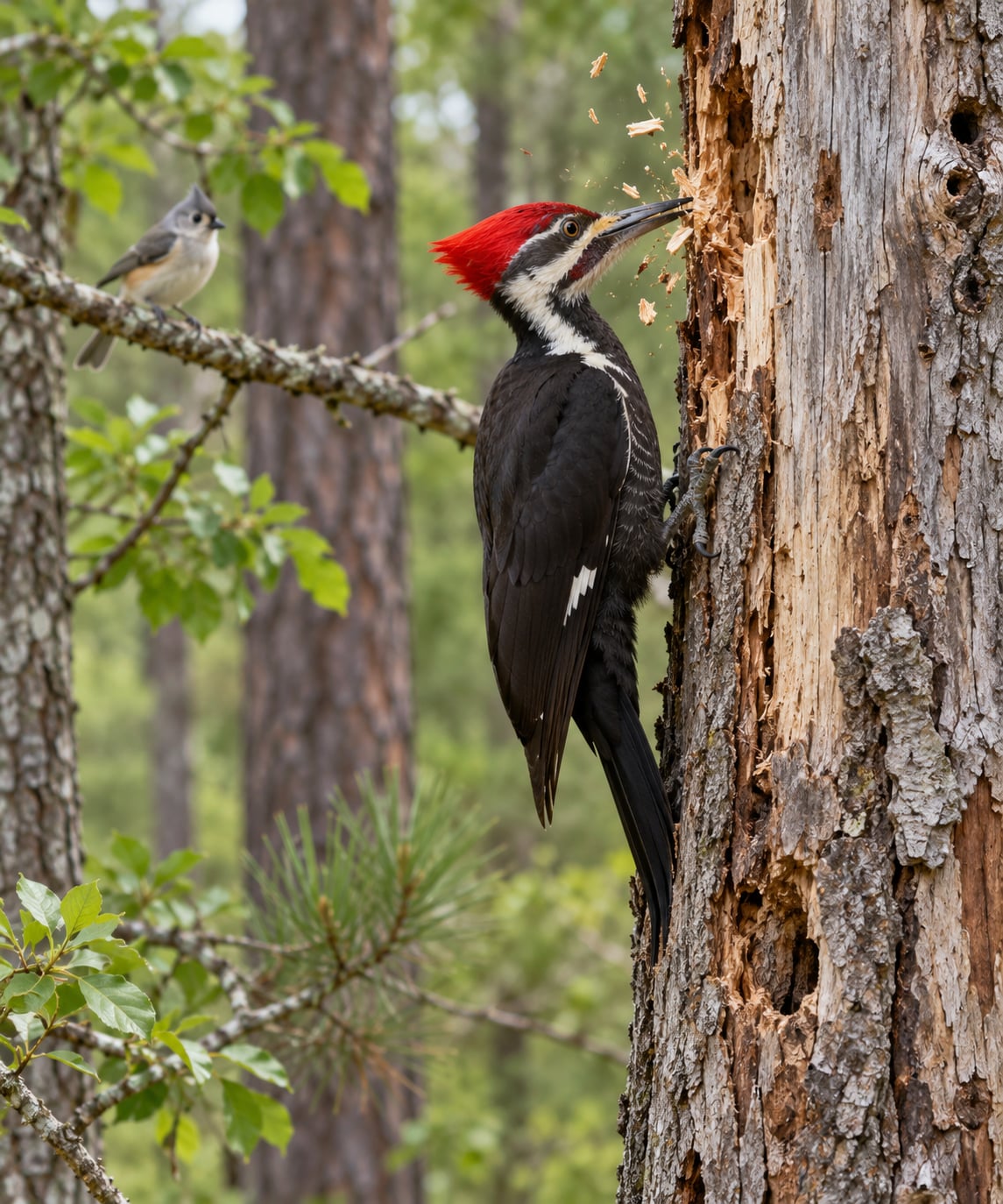
Woodpecker drumming is identified with four things: speed in beats per second, rhythm, how long each roll lasts, and the pitch the surface produces. That is how to identify woodpeckers by their drumming without ever seeing the bird. A slow, even, ringing roll usually means a Red-bellied Woodpecker, and a fast series that builds, peaks, and fades usually means a Pileated.
Add two more checks and you can call most birds with confidence: what the bird is drumming on, and a quick look at the bird itself. The process takes practice, but it is the fastest way to name a woodpecker you heard but never saw, and experienced birders reach for the same two checks every time.
One caveat up front, because it shapes everything below: both sexes drum in nearly every species. Drumming tells you which species is claiming the wood, but it almost never tells you whether you are hearing a male or a female.
Table of Contents
- What You Need to Identify Woodpeckers by Their Drumming
- Step-by-Step: Seven Checks From Sound to Species
- 1. Listen for the location and duration of the drumming
- 2. Compare the rhythm and pattern
- 3. Judge the pitch and tone
- 4. Check the habitat and tree type
- 5. Look for confirming visual field marks
- 6. Use call and flight behavior as supporting evidence
- 7. Compare common southeastern woodpecker signals
- Common Mistakes in Woodpecker Sound Identification
- Frequently Asked Questions
- What time of year do woodpeckers drum?
- What time of day are woodpeckers most active and loudest?
- Why is a woodpecker drumming on my house?
- Can you identify a woodpecker by sound alone?
- Is woodpecker drumming the same as nest excavation?
- Conclusion: Listen for the Whole Pattern, Then Find the Bird
What You Need to Identify Woodpeckers by Their Drumming
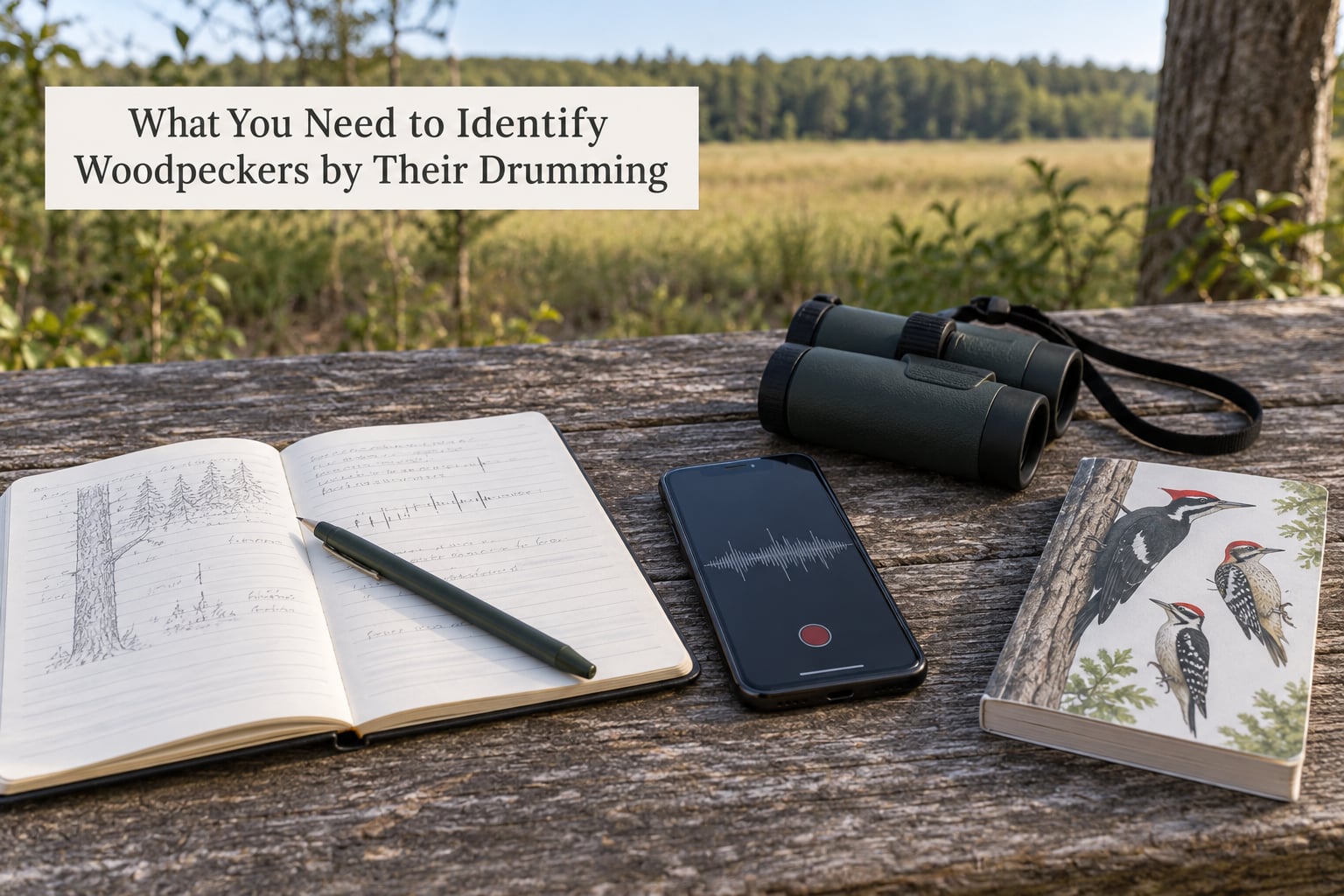
You need almost nothing. A phone with the built-in voice recorder, a pair of headphones, binoculars, and a field guide will carry you through years of backyard birding.
Headphones matter more than people expect. A Downy Woodpecker drumming at roughly 15 taps per second lands near the top of what a phone speaker can reproduce, so the thin, fast birds get smeared into noise until you listen with earbuds. A pair of earbuds fixes a surprising amount of the problem.
For a field guide, David Sibley’s work is the reference most birders reach for when a sound ID needs to be confirmed visually, and Cornell Lab of Ornithology’s All About Birds species pages pair a description with audio you can play back at full volume. If you want one app rather than a book, Merlin Sound ID from the Cornell Lab listens to a clip and offers a species list. I refresh the figures in this guide each 2026 because rates and ranges shift a little as the research moves.
Two habits do more work than any gadget. Write down the date, the time, the tree type, and what the roll sounded like, because your memory of a sound is unreliable within about ten minutes. And always look up afterward. Half of a drumming ID is a real field mark, and the other half is the bird that produced it.
Step-by-Step: Seven Checks From Sound to Species
Run the checks in this order. The early ones cost you ten seconds and eliminate the most wrong answers, so you never build an ID on pitch alone and spend the rest of the morning defending it.
1. Listen for the location and duration of the drumming
Where a bird drums says as much as how it sounds. Dead snags and large live trees, a woodland edge, an open grassy area, a utility pole, or the side of a house are all different signals.
Pileated Woodpeckers favor big trees in mature forest and rarely bother with a small yard tree. Red-cockaded Woodpeckers work living pines rather than snags, which matters in the Southeast where dying trees are less common. Northern Flickers are open-country birds that drum on posts, fences, and dead trees in sparse woodland. If the sound is coming from a metal mailbox, siding, or a chimney cap, you are almost certainly dealing with a suburban Downy, Hairy, or Red-bellied.
Then time the whole event. Note how many rolls you hear and how long the gap between them runs. A Red-bellied gives several evenly spaced bursts. A Hairy fires one fast burst and can leave you waiting twenty seconds or more for the next one. You worked it if you can say, in one sentence, where the bird was and how long the whole sequence lasted.
2. Compare the rhythm and pattern
Rhythm is the strongest single clue once you know the species set. Learn these five patterns and you will recognise most birds you are likely to meet.
- Fast, even roll. A sustained machine-gun burst with an unchanging pace. Sapsuckers and both Downy and Hairy Woodpeckers fit here.
- Paired taps. Two or three blows, then a distinct gap, repeated. Often a single bird working a spot rather than a territorial drum.
- Accelerating series. The strikes start slowly, build quickly to a peak, then trail off. This is the Pileated Woodpecker signature, and it is why people know the species by sound more often than by sight.
- Single emphatic blows. One hard strike repeated with long pauses, or a lone blow used as a contact call.
- Irregular and messy. Unsteady, off-beat, and genuinely irregular patterns do occur. A birder on a Lake Padden walk once recorded an unfamiliar rhythm that turned out to be a real woodpecker behaving atypically, so do not discard a bird for sounding strange.
3. Judge the pitch and tone
Tone reflects two things at once: the bird’s bill and body, and the surface it struck. Dead wood rings and carries, live wood dulls, and metal rings out at a distance that surprises people. A woodpecker drumming on a transmission tower can sound like an air raid siren to a passerby, which is really a description of sheet metal, not of the bird.
Within the southeastern set, a Red-bellied’s roll reads as high and clean, a Pileated as lower and heavier with more body under it, and flickers as flatter and less musical. Treat this as a supporting check. A distant Downy sounds like a Hairy, and a loud roll on a hollow snag can sound like something much bigger than it is. Pitch gets you a shortlist, not a verdict.
4. Check the habitat and tree type
Mature pines, bottomland hardwoods, open wooded edges, scattered snags, and suburban yards with established shade trees all produce different lists of likely species. If you are in a mature longleaf or loblolly pine stand in the Southeast, a quiet, high, insect-like tapping on a living pine is worth pausing over. If you are on a city street under street trees with a metal pole nearby, the realistic candidates are Downy, Hairy, Red-bellied, and Red-headed.
Habitat also filters the non-woodpeckers. White-breasted Nuthatches are noisy in the same trees, and they do not drum. If your candidate does not live in the wood you are standing in, keep looking.
5. Look for confirming visual field marks
Confirm the sound ID with the bird. After a drum, the bird usually stays put, and you often get a clear look within a minute or two. Check size first, because a 9 inch Pileated beside a 6 inch Downy is unmistakable, then head pattern, back color, and bill.
Useful confirmations: a Red-bellied shows faint red on the lower belly, but only when it leans back, so check the back and the zebra barring on the wings instead. A Red-headed has an entire red head, with no red belly at all. A Red-cockaded carries a bold black and white face and a small black cap. Northern Flicker is a brown, ground-dwelling bird that spends most of its time foraging rather than clinging to bark. Once you have Downy and Hairy side by side, the bill difference is easy and the back pattern settles it, though the back view is a much easier field mark than the sound.
6. Use call and flight behavior as supporting evidence
Drumming is one signal in a package. The other signals are cheap to gather and they break ties that drumming cannot.
Flight is the first one to check. A Pileated moves in deep undulating swoops with wings folded at the bottom of each dip. A Red-bellied flies in straight, stiff glides rather than waves. A flicker bounds through the air with long, slow wingbeats and usually lands on the ground. Listen for calls too, since a perched bird usually talks between drums.
Feeding behavior is the tiebreaker of last resort, and it is excellent. Yellow-bellied and Williamson’s Sapsuckers drill neat rows of small holes, and that pattern of holes is the field mark, not the sound. A Downy working a stem produces the same tidy rows of little holes, and once you know to look for them they become an entire new obsession to watch. A flicker is digging an ant nest on the ground, not pecking wood.
Location habits help as well. A bird returning to the same tree or the same dead limb for several mornings is holding territory, and territory is why the drum was delivered.
7. Compare common southeastern woodpecker signals
Here is the compact reference I keep in my head. Rates are approximate averages from published figures, mostly those popularized by David Sibley, and individual birds vary.
| Species | Drumming rate | Roll length and rhythm | Best supporting clue |
|---|---|---|---|
| Downy Woodpecker | About 15 taps per second | Short, light, even; repeats often | Small bird, short bill, backyard trees |
| Hairy Woodpecker | 25 or more taps per second | Short bursts with long pauses of 20 seconds or more | Bigger bill, white back stripe, no spots |
| Red-bellied Woodpecker | About 19 beats per second | Moderate, even, high and ringing, several bursts in a series | Zebra barring on back, faint red belly, faint call |
| Pileated Woodpecker | About 15 beats per second | Accelerating series that peaks then trails off; very loud | Large, crest, black and white, deep resonant boom |
| Red-headed Woodpecker | No widely published rate | Flat, even hammering, often on snags | Solid red head, white wing patches |
| Northern Flicker | Slower individual knocks | Long extended runs rather than a machine-gun roll | Brown, barred back, forages on the ground |
| Yellow-bellied Sapsucker | Fast, even taps, no fixed rate | Long ringing roll, several rolls in a series | Rows of small drilled holes, white wing patches |
| Williamson’s Sapsucker | Fast, even taps, no fixed rate | Very similar to Yellow-bellied, often in a repeated series | Black body with yellow belly, western pine forest |
| Red-cockaded Woodpecker | No widely published rate | Quiet, high, insect-like tapping rather than a drum roll | Living mature pines, resin wells, bold face pattern |
No single drumming feature is diagnostic. Sapsucker species overlap almost completely in sound, Red-bellied and Pileated drift toward each other when a bird is far away, and the substrate can rewrite the pitch. Use the table to build a shortlist, then use the habitat and the bird to settle it.
Common Mistakes in Woodpecker Sound Identification
Judging pitch from a distance. This is the most common error, and it produces a Pileated in a county with no Pileated. Distance and wind flatten the fast, thin rolls and boost the loud, resonant ones. Judge speed and rhythm at a distance. Hold pitch for when the bird is close and quiet.
Assuming every loud drumming is a Pileated. Loudness is mostly about the surface. A Downy on a hollow metal chimney cap will out-carry a Pileated on soft pine, and a red-bellied on a dead snag can sound enormous from a quarter mile off. Work out what the bird is hitting before you trust the volume.
Confusing branches, boards, and other things with drumming. Loose trim knocking against a chimney in wind, rain on a metal roof, an expanding porch light, hail in freezing weather, and a branch dropping all imitate woodpeckers convincingly. The giveaways are that they have no repeating pattern and no visible bird, and that they keep going when the bird has left the area.
Confusing foraging and excavation with drumming. A bird chipping insects out from under bark is making sound, but it is irregular and close, and it is the same sound you hear when the bird is eating. The distinction birders argue about is simple: drilling for insects is audible, while eating the insect is close to silent. Nest excavation is a different, more deliberate hammering, usually paired with a visible cavity in progress.
Believing a drumming bird is excavating in your siding. It almost never is. A bird hammering on a house, a mailbox, or a vent is advertising, not digging a nest. Neighbors trading tips online about damage from drumming mostly have misread advertising for construction. Look for chips, dust, or a cavity to worry about, not noise.
Ignoring habitat, or assuming males only drum. Both sexes drum in most species, so a spring drum tells you nothing about sex. A field mark, a date, and a habitat note will still build a stronger record than the sound alone.
Discarding an odd pattern. If the rhythm does not match anything you know, record it and check the bird. Genuinely irregular drumming happens, and more than one off-beat mystery has resolved only when the bird finally came into view.
Frequently Asked Questions
What time of year do woodpeckers drum?
Woodpeckers drum year-round, in every month and in any weather, because both sexes use drumming to hold territory. The Cornell Lab of Ornithology notes a clear uptick from roughly March through June, when males and females are advertising territories and looking for mates. The pattern rises before nesting, dips while adults are provisioning nestlings, and climbs again once young have fledged and disperse to new wood.
What time of day are woodpeckers most active and loudest?
Early morning is best, largely because the air is still and background noise is low, so slow rolls carry clearly. Most drumming happens in the first few hours after sunrise, with a smaller bump through late morning. Midday is the least productive window. A territorial bird near a good snag will drum at any hour, so a quiet afternoon in the woods is not proof that nobody is there.
Why is a woodpecker drumming on my house?
Almost always for advertising, not nest building. A woodpecker selects the loudest, most resonant surface available, which is usually metal chimney flashing, a vent cap, siding, a gutter, or a mailbox. Drumming on a house is a territorial and courtship signal that carries a long way in a neighborhood. Check for wood chips or a cavity if you are concerned about damage; noise alone is not a sign of excavation.
Can you identify a woodpecker by sound alone?
Often, yes, once you know speed, rhythm, and roll length. A Hairy Woodpecker at 25 or more taps per second is hard to confuse with a Downy at roughly 15. The limits are real: both sexes drum, sapsucker species sound nearly identical, and the surface changes the pitch. Cross-check with Merlin Sound ID, BirdNET, or the All About Birds species pages, and confirm the bird visually whenever you can.
Is woodpecker drumming the same as nest excavation?
No, and telling them apart settles most homeowner questions. Drumming is a repeated, rhythmic, deliberate burst delivered to a hard surface for communication. Excavation is slower, louder per blow, and always accompanied by falling wood chips and a widening cavity. Foraging pecks for insects are irregular and quiet by comparison, and drilling to reach an insect is audible while eating it is not.
Conclusion: Listen for the Whole Pattern, Then Find the Bird
Start with the full sequence, not the first burst. Note where the sound came from, how long the roll lasted, whether it was even or accelerating, and how fast it was. Then use the habitat to build a shortlist, look up the bird, and let a field mark settle it.
That is the whole process, and it gets easier every time you write the sound down. If you keep a short log of dates, tree types, and your best guess, you will find within a season that you can name most of your local woodpeckers by ear alone, and the guess you were once afraid to file on a checklist becomes a record you trust. The figures here are current as of 2026 and worth revisiting as new recordings come in.