Most owls are heard long before they are seen, so the call is the field mark that matters. To identify owls by their calls at night, listen for four things: how many notes, how they are spaced, whether the pitch rises or falls, and whether the tone is soft or harsh. Match that pattern to a species and you have an identification you can trust, even from a dark treeline.
It takes a few evenings of practice. The first night you will hear maybe two owl species and get one of them right, and that is a perfectly good start.
Table of Contents
- What You Need
- Step-by-Step
- 1. Choose a Quiet Listening Location
- 2. Let Your Ears Adjust and Listen for the Full Pattern
- 3. Compare the Call With Common Owl Vocalizations
- Great Horned Owl
- Barred Owl
- Eastern Screech-Owl
- Western Screech-Owl
- Eastern Barn Owl
- Northern Saw-whet Owl
- Great Gray Owl
- Long-eared Owl
- Short-eared, Snowy and Burrowing Owls
- 4. Use Habitat, Behavior, and Timing as Clues
- 5. Confirm the ID With a Second Signal
- Common Mistakes
- Frequently Asked Questions
- What owl hoots three times?
- How do I tell a Barred Owl from a Great Horned Owl by sound?
- What does it mean to hear an owl calling at 3am?
- Can you tell male and female owls apart by their calls?
- Is there a free app for identifying owl calls?
- Should I play owl calls to attract one?
- Conclusion
What You Need

You need very little. A warm layer, shoes that handle damp grass, and somewhere safe to stand for twenty minutes will do most of the work.
- A quiet location. Pick a place away from roads, generators, air conditioners and dog kennels. Background noise does more to ruin owl identification than distance does.
- Warm clothing and a seat. You will be standing still in October. Sit on a log if you can.
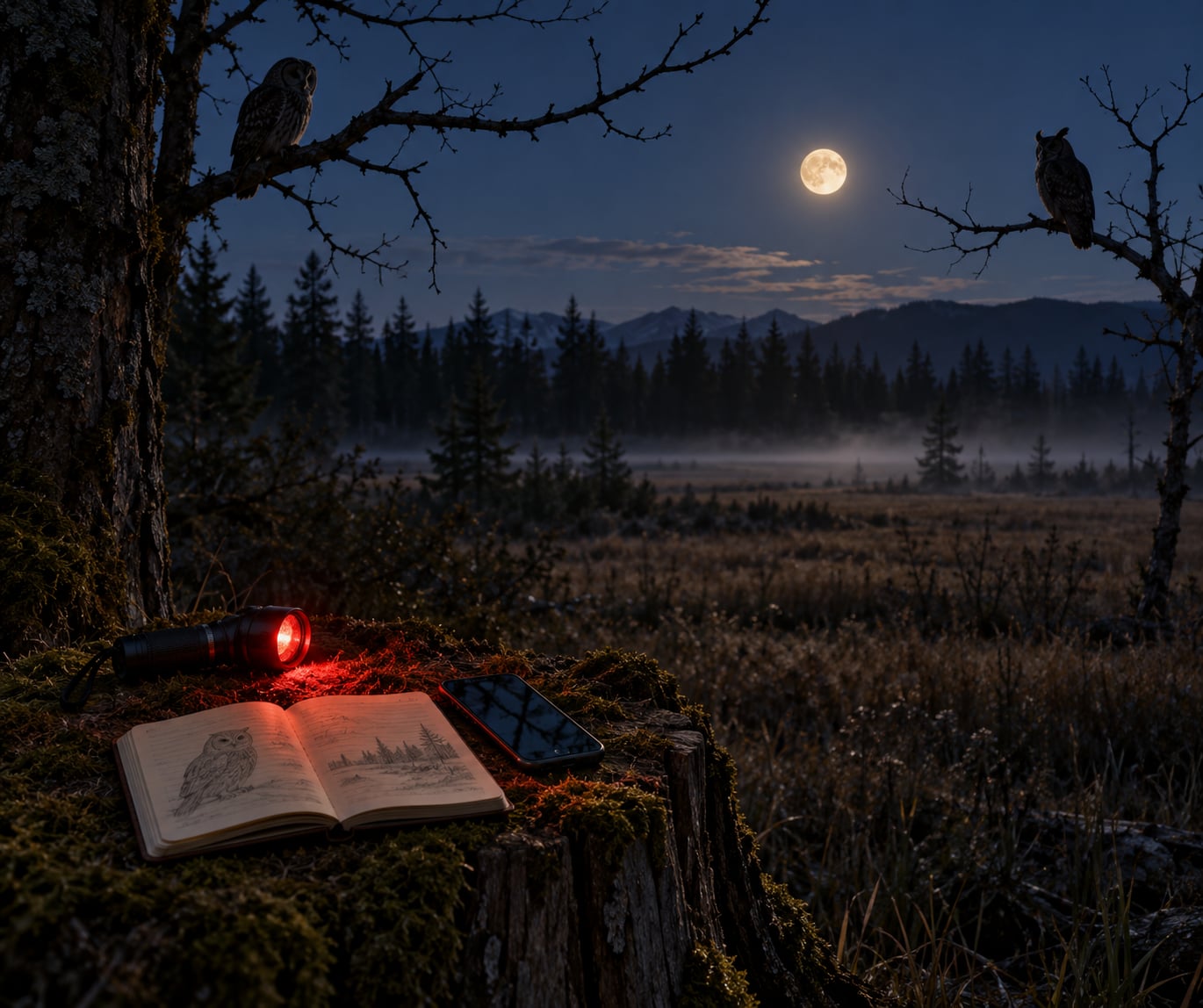
- A flashlight with a red filter or red tape over the lens. White light scatters far and gives away your position to everything else out there, including the owl.
- Binoculars. Useful later, for confirming a bird you have already heard.
- A phone or small notebook. For the words “three notes, low, soft, about four seconds apart” that you will absolutely forget by morning.
- A recorder, if your area allows it. Recording turns a vague memory into evidence you can replay and check against an archive.
Skip the owl-call playback apps for now. They are a genuine stress test for the bird and can get a territory-holding owl to abandon a nest site, so save them for reviewing recordings you have already made.
Step-by-Step
1. Choose a Quiet Listening Location
Go where owls actually are: the edge of mixed woods, a wetland margin, a park with old trees, or a suburban street with mature canopy. Forest edges work better than the middle of a forest, because edges give an owl somewhere to hunt and somewhere you can stand without pushing deep into cover.
Stay off private property without permission, keep well back from roadsides where you will be listening to traffic, and check local rules for parks after dark. Some preserves close entirely once the gate closes.
You will know the location is good if, after five quiet minutes, you can hear a cricket, a distant road with no traffic on it, and at least one bird besides the owl. If you cannot hear those, the owl will be audible but you will be too tired and distracted to work on the call.
2. Let Your Ears Adjust and Listen for the Full Pattern
Sit down, put the phone away, and do nothing for a full five minutes. Human hearing adapts quickly in low light, and most first-time listeners make their call about a bird in the first minute and then stop listening.
Once something calls, count and describe rather than name. Write down the number of notes, the gap between them in seconds, the pitch trend, and the tone. “Two notes, second one lower, raspy, repeated four times over two minutes” is a field description you can research. “Spooky” is not.
Then wait. Owls call in sequences, and a species that has gone quiet after one hoot often returns within a few minutes. A second sequence is often the moment the ID clicks, because the pattern repeats and the interval between repeats becomes obvious.
3. Compare the Call With Common Owl Vocalizations
Now match your description against the species you could plausibly have nearby. The most useful distinctions in North America:
Great Horned Owl
A deep, soft, low hoot, often three notes: hoo, h’hoo, hoo, or sometimes two. Males are lower pitched than females, so a very deep voice is usually a male. This is the owl most people mean when they say they heard a hooting owl, and it is the sound behind almost every “what owl hoots three times” search.
Barred Owl
Clear, expressive hoots that translate to “who cooks for you, who cooks for you-all.” A second, longer phrase, “who cooks for you-all,” often answers the first. The same bird gives a wild caterwauling that has been compared to a pack of monkeys and to a hawk with a sore throat, and that caterwauling is the call that confuses people most. Fewer large ear tufts, a barred chest, and a preference for wet, mature hardwood forest help separate it from a Great Horned.
Eastern Screech-Owl
Despite the name, this owl does not screech. It gives a soft, hollow, descending whinny that sounds horse-like, plus an even, steady trill of short notes on one pitch, and a longer warbling song used in spring. Small owl, residential streets and wooded suburbs, cavities in trees and nest boxes.
Western Screech-Owl
A series of evenly spaced, accelerating whistles, often described as a bouncing ball rolling and speeding up. The pitch is the giveaway: higher and squeakier than an Eastern, and the run speeds up rather than staying flat. Where the two species meet in the Rockies, the accelerating run versus the even trill is the cleanest split.
Eastern Barn Owl
A long, harsh, rasping shriek that some people find genuinely alarming, and a softer, breathy version used around nests. It is a one-note call with no pattern, and it carries much further than you would expect from a light-bodied bird. Open farmland, barns, roadside ditches and marsh edges. Most active in the last two hours before dawn, which is one reason it gets blamed for noises that stopped hours earlier.
Northern Saw-whet Owl
A rhythmic, mechanical tooting, one repeated beep on a single pitch, like a watch winding or a distant boat whistle. Short, evenly spaced, insistent. Dense conifer and mixed woods, especially along migration corridors. Small enough that a person can walk right past it in daylight and never know.
Great Gray Owl
A very low, resonant hoot with a flat, almost wooden quality, slower and heavier than a Great Horned. Rare, and associated with large tracts of mature boreal forest. If you think you have heard one and you are east of the Rockies, verify carefully before you report it.
Long-eared Owl
Tall, thin, and a patient caller. A series of evenly spaced whoos, sometimes delivered once and sometimes repeated up to two hundred times, from one frozen perch. Long, thin tree cavities, dense conifer plantations and sheltered woodlots. Also the species most likely to be sitting motionless a few feet from a trail in daylight.
Short-eared, Snowy and Burrowing Owls
Short-eared Owls bark a single sharp kek, sometimes from a flight, and hunt over open grassland. Snowy Owls hoot low, often in pairs of notes, with a buzzy edge. Burrowing Owls give a low, hollow coo repeated rapidly, and in winter they may be seen far from where anyone expects them.
4. Use Habitat, Behavior, and Timing as Clues
Habitat narrows the list faster than anything else. A hollow, rising whoop in a dense conifer stand in February is a saw-whet. A rising screaming note over a hay field in August is a short-eared. Call alone almost never proves an ID on its own, so use these to filter rather than to decide.
Perch and flight behavior help too. A Barn Owl shows a white underside and a heart-shaped facial disk if you get a flash of the face. A Great Horned sits still and heavy on a big limb; a Long-eared stands upright and slim against a trunk. If crows start mobbing something in daylight and you can find the mob, you have your owl.
Timing narrows it further. Territorial and pair-contact calling peaks in fall as juveniles disperse and in late winter into early spring as pairs re-establish boundaries. Breeding-season duets, including the Barred Owl’s who cooks for you-all, mostly happen near a nest, which is exactly when you should increase your distance.
Geographic range is a filter too, not a proof. A Barn Owl in a northern state in January is worth a second look but not an assumption, and an owl that “sounds like” a Western Screech-Owl in the Appalachians in October is far more likely to be an Eastern or a juvenile.
5. Confirm the ID With a Second Signal
Check the call against Cornell Lab’s All About Birds species accounts and the Macaulay Library, which is the reference birders trust most for verifying a voice. eBird lets you attach a recording to a checklist entry, and Xeno-canto holds a large archive of identified recordings from across the world.
Merlin’s sound ID is genuinely useful and free, and it works well when you are looking for a common resident species. Treat it as a second opinion rather than a verdict: birders on the forums report it confidently naming species that do not occur in their area, and juvenile begging calls are a known weak spot.
Look for a second signal whenever you can. A second call sequence in the same spot, a daytime silhouette, a scattering of feathers or a pellet below the perch, a nest cavity, or a recording you can replay. Two independent signals beat one, and a recording you submit becomes a record someone else can learn from.
If you want to keep hearing owls, put up a nest box instead of playing calls. Screech-owls take well to boxes with a 9 to 12 inch floor and a 2 inch entry hole, mounted high with a predator guard. Barn Owls do fine in a box on a pole in open ground. Follow local rodenticide guidance too, since secondary poisoning kills owls that eat poisoned mice.
Common Mistakes
Deciding from one isolated sound. A single hoot told you almost nothing. A single caterwaul is a genuinely hard identification, so record it and wait for a repeat.
Assuming it is an owl at all. This is the single most common mistake, and it is usually a frog. Spring peepers, chorus frogs and pine barrens treefrogs produce endless rhythmic peeping; a gray treefrog sounds like a short snarl; insects build and drop in volume in a rising and falling pulse. A Common Nighthawk gives a churring, insect-like phrase that confuses people for an owl. Coyotes yip in a rising, yipping series that mimics a distant hoot, and a possum gives a low nasal hiss. Rule these out by timing, location and pitch trend before you start choosing species.
Ignoring range and season. The call narrows to a short list; geography and date cut that list to one or two. Skipping them is how rare species get reported from counties they have never occupied.
Trying to use the moon or the weather to identify. Bright full-moon nights make owls hunt in the open and call more, and quiet overcast nights make them harder to hear. Neither says anything about which owl is making the sound.
Approaching a calling owl in spring. Repeated calling in late winter and early spring usually means a pair is near a nest or has owlets nearby. Some owlets leave the nest before they can fly, and fledglings on the ground beg loudly and are vulnerable to everything. Stay on the trail, keep dogs leashed, and back off if the bird goes quiet when you approach.
Describing the call with feelings. Spotted, eerie, haunted and spooky cover almost the whole range of nocturnal bird sound. Note count, spacing, pitch trend and tone instead, and your ID improves immediately.
Frequently Asked Questions
What owl hoots three times?
The Great Horned Owl is the classic three-note caller, often giving a deep, soft hoo, h’hoo, hoo. Snowy Owls usually give one or two lower, buzzier notes and Barred Owls give a longer four-note phrase instead. A three-note hoot heard anywhere Great Horned Owls live is a good starting guess, but range and habitat still matter.
How do I tell a Barred Owl from a Great Horned Owl by sound?
A Great Horned gives a deep, slow, soft two or three note hoot with a hollow boom. A Barred Owl phrases its hoots conversationally, roughly who cooks for you, who cooks for you-all, in a higher, clearer voice, and it often answers its own first phrase. The Barred also gives a wild caterwauling call no Great Horned makes. Habitat helps: Barreds favor mature, often wet hardwoods.
What does it mean to hear an owl calling at 3am?
Almost always the ordinary business of an owl: a territory call, a call between a pair, or a juvenile begging for food. Owls are active through the whole night, and a male holding a territory will often hoot for hours at a stretch. It is not a sign of anything unusual, and nothing about the hour is ominous. Listen, note the pattern, and enjoy it.
Can you tell male and female owls apart by their calls?
Often, yes. Male owls usually give the lower-pitched version of a species call, and females the higher one. In duetting species such as the Eastern Screech-Owl the two voices are clearly different, with the female answering the male at a higher pitch. Recordists working with Spotted Owls make the same distinction by pitch. With most species you need a sustained call rather than a single hoot to be confident.
Is there a free app for identifying owl calls?
Merlin Bird ID from the Cornell Lab of Ornithology has a free sound identification mode that works well on common resident species. eBird, the Macaulay Library and Xeno-canto are free and let you compare your own recording against identified archive audio, and you can submit a clip to eBird through the app. Treat any app result as a second opinion, since juvenile begging calls are often mis-assigned.
Should I play owl calls to attract one?
Generally no. Playback can pull a territorial owl away from a nest, cause a pair to abandon a site, and in some regions is restricted near active nests. It also tends to teach an owl to associate your location with a noisy intruder. A nest box is a better answer, since screech-owls and Barn Owls both take boxes readily. If you are confirming a rare sight, follow local guidance and keep your distance.
Conclusion
Start with the simplest version of this: pick a quiet, legal spot near woods or open water, stand still for five minutes, and listen to a whole call sequence instead of a fragment. Count the notes, note the spacing and whether the pitch rises or falls, then match that against the species your area can actually support. Habitat, season and a second signal turn a guess into an identification you would be happy to submit to eBird.