Learning how to signal for help in a remote marsh comes down to four things you can do at once: make noise, make light, make smoke or movement, and transmit your position electronically. Then repeat whatever works on a rhythm, from the safest place you can reach, until someone sees you. Most of this takes under ten minutes of practice before you ever need it.
A marsh is harder than open country. Reeds and cattails block sight lines, water swallows your tracks, wind cuts sound across the flat, and the tide decides how much ground you can stand on. Winter water will put a hypothermia patient on a stretcher in about half an hour, so warming yourself is part of signalling.
Nobody needs every device on the market. What matters is that you own the method you are relying on, that it is on your body rather than buried in a pack, and that you know the three-of-anything rule: three whistle blasts, three flashes, three fires, three gunshots. Repeated three times, that is the international distress convention and it means distress whether you are hunting, paddling or boating.
Table of Contents
- What You Need
- Communication gear
- Sound and light signals
- Visibility and survival
- Backup options for water and low visibility
- Signal methods at a glance
- Step-by-Step
- Step 1: Assess the Situation and Make a Plan
- Step 2: Call Emergency Services or Send a Distress Message
- Step 3: Send a Radio Distress Call
- Step 4: Make Yourself Visible
- Step 5: Make Your Position Easy to Find
- Step 6: Signal Repeatedly and Conserve Equipment
- Step 7: Protect Yourself While Waiting for Rescue
- Step 8: Contact the Rescuing Party and Report Changes
- Common Mistakes
- Giving a vague location
- Burning flares too early
- Leaving the site
- Relying on a phone with no coverage
- Signalling without a reference point
- Carrying the beacon where you cannot reach it
- Spamming the radio channel
- Frequently Asked Questions
- How to signal for help in the wilderness?
- What is the international emergency signal for distress when hunting?
- What is the symbol for needing help?
- What is the spoken emergency signal over a VHF radio?
- How to signal for help with a whistle?
- Should you stay with your boat if it capsizes?
- Conclusion
What You Need
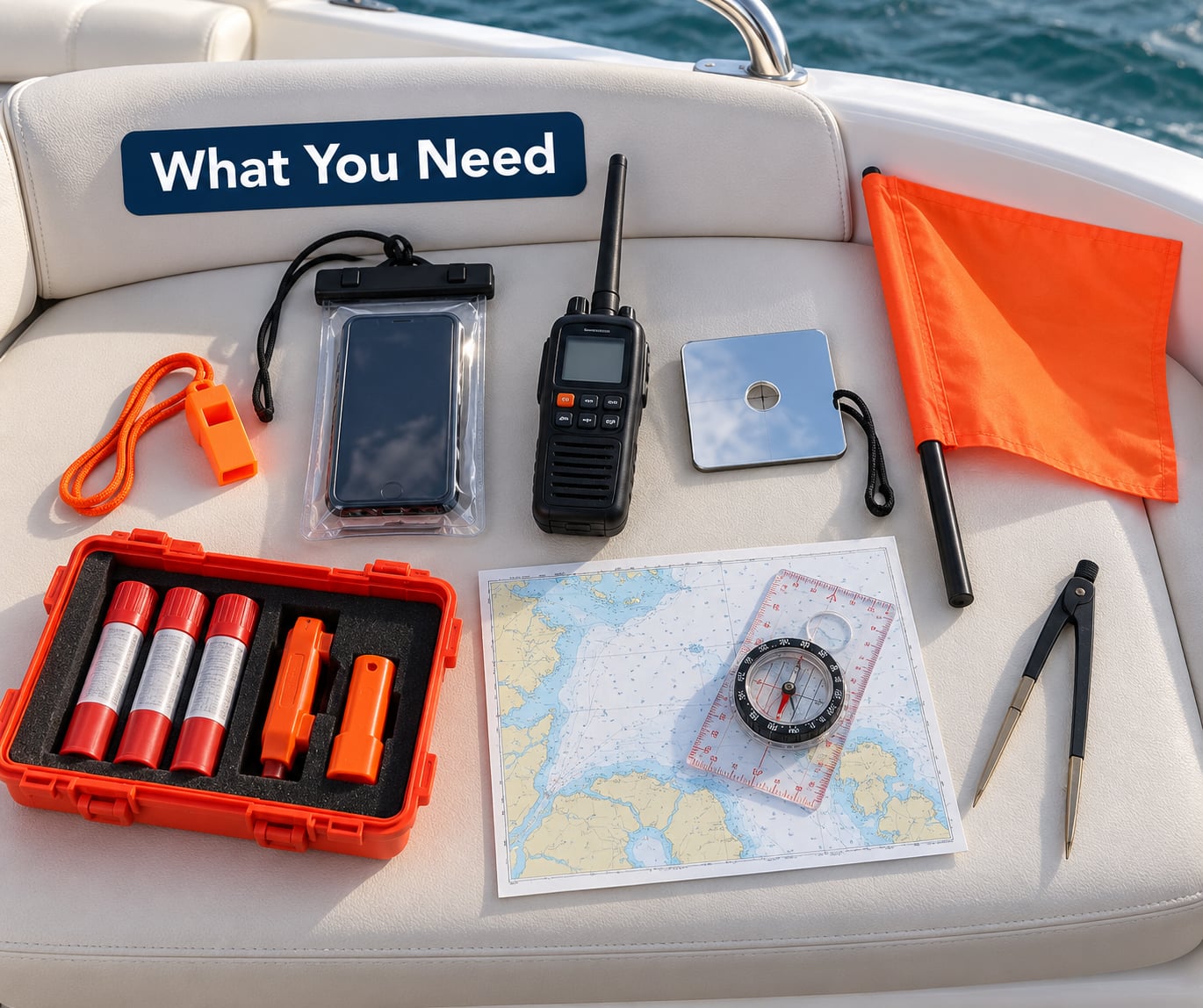
Carry the layers of signalling gear in this order of reliability: an electronic beacon that works without a cell tower, a sound source that runs without a battery, a visual signal that needs no power at all, and the gear that keeps you alive long enough to be found.
Communication gear
- A VHF marine radio if you are boating anywhere on tidal water. It reaches the Coast Guard on Channel 16 without any cell coverage, and a DSC-equipped set sends your position automatically.
- A charged phone in a waterproof pouch, with the emergency numbers already entered. Partial bars are not a plan, but a phone that reaches the tower once is worth a lot.
- A satellite messenger or PLB if nobody has line of sight to you. A PLB sends a registered position to an emergency operations centre. A two-way messenger lets you exchange text with your contact.
Sound and light signals
- A whistle on a lanyard or PFD strap, not in a jacket pocket. A pea whistle carries far further than shouting and does not tire you out.
- A signal mirror with a rough glass surface. It throws flashes for miles in sun and is the one visual signal that beats night gear by day.
- A headlamp or flashlight you can strobe, plus a waterproof matches or lighter and a fire starter that works wet.
- Flares, stored where they stay dry. Handheld smoke, aerial flares and signal fireworks each fail in a different condition, so a mixed kit beats a single type.
Visibility and survival
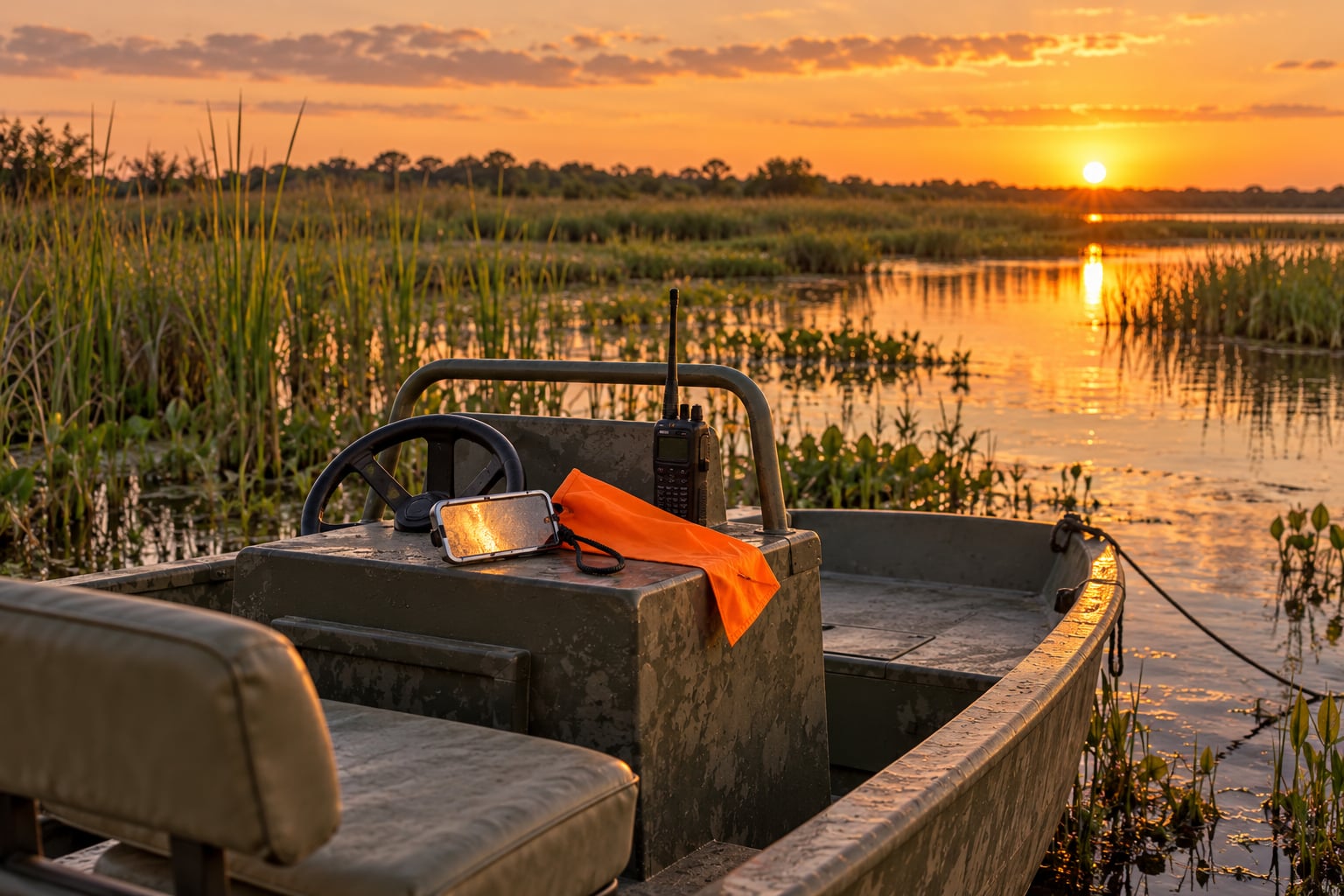
- Blaze orange panels or a flag strapped to the boat or the pack, plus a mirror-finish or retroreflective surface on anything you have.
- A map, compass and GPS unit with the route you came in on marked, plus a paper copy in case the batteries die.
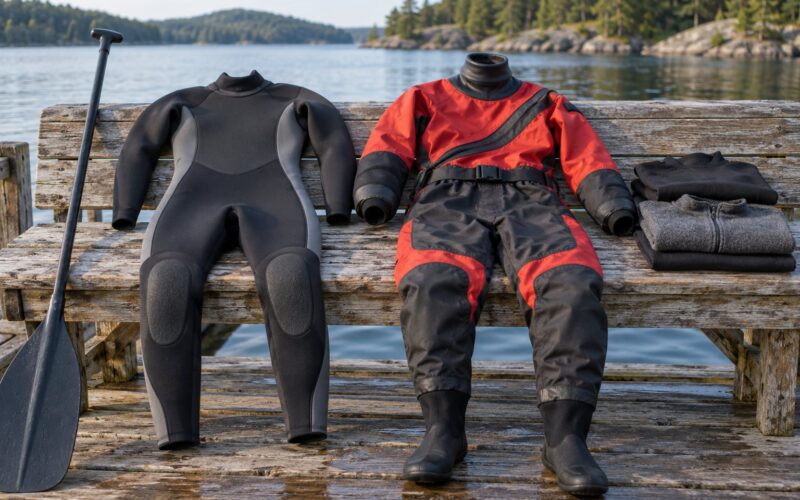
- A personal flotation device worn, not stowed, a wader belt, a first aid kit, extra dry layers and a thermos of something hot.
Backup options for water and low visibility
Everything lives in a dry bag, and everything is reachable from where you stand or float. Keep a second whistle on the boat even if you keep the first on your body. In fog, a whistle beats a horn; in wind, a horn beats a whistle; at night, light beats both.
Signal methods at a glance
| Signal method | How it is made | Typical usable range | Needs daylight | Power or fuel | Works alone |
|---|---|---|---|---|---|
| Whistle | Three short blasts, repeat | A few hundred metres to a mile in still air | No | None | Yes |
| Air horn or boat horn | Three blasts on the horn | A mile or more over flat water | No | Canister | Yes |
| Signal mirror | Sweep the sun toward searchers | Several miles on a clear day | Yes, strong sun | None | Yes |
| Ground-to-air symbols | Large V, X or SOS in a clearing | Visible to aircraft overhead | Yes | Time and space | Yes, slowly |
| Three fires in a triangle | Lit fuel, spaced, kept burning | Clearly visible at night | No | Fuel and dry tinder | Yes |
| Smoke column | Green vegetation or damp fuel burning | Highly visible in daylight | Yes | Fuel | Yes |
| Flares | Aerial flare or signal fireworks | Several miles for a high flare | Yes, best at dusk | Single use | Yes |
| Headlamp or flashlight | Three flashes in a group, repeat | Line of sight, a few hundred metres | No | Batteries | Yes |
| VHF radio, Channel 16 | Spoken Mayday with position | Line of sight and radio horizon | No | Battery | Yes |
| PLB or satellite messenger | Press SOS and speak to an operator | Satellite, no local coverage needed | No | Battery, subscription for messengers | Yes |
Read the table as a ranking, not a script. If you can run any electronic method, run it first and signal audibly and visibly while you wait for a reply. Electronics buy you a two-way conversation; sound and light buy you attention from people who never knew to look.
Step-by-Step
Step 1: Assess the Situation and Make a Plan
Before anything else, name the immediate threat to life. Cold water, an engine failure in a shipping channel, a bleed that will not stop, a partner under water. Everything after this step is worthless if the first problem kills you in the next ten minutes.
Then estimate three things honestly: how long you can last, how long until light or visibility changes, and where rescuers would look. Choose a position that is high or open, near a channel or trail that a boat can use, and easy to describe. Decide now whether to call, transmit, move, or hold position.
Step 2: Call Emergency Services or Send a Distress Message
Say the words first: “This is an emergency.” Then give your exact location, your situation, what you need and how many people you are with. In the United States, 911 reaches the Coast Guard for marine incidents, and the state patrol or county sheriff covers most inland marsh rescues.
If voice will not connect, send a text. Many people on forums and outfitter message boards report that 911 will connect from a phone showing no bars when another phone’s text goes through; the reverse is not guaranteed, so try the text while you keep the phone in your hand and pointed at the sky.
Technicians will tell you honestly that partial bars are not coverage. Experienced paddlers and backcountry users on outdoor forums repeat the same advice: never build a plan around a cell signal in a wetland.
Step 3: Send a Radio Distress Call
A marine radio call is the strongest signal you can make on open water. Key the handset on Channel 16 and say “Mayday, Mayday, Mayday” three times, then read the format every crew knows: vessel or party description, position, nature of the emergency, assistance required, and number of people aboard.
Position means something specific on water. Give latitude and longitude from your GPS, or a named channel, a channel marker number, a bridge, and a direction and distance from it. Coast Guard skippers and SAR veterans point out that search and rescue is a core service and is never billed, so an unnecessary call costs nothing but pride.
Use “Pan-Pan” for a urgent but non-life-threatening problem such as a breakdown, and “Mayday” only when someone is in danger of dying. Mixing them up is the most common radio mistake, and responders notice.
Step 4: Make Yourself Visible
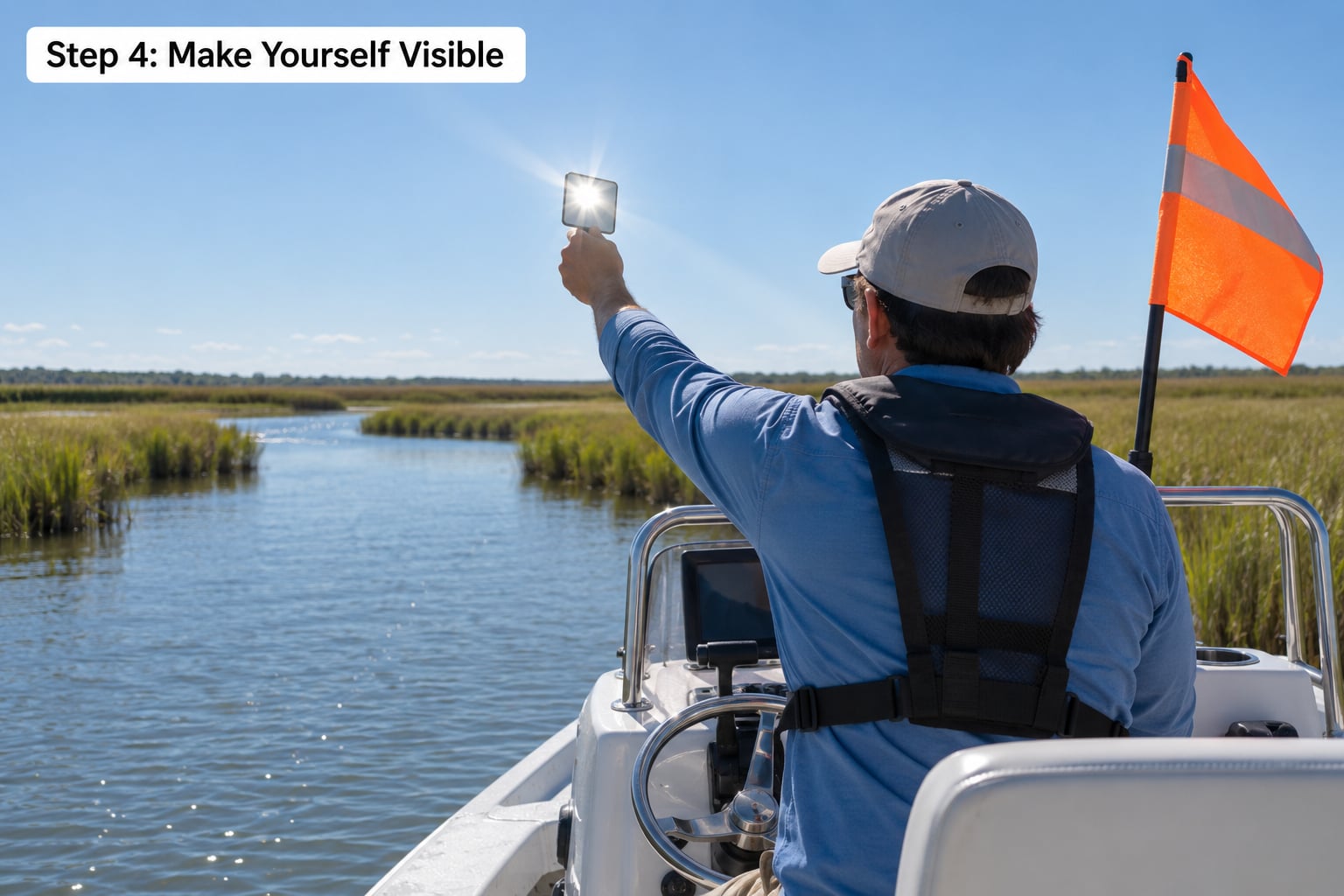
Visibility work is about contrast, not brightness. A marsh is a flat brown and green world, so blaze orange, white, red and reflective surfaces stand out in it. Strap a panel to the bow, the blind, the pack lid or the motor cowling so it shows above the reeds.
A mirror works when the sun is behind you and the searcher’s eyes are in front of you. Sweep slowly toward the aircraft or shore rather than holding a steady beam, which reads as a lens flare. Any glint counts: a belt buckle, a watch face, sunglasses, a knife blade or a foil wrapper all catch the same way a purpose-built mirror does.
At night, fire beats gear. Three fires in a triangle with a green branch or a piece of tarp in the middle reads as an emergency to anyone trained. In daylight, fire is nearly invisible, so use smoke instead: damp green reeds, moss, oily rags or a firework smoke flare produce a column that stands up above the treeline.
Step 5: Make Your Position Easy to Find
Give rescuers a target, not a guess. Put a flag on the highest solid point you can reach, tie bright material to a channel stake, and note the GPS coordinates on paper as well as on the device. A search that starts at a marker ends in minutes instead of hours.
Move only when it buys you safety. Wading a “shortcut” across a soft-bottom channel is how people who had working gear end up in the water. If you must move, move along a bank or a known levee where a boat can follow, and re-send your new coordinates.
Step 6: Signal Repeatedly and Conserve Equipment
One burst means nothing; a pattern means intent. Set a rhythm you can hold for an hour: three whistle blasts, pause, three again. Three flashes, pause, three again. Signal when you hear or see an aircraft, a boat or a person, then keep the same rhythm in the quiet gaps.
Conserve what runs out. Flares are one-shot, so hold aerial flares until you hear a boat or see an aircraft inside its useful life. Save batteries by dimming screens, keeping the phone in airplane mode after sending, and using the mirror and whistle, which need no charge at all.
Step 7: Protect Yourself While Waiting for Rescue
Most of the wait happens after the signal is sent, and cold is what usually ends it. Get out of the water, keep your personal flotation device on, and change into the dry layer you kept in a dry bag. Move your arms and legs, drink something warm, and huddle with a partner if you have one.
Stay with the boat unless the boat itself is the danger. A hull is a big orange object floating above the reeds and it keeps you out of cold water. Leaving shore to “go for help” means a second search in a place where nobody knows you are going.
Watch footing, snakes, stumps and submerged timber. Do not light a fire near dry reeds unless you have to, and do not let a panicking companion talk you into a wade you would not choose sober.
Step 8: Contact the Rescuing Party and Report Changes
Answer every radio call with your name, position and condition, and keep the handset with you rather than stowed. Tell them immediately if you drift, take on water, find an injury, lose a light, or run the boat aground somewhere new.
A satellite SOS opens a conversation with an operator who asks questions before dispatching anyone. Experienced users on outdoor forums make the same point: the button is not a launch command, it is a phone call, so be ready to answer clearly and stay with it. Users who carry a two-way messenger often say the check-in function, not the SOS, is the feature they actually rely on.
Common Mistakes
Giving a vague location
“Somewhere near the marsh” costs you the whole search. Fix this by reporting coordinates, a channel name, a marker number and a direction of travel from a known point, then repeat the location at the end of every transmission so it is written in the log.
Burning flares too early
An aerial flare has roughly ten seconds of useful height and often nobody to see it. Fix this by flaring when you hear an outboard or see an aircraft, and using the whistle and mirror, which cost nothing, in between.
Leaving the site
Walking away from a visible boat trades a known position for an unknown one. Fix this by staying put unless the spot itself is unsafe, and if you do move, tell the dispatcher the new position and leave a marker behind.
Relying on a phone with no coverage
Partial bars are not service, and a failed call wastes the minutes you needed. Fix this by carrying a second, coverage-independent method, which for most marsh trips means a PLB, a satellite messenger or a VHF radio with a DSC position button.
Signalling without a reference point
A flash in an empty skyline is hard to interpret. Fix this by pairing every signal with a marker: a flag, a fire, a panel, a smoke column, and by pointing the signal toward where a boat or aircraft would actually approach.
Carrying the beacon where you cannot reach it
Backcountry users and SAR veterans say the same thing over and over: a beacon in the bottom of a pack is not a beacon. Fix this by wearing the PLB or messenger on your body, on the PFD strap, and testing the button before you leave the truck.
Spamming the radio channel
Continuous keying hides the coast guard and other boats from you. Fix this by transmitting for a few seconds, listening for two minutes, then repeating, and by reserving Mayday for grave and imminent danger.
Frequently Asked Questions
How to signal for help in the wilderness?
Do four things at once: make noise with three whistle blasts on a rhythm, make light with three mirror or flashlight flashes, make yourself visible with blaze orange or a marker at a channel or landing, and transmit electronically by calling emergency services or pressing SOS on a PLB or satellite messenger. Give an exact location every time you signal, then repeat the pattern instead of signalling once.
What is the international emergency signal for distress when hunting?
Three of anything, repeated. Three whistle blasts, three gunshots, three flashes of light or three fires in a triangle all mean the same thing worldwide. Hunters in groups agree on simple codes beforehand, such as three long blasts for help, but a stranger reading your signal only knows one rule. Keep signalling on a steady rhythm so searchers can tell an intentional pattern from normal movement.
What is the symbol for needing help?
From the air, a large V means you need help and a large X means you do not. Spell SOS in block letters ten to twelve feet tall if you have the room and the time. A ground-to-air signal only works in daylight, needs flat open ground with no shadows cutting across it, and takes far longer to build than most people expect. In a marsh, a fire, smoke or flag usually beats a symbol.
What is the spoken emergency signal over a VHF radio?
The word is Mayday, said three times on Channel 16, the international distress and calling frequency. Follow it with your vessel or party description, your position, the nature of the emergency, the assistance you need and the number of people aboard. Say Pan-Pan instead when the situation is urgent but nobody’s life is in immediate danger.
How to signal for help with a whistle?
Blow three short blasts, wait, and repeat. You do not need to spell the full SOS pattern, because whistles carry much further than a shout and take almost no breath to use. Attach the whistle to your PFD strap or a lanyard so your hands stay free, and in strong wind or during heavy boat noise, add an air horn or the boat’s own horn, which carries much further over flat water.
Should you stay with your boat if it capsizes?
Yes, unless the boat itself is the danger. A hull is a large, bright object floating above the reeds, and it keeps your head out of cold water while searchers scan the channel. Swim to it, climb up if you can, and stay attached. Leaving the boat means becoming harder to see and harder to describe, which lengthens the search.
Conclusion
Make the call or the distress transmission first, and give an exact location every time you speak. Move only if you have to, then get to the highest, driest, most visible point you can reach and mark it. Signal sound, light and smoke on a repeating three-beat rhythm, and hold your flares and your batteries for the moment someone is close enough to use them. Everything after that is keeping yourself warm, dry and easy to find until the boat arrives.
This guide was checked for 2026 and reflects standard Coast Guard, search and rescue and outdoor safety guidance. Nothing here replaces calling emergency services the moment a real emergency is underway.