A truck emergency kit for backroads is one waterproof, labeled container holding the tools, water, food, medical supplies, communications gear, and recovery equipment you need to handle a flat, a dead battery, or an injury for at least 72 hours when nobody is coming. This list covers the 12 items worth carrying, what each one actually does, and how to pack it.
If you drive a pickup or 4×4 past the last gas station, the risk profile changes completely. On pavement a breakdown is an inconvenience. Fifty miles up a forest road at dusk, a single shredded tire can turn into an overnight wait, and nobody is driving past to see your hazard lights. Backroad forum regulars make the same point over and over: gear follows the route, not the trend, and the most useful kit is the one you have actually practiced with.
I have packed kits for desert routes in Arizona and for winter trips into Montana timber, and the mistake I have made most often is leaving the important things at the bottom of a pile under a bed liner. So the rule that shapes everything below: whatever can save your life lives where you can reach it in ten seconds, without unloading.
Table of Contents
- What to Put in a Truck Emergency Kit for Backroads: At a Glance
- 1. Compact First-Aid Kit
- 2. Drinking Water and Water Treatment
- 3. Shelf-Stable Food and Extra Rations
- 4. Flashlight and Headlamp
- 5. Batteries and a Rugged Power Bank
- 6. Offline Maps and Navigation Backup
- 7. Satellite Messenger or Personal Locator Beacon
- 8. Tire Repair and Basic Recovery Tools
- 9. Compact Tool Kit
- 10. Shovel, Traction Aid, and Mud Kit
- 11. Emergency Shelter and Weather Protection
- 12. Fire Starter, Signaling Tools, and Personal Essentials
- What to Put in a Truck Emergency Kit for Backroads by Season
- Frequently Asked Questions
- How often should I replace items in a truck emergency kit?
- Where should I store an emergency kit in my truck?
- Is a first-aid kit enough for backroad travel?
- Should every vehicle have a satellite messenger or PLB?
- How much emergency supplies should solo drivers carry?
- Conclusion
What to Put in a Truck Emergency Kit for Backroads: At a Glance
Twelve categories, sorted by what actually happens when things go wrong. The packing notes matter as much as the items, since a water bottle that freezes or a flashlight with dead batteries is just weight.
| # | Item | Primary purpose | Packing or replacement note |
|---|---|---|---|
| 1 | Waterproof first-aid kit | Cuts, burns, sprains, stopping bleeding | Plastic case, reseal zip bags; check expiration twice a year |
| 2 | Water plus treatment | Hydration and purifying questionable sources | Plan for the trip plus reserve; swap water every trip, not on a schedule |
| 3 | Shelf-stable food | Calories without refrigeration | Pack extra days; rotate the stack so nothing ages in the tote |
| 4 | Flashlight and headlamp | Working on the truck and signaling at night | Carry both; test monthly, swap cells, use lithium in cold weather |
| 5 | Spare batteries and power bank | Keeping lights, phone, and GPS alive | Match cell chemistry to the device; never store loose cells loose |
| 6 | Offline maps and paper map | Direction when the phone dies or loses signal | Download before leaving; refresh maps each season |
| 7 | Satellite messenger or PLB | Reaching help beyond cell coverage | Register, test, and subscribe; check the subscription before the trip |
| 8 | Tire plug kit and inflator | Fixing a puncture where you are stopped | Two plugs minimum; deflator caps wear out |
| 9 | Compact tool kit | Minor roadside and camp repairs | Bag and grease the tools; ditch what you have never used |
| 10 | Shovel and traction boards | Getting unstuck from sand, silt, or mud | Coat the boards with mud or wax to keep mud off them |
| 11 | Shelter and weather layers | Staying warm and dry through a long wait | Pack the bivy where you can grab it, not in a sleeping bag |
| 12 | Fire starter, signaling, documents | Being found and staying warm | Waterproof matches or a windproof lighter; keep ID copies current |
1. Compact First-Aid Kit
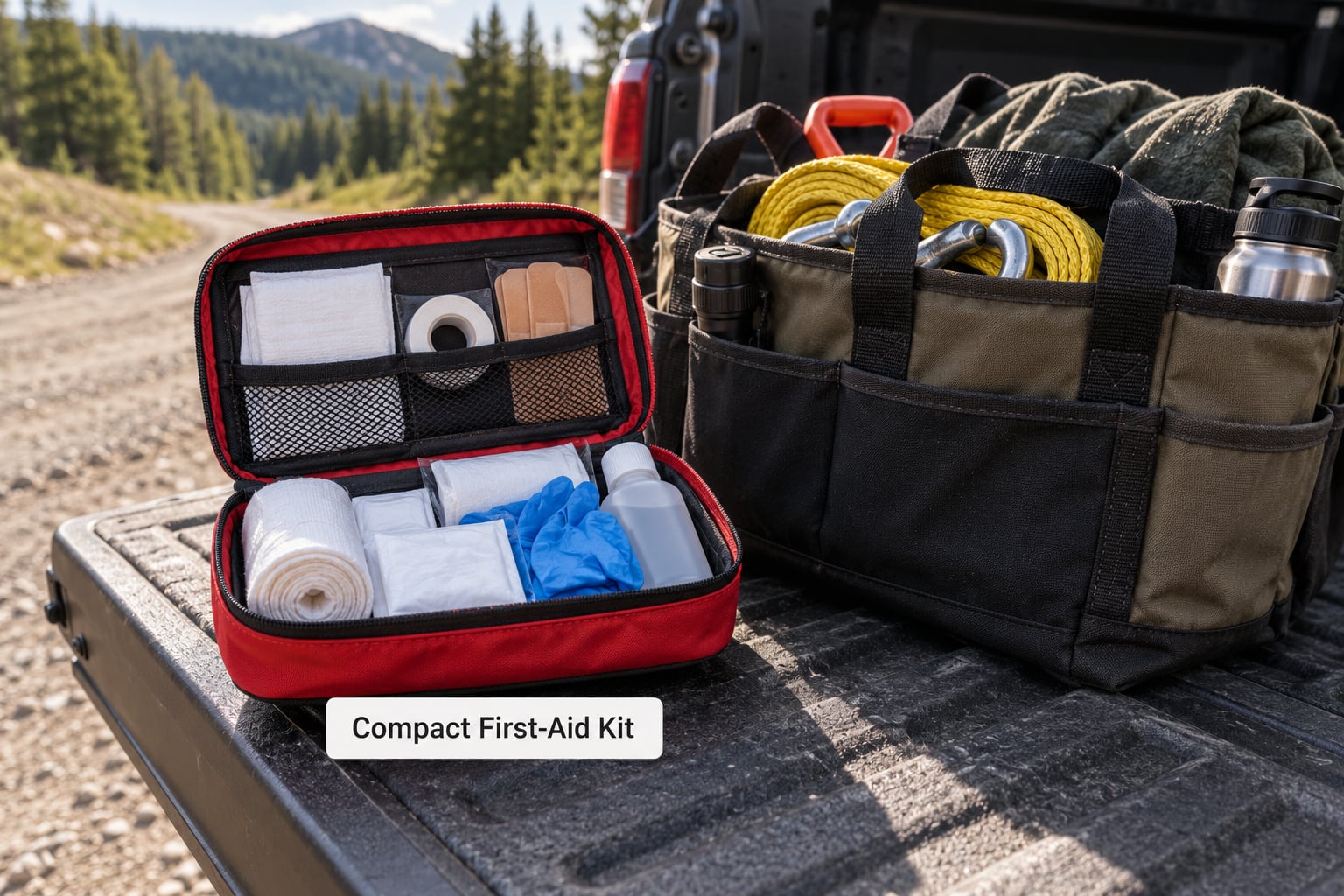
A waterproof first-aid kit belongs in every truck, in the cab, not the bed. On dirt roads the highest-consequence injuries are cuts from sharp rocks and brush, burns from a hot exhaust or camp stove, sprains, and the odd fall.
Build around gauze and roller bandages, adhesive bandages, nitrile gloves, antiseptic wipes, tape, tweezers, and whatever daily medication you actually take. Add a small elastic wrap and a pair of shears for clothing, which you will want when someone is bleeding through a jacket.
For a minor cut, rinse with clean water, press the antiseptic wipe down, apply a gauze pad held with tape, and change it once it is soaked through. Gloves matter more than people expect, because blood on your hands means you cannot handle your phone, your wheel, or a radio.
The recurring advice, in nearly every thread I read on the topic, is that a first-aid kit plus a CPR class beats a first-aid kit alone. Training you have used once beats training you have only read about.
2. Drinking Water and Water Treatment
Most people under-plan water. Carry one gallon per person per day for the planned trip, then add at least two extra days as reserve, because a delay is the normal case rather than the exception.
Desert heat changes the math quickly. In midsummer you can lose a gallon a day through sweat and breathing alone, and a stuck truck in a wash means hours of stationary heat with no shade. A high-desert driver should carry more reserve than the two-day minimum I just mentioned.
Water is still needed on routes with reliable crossings. That dry river bed may be dry in spring and a foot deep in late summer, and nobody is timing your trip to the forecast.
Carry a backup treatment as well: a compact filter or chemical purification tablets in a sealed bag. If a creek runs clear and cold it can still carry giardia, and stomach trouble at mile 60 with no road access is a genuinely bad night. Store bottles upright and shaded so the plastic does not get hot and bitter.
3. Shelf-Stable Food and Extra Rations
Plan calories, not meals. One meal per person per day leaves nothing for a second day of walking or waiting, and people in a survival situation need more energy than a normal trip, not less.
Good choices are dense and boring: energy bars, nut and fruit blends, jerky, pouches of tuna or chicken, peanut butter in single-serve packs, dried fruit, and instant oatmeal packets that only need hot water. Nothing that needs a fridge, and nothing that crumbles into the rest of the kit.
A practical routine is three days of food plus one extra day per person. Pack it in meal-size bags rather than one bulk sack, so a truck that gets partly unloaded does not take the whole food supply with it.
4. Flashlight and Headlamp
Carry both, because they do different jobs. The handheld flashlight throws a beam down a dark road and lets you check tire pressure, while the headlamp frees both hands under a bumper or a hood.
Bring spare batteries for each. A flashlight you have never tested in the dark is a paperweight, and cold nights drain cells faster than people expect.
Low-brightness and strobe modes matter more than lumen numbers on a backroad. A low setting preserves battery life for hours of signaling and map reading, and strobe is easier to spot at distance than a steady beam pointed at the ground. Aim the beam toward the road surface or above the horizon, not into oncoming traffic.
5. Batteries and a Rugged Power Bank
Everything you rely on runs on stored energy: flashlights, headlamp, phone, GPS unit, satellite device. A power bank rated for the weather keeps the phone alive long enough to download maps and send a message before it dies.
Carry spare cells that match your devices. Mixing lithium and alkaline chemistry in the same compartment gets you a leaking battery and nothing else, so keep them in separate labeled bags.
Do not leave lithium cells or a power bank loose in a hot truck bed or under glass in summer heat. Store them in the cab with the climate control running when parked, and recharge the bank fully before every trip so you know its real capacity.
6. Offline Maps and Navigation Backup
Maps that need a signal are useless on a backroad. Download the full region offline before you leave, including the route and the roads either side of it, since detours are common once a tire goes out.
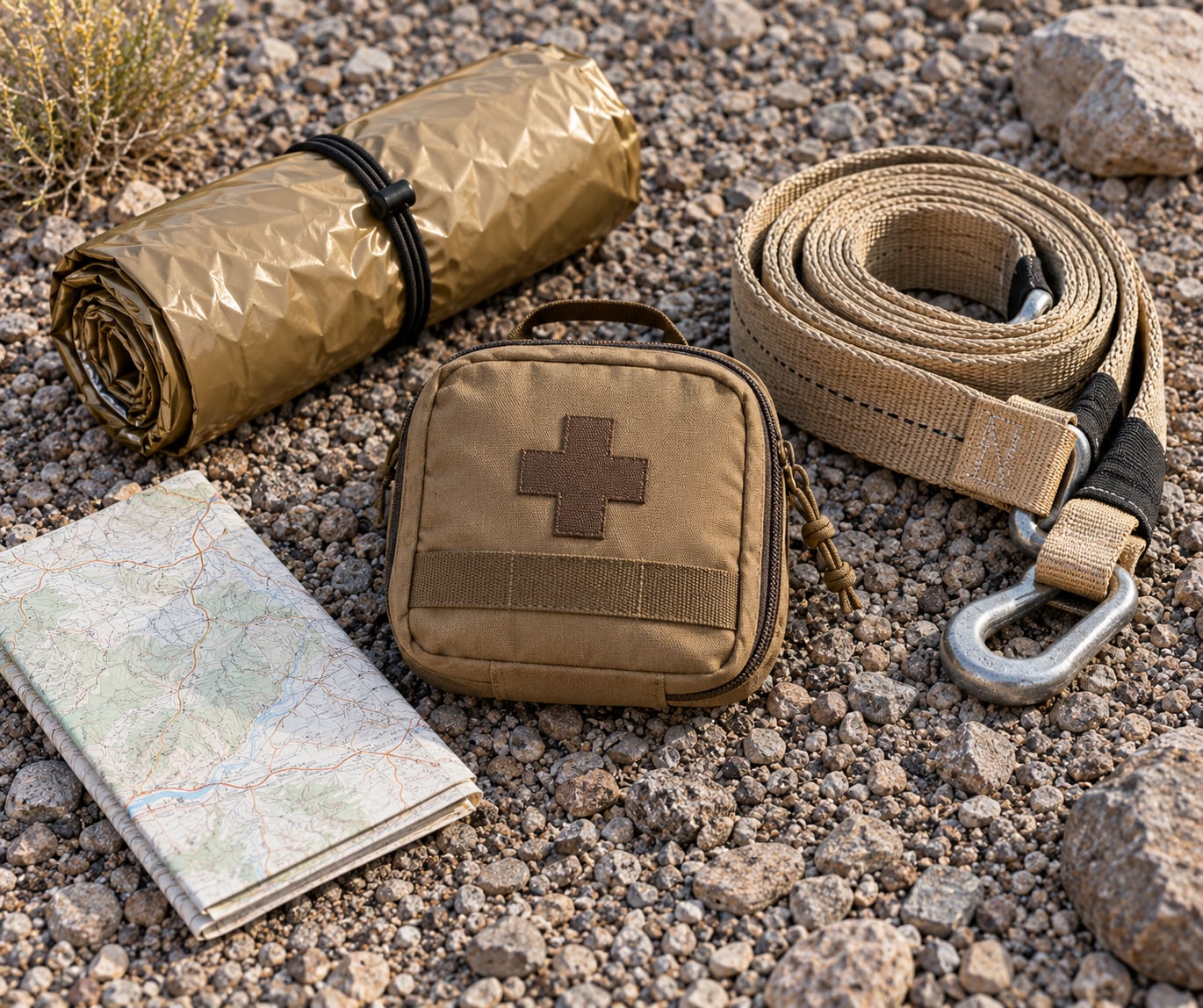
Carry a paper map or road atlas of the same area in the cab. It survives a dead battery, a cracked screen, and water, and it gives your passenger something real to look at while you work.
A baseplate compass is cheap and weighs nothing, but only if you know how to orient it. Spend an hour practicing with a local landmark before you rely on it. A dedicated handheld GPS unit is a reasonable third layer for drivers who never go back to a coverage zone; a paper map is still the backup for the GPS itself.
7. Satellite Messenger or Personal Locator Beacon
A two-way satellite messenger lets you send and receive text messages over the satellite network when no cell tower is in range. A personal locator beacon does one job: when you press the button, it broadcasts your position to a rescue coordination center, and it works with no subscription.
The messenger is better for a normal backcountry day trip, since you can check in, send weather reports, and coordinate with family. The PLB is better for the scenario where nobody knows you are out there, since it does not need charging discipline and it broadcasts to search and rescue.
Whichever you carry, do the boring part: register the device, confirm the account, test it before the trip, and confirm the subscription is current. Device manuals are not the test. If it needs a subscription, that subscription needs renewing before the trip, not after.
8. Tire Repair and Basic Recovery Tools
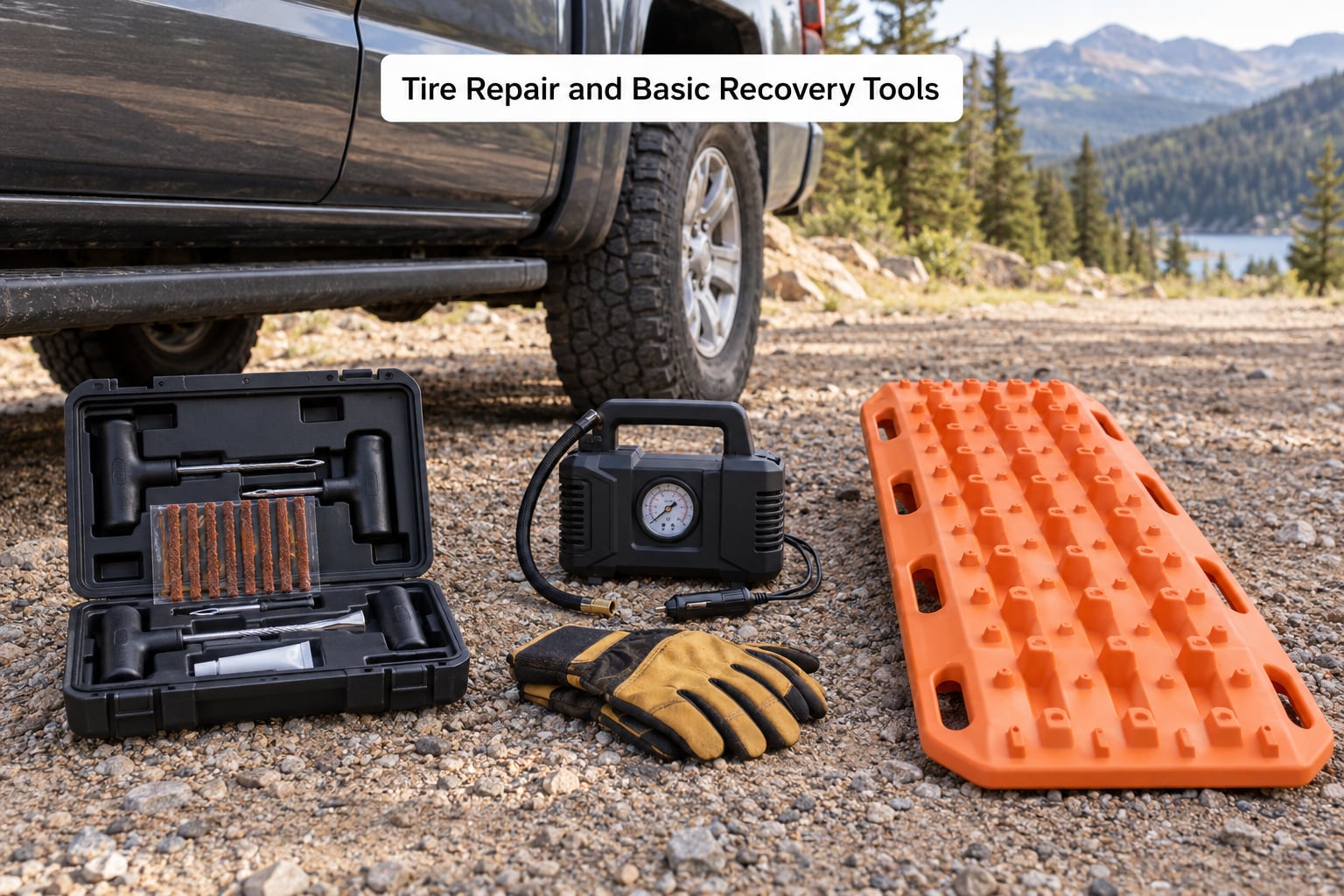
A blowout on a remote dirt road is the single most common reason a truck does not come home, and corrugated washboard roads are brutal on sidewalls. Carry a string-style plug kit with at least two plug strings, a reaming tool, and a lubricant, plus a portable 12V inflator you have actually run to completion.
A plug patches the hole in the tread. It is fast and gets you to a road. It does not repair a cut in the sidewall or a blowout that shredded the whole tire, so carry a full-size spare and know the change-out before you need it.
Gloves and a small traction board belong in the same bag. Hand protection prevents the cut hands that end a recovery, and a traction board is often all you need to get a buried rear wheel spinning again.
Tow straps, a jack, shackles, and any larger recovery gear need practice. Experienced overlanders describe the proven minimal set as a shovel, a rated recovery strap, two soft shackles, one hard shackle, a tree saver, and traction boards, and they repeat the same caveat: know your gear rating and your anchor points before you need them under load.
9. Compact Tool Kit
Buy a vehicle tool kit, not a household set. Household kits are full of picture-hanging hardware and short screwdrivers; what you want on a road is a multitool with a full-size blade and scissors, a small adjustable wrench, needle-nose and slip-joint pliers, a tape roll, and zip ties.
Duct tape and electrical tape earn their weight twice over, once for wiring and once for anything temporary and structural. A short length of spare wire, a few common hose clamps, and a handful of common fasteners handle the small failures that strand people.
Bag the tools and add a light coat of grease or corrosion inhibitor. Seized ratchets have ruined more trip plans than flat tires, and a plastic tray keeps the kit from becoming a loose handful of metal in a tote.
Stay under about ten pounds. Anything heavier belongs in a separate recovery box, and anything you have never used should go in the garage, not the truck.
10. Shovel, Traction Aid, and Mud Kit
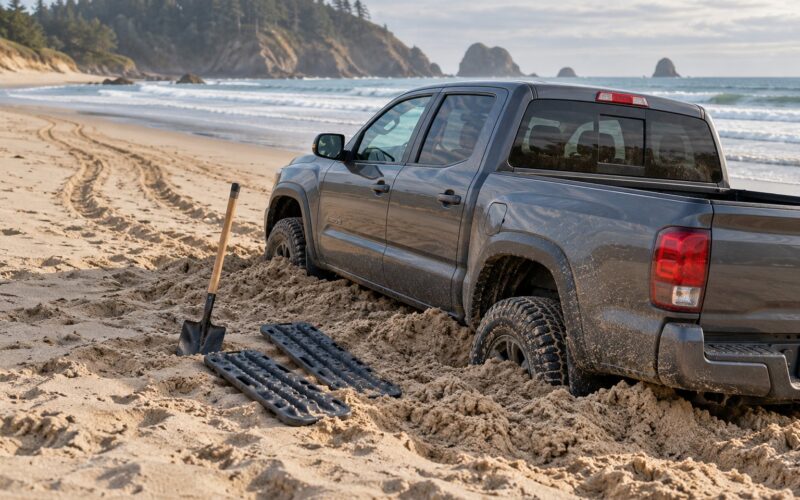
A short shovel is the most-used recovery tool and the cheapest. Digging out a buried tire or clearing silt from behind a wheel takes ten minutes with a shovel and hours with anything else.
Traction boards go under the tires when the surface is wet clay, loose gravel, or sand. Keep them in the cab or in a weatherproof box, because grit is what kills them, and wipe them with mud before use so they bite instead of slipping.
A small bag of sand or cat litter is the classic mud kit for adding grip under a wheel that spins on ice or thin snow. Do the work in short bursts, because traction boards and a shovel are slow, and a spinning wheel digs a hole faster than you fill it.
Do not dig out alone if the vehicle sits on a slope or near moving water. Get out of the downhill path first, and call for help rather than letting a heavy truck move while you are standing downhill of it.
11. Emergency Shelter and Weather Protection
A breakdown at dusk becomes an overnight wait surprisingly often, and a dry shelter matters more than a comfortable one. Pack an emergency bivy or a compact thermal blanket, and know that a blanket reflects heat and blocks wind while a bivy is a small shelter you can crawl into.
Add a weatherproof tarp or a compact poncho that covers you and your chest, since wet clothing in a stationary vehicle at night is how mild temperatures turn dangerous.
Wear or pack a warm layer that works while sitting still. A wool or synthetic base layer and a wind shell are worth more than a heavy jacket, because rescue can take hours and you will not be moving to stay warm.
Store the shelter where you can reach it without opening a sleeping bag or digging through a cooler. In a hurry at midnight, anything buried is anything you do not have.
12. Fire Starter, Signaling Tools, and Personal Essentials
Group only the supplies that share a purpose: making yourself findable and keeping yourself warm through a long night. A waterproof fire starter, a whistle, a reflective triangle, and work gloves all do that.
Whistles carry farther than a voice and cost almost nothing, so carry one on your person rather than in the truck. A reflective triangle is for traffic on a road, and a few road flares help on dark stretches, though check the burn rules where you are driving before lighting anything.
Carry a ferro rod or a windproof lighter, plus a small dry tinder bundle. Never rely on matches alone in wind or wet conditions, and remember that fire is a comfort and a heat source, not a rescue plan.
Finally, keep copies of your ID, insurance card, registration, and emergency contacts in a waterproof sleeve, along with any prescription medication you need. Take your actual medication with you every trip rather than storing a spare bottle permanently in a glovebox. These are small items that remove an entire category of problem: a driver with a seizure six hours from help with no record of their name, allergies, or blood type.
What to Put in a Truck Emergency Kit for Backroads by Season
The core twelve stay the same all year. What changes is the swap list, and swapping is cheap compared with carrying everything.
For hot desert routes, add extra water and electrolyte packets, a sun shade or reflective windshield cover, a wide-brim hat, and an insulated container. Two gallon jugs in the shade beat five in a hot bed.
For cold alpine and winter roads, add extra layers, chemical hand warmers, a hat and gloves that you can wear while stuck inside the cab, a shovel with a plastic blade, and tire chains if your route demands them. Swap lithium cells into your lights, since alkaline performance drops in the cold.
For heavy rain and mud season, add a waterproof tarp, spare fuses, wire, and hose clamps, plus a bag of sand or cat litter for grip on slippery approaches. Dry the connectors before you wrap them in electrical tape.
For wildfire-prone country, carry more water, a respirator-style mask for dust and smoke, and check fire restrictions before you leave. Keep the lighters and matches sealed and know when you are not permitted to make a fire at all.
Frequently Asked Questions
How often should I replace items in a truck emergency kit?
Check the kit twice a year and top it up after every trip. Replace water on every trip regardless of age, and swap food as you rotate the stack so nothing sits for years. Test flashlights and the satellite device at each check, and replace the first-aid kit whenever an expiration date passes. Batteries lose capacity in storage, so swap spares every year or when a light dims noticeably.
Where should I store an emergency kit in my truck?
Split it in two. Keep the medical kit, light, power bank, and documents in the cab where you can reach them without leaving the road, and put water, food, shelter, and recovery gear in a sealed box or bag in the bed. Truck bed toolboxes lock against weather and theft, which solves the two complaints that come up most often. Whatever stays in the bed should also be reachable from inside the cab.
Is a first-aid kit enough for backroad travel?
No. A kit treats cuts and sprains, but serious bleeding, a chest injury, or hypothermia need trained hands, and those calls get made far from a road. Most advice puts a first-aid or CPR class ahead of extra gear. Pack a good waterproof kit, then take the course. Also carry your real medications, because a kit has no prescriptions in it.
Should every vehicle have a satellite messenger or PLB?
Anyone driving where cell coverage ends should have one of the two, especially solo. A messenger suits planned trips and lets you check in; a PLB needs no subscription and broadcasts a distress signal when nobody knows you are out. Families and weekend campers on mapped routes can often manage with a phone and a paper map, but the cost of a device is small against a night of walking for help.
How much emergency supplies should solo drivers carry?
Scale the load to the furthest point you could walk in a day, which on most backroads is not far. One gallon of water per day, three days of food plus one spare day, a full-size spare, and enough fuel to run the vehicle a few hours while you wait is a reasonable target. Keep it light enough that you would actually unload it and use it rather than leaving it buried under a bed liner.
Conclusion
Start with the high-consequence items and put them where your hand lands first: a waterproof first-aid kit, a light, a charged power bank, water, a full-size spare with a plug kit, and a satellite device that is registered and tested.
Then open the box every six months, check dates and batteries, and add the seasonal items for where you are actually driving. Take one short shake-down trip to a place with help nearby and use the gear, because discovering a dead flashlight or a plug kit that does not fit your tire at midnight is the wrong time to find out. Everything past that is custom work for your route, your weather, and how many people ride along.